HARO, now rebranded as Connectively, is a media outreach platform that connects journalists seeking expert quotes with sources willing to provide them, and it has become one of the most reliable ways to earn editorial backlinks from high-authority news and industry sites. For SEO teams and business owners, it offers a rare combination: real coverage on trusted domains, without paid placements or guest post fees.
Getting this right matters now because link building has gotten harder and journalists get flooded with irrelevant pitches daily. A weak pitch process wastes hours and earns nothing.
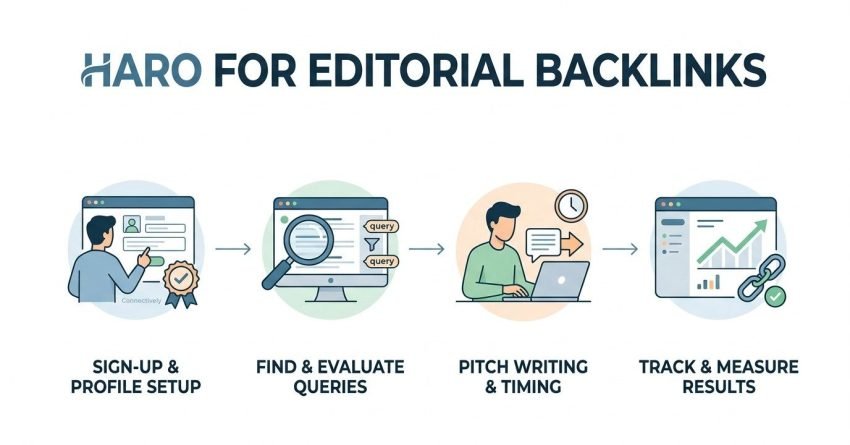
This guide covers how the platform works and why its links carry SEO weight, the sign-up and profile setup process, how to find and evaluate the right queries, pitch writing and timing strategy, and how to track, verify, and measure the backlinks you earn.
What Is HARO and How Does It Work?
HARO is a query-based platform where journalists submit requests for expert sources and registered members respond with pitches hoping to be quoted in the resulting article. The system runs on a simple loop: a reporter posts a request, sources pitch relevant expertise, and the reporter picks quotes to include, often linking back to the source’s website in the byline or attribution.
I’ve used platforms like this for years, and the appeal is obvious. A journalist writing for a site with genuine domain authority needs a quote, and if your pitch fits, you get named and linked without paying for placement.
Who Uses HARO (Sources vs. Journalists)
Two distinct groups sit on either side of every HARO query: journalists posting requests and sources responding to them. Journalists include freelance writers, staff reporters, and bloggers at publications ranging from small trade outlets to major national news sites.
Sources are typically consultants, executives, founders, and subject matter experts trying to get quoted and linked. Understanding which side of a query you’re reading determines how you should tailor a pitch.
HARO’s Transition to Connectively
HARO rebranded to Connectively in 2024 after being acquired by Cision, folding the service into Cision’s broader PR technology suite. The core mechanic stayed the same, but the interface, pricing tiers, and some matching features changed under the new name.
Anyone searching “HARO” today will eventually land on Connectively’s signup page, and long-time users should expect a period of adjustment as the platform migrates its backend.
Why HARO Backlinks Are Valuable for SEO
HARO backlinks are valuable because they come from editorially earned placements on high-authority news and industry publications rather than paid or self-published sources, which search engines weigh far more heavily in ranking calculations. A single mention in a major outlet can carry more ranking value than dozens of low-quality directory links.
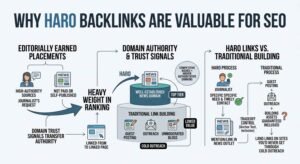
I look at these links the way I look at any earned media placement: the domain’s trust signals transfer some authority to the linked page, and the association itself builds credibility beyond SEO.
Domain Authority and Trust Signals
Search engines use signals like domain authority, editorial trust, and link context to judge how much weight a backlink should carry. A link from a well-established news domain sits in a completely different tier than a link from an unmoderated blog network.
Ahrefs’ analysis of top-ranking pages has repeatedly found that pages ranking in competitive niches tend to have a higher proportion of links from authoritative, editorially controlled domains.
HARO Links vs. Traditional Link Building
Traditional link building often involves guest posting, outreach for resource page inclusion, or building linkable assets that attract organic citations over time. HARO backlinks skip most of that process because the journalist initiates contact through a specific, timely need.
The tradeoff is control. You can’t dictate anchor text or guarantee inclusion, but the links that do land tend to sit on sites you’d never get through cold outreach alone.
How to Sign Up for HARO (Now Connectively)
Signing up for Connectively (formerly HARO) requires creating a free or paid account, selecting the source role, and building a profile with your expertise areas and industry categories. The process takes about ten minutes for a basic account.
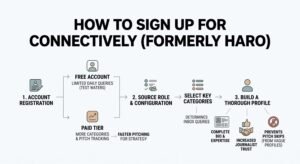
Registration alone won’t get you links. What matters after signup is how you configure your profile and which categories you select, since that determines which queries reach your inbox.
Choosing the Right Account Type
Connectively offers multiple tiers, from a free basic plan with limited daily queries to paid tiers that unlock more categories, faster query delivery, and pitch tracking tools. A free account works fine for testing the waters.
Anyone pitching regularly for client work or building this into an ongoing content strategy usually finds the paid tiers worth it, since faster access to queries directly affects response speed.
Setting Up Your Source Profile
A complete source profile includes your name, title, company, area of expertise, and a short bio that journalists see when you’re quoted. Filling this out thoroughly increases the odds a journalist trusts your pitch enough to open it.
Vague or incomplete profiles get skipped more often, since journalists screening dozens of pitches favor sources whose expertise is immediately obvious.
Understanding HARO Query Emails and Categories

HARO and Connective query emails arrive in scheduled batches, organized into industry categories like business, health, technology, and lifestyle, and each query lists the journalist’s specific request, deadline, and submission requirements. Reading the full requirements before pitching saves wasted effort on queries you don’t qualify for.
Every query email is a compressed opportunity list, and skimming instead of reading closely is the most common reason good pitches don’t get sent.
The Three Daily Query Windows
Queries traditionally arrived in three batches per day, morning, midday, and evening, giving sources multiple windows to catch relevant requests. Connectively has adjusted some of this cadence since the rebrand, but the batch structure still shapes how sources should plan their pitching schedule.
Checking every batch consistently, rather than sporadically, is what separates sources who land placements regularly from those who miss deadlines.
Query Categories and Industry Relevance
Categories segment queries by industry so sources only see requests relevant to their registered expertise areas, covering everything from finance and health to technology and travel. Selecting the right categories during profile setup directly determines your query volume and relevance.
Picking too many unrelated categories dilutes your inbox with irrelevant requests and makes it easier to miss the ones that actually fit.
How to Find the Right HARO Queries to Pitch
The right HARO queries to pitch are the ones matching your genuine expertise, published by a reputable outlet, with a deadline you can realistically meet with a thoughtful response. Chasing every query regardless of fit wastes time and damages your credibility as a source.
I treat query selection as a filtering exercise, not a volume game. Fewer, well-matched pitches consistently outperform mass pitching every query in a category.
Filtering Queries by Relevance and Authority
Filtering by relevance means only responding to queries within your actual expertise, while filtering by authority means prioritizing outlets with real domain strength over unknown or low-traffic sites. Both filters matter because a technically successful placement on a weak site delivers little SEO value.
Checking the publication’s reputation before pitching, even briefly, prevents wasted effort on outlets that won’t move the needle.
Red Flags to Avoid in Low-Quality Queries
Certain queries signal low value immediately: vague requests with no clear publication named, anonymous-sounding senders, or asks for free extensive work disguised as a quote request. These patterns show up often enough that experienced sources learn to skip them fast.
A query that reads like a content mill fishing for free material rarely converts into a legitimate, linkable placement.
How to Write a Winning HARO Pitch
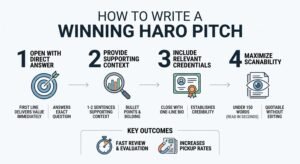
A winning HARO pitch answers the journalist’s exact question in the first two sentences, includes relevant credentials, and stays under 150 words so it can be read and evaluated in seconds. Journalists reviewing 50+ pitches per query don’t have time for lengthy introductions.
I write every pitch assuming the journalist will read only the first line before deciding whether to continue, so that line has to deliver value immediately.
Pitch Structure and Formatting
Effective pitch structure opens with the direct answer, follows with one or two sentences of supporting context or data, and closes with a one-line bio establishing credibility. Bullet points and bolded key phrases make pitches easier to scan quickly.
Journalists on tight deadlines gravitate toward pitches they can extract a usable quote from without editing, so formatting for scannability directly increases pickup rates.
Common Pitch Mistakes That Get Ignored
The most common mistakes are pitching outside your expertise, sending generic answers that could apply to any query, and writing pitches long enough to require scrolling. These patterns get filtered out almost instantly by journalists skimming their inbox.
Another frequent mistake is failing to include a name and title early, which forces the journalist to hunt for credibility signals they need immediately.
HARO Response Timing and Speed Strategy
Response timing on HARO queries directly affects pickup rates, since journalists often select their quote from the first several strong responses rather than reading every submission that arrives before the deadline. Fast, high-quality responses consistently outperform slower, more polished ones.
I prioritize speed over perfection for time-sensitive queries, because a good pitch sent within the first hour beats a great pitch sent on the last day.
Why the First Two Hours Matter Most
Journalists working on same-day or next-day deadlines frequently close out their search as soon as they have enough usable quotes, sometimes within hours of posting the query. Pitches sent in this early window get read while the journalist still has bandwidth and interest.
Waiting until close to the deadline to respond means competing against an inbox the journalist may have already stopped checking closely.
Building Credibility as a HARO Source
Building credibility as a HARO source means consistently including verifiable credentials, specific data points, and a professional bio that gives journalists confidence in quoting you accurately. Journalists are more likely to select sources who reduce their own verification workload.
Credibility compounds here. Once you’ve been quoted a few times, referencing those past placements in future pitches adds social proof that speeds up trust.
Using Credentials and Data to Stand Out
Specific data points, original research, or a clearly stated professional credential make a pitch stand out among dozens of generic responses. A vague claim carries far less weight than a stat with named attribution.
Statistics from HubSpot’s research library show that content backed by original data or specific numbers tends to earn more editorial pickup than generalized commentary.
Creating a Reusable Bio and Boilerplate
A reusable bio and boilerplate save time across every pitch and ensure consistent, professional framing of your title, company, and expertise. Keeping a polished two-sentence version ready means you’re never rushing to write a bio under deadline pressure.
Consistency across placements also helps journalists searching for past quotes from you find a recognizable, professional presence.
How to Track and Follow Up on HARO Pitches
Tracking HARO pitches means logging every query you respond to, the outlet, the deadline, and whether you received a reply, so you can measure your pitch success rate over time. Without tracking, it’s nearly impossible to tell which pitch styles are actually working.
I keep a simple spreadsheet for this because the volume adds up fast, and patterns in what gets picked up only become visible with a record to review.
When (and When Not) to Follow Up
Following up makes sense only if the journalist’s deadline has passed and the article hasn’t been published yet, since most journalists don’t want reminders before their deadline. A single, polite follow-up after publication is reasonable; repeated follow-ups usually damage the relationship.
Most successful pitches never require a follow-up at all, since journalists typically respond directly if they plan to use your quote.
Verifying and Monitoring Your HARO Backlinks
Verifying HARO backlinks means checking published articles to confirm your link was actually included, since journalists sometimes name a source without linking to their site. This step gets skipped often, and it’s the difference between assuming a placement helped and confirming it did.
I check every placement personally rather than trusting that a quote automatically became a link, because attribution without a hyperlink provides no direct SEO value.
Tools for Tracking New Backlinks
Backlink monitoring tools like Ahrefs and Google Search Console can alert you when a new referring domain appears, which is often the fastest way to catch a HARO placement you weren’t notified about. Setting up alerts removes the need to manually search for your name across the web.
Search Console’s links report specifically shows new referring domains over time, making it a free option for tracking placement wins.
What to Do When a Link Isn’t Added
When a quote is published without the promised link, a polite, brief email to the journalist requesting the correction is the standard next step. Most journalists will add a missing link if the request comes quickly and professionally.
Some publications have strict no-link editorial policies regardless of promises made during pitching, and in those cases, the mention itself may still carry indirect brand value even without a direct link.
Common HARO Mistakes That Waste Opportunities
The most common HARO mistakes are pitching irrelevant queries, submitting generic, unspecific answers, ignoring word limits, and failing to verify whether promised links were actually published. Each of these mistakes wastes both the source’s time and the journalist’s trust in future pitches.
Sources who repeatedly send off-topic or low-quality pitches often find their responses ignored even when a genuinely relevant query appears later, since journalists remember unhelpful past submissions.
HARO Alternatives and Complementary Link Building Tactics
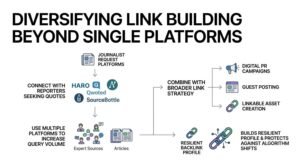
HARO alternatives include other journalist-source matching platforms and PR outreach tools that connect experts with reporters seeking quotes for articles. Relying on a single platform limits how many placement opportunities a source can realistically access.
I treat HARO as one channel within a broader digital PR strategy rather than a standalone tactic, since diversifying sources reduces dependency on any one platform’s query volume.
Other Journalist Request Platforms
Platforms like Qwoted and SourceBottle operate on a similar model, connecting journalists with expert sources across various industries and publication types. Using multiple platforms increases the total volume of relevant queries reaching your inbox each week.
Each platform has its own query volume and industry focus, so testing more than one often surfaces opportunities a single platform would miss entirely.
Combining HARO With a Broader Link Strategy
Combining HARO pitching with digital PR campaigns, guest posting, and linkable asset creation builds a more resilient backlink profile than relying on any single tactic alone. Earned media links work best alongside strategic outreach rather than as a complete substitute for it.
A diversified link acquisition approach also protects against algorithm shifts that might devalue one specific link-earning method over time.
How to Measure the SEO Impact of HARO Links
Measuring the SEO impact of HARO links means tracking changes in referring domain count, domain rating, organic traffic, and keyword rankings for the linked page after each placement goes live. Isolating the exact impact of one link is difficult, but trend tracking over multiple placements shows patterns.
I look at cumulative effect rather than judging any single placement in isolation, since one link rarely moves rankings dramatically on its own.
Metrics That Matter (DR, Referral Traffic, Rankings)
The core metrics worth tracking are domain rating of the linking site, direct referral traffic generated by the link, and keyword ranking movement for the linked page’s target terms. Moz’s ranking factors research consistently identifies link authority as one of the stronger correlating factors with search visibility.
Tracking all three together, rather than any single metric alone, gives the clearest picture of whether a HARO placement is contributing real SEO value.
Conclusion
HARO, now Connectively, connects sources with journalists to earn genuine editorial backlinks from authoritative domains. Understanding queries, pitch timing, and verification turns this into a repeatable link acquisition channel.
Earned media links work best combined with broader technical SEO, content, and outreach strategies rather than standing alone as a complete link building plan.
We help brands build sustainable backlink profiles that combine digital PR with technical execution. Partner with White Label SEO Service to turn earned placements into measurable organic growth.
Frequently Asked Questions
Is HARO free to use for backlinks?
Yes, Connectively (formerly HARO) offers a free tier for sources responding to journalist queries. Paid tiers unlock more categories and faster query access, but free accounts can still earn placements.
How long does it take to get a HARO backlink?
Most successful placements appear within one to four weeks of pitching, depending on the journalist’s publishing schedule. Some articles publish within days; others take longer or never publish at all.
What happened to HARO after the Connectively rebrand?
HARO was acquired by Cision and rebranded as Connectively in 2024. The core source-journalist matching function remained the same under the new platform name.
How many HARO pitches should I send per day?
There’s no fixed number, since quality matters more than volume for pitch success. Most experienced sources send a handful of highly relevant pitches rather than mass-responding to every query.
Do HARO backlinks help with Google rankings?
Yes, HARO backlinks can help rankings because they typically come from high-authority, editorially trusted domains. Their impact varies based on the linking site’s authority and relevance.
Can beginners with no press experience use HARO?
Yes, beginners can use HARO successfully by focusing on queries matching their genuine expertise and writing clear, direct pitches. Press experience helps but isn’t required to get started.
What industries benefit most from HARO link building?
Industries with frequent news coverage, like finance, health, technology, and business, tend to see the most HARO query volume. Niche industries can still succeed with fewer but highly targeted pitches.