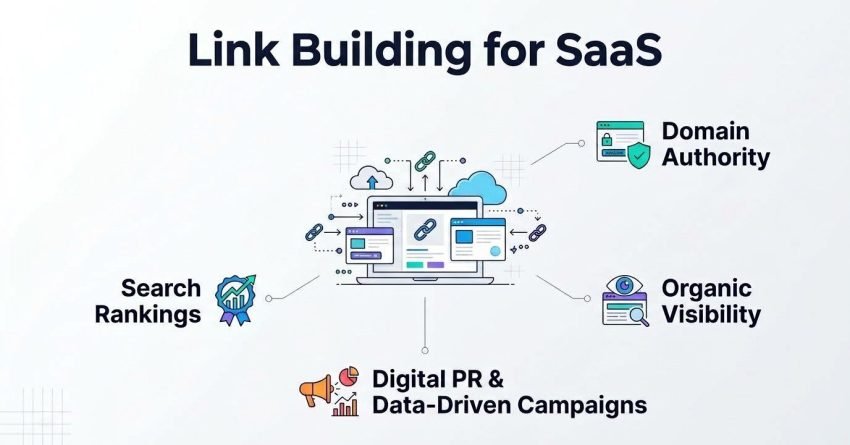
Link building for SaaS is the process of earning backlinks from other websites to strengthen a software company’s search rankings, organic visibility, and domain authority. I’ve watched SaaS founders confuse this with generic SEO link building, but the buyer journey, sales cycle, and content types in software are different enough that the approach needs its own playbook.
Getting this wrong wastes budget on links that never move rankings. Getting it right compounds traffic, trust, and pipeline for years.
This guide covers what SaaS link building actually is and why it matters, the metrics and link types worth pursuing, the strategies and tools that produce results in 2025, and how to evaluate cost, timeline, and ROI before committing budget.
What Is Link Building for SaaS?
Link building for SaaS is the practice of acquiring backlinks from external websites to a software company’s domain, using tactics suited to a niche, often technical buyer audience. It’s not the same game as e-commerce or local SEO link building.
SaaS products solve narrow problems for narrow audiences, which means the pool of genuinely relevant linking sites is smaller. I’ve found that this scarcity is exactly why digital PR and data-driven campaigns tend to outperform generic outreach for software brands; quality matters more than volume here.
Why SaaS Link Building Differs From Traditional SEO
SaaS link building differs from traditional SEO because the target audience is smaller, more technical, and concentrated on industry-specific publications rather than broad consumer media. A local bakery can earn links from general local blogs; a DevOps tool can’t.
We’re working with a narrower set of relevant domains: developer communities, SaaS review sites, industry newsletters, and niche B2B publications. This changes which tactics are worth the effort.
How Backlinks Influence SaaS Search Rankings
Backlinks influence SaaS search rankings by signaling to search engines that other credible sites vouch for a domain’s content and expertise. Ahrefs’ study of 2 million keywords found a strong correlation between referring domains and higher organic rankings across competitive terms.
I treat this correlation as directional, not absolute. Content quality and technical SEO still have to hold up their end.
Why Link Building Matters for SaaS Growth
Link building matters for SaaS growth because it directly affects organic visibility, which is typically the lowest-cost acquisition channel once it’s built out. Paid acquisition scales spend linearly with growth; organic doesn’t.
I’ve seen SaaS companies plateau on paid ads simply because CAC became unsustainable. Backlinks and the rankings they support are what let organic pick up that slack over time.
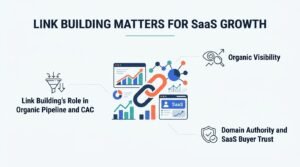
Link Building’s Role in Organic Pipeline and CAC
Link building supports organic pipeline growth by helping bottom-of-funnel and comparison pages rank, which brings in buyers actively evaluating tools. These are often higher-intent visitors than top-of-funnel blog traffic.
Lower CAC isn’t instant. It shows up gradually as rankings climb and compound over multiple content pieces.
Domain Authority and SaaS Buyer Trust
Domain authority is a third-party score that estimates a website’s overall ranking strength based on the quantity and quality of its backlink profile. Buyers rarely look at DA directly, but the visibility it correlates with does shape trust.
A tool ranking on page one for “project management software alternatives” reads as more credible than one nobody can find.
Core Link Building Metrics SaaS Teams Should Track
The core metrics SaaS teams should track for link building are domain authority, referring domains, and anchor text distribution, because each measures a different dimension of link profile health. Tracking only one gives an incomplete picture.
I check these monthly, not link-by-link, since single links rarely move the needle on their own.
Domain Rating and Domain Authority
Domain Rating (Ahrefs) and Domain Authority (Moz) are third-party scores from 0 to 100 that estimate a website’s backlink strength relative to other sites. Neither is a Google ranking factor directly, but both correlate with ranking ability.
I use these scores to prioritize outreach targets, not to judge our own progress in isolation.
Referring Domains vs. Total Backlinks
Referring domains count the number of unique websites linking to a page, while total backlinks count every individual link, including multiples from the same site. Ten links from one domain carry far less weight than ten links from ten different domains.
This is the single most common mistake I see SaaS teams make when reading link reports. Domain diversity almost always beats raw link count.
Anchor Text Distribution
Anchor text distribution refers to the mix of exact-match, branded, and generic anchor phrases used across all backlinks pointing to a site. An unnatural concentration of exact-match keyword anchors is one of the clearest signals of manipulative link building to search engines.
I aim for branded and naked-URL anchors to dominate, with keyword-rich anchors making up a minority.
Types of Links SaaS Companies Should Pursue
SaaS companies should prioritize editorial links, resource page links, digital PR links, and niche directory or review site links because these types tend to carry the strongest relevance and trust signals. Not every link type is worth equal investment.
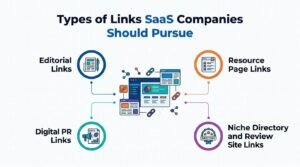
Editorial Links
Editorial links are backlinks earned naturally when a writer references a company’s content, data, or tool because it adds value to their own article. These are the hardest to earn and the most valuable, since no exchange or ask is involved.
Resource Page Links
Resource page links come from curated lists that websites maintain to point readers toward useful tools, guides, or references in a given industry. Finding these pages usually takes targeted search operators and manual review.
Digital PR Links
Digital PR links are earned when a data study, survey, or newsworthy campaign gets picked up and cited by journalists or industry publications. HubSpot’s 2024 State of Marketing report is a well-known example of a single data asset earning hundreds of referring domains over time.
Niche Directory and Review Site Links
Niche directory and review site links come from platforms like G2, Capterra, and industry-specific software directories that list and review SaaS products. These links carry a mix of SEO value and direct referral traffic from buyers actively comparing tools.
SaaS Link Building Strategies That Work in 2026
The SaaS link building strategies producing results in 2026 are guest posting on industry publications, digital PR campaigns, free tools and interactive content, HARO-style journalist outreach, and comparison page link earning. Each works differently and suits different resource levels.
Guest Posting on Industry Publications
Guest posting for SaaS involves contributing original articles to relevant industry blogs and publications in exchange for a byline link back to the contributor’s site. Quality outlets are selective, so acceptance rates are often below 10%.
I found relevance matters more than domain size here. A niche SaaS blog with real readership outperforms a generic high-DA site with no topical overlap.
Digital PR and Data-Driven Campaigns
Digital PR campaigns package proprietary data, surveys, or industry benchmarks into a story that journalists and bloggers want to cite. Backlinko’s analysis of 11.8 million Google search results is a frequently cited example of this approach done well.
This strategy requires more upfront investment than outreach-based link building, but a single successful campaign can outproduce months of manual pitching.
Free Tools and Interactive Content
Free tools and calculators attract backlinks because other sites want to reference something genuinely useful to their own readers, not just another blog post. A free SEO audit tool or ROI calculator tends to accumulate links passively over years.
HARO and Journalist Outreach
HARO-style outreach connects SaaS experts with journalists actively seeking sources and quotes for articles in progress. Response speed and quote quality determine pickup rate more than company size does.
Comparison and Alternative Page Link Earning
Comparison and alternative pages earn links when other sites reference them as a resource for buyers evaluating options in a category. These pages also tend to double as high-converting bottom-of-funnel content, making the link building and conversion goals overlap naturally.
Content Assets That Naturally Earn Links
The content assets that naturally earn links for SaaS companies are original research, industry reports, and free interactive tools, because each provides standalone value that other sites want to cite. Standard blog posts rarely attract links on their own.
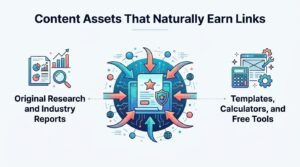
Original Research and Industry Reports
Original research involves surveying an audience or analyzing proprietary data to produce statistics that don’t exist anywhere else. Once published, these become the most linked-to asset type in most SaaS content libraries because journalists need original numbers to cite.
Templates, Calculators, and Free Tools
Templates and calculators earn links by solving a specific, recurring problem that a reader’s own audience will also face. I’ve seen a single well-promoted calculator outperform twenty guest posts combined in total referring domains earned.
SaaS Review Sites and Their Link Building Value
SaaS review sites carry link-building value because platforms like G2, Capterra, and TrustRadius are frequently linked to by third-party “best of” articles and comparison content. A strong review profile compounds the value of every mention.
G2, Capterra, and TrustRadius Profiles
G2, Capterra, and TrustRadius are third-party software review platforms where verified users rate and review SaaS products across categories. Maintaining an active, well-reviewed profile on each is close to table stakes for B2B software today.
Earning Reviews That Support Backlink Value
Review volume and recency both affect how often a review platform’s profile page gets cited or ranked in third-party comparison content. A customer feedback strategy built around post-onboarding review requests tends to outperform sporadic one-off asks.
Outreach Process for SaaS Link Building
The outreach process for SaaS link building involves prospecting relevant sites, personalizing each pitch to that site’s audience, and following up systematically. Skipping personalization is the fastest way to get ignored.
Prospecting Relevant Sites
Prospecting is the research phase where a team identifies websites that are topically relevant, reasonably authoritative, and realistically open to linking. I filter out sites with no organic traffic early, since a link from an unvisited page carries little practical value beyond the raw metric.
Personalized Pitch Frameworks
A personalized pitch references something specific about the target site’s existing content rather than sending a generic templated request. Response rates on personalized pitches run several times higher than mass-blasted templates in most outreach campaigns I’ve reviewed.
Link Building Tools for SaaS Teams
The tools SaaS teams need for link building fall into three categories: prospecting and research, outreach and CRM, and backlink monitoring. Each stage of the process benefits from different software.
Prospecting and Research Tools
Prospecting tools like Ahrefs, Semrush, and Pitchbox help identify link opportunities by analyzing competitor backlink profiles and topical relevance. I rely on competitor backlink gap reports as the fastest way to find realistic first targets.
Outreach and CRM Tools
Outreach and CRM tools like Hunter.io, Mailshake, and BuzzStream manage the sending, tracking, and follow-up of link building pitches at scale. Without one of these, most SaaS teams lose track of who they’ve already contacted within a few weeks.
Backlink Monitoring Tools
Backlink monitoring tools track new and lost links over time, alerting teams when a valuable link disappears or a toxic one appears. I check these reports monthly to catch link loss before it compounds into a ranking drop.
How to Evaluate Link Quality Before Pursuing It
Link quality should be evaluated using relevance, authority, and organic traffic signals before any outreach effort is spent pursuing it. A high-DR site with zero topical relevance is often a wasted opportunity compared to a smaller, more relevant one.
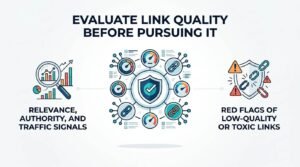
Relevance, Authority, and Traffic Signals
Relevance measures whether a linking site’s audience and topic overlap with the target site’s subject matter, while authority and traffic measure the site’s overall strength. All three should be checked together, not in isolation.
Red Flags of Low-Quality or Toxic Links
Red flags for toxic links include sites with no organic traffic, irrelevant foreign-language content, private blog networks, and unnatural anchor text patterns. Google’s Search Central spam policies explicitly call out link schemes as a manual action risk.
Common SaaS Link Building Mistakes to Avoid
The most common SaaS link building mistakes are chasing DR over relevance, using exact-match anchors excessively, and buying links from irrelevant networks. Each of these can trigger diminishing returns or manual penalties.
I’ve reviewed backlink profiles where a single toxic link cluster suppressed rankings across an entire domain until it was disavowed.
How Much Does SaaS Link Building Cost?
SaaS link building typically costs between $1,000 and $10,000 per month depending on the mix of tactics, agency involvement, and content production required. Digital PR campaigns and original research sit at the higher end due to design and promotion costs.
DIY outreach costs less in cash but requires significant internal time investment instead.
How Long Until SaaS Link Building Shows Results?
SaaS link building typically takes four to nine months to produce measurable ranking movement, since new links need time to be crawled, trusted, and factored into rankings. Ahrefs’ study of ranking timelines found most top-ranking pages were over a year old when they reached page one.
Early links often show no visible effect for weeks. Compounding value shows up later, once enough relevant links accumulate around a topic cluster.
Measuring Link Building ROI for SaaS
Measuring link building ROI for SaaS means connecting specific link acquisition efforts to downstream changes in organic traffic, rankings, and pipeline contribution. Vanity metrics like total backlink count don’t answer whether the effort paid off.
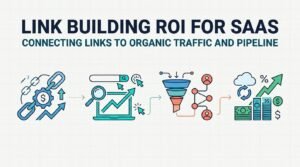
Connecting Links to Organic Traffic and Pipeline
Connecting links to pipeline requires tracking which pages gained links, whether those pages’ rankings improved, and whether the resulting traffic converted into leads. Google Search Console data paired with CRM attribution gives the clearest picture of this chain.
Conclusion
Link building for SaaS comes down to relevance over volume, patient measurement, and matching tactics to a technical buyer audience.
Search visibility compounds when strategy, content, and outreach work together across the wider organic growth picture.
We help SaaS teams build this system properly. Talk to White Label SEO Service about a link building strategy built for real pipeline growth.
Frequently Asked Questions
Is link building still important for SaaS SEO in 2025?
Yes, link building remains a core ranking factor for SaaS SEO in 2025. Search engines still use backlinks as a primary trust and authority signal, especially in competitive software categories.
How many backlinks does a SaaS site need to rank well?
There’s no fixed number of backlinks required to rank well. Ranking depends more on referring domain quality and relevance than on hitting a specific backlink count.
What is a good domain rating for a SaaS startup?
A domain rating between 20 and 40 is realistic for most SaaS startups within their first two years. Established competitors in the same space typically sit well above 50.
Should SaaS companies buy backlinks?
No, buying backlinks violates Google’s spam policies and risks manual penalties. Earned links through content, PR, and outreach produce safer, longer-lasting results.
What’s the difference between SaaS SEO and SaaS link building?
SaaS SEO covers the full discipline of improving organic visibility, including technical SEO, content, and on-page optimization. Link building is one specific component within that broader SEO strategy.
Can guest posting alone build a strong SaaS backlink profile?
No, guest posting alone rarely builds a fully strong profile. A diverse mix of editorial links, digital PR, and review site links produces a more resilient and natural-looking backlink profile.
How do I find link building opportunities for a niche SaaS product?
Competitor backlink gap analysis is the fastest way to find opportunities for a niche SaaS product. Tools like Ahrefs or Semrush reveal which sites already link to similar competitors.