Account-based link building is a targeted approach to earning backlinks that focuses on specific high-value companies rather than broad, volume-based outreach. It borrows its core logic from account-based marketing, treating each target company as its own market and building content and outreach specifically to earn links from the sites that influence its buying committee. B2B companies use this method because their buyers are few, their sales cycles are long, and generic outreach rarely reaches the right decision-makers.
Most B2B teams waste outreach hours chasing links that carry no relevance to their actual buyers. This mismatch between effort and business impact is exactly what account-based strategies fix.
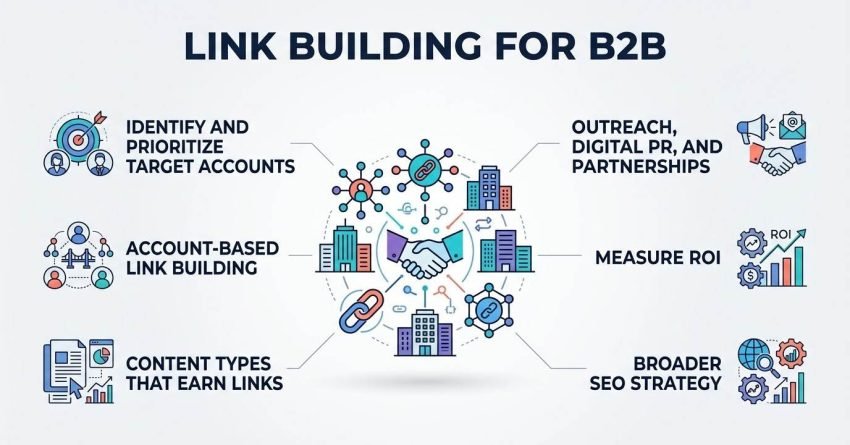
This guide covers what account-based link building actually is, why traditional tactics fall short for B2B, how to identify and prioritize target accounts, the content types that earn links from them, and how to execute outreach, digital PR, and partnerships. I’ll also cover how to measure ROI and where this fits into a broader SEO strategy.
What Is Account-Based Link Building?
Account-based link building is the practice of designing link acquisition campaigns around a defined list of target companies instead of a broad topic or keyword list. I treat each account like its own mini-market, researching the sites its stakeholders read, cite, and trust before I ever pitch a link.
This approach borrows directly from account-based marketing, where sales and marketing align around named accounts rather than anonymous funnel stages. The same logic works for links: a backlink from a site your exact buyer persona reads carries more weight than ten backlinks from unrelated blogs.
How It Differs From Traditional B2B Link Building
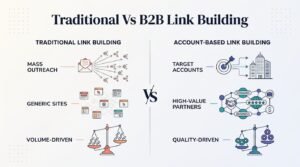
Traditional link building optimizes for volume and domain authority across a broad niche. Account-based link building optimizes for relevance to a specific buying committee, even if the site’s overall authority is modest.
I’ve found that a link from a mid-authority publication your prospect’s CFO actually reads outperforms a high-authority link from a generic business blog. The traffic and trust signal both point in the right direction.
Why ABM Principles Apply to Link Acquisition
Account-based marketing succeeds by treating each account as a market of one, and link acquisition benefits from the same discipline. When I map link targets to the same accounts sales is already pursuing, the content and outreach work double duty, building both authority and pipeline awareness.
This alignment between SEO and sales is rare in B2B, which is precisely why it creates a competitive advantage.
Why Traditional Link Building Fails for B2B Companies
Traditional link building fails for B2B companies because it optimizes for search volume in a market where the real buyers are few, specific, and rarely searching in bulk. Most B2B link building playbooks were built for consumer or high-volume niches, where thousands of relevant sites exist, and outreach at scale makes statistical sense.
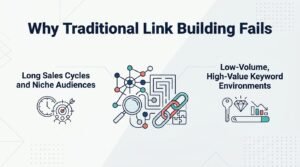
Long Sales Cycles and Niche Audiences
B2B sales cycles often run six to eighteen months, and the audience reading industry content is small and specialized. Generic guest post outreach lands on sites with no overlap with that audience, producing links that do nothing for pipeline or rankings that matter to the business.
Low-Volume, High-Value Keyword Environments
B2B keywords frequently see under 100 monthly searches, yet a single closed deal can be worth six or seven figures. This volume mismatch means link building has to prioritize relevance and buyer alignment over raw keyword search volume, which is the opposite of most mainstream link building advice.
Core Components of an Account-Based Link Building Strategy
An account-based link building strategy has three core components: target account identification, content mapped to account pain points, and relationship-driven outreach. Each component depends on the one before it, so skipping account identification undermines everything built afterward.
Target Account Identification
I start every account-based campaign by pulling a defined list of target accounts, usually sourced directly from sales or the CRM. This list becomes the filter for every subsequent link-building decision, from content topics to outreach targets.
Content Mapped to Account Pain Points
Generic content earns generic links. I build content assets reports, tools, or guides around the specific pain points that matter to the industries and roles represented in the target account list, which naturally attracts links from sites those exact people read.
Relationship-Driven Outreach
Cold, templated outreach rarely converts in B2B because the audience is small enough that reputation matters. I invest in warming up relationships with editors, analysts, and site owners in the target accounts’ orbit before ever sending a pitch, and personalized outreach techniques make that warm-up systematic rather than accidental.
Identifying and Prioritizing Target Accounts for Link Outreach
Identifying target accounts for link outreach starts with firmographic filters (industry, company size, revenue) layered with technographic data (the tools and platforms an account already uses). This combination tells me which companies are both a good customer fit and a realistic link target.
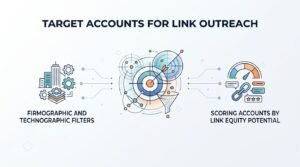
Firmographic and Technographic Filters
I filter by industry vertical, employee count, and revenue band first, since these determine whether an account matches the ideal customer profile at all. Technographic data on the software stack a company runs adds a second layer, revealing integration and partnership link opportunities that firmographics alone would miss.
Scoring Accounts by Link Equity Potential
Not every qualified account is a strong link target. I score accounts by the domain authority and topical relevance of the media, review sites, and communities associated with their industry, prioritizing outreach toward accounts whose ecosystems can realistically pass meaningful link equity.
Content Assets That Earn Links From B2B Target Accounts
The content assets that earn links from B2B target accounts are original research, interactive tools, and executive thought leadership, because each gives industry sites a concrete reason to cite the source. Generic blog posts rarely earn organic backlinks in B2B niches, no matter how well-written.
Original Research and Industry Data
Original data is the single strongest link magnet in B2B SEO. An Ahrefs study of B2B content found that pages featuring proprietary data or original research earn significantly more referring domains than opinion-based posts, because journalists and analysts need a citable number.
Tools, Calculators, and Templates
Interactive tools ROI calculators, benchmarking tools, or free templates solve an immediate problem for a visitor and get bookmarked and linked from resource pages across an industry. I’ve seen a single well-built calculator outperform a dozen blog posts in referring domains over a year.
Executive Thought Leadership
Bylined articles and expert commentary from a company’s founders or executives build the kind of personal authority that industry publications want to cite. This works especially well when the executive’s insight ties directly to a trend the target account’s industry is actively discussing.
Personalized Outreach Techniques for Account-Based Campaigns
Personalized outreach in account-based link building means tailoring the pitch, the contact, and the timing to the specific stakeholders inside a target account rather than sending one template to a mass list. Generic outreach gets ignored; personalized outreach gets replies.
Multi-Threaded Outreach Across Stakeholders
I rarely rely on a single point of contact inside a target account’s media or partner ecosystem. Reaching multiple stakeholders an editor, a contributor, and a social media manager increases the odds that at least one channel responds and champions the link internally.
Timing Outreach to Buying Committee Signals
Outreach timed to a target account’s active buying signals, like a recent funding round or leadership change, gets noticed because it’s relevant to what’s already on their mind. I track these signals through intent data platforms before sending any pitch.
Digital PR Strategies for B2B Account-Based Link Building
Digital PR for account-based link building means pitching data-backed stories to journalists and industry publications that the target accounts’ buying committees actually read. This differs from mass PR blasts by narrowing the media list to outlets with proven relevance to the account list.
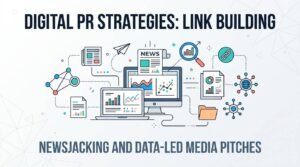
Newsjacking and Data-Led Media Pitches
Tying a company’s original data to a breaking industry trend gives journalists a reason to cite the source quickly. I keep a standing bank of statistics ready so a pitch can go out within hours of a relevant news cycle, which is often the difference between landing a link and missing the window entirely.
Leveraging Partnerships and Co-Marketing for B2B Backlinks
Partnerships and co-marketing generate B2B backlinks through joint content, integration directories, and marketplace listings that already have an incentive to link back. These links tend to be higher quality because both parties benefit from the association.
Vendor, Integration, and Marketplace Partnerships
Software companies with integration marketplaces, like app directories, list partner companies with a backlink by default. I prioritize building integrations or partnerships with platforms the target accounts already use, since the resulting link comes with built-in relevance and referral traffic.
Measuring the ROI of Account-Based Link Building
The ROI of account-based link building is measured by tracking referring domains against pipeline influence, not just Domain Rating. A link building program that grows DR but never touches a target account’s buying journey isn’t delivering account-based value, even if the metrics look good in a standard link report.
Link Metrics That Matter for B2B (DR, Relevance, Traffic)
Domain Rating still matters, but I weight it against topical relevance and actual referral traffic from the linking page. A Semrush analysis found that referring domains with topical relevance scores above 70% correlated more strongly with ranking improvements than raw DR alone.
Connecting Links to Pipeline and Revenue
I tie link building reports directly to CRM data, checking whether traffic and leads from linked pages correspond to target accounts already in the sales pipeline. This connection is what separates account-based link building from vanity metric tracking.
Tools and Technology for Account-Based Link Building
Account-based link building relies on a technology stack combining CRM data, intent data platforms, and outreach automation tools to connect link targets with sales-qualified accounts. Without this stack, account-based execution collapses back into generic outreach at scale.
CRM, Intent Data, and Outreach Platform Stacks
I connect the CRM’s account list to an intent data platform to flag buying signals, then feed qualified targets into an outreach tool that tracks personalized sequences. This stack keeps link building aligned with sales priorities instead of operating as an isolated SEO task.
Common Mistakes in B2B Account-Based Link Building
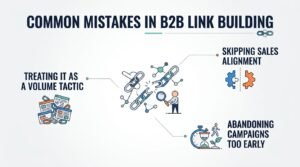
The most common mistake in B2B account-based link building is treating it as a volume tactic instead of a precision one, which defeats the entire purpose of the account-based approach. Teams that measure success by total link count rather than account relevance end up right back where traditional link building left them.
Other frequent mistakes include skipping the sales alignment step, so marketing pursues accounts sales never intended to target, and abandoning campaigns too early because B2B link cycles take longer to show pipeline impact than transactional SEO tactics.
How Account-Based Link Building Fits Into a Broader B2B SEO Strategy
Account-based link building fits into a broader B2B SEO strategy as the authority-building layer that supports technical SEO and content strategy already targeting the same accounts. It doesn’t replace keyword-driven content or technical optimization; it reinforces both by earning links from sites the target audience already trusts.
I treat this method as one pillar among several, working alongside on-page optimization and content built around the buyer journey stages those same accounts move through.
Conclusion
Account-based link building connects target accounts, tailored content, and relationship-driven outreach into one coherent authority-building system. It works alongside technical SEO and content strategy as part of a complete organic growth approach, not as an isolated tactic.
We help B2B teams build account-based link strategies that earn relevant, revenue-connected backlinks. Talk to White Label SEO Service about your link building roadmap today.
Frequently Asked Questions
What is account-based link building?
Account-based link building is a strategy that targets backlinks from sites relevant to a specific list of target companies rather than a broad audience. It applies account-based marketing principles to SEO outreach and content.
How is account-based link building different from regular link building?
Regular link building optimizes for volume and general domain authority. Account-based link building optimizes for relevance to a defined list of target accounts, even when overall site authority is lower.
Why does traditional link building underperform for B2B companies?
Traditional link building assumes high search volume and broad audiences, which don’t match B2B’s long sales cycles and niche buyer groups. Generic outreach misses the specific sites B2B decision-makers actually read.
What content earns the most B2B backlinks?
Original research, interactive tools, and executive thought leadership earn the most B2B backlinks. These formats give industry sites a concrete, citable reason to link rather than a general opinion piece.
How do you measure ROI on account-based link building?
ROI is measured by connecting referring domains and traffic to pipeline data in the CRM, not just Domain Rating growth. A campaign only counts as effective if it influences accounts already in the sales funnel.
What tools support account-based link building?
CRM platforms, intent data tools, and outreach automation software support account-based link building by connecting sales-qualified accounts to personalized outreach sequences. This keeps link building aligned with sales priorities.
Can small B2B companies do account-based link building?
Small B2B companies can run account-based link building by starting with a short, high-value target account list instead of scaling outreach broadly. Focused effort on fewer accounts often outperforms broad campaigns with limited resources.