I’ve spent years watching local businesses pour money into SEO without understanding why their competitor two blocks away outranks them. Local link building is the process of earning backlinks from geographically or contextually relevant websites to strengthen a business’s authority and visibility in local search results. It works alongside on-page SEO and citations to tell Google a business is a trusted, established part of its community.
Businesses that skip this step often plateau in local rankings no matter how good their website looks. Google weighs trust signals heavily, and links remain one of the strongest.
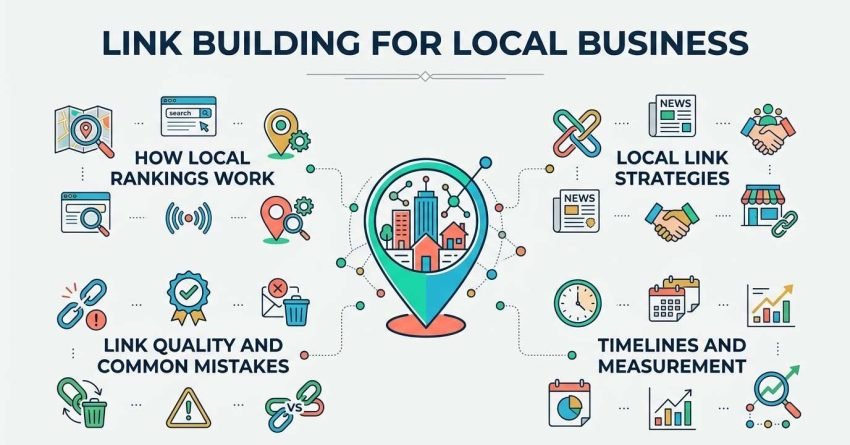
This guide covers what local link building actually means and how local rankings work, the main categories of local link strategies from citations to partnerships and media outreach, how to judge link quality and avoid common mistakes, and what realistic timelines and measurement look like once a campaign is running.
What Local Link Building Means for Small Businesses
Local link building is the practice of earning backlinks specifically from websites tied to a business’s geographic area or local industry niche, rather than chasing high-authority national sites. This distinction matters because Google evaluates local relevance separately from generic domain authority.
A link from a national tech blog might carry weight for a SaaS company, but it does little for a plumber trying to rank in Austin. Local relevance signals tell search engines a business is actually rooted in the community it claims to serve.
How It Differs From National Link Building
National link building chases broad authority and traffic volume, while local link building prioritizes geographic and community relevance over raw domain metrics. A link from a small local newspaper often outperforms a mediocre national guest post for a local business.
I’ve seen campaigns fail because agencies applied national link tactics to local clients. The strategies overlap in method but diverge sharply in target selection and success metrics.
Why Local Relevance Matters to Google
Google’s local algorithm weighs three core factors: proximity, relevance, and prominence, and backlinks primarily influence prominence. A locally relevant backlink profile signals that a business is recognized and referenced within its own community, not just online in general.
This is why a single link from a respected local chamber can outperform ten generic directory submissions.
How Local Search Rankings Actually Work
Local search rankings are determined by a combination of Google Business Profile signals, on-page relevance, and off-page trust factors like backlinks and reviews. Understanding this mix explains why link building alone never fixes a broken local SEO strategy.
Businesses ranking in the top three local results typically show strength across all three pillars, not just one.
The Role of the Local Pack vs. Organic Results
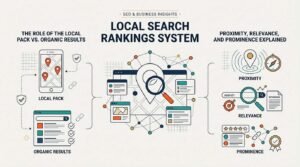
The Local Pack is the map-based three-result block that appears above organic listings for location-based searches, and it draws the majority of local search clicks. Ranking in organic results still matters, especially for research-stage queries, but the Local Pack captures the highest-intent, ready-to-buy searches.
Backlinks influence both, though their weight in Local Pack ranking is intertwined with Google Business Profile optimization.
Proximity, Relevance, and Prominence Explained
Proximity measures how close a business is to the searcher, relevance measures how well a business matches the search query, and prominence measures how well-known and trusted a business is based on signals like reviews, citations, and backlinks. A business can’t control proximity, but relevance and prominence are both directly improvable through content and link strategy.
Why Backlinks Matter for Local SEO
Backlinks act as third-party votes of confidence that tell Google a business is credible, established, and worth trusting in local search results. Without them, even a perfectly optimized Google Business Profile struggles to compete against businesses with genuine community backing.
An Ahrefs study of local ranking factors found that businesses ranking in the top three local pack positions had significantly more referring domains than those ranking lower, even after controlling for review count.
Backlinks as a Trust and Authority Signal
Search engines use backlinks as a proxy for real-world trust, since a link from another website is effectively a recommendation. Local backlinks compound this effect because they demonstrate trust within a specific, verifiable community context.
How Backlinks Interact With Google Business Profile Rankings
Google Business Profile rankings are influenced by off-site signals including backlink authority and citation consistency, not just the profile’s own content and reviews. A business with a strong backlink profile tends to see its Google Business Profile treated as more authoritative during ranking evaluation.
This connection is why link building and Google Business Profile optimization should never be run as separate, disconnected efforts.
Types of Local Link Building Strategies
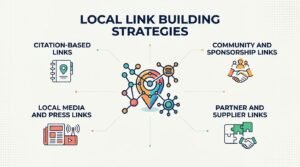
Local businesses have access to several distinct link acquisition categories, each suited to different resources and timelines. Citation-based links, community sponsorships, local media coverage, and partner relationships each carry different trust weight and effort requirements.
Most sustainable local link profiles blend several of these types rather than relying on just one.
Citation-Based Links
Citation-based links come from business directories and listing platforms that publish a business’s name, address, and phone number alongside a link back to its website. These are typically easier to earn but carry lower individual authority than editorial links.
Community and Sponsorship Links
Community and sponsorship links come from local organizations, events, and nonprofits that list sponsors and partners on their websites, often as part of a sponsorship package. These links tend to carry strong local relevance because the linking domain is genuinely tied to the community.
Local Media and Press Links
Local media and press links come from newspapers, TV station websites, and regional blogs that cover a business as part of a news story or feature. These links are highly valued because local news domains typically carry both authority and strong geographic relevance.
Partner and Supplier Links
Partner and supplier links come from businesses a company works with directly, such as suppliers, contractors, or referral partners who list each other on their websites. These links work best when the relationship is genuine and mentioned in a natural business context rather than a forced exchange.
Local Business Citations and NAP Consistency
A local business citation is any online mention of a business’s name, address, and phone number, whether or not it includes a clickable link. Citations function differently from backlinks, but they contribute to the same prominence signal Google uses for local rankings.
What Counts as a Citation
A citation counts anywhere a business’s NAP information appears consistently, including directories, social profiles, and industry-specific listing sites. Not every citation includes a link, but consistency across all of them still influences local trust signals.
Why NAP Consistency Affects Rankings
NAP consistency refers to keeping a business’s name, address, and phone number identical across every online listing, and inconsistencies can confuse Google’s local ranking algorithm. A BrightLocal industry survey found that citation accuracy remains one of the most commonly mismanaged local SEO factors among small businesses.
Fixing inconsistent citations often produces a faster ranking improvement than acquiring new links, simply because it removes confusion rather than adding new signals.
Earning Links Through Local Partnerships
Local partnership links come from genuine working relationships with other area businesses, where each party references the other as a trusted resource or vendor. A landscaping company and a local nursery, for example, naturally have reason to link to each other.
I’ve found these links tend to last longer than transactional ones because the underlying relationship gives both parties incentive to keep the connection accurate and current. This approach requires identifying which local businesses share an audience without being direct competitors.
Chamber of Commerce and Local Association Links
Chamber of commerce membership typically includes a business directory listing with a backlink, making it one of the most accessible local link sources available. Local trade associations and business improvement districts often offer similar member directory links.
These links carry above-average trust because chamber websites are recognized as legitimate community institutions rather than link farms.
Sponsorships and Community Involvement as Link Sources
Sponsoring local events, youth sports teams, or community fundraisers frequently results in a backlink from the organizing entity’s website as part of standard sponsor recognition. This strategy works particularly well for service businesses that already have a marketing budget allocated to community goodwill.
The link value is a byproduct of a legitimate community investment, which is part of why Google treats these links favorably.
Local Media Outreach and Digital PR
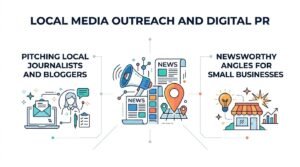
Local digital PR involves pitching stories, data, or expert commentary to local journalists and bloggers in exchange for coverage that includes a backlink. This strategy requires more effort than directory submissions but produces links with substantially higher authority and relevance.
Pitching Local Journalists and Bloggers
Successful local media pitches connect a business to a timely, locally relevant story angle rather than promoting the business directly. Journalists respond to newsworthiness, not marketing copy, so the pitch needs to lead with the story’s public interest value.
Newsworthy Angles for Small Businesses
Newsworthy angles for local businesses typically include community milestones, original local data, unusual expertise, or involvement in a current local event or issue. A flooring company commenting on a local housing trend has a stronger pitch than one simply announcing a sale.
Guest Posting on Local and Industry Websites
Guest posting for local SEO means contributing an article to another website in exchange for a backlink, ideally on a site with genuine local or industry relevance. This tactic works best when the guest content provides real value to the host site’s audience rather than existing purely to house a link.
Quality matters more than volume here. A handful of well-placed, relevant guest posts outperforms dozens of low-effort placements on unrelated sites.
Leveraging Local Directories and Review Platforms
Beyond major citation sources, niche directories and review platforms specific to an industry or region can provide additional local backlink opportunities. Platforms that cater to a specific trade or metro area often carry more local relevance than broad, generic directories.
Review platforms in particular double as both a citation source and a trust signal, since prospective customers frequently check them before making a decision.
Content That Naturally Attracts Local Links
Certain types of content are inherently more likely to earn backlinks because other websites have a genuine reason to reference them. Local guides, original research, and resource pages tend to outperform standard blog content for link acquisition.
Local Guides and Resource Pages
A local resource page compiles genuinely useful, non-promotional information about an area or industry, which gives other local sites a practical reason to link to it. A “moving to [city] checklist” from a real estate agency is a common example that attracts links from unrelated local blogs and community sites.
Original Local Data and Studies
Original data drawn from a business’s own customer base, local market, or industry position creates a citable resource that journalists and bloggers reference when writing related stories. A Moz study on content and link acquisition found that data-driven content earns links at a notably higher rate than opinion or advice-based posts.
How to Evaluate Link Quality for Local SEO
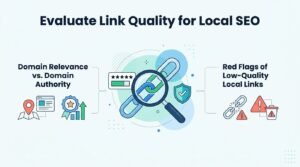
Not every backlink strengthens local rankings, and some can actively cause harm if they come from spammy or irrelevant sources. Evaluating link quality means checking relevance, authority, and trustworthiness before pursuing or accepting a link opportunity.
Domain Relevance vs. Domain Authority
Domain relevance measures how topically or geographically connected a linking site is to the target business, while domain authority measures general site strength regardless of topic. For local SEO, relevance frequently matters more than raw authority, since a moderately strong local site often outperforms an unrelated high-authority one.
Red Flags of Low-Quality Local Links
Red flags include link farms, unrelated foreign-language directories, paid link networks, and sites with no real audience or editorial standards. Acquiring links from these sources risks a Google penalty rather than a ranking boost, which makes vetting worth the extra time.
Common Local Link Building Mistakes
Many local businesses waste budget chasing link volume instead of link relevance, submitting to hundreds of generic directories that provide little ranking value. Others neglect NAP consistency entirely, undermining the value of every citation they’ve built.
A third common mistake is treating link building as a one-time project instead of an ongoing part of local visibility maintenance.
How Long Local Link Building Takes to Show Results
Local link building typically takes three to six months to produce measurable ranking movement, and six to twelve months for substantial local pack visibility gains. This timeline reflects both the time needed to acquire quality links and the time Google takes to factor new signals into rankings.
Businesses in highly competitive metro areas often need the longer end of that range, while smaller markets can see faster movement.
Measuring the Impact of Local Link Building
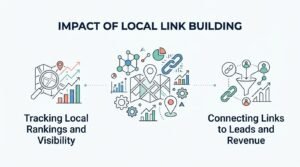
Measuring local link building requires tracking both the links themselves and the downstream effect on rankings, traffic, and leads. Link count alone tells an incomplete story without corresponding visibility and conversion data.
Tracking Local Rankings and Visibility
Local rank tracking tools and Google Business Profile insights show how visibility shifts in specific geographic areas over time, which link building alone cannot reveal. Monitoring rank position for target local keywords alongside new link acquisition helps isolate which links are actually moving the needle.
Connecting Links to Leads and Revenue
The most meaningful measurement ties link building activity to actual leads and revenue using tools like Google Analytics and call tracking, not just ranking position. A business that ranks higher but sees no increase in qualified leads needs to examine conversion factors separately from the link strategy itself.
Conclusion
Local link building works alongside citations, reviews, and on-page signals to build the trust Google rewards with visibility. Real results take months, not days, and come from relevance over volume.
We help businesses build link strategies that reflect genuine community connections and long-term authority. Partner with White Label SEO Service to build a local link profile that actually moves rankings and revenue.
Frequently Asked Questions
What is local link building?
Local link building is the process of earning backlinks from geographically or industry-relevant websites to strengthen a business’s local search authority. It differs from national link building by prioritizing community relevance over broad domain metrics.
How many backlinks does a local business need?
There’s no fixed number, since link quality and relevance matter more than raw count for local rankings. A smaller number of highly relevant local links typically outperforms a large volume of generic ones.
Are local citations the same as backlinks?
Citations and backlinks overlap but aren’t identical, since a citation may list NAP data without including a clickable link. Both contribute to local prominence signals, but backlinks generally carry more direct ranking weight.
How long does local link building take to work?
Local link building typically takes three to six months for initial ranking movement and six to twelve months for substantial visibility gains. Competitive markets usually require the longer end of that timeline.
Can a local business rank without link building?
A local business can rank temporarily without link building, especially in low-competition areas, but sustained top rankings usually require backlink support. Prominence signals weaken over time without ongoing authority building.
What is a good local link building strategy for startups?
Startups benefit most from chamber of commerce listings, local partnerships, and community sponsorships, since these are accessible and carry genuine relevance. These sources build a foundation before pursuing more competitive media placements.
How do I know if a local backlink is high quality?
A high-quality local backlink comes from a relevant, trustworthy site with real traffic and editorial standards, not a link farm or spam directory. Checking domain relevance and audience legitimacy before pursuing a link prevents wasted effort.