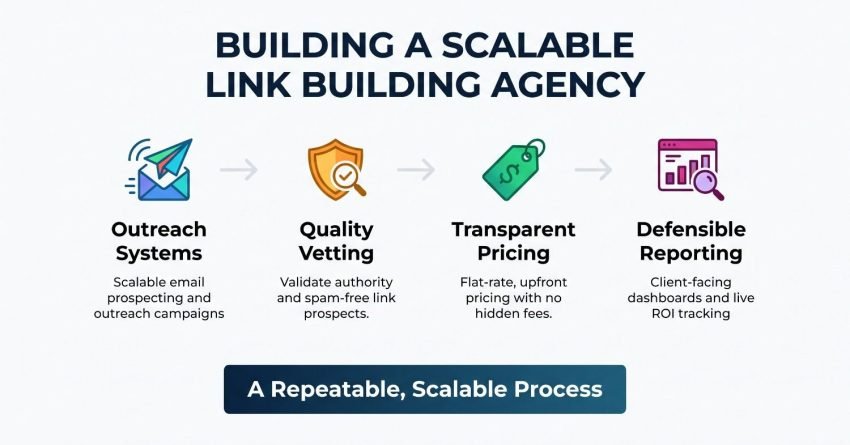
A link building agency is a specialized service business that earns backlinks for client websites through outreach, content creation, and relationship-based placements to strengthen search rankings. Running one successfully means combining outreach systems, quality vetting, transparent pricing, and defensible reporting into a repeatable process that clients trust and rebook. Anyone can send emails asking for links. Building an agency that survives past year one means systemizing that process into something scalable and defensible.
I’ve watched agencies collapse within a year because they treated link building as a side hustle instead of an operations problem. The businesses that last treat sourcing, pricing, and reporting as seriously as any SaaS company treats churn.
This guide covers what the business actually involves and whether it’s viable, how to structure your service delivery and pricing, the outreach and vetting systems that keep links safe, and how to hire, report results, and scale once the model works.
What Does a Link Building Agency Actually Do?
A link building agency acquires backlinks on behalf of client websites, using outreach, content partnerships, and paid or earned placements to improve a domain’s authority and search rankings. The work sits downstream of content and technical SEO but drives a huge share of ranking improvement once those foundations exist.
Most agencies offer a mix of guest posting, digital PR, niche edits, and resource link placements. Backlinks remain one of the top three ranking factors Google’s algorithm weighs, which is exactly why the service exists at scale.
Link building doesn’t work in isolation from the rest of SEO. Agencies that only sell links without understanding on-page optimization or technical SEO fundamentals tend to overpromise results they can’t actually control, because rankings depend on more than just referring domains.
Is Starting a Link Building Agency a Good Business Model?
Starting a link building agency is a viable business model because demand for backlinks remains constant, margins can exceed 50% once processes are systemized, and the service scales without heavy capital investment. I’ve seen solo operators grow six-figure books of business within 18 months using nothing but a laptop and a proven outreach system.
Demand isn’t slowing down. Digital PR and guest posting spend continues climbing as brands compete for the same finite pool of high-authority placements. That scarcity is actually good news for agencies with strong relationships and vetting processes, since it prices out sloppy competitors.
Margins vary wildly depending on delivery model. An agency doing 100% manual outreach with in-house writers might net 30–40%. One using a hybrid of automation and white-label link-building partners can push past 55%, because the fulfillment cost per link drops sharply at volume.
Profitability hinges on one variable most new agency owners underestimate: churn. Client retention above 80% after six months is what separates a sustainable agency from one perpetually stuck in new-business mode.
How to Build a Business Plan for a Link Building Agency
A link building agency business plan defines your niche, service packages, pricing structure, and target client profile before you acquire a single lead. Skipping this step is the single most common reason new agencies stall at 3–5 clients and can’t grow past it.
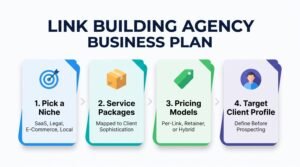
Pick a niche early. Generalist link-building agencies compete on price. Agencies that specialize in SaaS, legal, e-commerce, local service businesses compete on results and can charge 30–50% more because they understand the vertical’s link landscape.
Service packages should map to client sophistication. A startup might want a flat monthly retainer for 4–6 links. An established brand might want a custom digital PR campaign with quarterly reporting tied to specific ranking targets.
Pricing models generally fall into three buckets: per-link, monthly retainer, or hybrid. Retainer pricing tends to produce the most predictable agency revenue, since it smooths out the feast-or-famine cycle that per-link pricing creates when outreach response rates dip.
Legal and Operational Setup for a Link Building Agency
Setting up a link building agency legally requires registering a business entity, drafting client service agreements, and defining liability boundaries around link removal and ranking guarantees. Most operators default to an LLC structure for the liability protection alone.
Contracts matter more in this industry than most service businesses realize. Service agreements need explicit language around what happens if a placement gets removed, refund windows, and, critically, a disclaimer that no agency can guarantee specific rankings, since Google’s algorithm is outside anyone’s direct control.
Liability exposure grows fastest around penalty risk. Contracts should clarify that clients approve link sources before placement, which protects the agency if a client later claims a link caused a manual action.
Building Your Link Building Process and Methodology
A link building methodology combines outreach-based acquisition, content-driven link earning, and guest posting into a repeatable workflow that produces consistent monthly placements. Agencies that rely on just one method plateau fast once that channel’s response rates decline.
Outreach-based acquisition means identifying relevant sites, pitching a resource or replacement link, and following up systematically. Response rates on cold outreach typically sit in the 1–5% range, which is why volume and personalization both matter.
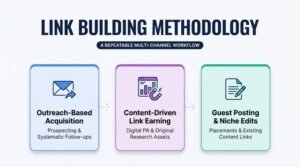
Content-driven link earning, often called digital PR, creates genuinely link-worthy assets like original research, data studies, or interactive tools that journalists and bloggers cite naturally. This method costs more upfront but produces links that outreach alone can rarely secure, including placements on major publications.
Guest posting and niche edits round out most agency service menus. A niche edit inserts a client’s link into existing, already-indexed content rather than publishing something new, which often moves faster than waiting for a guest post to go live and get indexed.
How to Source and Vet Quality Link Prospects
Vetting link prospects means evaluating domain authority, organic traffic, topical relevance, and spam signals before pursuing a placement. Skipping this step is how agencies end up building links that do nothing or, worse, attract a Google manual action against the client’s site.
Domain authority and trust metrics give a fast first filter, but they’re not sufficient alone. A site with strong authority metrics but zero real organic traffic is often a link farm dressed up to pass automated checks.
Toxic link sources share common patterns: excessive outbound links per page, irrelevant subject matter, thin content, and traffic that has collapsed over the past 12 months. Manual review of the linking page itself, not just the domain metrics, catches problems that tools alone miss.
Building an Outreach System That Scales
An outreach system that scales combines templated but personalized email sequencing, prospecting automation, and structured follow-up cadences to maintain consistent placement volume as client load grows. Manual, one-off outreach caps out fast, usually around 2–3 clients per outreach specialist.
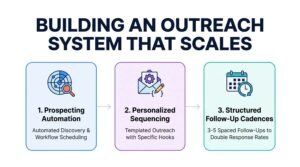
Outreach tools handle prospecting, email sending, and follow-up scheduling, but the sequencing strategy matters more than the software itself. Three to five follow-ups spaced across two weeks typically doubles response rates compared to a single pitch email.
Personalization at scale doesn’t mean writing every email from scratch. It means building templates with genuine, specific hooks referencing a recent post, a shared connection, or a real content gap inserted into a structured but flexible framework.
Hiring and Structuring Your Link Building Team
Structuring a link building team means defining clear roles for outreach specialists, content writers, and account managers before scaling past a handful of clients. Trying to do all three yourself is fine at 2 clients. It breaks down completely by client 6 or 7.
Outreach specialists handle prospecting and email sequencing. Content writers produce the guest posts, linkable assets, and pitch materials. Account managers own client communication and reporting, which frees outreach staff to focus purely on placement volume.
Most growing agencies choose between in-house hires, freelance contractors, or a white label fulfillment partner for overflow capacity. White label partners let an agency absorb new client volume without the lag time of hiring and training new staff.
Pricing Your Link Building Services Profitably
Pricing link building services profitably requires understanding your true cost-per-link, including outreach time, content costs, and placement fees before setting client-facing rates. Agencies that price based on competitor rates alone frequently discover they’re losing money on every placement.
Cost-per-link breaks down into acquisition cost (outreach time, tools, prospecting), content cost (writing the guest post or asset), and placement cost (any fee paid to the publishing site). A realistic fully-loaded cost per quality link often lands between $150 and $400, depending on niche competitiveness.
Retainer pricing tends to win on predictability for both sides. Project-based pricing works better for one-off digital PR campaigns tied to a specific launch or announcement, where the deliverable has a clear start and end date.
How to Find and Acquire Your First Clients
Acquiring your first link building clients typically means combining cold outreach, referral requests, and visible proof-of-work like case studies to overcome the trust gap that new agencies face. Nobody wants to be your first client, so the sales process has to work harder to earn that trust.
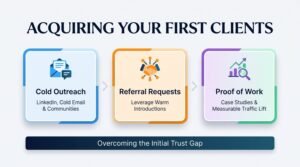
Cold outreach and lead generation channels LinkedIn, cold email, and niche communities where SEO buyers already gather remain the fastest path to initial traction. Response rates are low, so volume and targeting both matter early on.
Case studies and portfolio proof solve the credibility problem faster than sales pitches do. Even a single detailed before-and-after case study, showing referring domain growth and organic traffic lift over 90 days, converts skeptical prospects better than generic service descriptions.
Reporting and Proving Link Building ROI to Clients
Proving link building ROI to clients means tracking referring domains, domain rating changes, and downstream organic traffic impact, then presenting that data in a format the client actually understands. Technical metrics mean nothing to a client who just wants to know if leads are increasing.
Key metrics worth tracking include new referring domains per month, average domain rating of acquired links, and most importantly, organic traffic and keyword ranking movement tied to the pages that received links. Isolating that correlation is what separates credible reporting from vanity metrics.
Client-facing dashboards, built in tools like Google Looker Studio pulling from Google Search Console and Google Analytics, turn raw data into a monthly narrative clients can actually act on.
Common Risks and Compliance Issues in Link Building
The biggest compliance risk in link building is running afoul of Google’s link spam policies, which can trigger manual actions that strip a client’s rankings overnight. Google’s Search Central documentation explicitly names link schemes as a violation that can result in ranking penalties.
Google’s link spam policies specifically target paid links that pass ranking signals without a nofollow tag, large-scale automated link exchanges, and low-quality guest posting done purely for links rather than genuine editorial value.
Avoiding penalization risk for clients means favoring editorial relevance over sheer volume, diversifying anchor text naturally, and steering clear of obviously manipulative patterns like site-wide footer links or excessive exact-match anchors.
Scaling a Link Building Agency Long-Term
Scaling a link building agency long-term requires systemizing outreach workflows, documenting processes so hiring doesn’t bottleneck growth, and eventually expanding service offerings beyond pure link building. Agencies that stay a one-person outreach operation top out fast, usually somewhere around $15–20k in monthly revenue.
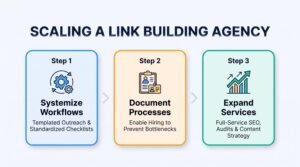
Systemizing and automating workflows, templated outreach sequences, standardized reporting formats, and defined vetting checklists is what lets an agency onboard its sixth client without everything breaking.
Many link building agencies eventually expand into full-service SEO, adding technical audits and content strategy once they’ve built enough trust with existing clients to upsell broader retainers.
Tools and Software Every Link Building Agency Needs
Running a link building agency requires prospecting tools, outreach automation software, and backlink monitoring platforms to manage volume without sacrificing quality control. Ahrefs or Semrush typically anchor the research side, covering domain metrics and competitor backlink analysis.
Outreach platforms handle email sequencing and follow-up automation, while a simple CRM or spreadsheet-based tracker keeps prospect status and placement history organized as volume grows past a few dozen active pitches per month.
How White Label Link Building Fits Into Your Agency Model
White label link building lets an agency outsource placement fulfillment to a third-party provider while maintaining the client relationship and branding under its own name. This model solves the capacity problem that stalls most agencies right at their growth ceiling.
Agencies use white label partners to absorb overflow demand, access established publisher relationships they haven’t built yet, or test new service lines like digital PR without hiring specialized staff immediately.
Conclusion
Running a link building agency means mastering outreach, vetting, pricing, and reporting as one connected system. It’s a scalable model, but only when process replaces improvisation. As search evolves, sustainable link acquisition stays central to organic growth. We built White Label SEO Service to help agencies deliver that consistently. Partner with us to scale your fulfillment without sacrificing quality.
Frequently Asked Questions
How much does it cost to start a link building agency?
Starting a link building agency costs relatively little upfront, often under $2,000 for tools and business registration. Most costs come later, from outreach software subscriptions and content production as you scale.
How long does it take to see results from link building?
Link building results typically appear within 3 to 6 months, depending on the site’s existing authority and competition level. Ranking movement usually lags behind the actual link placement by several weeks.
Can I run a link building agency with no SEO experience?
Running a link building agency without SEO experience is difficult but not impossible if you partner with experienced fulfillment help. Understanding ranking factors and vetting still matters for client trust and results.
What’s the difference between link building and guest posting?
Link building is the broader discipline of acquiring backlinks through any method, while guest posting is one specific tactic within it. Guest posting involves publishing original content on another site in exchange for a link.
How many links should an agency build per client per month?
Most agencies build between 4 and 10 quality links per client per month, depending on budget and niche competitiveness. Quality and relevance matter more than raw volume for ranking impact.
Is white label link building worth it for a new agency?
White label link building is often worth it for new agencies facing capacity constraints or lacking publisher relationships. It lets you deliver consistent results while you build internal systems and staff.
How do link building agencies avoid Google penalties?
Link building agencies avoid penalties by prioritizing editorial relevance, diversifying anchor text, and avoiding large-scale automated or paid link schemes. Manual vetting of every prospect site reduces this risk significantly.