

Local citations are online mentions of a business’s name, address, and phone number (NAP) across directories, apps, and platforms that search engines use to verify legitimacy and local relevance. I treat citation tracking as a recurring discipline, not a one-time cleanup, because directories update their data on their own schedules and errors creep back in constantly. Business owners managing their own local SEO often assume citations are “set and forget,” but that assumption quietly erodes rankings over months.
Inconsistent NAP data confuses search engines and splits ranking signals across duplicate or outdated listings. A business with 15% citation inconsistency competes at a real disadvantage against cleaner profiles in the same market.
This guide covers what citations are and why their health matters, the core metrics and tools used to monitor them, how to audit and fix inconsistencies, how to track growth and velocity over time, and how to turn all of that data into a report stakeholders actually understand. We also cover multi-location tracking and how citations fit into the bigger local SEO picture.
What Local Citations Are and Why Tracking Them Matters
A local citation is any online reference to a business’s name, address, and phone number, whether or not it includes a link back to the business website. I separate citations into two buckets immediately, because they behave differently and need different tracking approaches.
Structured citations live on directory platforms with a fixed data format: think Yelp, Google Business Profile, or Apple Maps, where NAP fields sit in designated boxes. Unstructured citations appear in free-form content, like a local news article mentioning a business address in a sentence, and are far harder to track or audit at scale.
NAP consistency means the exact same business name, address, and phone number format appears everywhere that business is listed. Search engines cross-reference NAP data across the web as a trust signal, and a Moz Local Search Ranking Factors survey found citation signals remain one of the measurable local pack ranking factors even as other signals have grown in weight.
A business operating under three different address formats across directories sends a fragmented signal that search engines have to resolve on their own, and they don’t always resolve it in the business’s favor.
Structured vs. Unstructured Citations
Structured citations are the priority for tracking because they’re indexed, queryable, and directly tied to ranking algorithms. Directory aggregators like Data Axle, Foursquare, and Neustar feed structured data to dozens of downstream platforms, which means one wrong structured citation can replicate itself across 20 other sites within weeks.
Unstructured citations matter more for brand authority and semantic relevance than for direct NAP verification, so I track them separately and with lower urgency.
NAP Consistency as a Ranking Signal
NAP consistency is the degree to which a business’s name, address, and phone number match exactly across every online listing. A 2024 Whitespark local ranking factors survey placed NAP consistency among the top five citation-related signals local SEOs actively monitor.
I check this signal first on any new account because it’s foundational. Every other citation metric depends on having a clean, verified NAP baseline to measure against.
The Core Metrics That Define Citation Health

Citation health is measured through three core metrics: accuracy rate, total coverage, and NAP consistency score, each revealing a different risk if left unchecked. I pull these three numbers before touching anything else on a new citation audit, because they tell me where the actual damage is concentrated.
| Metric | What It Measures | Healthy Benchmark |
| Citation Accuracy Rate | % of citations with fully correct NAP data | 90%+ |
| Citation Coverage | Total number of live, indexed citations | 40–80+ depending on industry |
| NAP Consistency Score | % match rate across all live listings | 95%+ |
Citation Accuracy Rate
Citation accuracy rate is the percentage of a business’s live citations that display fully correct name, address, and phone information with no typos, outdated suite numbers, or disconnected lines. I calculate it by dividing verified-accurate citations by total live citations found during an audit.
A rate below 80% usually points to a bigger root cause, like a past office move or rebrand that never propagated through directory aggregators.
Citation Coverage (Total Live Citations)
Citation coverage counts the total number of indexed, live citations a business holds across the directory ecosystem. Coverage targets vary by industry. A healthcare practice typically needs more niche directory citations than a general retail business.
Low coverage limits the total trust signal volume available to a search engine, even if the citations that do exist are perfectly accurate.
NAP Consistency Score
NAP consistency score measures the percentage of citations that match the business’s designated “master” NAP record exactly, character for character. I set the master record first, then measure every other listing against it rather than guessing at the “right” version after the fact.
How to Audit Your Existing Citation Profile

A citation audit is a systematic review of every existing online listing for a business to identify inaccurate, duplicate, or missing entries before any tracking system can be built. I start every audit the same way: pull the business’s current citation footprint using a search-based scan, then cross-reference it against the designated master NAP record.
Manual audits work for businesses with a small footprint, usually under 30 directories, but they get unreliable fast once a business operates in multiple cities or categories.
Manual Search vs. Automated Audit Methods
Manual citation auditing means searching directory by directory and recording findings in a spreadsheet, which gives full control but consumes significant time on larger profiles. Automated audit methods use crawling tools that query dozens of directories simultaneously and flag inconsistencies against the master record in a single pass.
I reach for automated tools once a business crosses roughly 50 existing citations, since manual review past that point introduces its own human error.
Tools for Tracking Local Citations
Citation tracking tools are software platforms that scan directory networks on a scheduled basis and report NAP accuracy, coverage, and changes over time. The right tool choice depends heavily on business size, number of locations, and reporting needs rather than any single “best” platform.
I evaluate tools against three criteria every time: directory coverage depth, update frequency, and whether the reporting output is client-presentable without heavy reformatting.
Enterprise Citation Platforms
Enterprise citation platforms like Yext, BrightLocal, and Moz Local monitor hundreds of directories simultaneously and push corrections automatically through aggregator partnerships. These platforms suit multi-location businesses or agencies managing citation profiles across dozens of client accounts at once.
Free and Low-Cost Tracking Methods
Free tracking methods include manual Google searches using the business’s exact NAP string in quotes, combined with a maintained spreadsheet logging each directory, its current data, and the last check date. This approach works well for single-location businesses with modest citation counts and tighter budgets.
Setting Up a Citation Tracking Spreadsheet or Dashboard
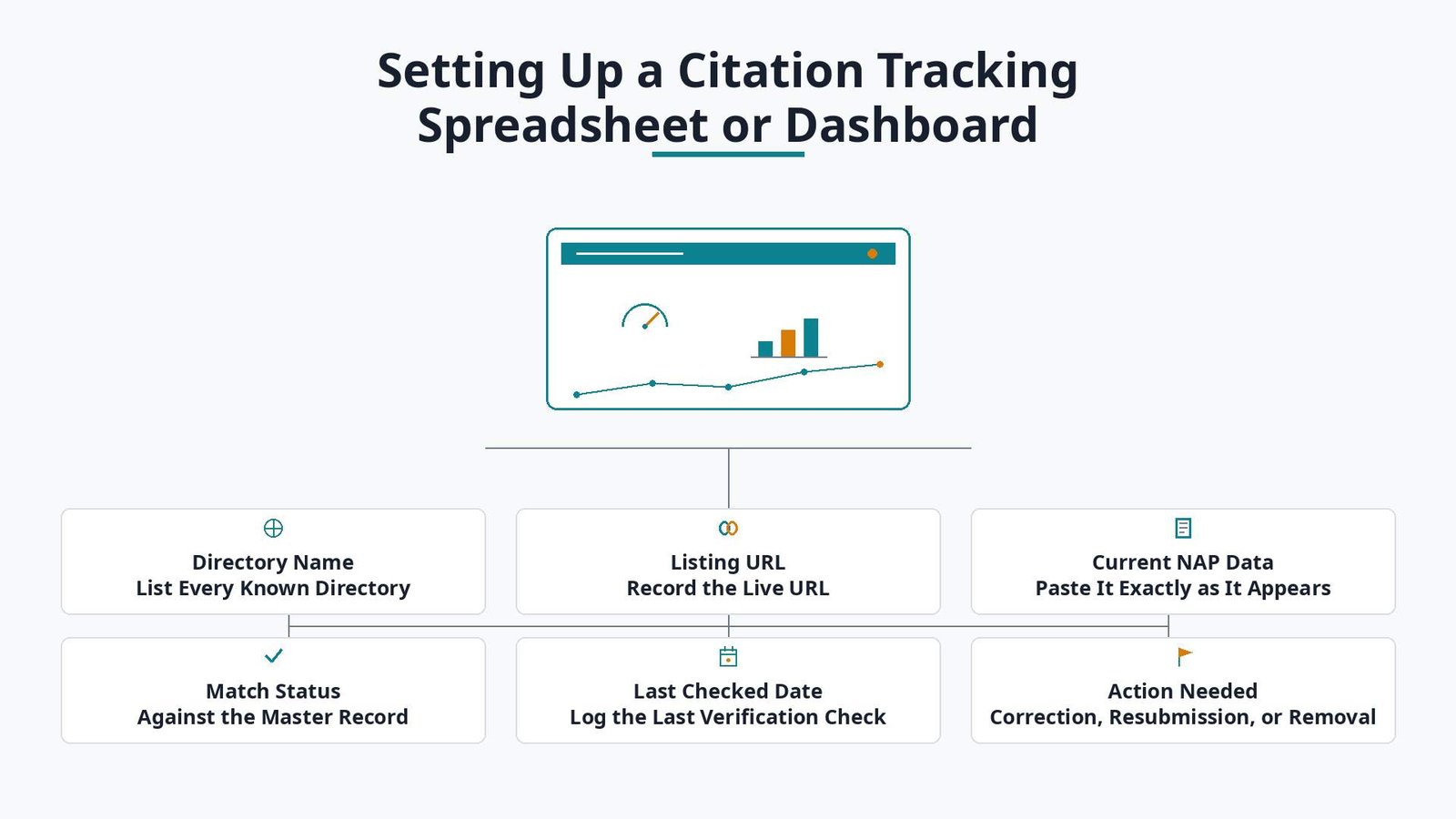
A citation tracking spreadsheet is a structured log recording every known directory listing, its current NAP data, verification status, and last audit date in one central file. I build mine with six columns every time: directory name, listing URL, current NAP data, match status, last checked date, and action needed.
- List every known directory in column one, starting with major aggregators and expanding to niche, industry-specific sites.
- Record the live URL for each listing so re-checking doesn’t require a fresh search each cycle.
- Paste the current NAP data exactly as it appears on each live listing.
- Mark a match or mismatch status against the designated master record.
- Log the date of the last verification check for every row.
- Flag any row needing correction, resubmission, or removal as a clear action item.
This structure turns a one-time audit into a living system anyone on a team can pick up and update on a monthly cycle.
Key Citation Sources to Monitor
Citation sources fall into two categories worth monitoring separately: major data aggregators that feed hundreds of downstream directories, and niche directories specific to an industry or location. Prioritizing aggregators first makes sense because a single correction there can cascade across dozens of smaller sites automatically.
Data Aggregators vs. Niche Directories
Data aggregators like Data Axle, Foursquare, and Neustar Localeze distribute business data to a wide network of secondary directories, apps, and GPS systems from one centralized source. Niche directories serve specific industries or geographies, such as legal directories for law firms or regional chambers of commerce listings, and they rarely pull from aggregator feeds automatically.
I check aggregators quarterly at minimum, since a stale aggregator record keeps re-propagating incorrect data even after individual directory listings get manually fixed.
How to Identify and Fix NAP Inconsistencies
NAP inconsistency fixing is the process of locating every mismatched listing against a master record and submitting corrections through each directory’s claim or edit process. I always start by confirming the master record is actually correct before touching a single listing, since correcting 40 directories toward a wrong baseline wastes the entire exercise.
- Confirm and lock in the master NAP record as the single source of truth.
- Pull a full list of mismatched listings from the audit or tracking spreadsheet.
- Claim unclaimed listings first, since unclaimed profiles are often the most outdated.
- Submit corrections directly through each platform’s business edit interface.
- Re-check corrected listings after 30 days, since directory updates don’t process instantly.
Some corrections take longer than others to propagate, and aggregator-sourced listings are usually the slowest to reflect a fix.
Tracking Citation Velocity and Growth Over Time

Citation velocity measures the rate at which new, accurate citations are added to a business’s online footprint over a given period, typically tracked monthly or quarterly. A business adding 3–5 new, verified citations per month shows healthier growth than one that built 50 citations once and never touched the profile again.
I track velocity on the same spreadsheet used for accuracy, adding a simple running count of newly verified listings each reporting cycle.
Connecting Citation Data to Local Ranking Performance
Citation data correlates with local ranking performance when NAP consistency improvements line up with measurable gains in local pack visibility and map rankings. I pull Google Business Profile insights and local rank tracking data side by side with citation accuracy scores to confirm the relationship isn’t coincidental for a specific account.
Local pack visibility is the frequency with which a business appears in the map-based three-result local search results for its target keywords. A BrightLocal ranking factors study found citation signals continue to influence local pack placement, particularly for businesses competing in categories with high listing saturation.
Correlating Citations with Local Pack Visibility
I build a simple side-by-side timeline: citation accuracy score on one axis, local pack keyword rankings on the other, checked monthly over a 90-day window. This comparison isolates whether citation cleanup work is actually moving the needle or whether other factors are driving ranking changes.
How to Build a Local Citation Report for Clients or Stakeholders
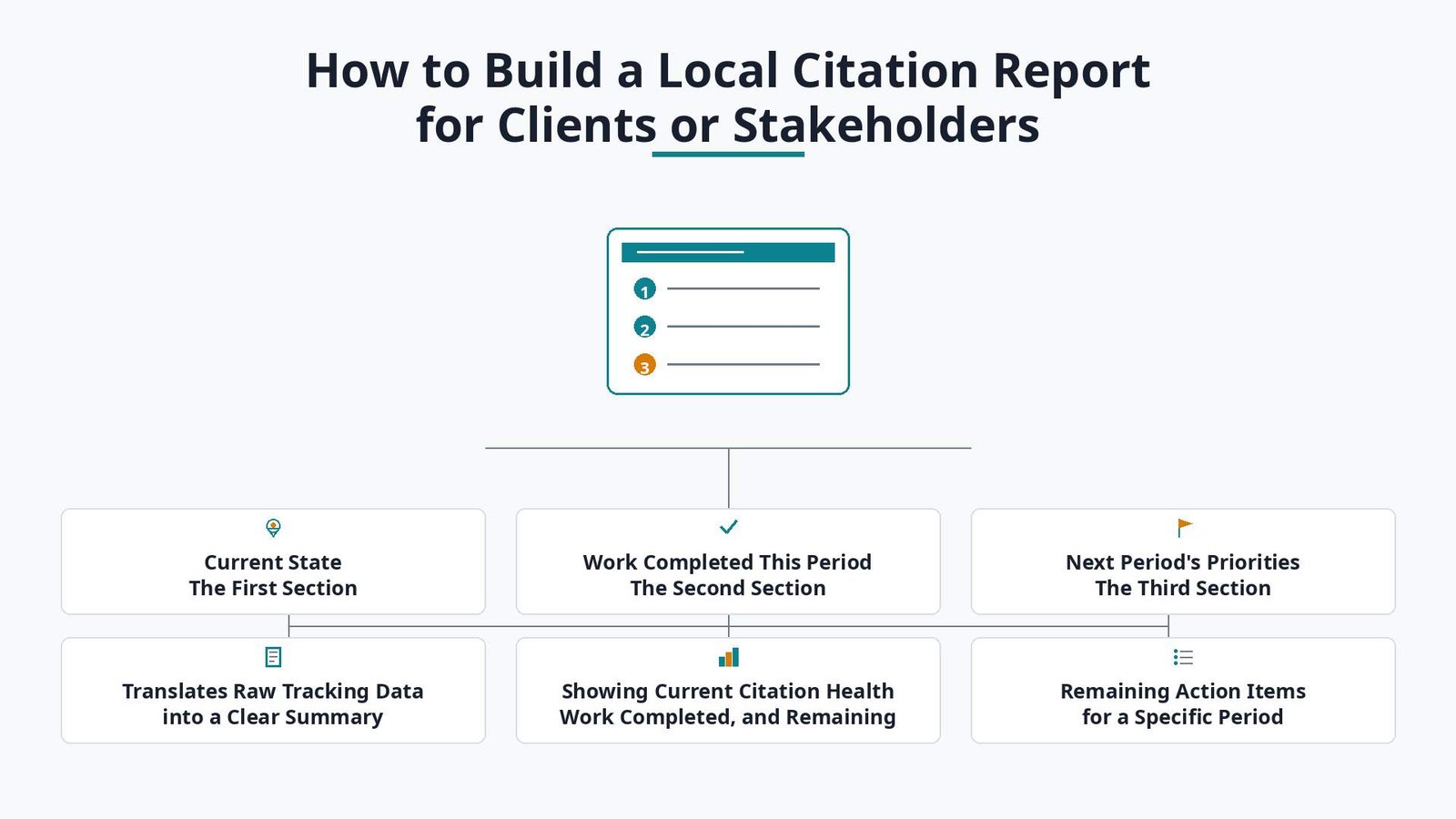
A local citation report translates raw tracking data into a clear summary showing current citation health, work completed, and remaining action items for a specific period. I build every report around three sections: current state, work completed this period, and next period’s priorities.
Essential Report Sections
- Current citation health snapshot: accuracy rate, coverage count, and NAP consistency score as of the report date.
- Corrections completed: a list of specific listings fixed, claimed, or removed during the period.
- New citations built: any new directory submissions completed since the last report.
- Outstanding issues: unresolved mismatches still pending directory processing.
- Ranking correlation summary: a brief note on whether local pack visibility shifted alongside citation changes.
Keeping each section to a few bullet points rather than raw spreadsheet exports makes the report readable for a stakeholder without SEO background.
Reporting Frequency and Cadence Best Practices
Reporting cadence refers to how often a citation report gets delivered to a client or internal stakeholder, with monthly being the most common standard for active accounts. Quarterly reporting works for stable, low-change accounts, while monthly suits businesses actively building out new locations or recovering from a past NAP problem.
| Account Type | Recommended Cadence |
| New account / active cleanup | Monthly |
| Stable, maintained account | Quarterly |
| Multi-location / high-growth | Bi-weekly to monthly |
Common Citation Tracking Mistakes to Avoid
Citation tracking mistakes typically stem from treating the process as a one-time project rather than an ongoing monitoring system. I see the same handful of errors repeatedly across accounts that inherited someone else’s incomplete citation work.
- Fixing listings without first locking in a verified master NAP record.
- Ignoring data aggregators and only correcting individual directories by hand.
- Skipping re-verification after submitting a correction, assuming it processed instantly.
- Tracking accuracy but never tracking coverage or velocity alongside it.
- Reporting raw spreadsheet data to clients instead of a readable summary.
Duplicate Citation Detection and Suppression

Duplicate citation detection is the process of identifying multiple listings for the same business location that compete against each other for the same search signals. Duplicates commonly form when a business moves locations, changes names, or gets re-added to a directory by a different employee or previous owner.
Suppression means formally merging or removing the duplicate listing so only one authoritative version remains active in the directory’s index. I prioritize duplicate suppression on Google Business Profile first, since competing duplicate listings there directly split local pack ranking signals.
Citation Tracking for Multi-Location Businesses
Multi-location citation tracking requires a separate master NAP record and tracking row for every individual business location rather than one combined record. Each location needs its own unique phone number or extension where possible, since shared numbers across locations create ambiguity that aggregators sometimes resolve incorrectly.
I build one master tracking sheet with a location-filterable view so a 10-location business can review all locations together or drill into one at a time without maintaining 10 separate files.
How Citation Tracking Fits into a Broader Local SEO Strategy

Citation tracking is one component of local SEO, working alongside Google Business Profile optimization, review management, and local content to build overall map and organic visibility. Citations alone rarely move rankings dramatically, but a broken citation profile caps the ceiling every other local SEO effort can reach.
I treat citation health as a foundation layer. The kind of work that doesn’t generate exciting month-over-month charts but prevents the rest of the strategy from underperforming due to a fixable technical gap.
Conclusion
Tracking citations means watching accuracy, coverage, and consistency together, not any single metric in isolation. Reporting turns that raw data into decisions stakeholders can act on with confidence.
Citation health supports the broader local SEO picture, working alongside rankings, reviews, and content to build lasting visibility. Strong tracking habits compound over time into fewer fires and steadier growth.
We help businesses build and maintain clean, trackable citation profiles as part of full-service local SEO. Reach out to White Label SEO Service to get your citation strategy under control.
Frequently Asked Questions
What is a local citation in SEO?
A local citation is any online mention of a business’s name, address, and phone number, whether or not a link is included. Citations appear on directories, apps, and platforms search engines use to verify business legitimacy.
How often should I check my business citations?
Monthly checks work best for active accounts, while quarterly suits stable, already-cleaned profiles. Multi-location or recently moved businesses should check more frequently until data stabilizes.
What is a good NAP consistency score?
A NAP consistency score of 95% or higher is considered healthy across most industries. Scores below 80% usually indicate an unresolved root cause, like an old address still propagating.
Can incorrect citations hurt my local rankings?
Yes, inconsistent NAP data confuses search engines and can split ranking signals across duplicate listings. This often shows up as suppressed local pack visibility compared to competitors with cleaner profiles.
What’s the difference between a citation audit and citation tracking?
A citation audit is a one-time review identifying current inaccuracies and duplicates. Citation tracking is the ongoing system that monitors accuracy, coverage, and velocity over time.
Do I need paid tools to track citations?
No, manual tracking with a spreadsheet works for small, single-location businesses. Paid tools become more cost-effective once a business crosses roughly 50 citations or manages multiple locations.
How long does it take to fix citation inconsistencies?
Most individual directory corrections process within 2 to 8 weeks, depending on the platform. Aggregator-sourced listings typically take the longest to fully propagate corrections.


