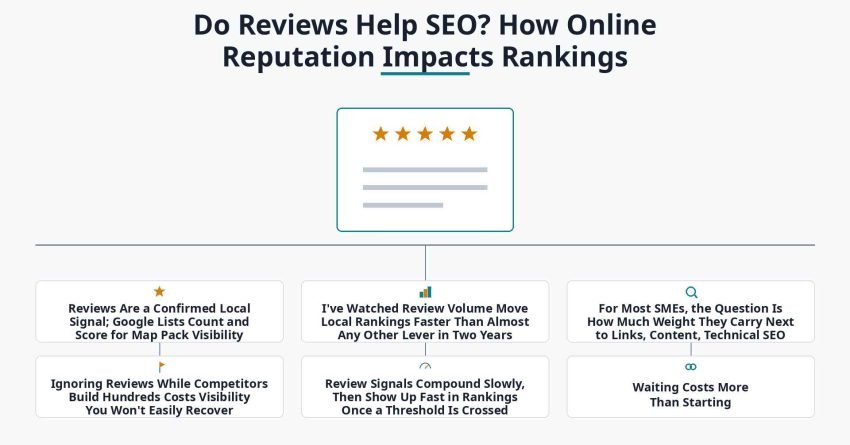
Online reviews are a confirmed local search ranking signal, and Google’s own local ranking documentation lists review count and score among the factors that influence map pack visibility. I’ve watched review volume move local rankings faster than almost any other lever in the last two years. For most SMEs reading this, the real question isn’t whether reviews matter. It’s how much weight they carry next to links, content, and technical SEO, and how to act on that.
Ignoring reviews while competitors build hundreds costs visibility you won’t easily recover. Review signals compound slowly, then show up fast in rankings once a threshold is crossed. Waiting costs more than starting.
This guide covers whether reviews genuinely move rankings and by how much, the specific signals Google’s algorithm evaluates inside reviews, how review content and responses build semantic and trust value, the real risk of fake or negative reviews, and how to measure impact against a realistic timeline.
Do Reviews Actually Affect Google Rankings?
Yes, reviews affect Google rankings, primarily through local search and indirectly through trust signals that influence organic visibility. Google has confirmed that review count and review score are two of the signals factored into local pack rankings, alongside relevance and distance. I treat reviews as a trust multiplier rather than a direct ranking factor for organic (non-local) results.
What Google Says About Reviews as a Ranking Factor
Google’s local ranking guidance is explicit: prominence, relevance, and distance determine map pack order, and prominence folds in review quantity and review score directly. A business is a local entity that accumulates reviews as a trust and prominence signal over time.
For organic (non-map) rankings, reviews work differently. They don’t appear in the core algorithm documentation the way backlinks or content relevance do, but they correlate strongly with click-through rate, dwell time, and branded search volume, all signals that feed back into how Google perceives a site’s authority.
I’ve seen businesses jump into the local 3-pack within weeks of a genuine review surge, while organic rankings moved more gradually as trust signals accumulated. Both effects are real, but they operate on different timelines and through different mechanisms, which is exactly what the next few sections unpack.
How Online Reviews Influence Local SEO and Map Pack Rankings
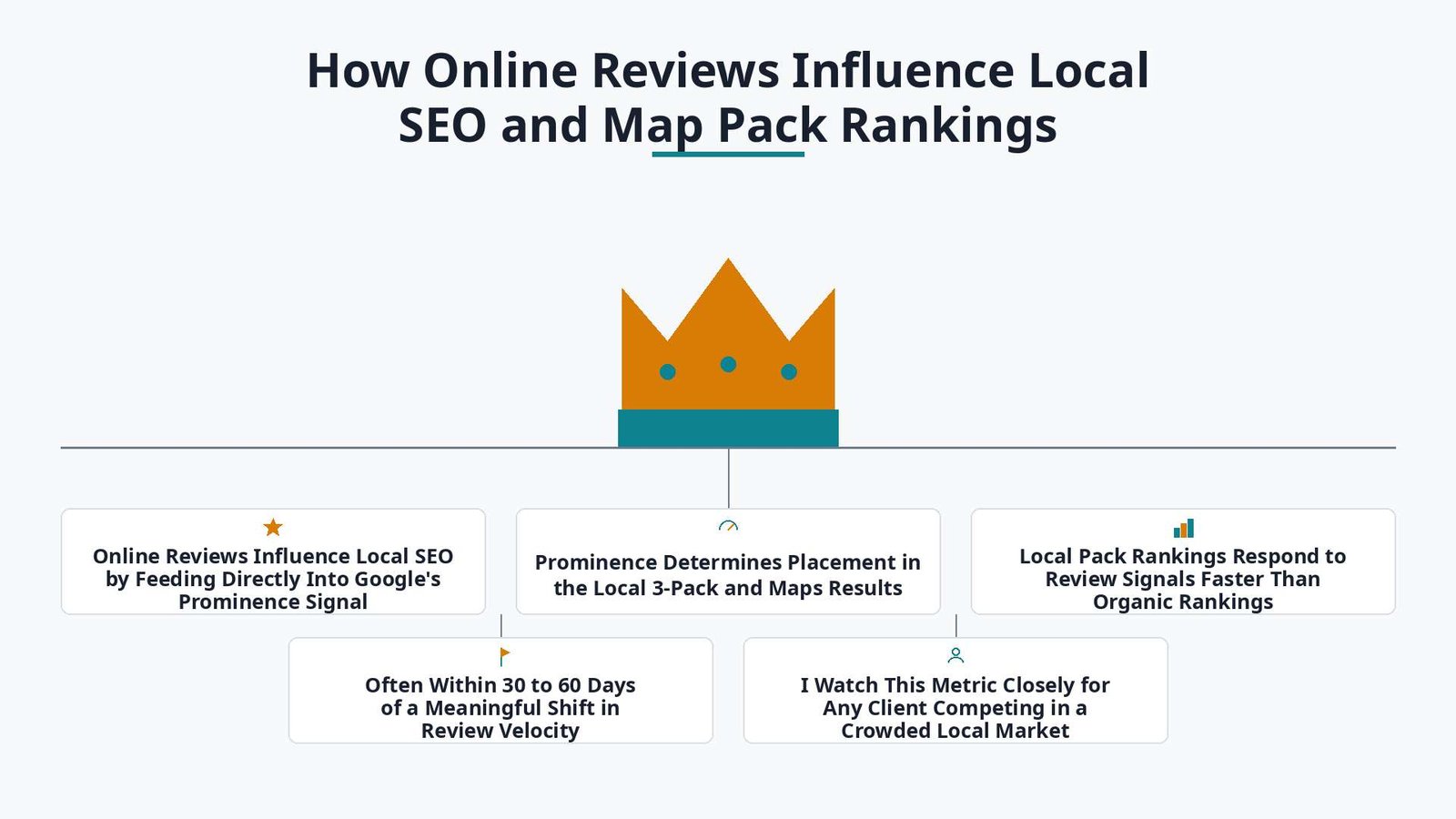
Online reviews influence local SEO by feeding directly into Google’s prominence signal, which determines placement in the local 3-pack and Maps results. Local pack rankings respond to review signals faster than organic rankings do, often within 30 to 60 days of a meaningful shift in review velocity. I watch this metric closely for any client competing in a crowded local market.
Review Signals Inside Google’s Local Algorithm
Local pack algorithm is a ranking system that weighs proximity, relevance, and prominence to decide which three businesses appear above the fold. Reviews sit inside the prominence component, and a business with 150 reviews at 4.6 stars consistently outranks a competitor with 20 reviews at 4.9 stars in head-to-head local searches.
This happens because volume signals real-world popularity and ongoing customer engagement, not just quality. BrightLocal’s 2024 Local Consumer Review Survey found that 98% of consumers read online reviews for local businesses, which tells Google that review pages carry genuine user engagement value worth rewarding.
Businesses chasing local visibility often over-focus on star rating and under-focus on volume and recency. Both matter, and the next section breaks down exactly which signals carry the most weight.
The Key Review Signals Google’s Algorithm Evaluates
Google’s algorithm evaluates four primary review signals: quantity, velocity, diversity, and recency, each contributing differently to prominence. I rank velocity as the most underrated of the four because it signals an actively growing, currently relevant business rather than one that peaked years ago.
Review Quantity, Velocity, Diversity, and Recency
Review velocity is the rate at which new reviews accumulate over a given period, and a steady stream of five reviews per month outperforms a single burst of fifty reviews that then goes silent. Google treats sudden spikes with more scrutiny, since unnatural patterns resemble manipulation.
Here’s how the four signals typically break down by impact:
| Signal | What It Measures | Relative Impact on Local Prominence |
| Quantity | Total review count | High |
| Velocity | Rate of new reviews over time | High |
| Diversity | Spread across review platforms | Medium |
| Recency | How recent the most recent reviews are | Medium-High |
Diversity matters because a business with reviews concentrated only on Google, while ignoring Yelp, Facebook, and industry-specific platforms, signals a narrower footprint than one with a presence across multiple trusted sources. I’ll come back to platform diversity in more detail further down.
Quantity alone doesn’t tell the whole story, which brings up the next common question: does star rating by itself move the needle?
Does Star Rating Alone Impact Search Visibility?
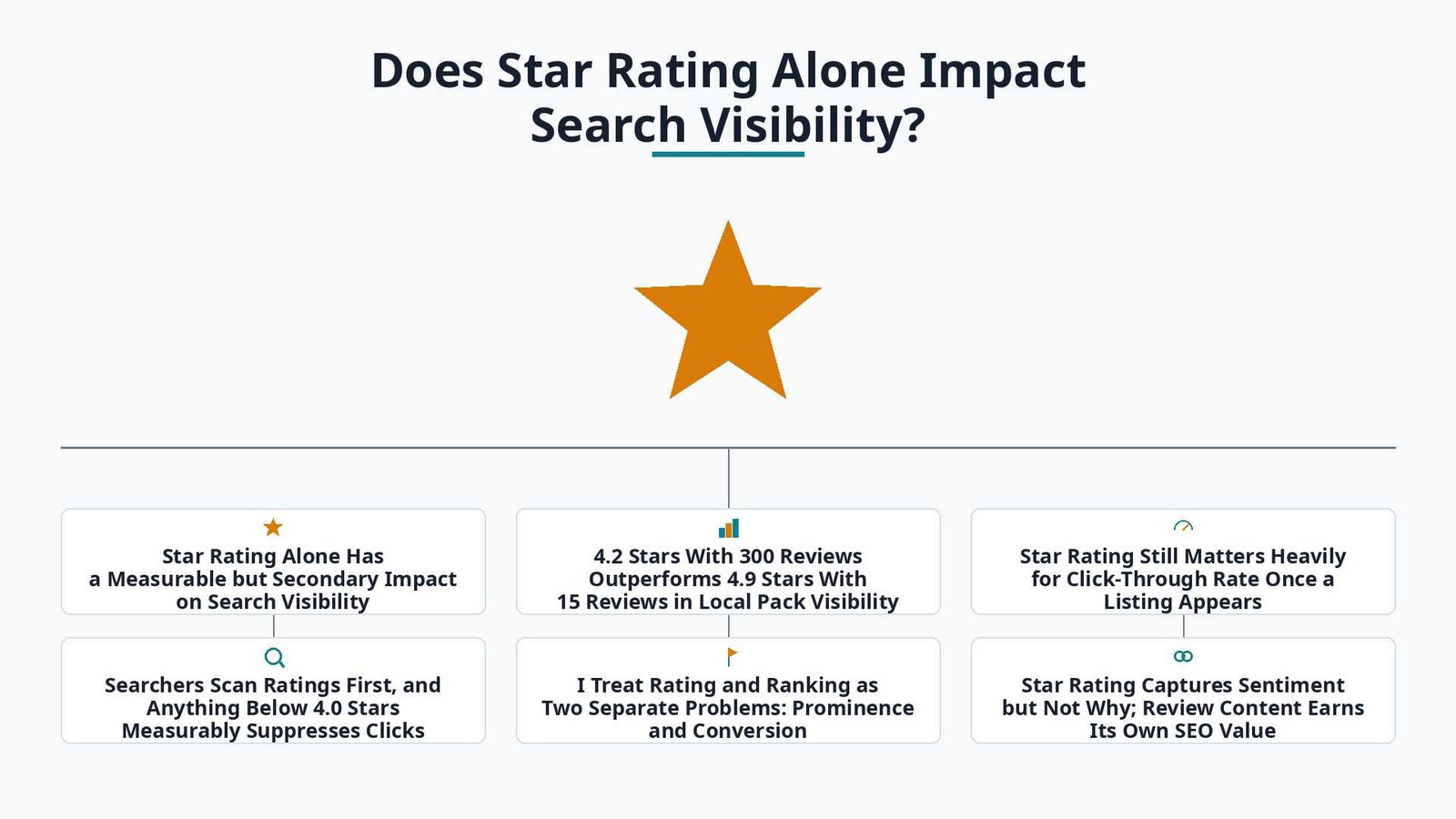
Star rating alone has a measurable but secondary impact on search visibility compared to review volume and velocity. A 4.2-star average with 300 reviews typically outperforms a 4.9-star average with 15 reviews in local pack visibility, because volume signals scale and trust at a level a handful of five-star reviews can’t replicate.
Star rating still matters heavily for click-through rate once a listing appears. Searchers scan ratings first, and anything below 4.0 stars measurably suppresses clicks even when the ranking position stays the same. I treat rating and ranking as two separate problems: one is about algorithmic prominence, the other is about conversion once you’re visible.
Star rating captures sentiment, but it says nothing about why customers feel that way, and that’s where review content earns its own SEO value.
How Review Content and Keywords Create Semantic SEO Value
Review content creates semantic SEO value when customers naturally mention services, locations, and attributes that reinforce a business’s topical relevance. A plumbing company whose reviews repeatedly mention “emergency pipe repair” and specific neighborhood names builds semantic association Google can match against those exact queries.
This works because user-generated content carries authenticity signals that business-written copy can’t replicate. Google’s review guidelines prohibit incentivizing specific keyword mentions, but naturally encouraging detailed feedback produces the same semantic enrichment without violating policy.
Review text acts as a continuous, free source of long-tail keyword variation that evolves with customer language. The next layer of value comes from how a business engages with that content, not just how it’s written.
Why Responding to Reviews Matters for SEO and Trust
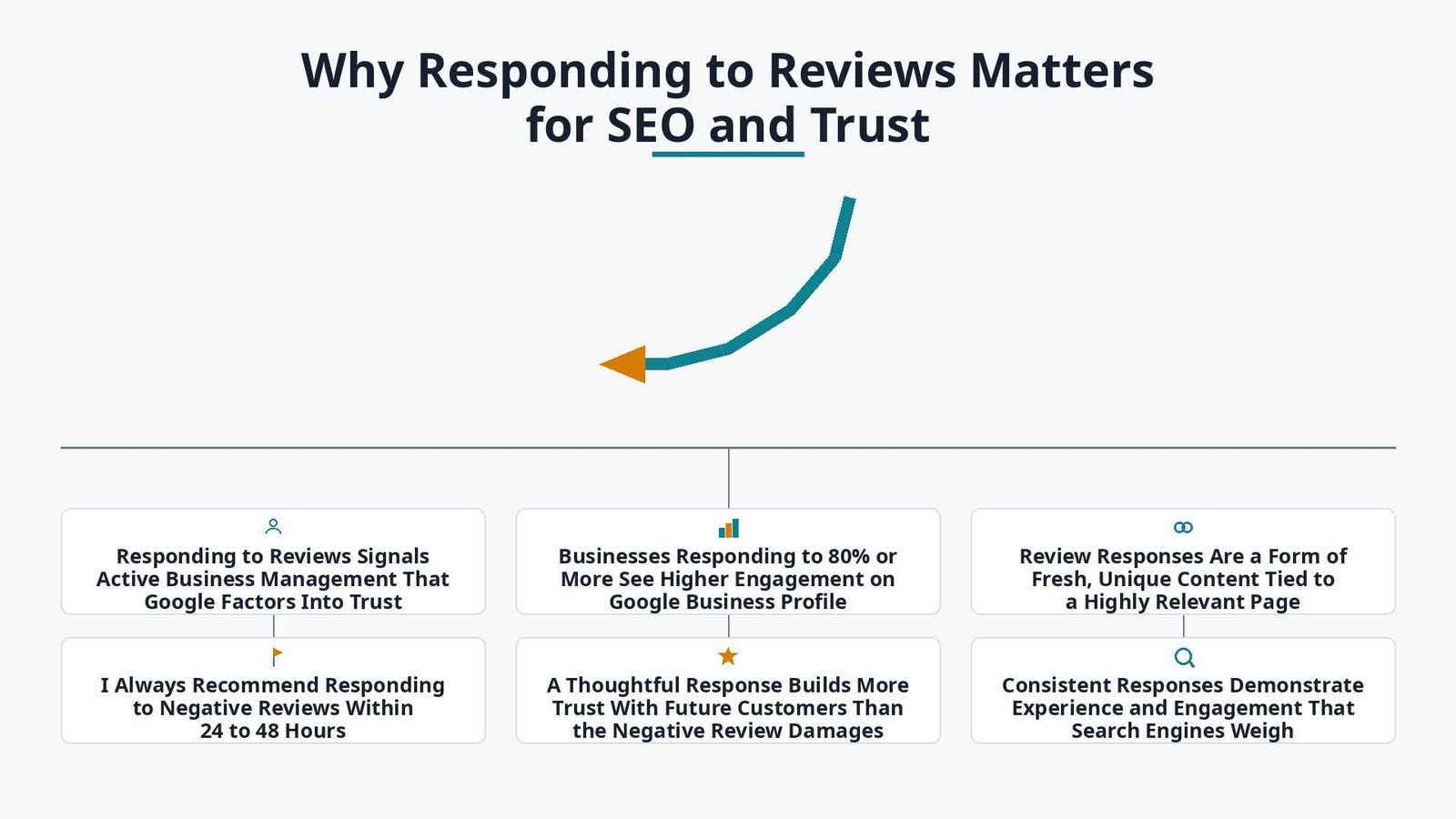
Responding to reviews matters for SEO because it signals active business management, which Google factors into local search trust assessments. Businesses that respond to 80% or more of their reviews see measurably higher engagement rates on their Google Business Profile listings.
Review responses are a form of fresh, unique content tied to a highly relevant page. I always recommend responding to negative reviews within 24 to 48 hours, since a thoughtful, professional response often does more to build trust with future customers than the negative review damages it.
Consistent responses also demonstrate the kind of experience and ongoing engagement that search engines increasingly weigh under broader trust frameworks, which is where reviews intersect with a much bigger ranking concept.
How Reviews Strengthen E-E-A-T and Google’s Trust Signals
Reviews strengthen E-E-A-T by providing third-party evidence of a business’s real-world experience and trustworthiness that Google can’t get from on-site content alone. E-E-A-T is a quality framework that stands for Experience, Expertise, Authoritativeness, and Trustworthiness, and reviews feed directly into the trust and experience components since they come from actual customers, not the business itself.
Reviews as Experience and Trustworthiness Evidence
Third-party validation carries more weight than self-reported claims because it can’t be fully controlled by the business being evaluated. A landscaping company that writes “we’re the most trusted team in town” makes a claim; 200 reviews describing specific, positive experiences prove it.
Google’s Search Quality Rater Guidelines explicitly reference reputation research as part of evaluating page and site quality, and reviews are one of the clearest reputation signals available publicly. This connects reviews to a much broader quality assessment than local pack rankings alone.
E-E-A-T is a framework, not a single metric, which naturally raises the comparison question against the other major trust signal in SEO: backlinks.
Reviews vs. Backlinks: Which Carries More SEO Weight?
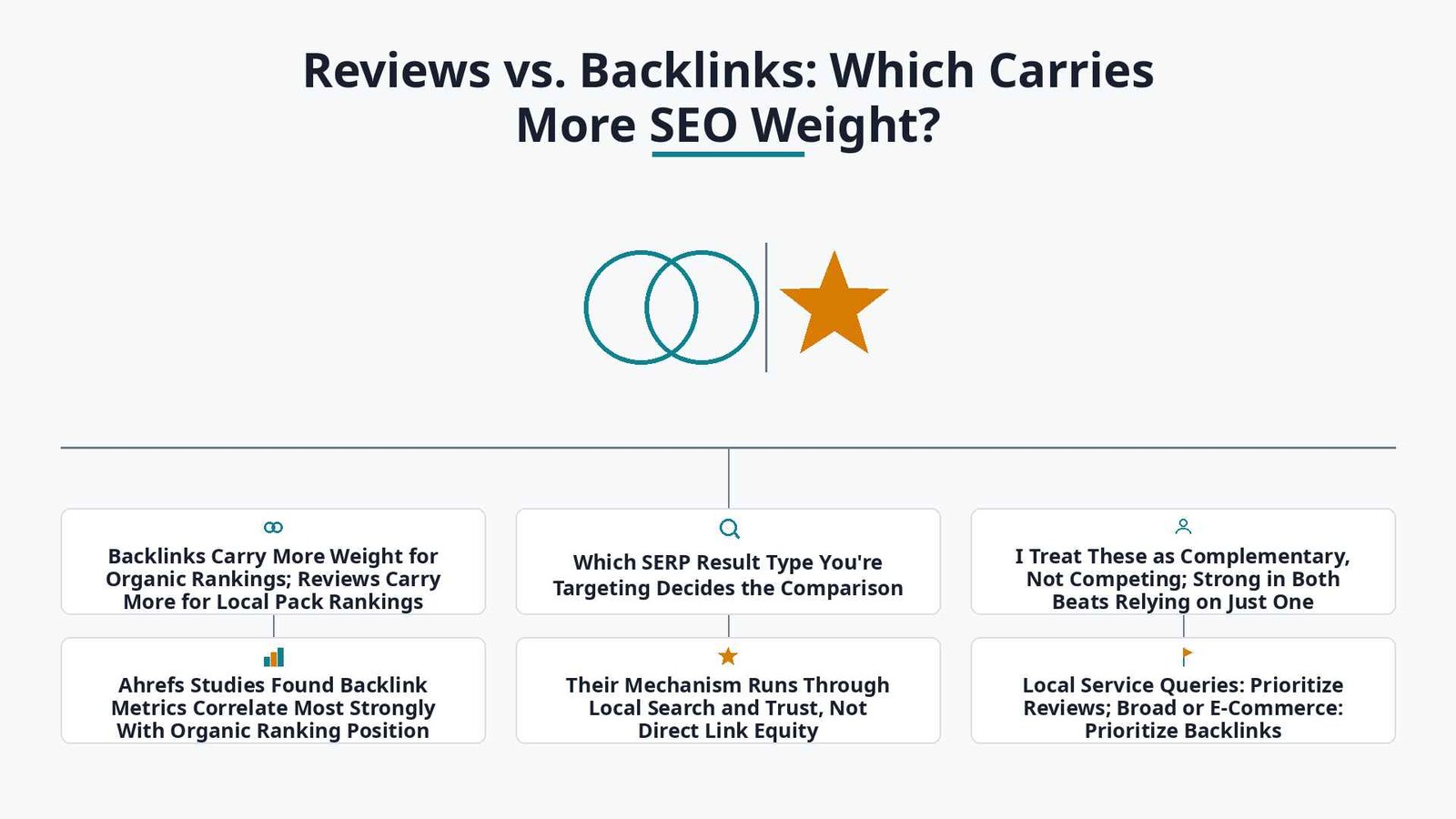
Backlinks generally carry more weight for organic rankings, while reviews carry more weight for local pack rankings, making the comparison dependent on which SERP result type you’re targeting. I treat these as complementary signals rather than competing ones, since a site strong in both consistently outperforms a site relying on just one.
Ahrefs’ large-scale ranking factor studies have repeatedly found backlink metrics correlate more strongly with organic ranking position than any single on-page or off-page signal measured. Reviews don’t appear in that same organic correlation data because their primary mechanism runs through local search and trust, not direct link equity.
A business targeting local service queries should prioritize reviews first; a business targeting broad informational or e-commerce queries should prioritize authoritative backlinks first. Review influence doesn’t stop at Google, though. Other platforms matter too.
Do Reviews on Yelp, Facebook, and Industry Sites Help SEO Too?
Reviews on Yelp, Facebook, and industry-specific platforms help SEO indirectly by building a diversified reputation footprint and generating additional branded search signals. Multi-platform review presence is a reputation signal that spans beyond a single source, which search engines increasingly reference when assessing overall business legitimacy.
A restaurant with strong reviews only on Google but none on Yelp or TripAdvisor looks incomplete compared to a competitor with a consistent 4.5-star reputation across five platforms. Diversified reviews also generate additional indexed pages that can rank independently for branded and “[business] reviews” queries, capturing additional search real estate.
Platform diversity builds the reputation; structured data helps search engines actually understand and display it.
How Review Schema Markup Improves Search Visibility
Review schema markup improves search visibility by enabling star ratings to display directly in search results, which increases click-through rate even without a ranking change. Review schema is structured data added to a webpage that tells search engines specifically where review and rating information lives on that page.
Google’s structured data guidelines require review schema to reflect genuine, verifiable reviews, and misuse can trigger manual penalties. A properly marked-up product or service page can display a star rating snippet directly in the search result, often lifting click-through rate by a noticeable margin compared to an unmarked listing in the same position.
Schema displays the reviews you already have; growing that review base in the first place is the next practical step.
Proven Strategies to Generate More Customer Reviews
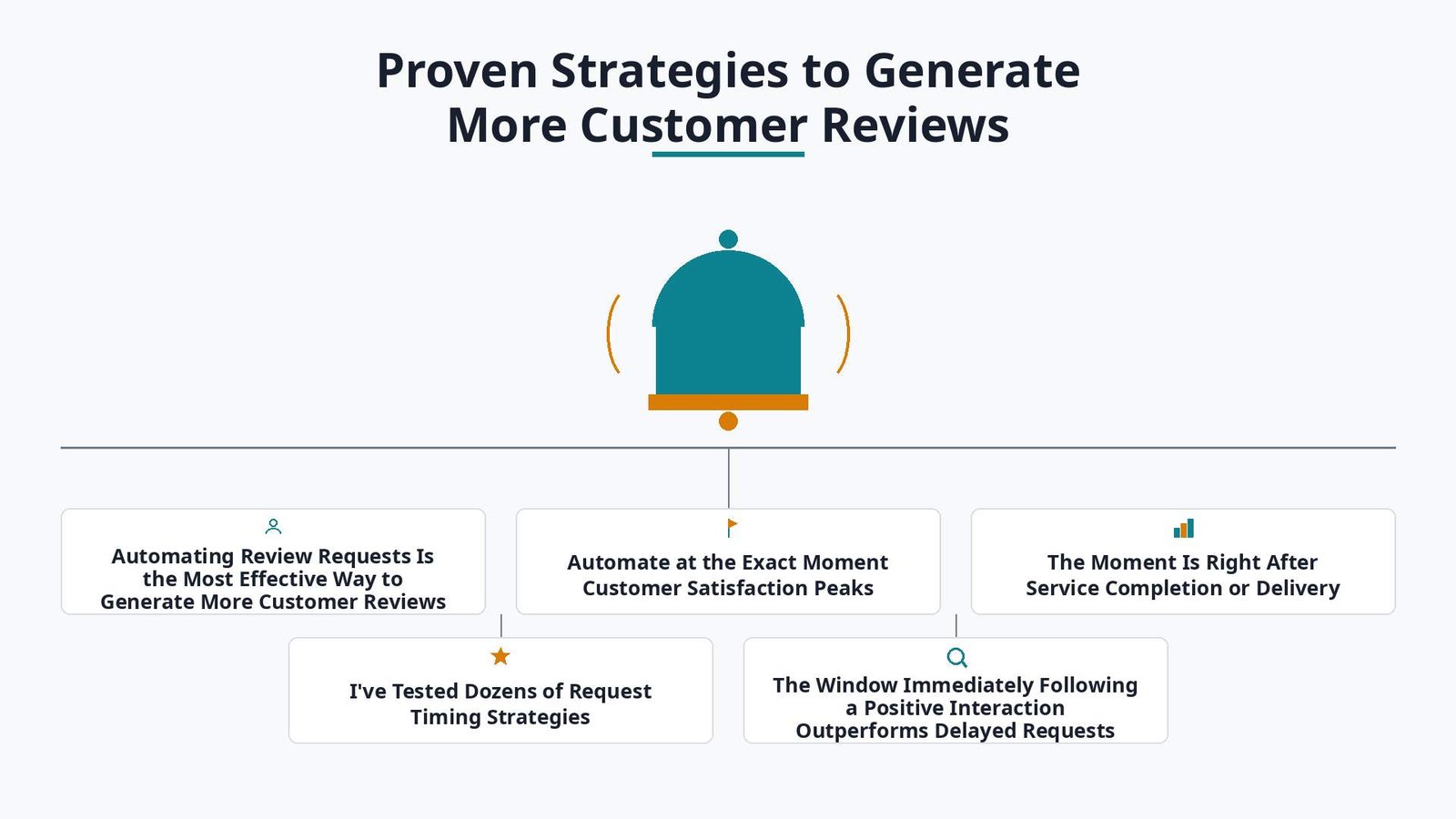
The most effective way to generate more customer reviews is automating review requests at the exact moment customer satisfaction peaks, typically right after service completion or delivery. I’ve tested dozens of request timing strategies, and the window immediately following a positive interaction consistently outperforms delayed requests sent days later.
Timing, Automation, and Request Channels That Work
Here’s the sequence that produces the most consistent review volume:
- Identify the peak satisfaction moment (service completion, delivery confirmation, successful support resolution)
- Send an automated request within 1 to 24 hours of that moment
- Use the channel the customer already engaged through (SMS for service businesses, email for e-commerce)
- Include a direct, one-click link to the review platform
- Follow up once, no more than 7 days later, for non-responders
- Segment requests by satisfaction score where possible, routing lower scores to private feedback first
- Monitor response rate monthly and adjust timing or channel accordingly
BrightLocal’s research found that 76% of consumers say they’re willing to leave a review when asked directly, which makes the ask itself the single highest-leverage action in this entire process. Growing volume is only half the picture. Handling what comes with that growth, including the negative side, matters just as much.
How Fake Reviews and Negative Reviews Affect Rankings
Fake reviews can trigger ranking penalties and listing suspensions, while genuine negative reviews rarely hurt rankings directly but can suppress click-through rate. Google actively detects unnatural review patterns, including sudden spikes, repeated phrasing across reviews, and reviews from accounts with no other activity history.
Fake review schemes are detectable patterns that violate Google’s policies and risk the entire Business Profile, not just individual listings. I’ve seen businesses lose their entire local visibility overnight after a bulk fake-review purchase triggered a profile suspension, erasing years of legitimate review equity in the process.
Genuine negative reviews behave completely differently. A 2-star review mixed into an otherwise strong profile rarely moves rankings on its own, but a pattern of unaddressed complaints compounds into reputation damage that eventually does affect visibility and conversion.
How to Handle and Recover From Reputation Damage
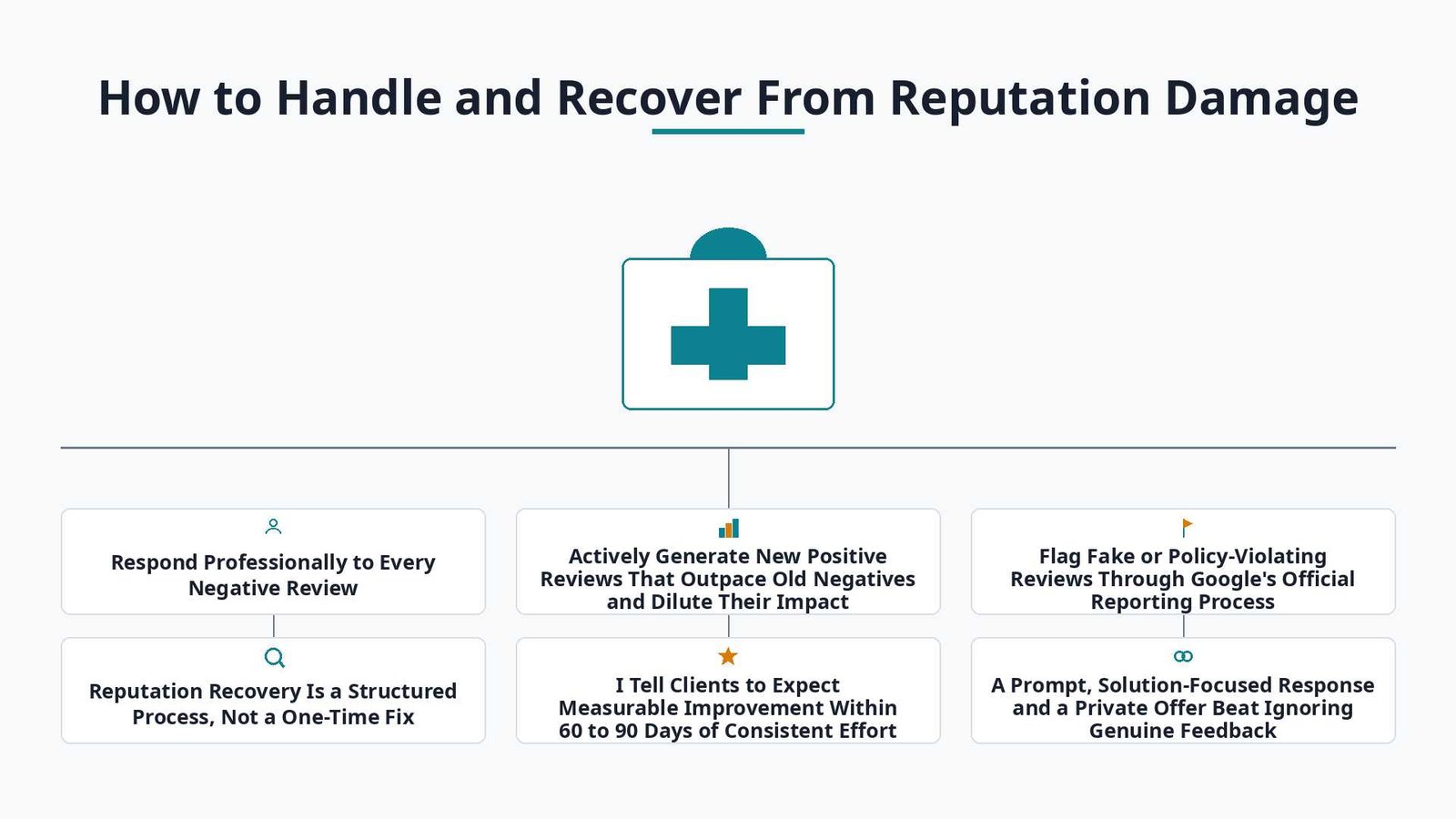
Recovering from reputation damage requires responding professionally to every negative review, actively generating new positive reviews, and flagging any reviews that violate platform policies. Reputation recovery is a structured process, not a one-time fix, and I tell clients to expect measurable improvement within 60 to 90 days of consistent effort.
Flagging fake or policy-violating reviews through Google’s official reporting process is the first step when damage comes from illegitimate sources. For genuine negative feedback, a prompt, solution-focused public response paired with an offer to resolve the issue privately does more for prospective customers than ignoring it ever will.
Outpacing old negative reviews with a steady stream of new positive ones dilutes their visual and statistical impact on the overall average. Once a recovery plan is in motion, the next step is proving it’s actually working.
How to Measure the SEO Impact of Your Review Strategy
Measuring the SEO impact of a review strategy means tracking local pack ranking position, Google Business Profile insights, and organic branded search volume before and after review initiatives. I set a baseline across these three metrics before launching any review campaign, then re-measure at 30, 60, and 90 days.
Google Business Profile Insights is a free reporting dashboard that shows how customers find and interact with a listing, including search queries and direct view counts. Pairing that data with Google Search Console branded query tracking shows whether review growth correlates with increased branded search interest, a strong indirect trust signal.
Local pack position tracking, done weekly for target keywords, is the clearest direct measurement since review signals feed that algorithm most heavily. With a measurement framework in place, the last practical question is how long all of this actually takes.
Realistic Timeline: How Long Until Reviews Impact Rankings?
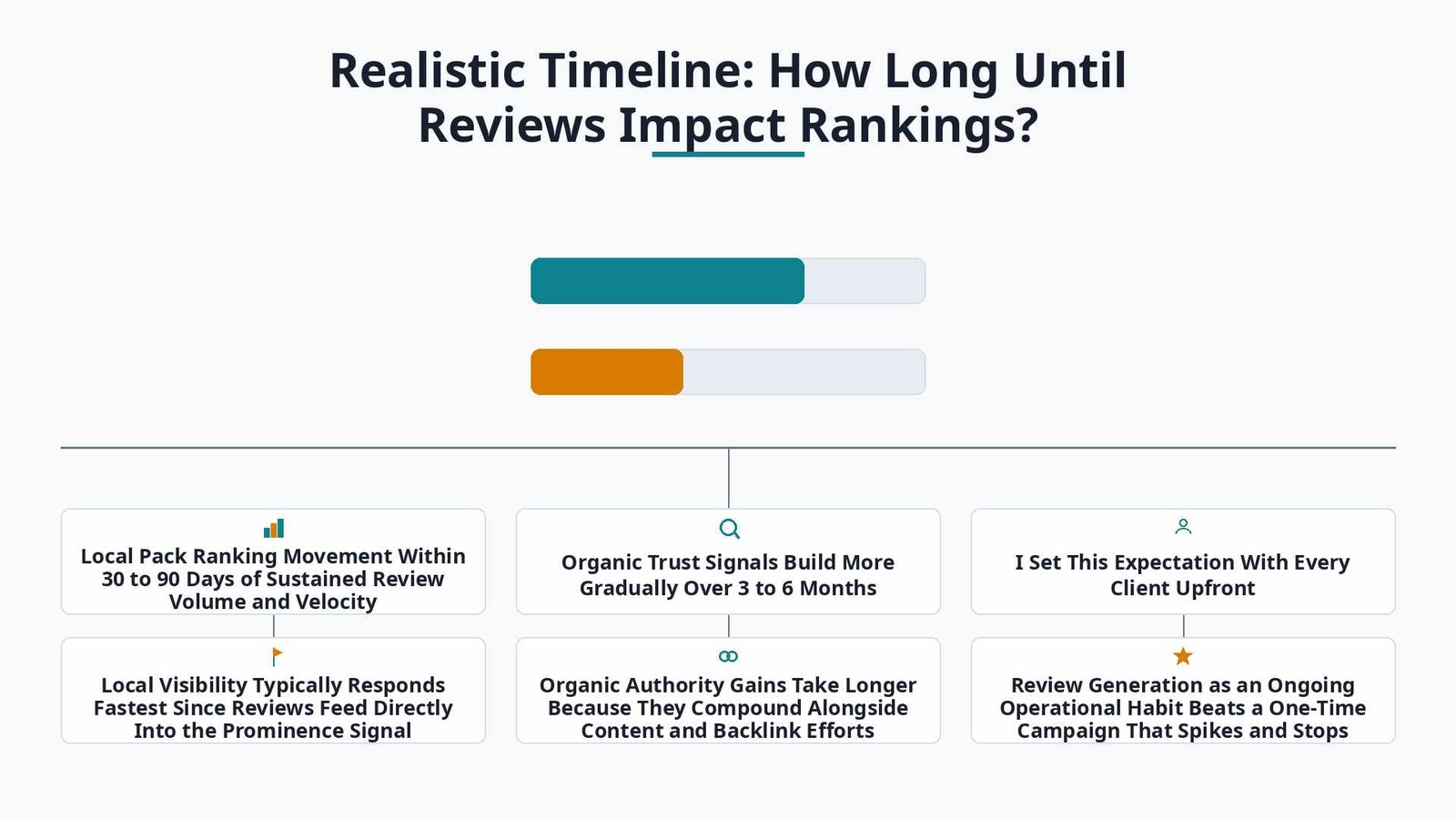
Most businesses see local pack ranking movement within 30 to 90 days of a sustained increase in review volume and velocity, while organic trust signals build more gradually over 3 to 6 months. I set this expectation with every client upfront, because review-driven SEO rewards consistency far more than short bursts of activity.
Local visibility typically responds fastest since reviews feed directly into the prominence signal. Organic authority gains, tied to branded search growth and broader trust signals, take longer because they compound alongside content and backlink efforts rather than acting alone.
Businesses that treat review generation as an ongoing operational habit, not a one-time campaign, consistently outperform those that spike activity once and stop.
Conclusion
Reviews function as a genuine ranking signal, weighted most heavily in local search, while reinforcing the broader trust signals organic rankings depend on. Volume, velocity, content, and response all compound together over time.
Review strategy works best as one piece of a complete search visibility plan, alongside technical SEO, content, and authority building across your full topic cluster.
We build review generation into every SEO strategy we run, and White Label SEO Service can show you exactly where your reputation stands today.
Frequently Asked Questions
Do more reviews really improve Google rankings?
Yes, more reviews improve local pack rankings because review count feeds directly into Google’s prominence signal. The effect is strongest for local search, not broad organic rankings.
How many reviews do I need to see an SEO impact?
Most businesses notice local ranking movement once they cross 20 to 50 reviews with consistent velocity. Quality and response rate matter alongside raw volume.
Does responding to every review help SEO?
Yes, responding to reviews signals active business management, which supports local trust scoring. Aim to respond to at least 80% of reviews within 48 hours.
Can negative reviews hurt my search rankings?
A single negative review rarely hurts rankings directly, but a pattern of unaddressed complaints damages click-through rate. Over time, that pattern can suppress visibility.
Do reviews matter more than backlinks for local SEO?
Reviews matter more for local pack rankings, while backlinks matter more for broad organic rankings. Both signals work best when developed together.
How long does it take for reviews to affect rankings?
Local ranking movement typically appears within 30 to 90 days of sustained review growth. Organic trust benefits build more gradually over 3 to 6 months.
Should I use review schema markup on my website?
Yes, review schema markup can display star ratings directly in search results, increasing click-through rate. It must reflect genuine, verifiable reviews to comply with Google’s policies.