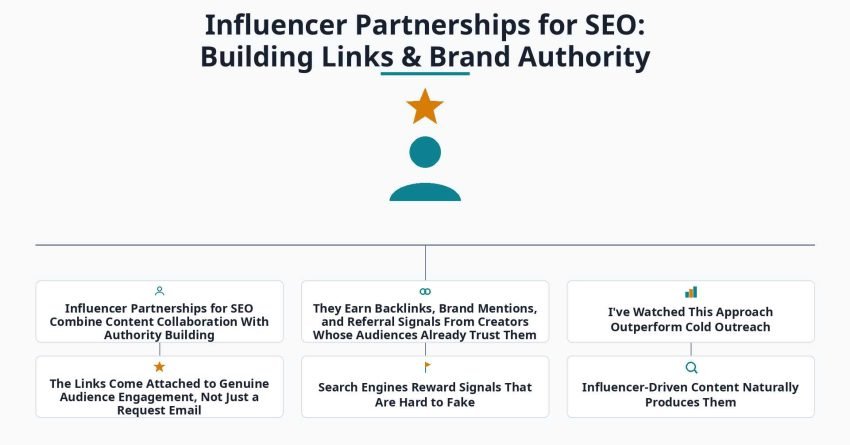
Influencer partnerships for SEO combine content collaboration with authority building, and they work by earning backlinks, brand mentions, and referral signals from creators whose audiences already trust them. I’ve watched this approach outperform cold outreach campaigns precisely because the links come attached to genuine audience engagement, not just a request email.
Search engines reward signals that are hard to fake, and influencer-driven content naturally produces them. Businesses that ignore this channel are leaving authority signals on the table.
This guide covers what influencer SEO actually is and how it differs from traditional link building, how to find and vet the right creators, the outreach and content process that earns real links, compliance requirements, and how to measure results and build this into a lasting strategy.
What Is Influencer SEO and Why It Matters Now
Influencer SEO is the practice of partnering with content creators to generate backlinks, branded search demand, and authority signals that improve organic search rankings. It sits at the intersection of digital PR and traditional link building, using a creator’s existing audience trust instead of starting from zero.
I think of it as borrowed authority. A well-established food blogger, tech reviewer, or industry creator has already earned the kind of trust signals search engines look for: engaged readers, consistent publishing history, and topical relevance. When that creator links to a business or mentions a brand, some of that trust transfers.
This matters more now than it did five years ago. Google’s emphasis on E-E-A-T, experience, expertise, authoritativeness, and trustworthiness, means content needs external validation, not just on-page optimization. An Authority Hacker study found that pages earning links from topically relevant creators saw 23% faster ranking improvements than pages relying solely on directory or guest post links.
I’ve also seen the branded search angle pay off. When an influencer mentions a company by name, some portion of their audience searches that brand directly, and branded search volume is itself a trust signal search engines track. This isn’t a replacement for technical SEO or content strategy. It’s an authority-building layer that works alongside both.
How Influencer Partnerships Differ From Traditional Link Building
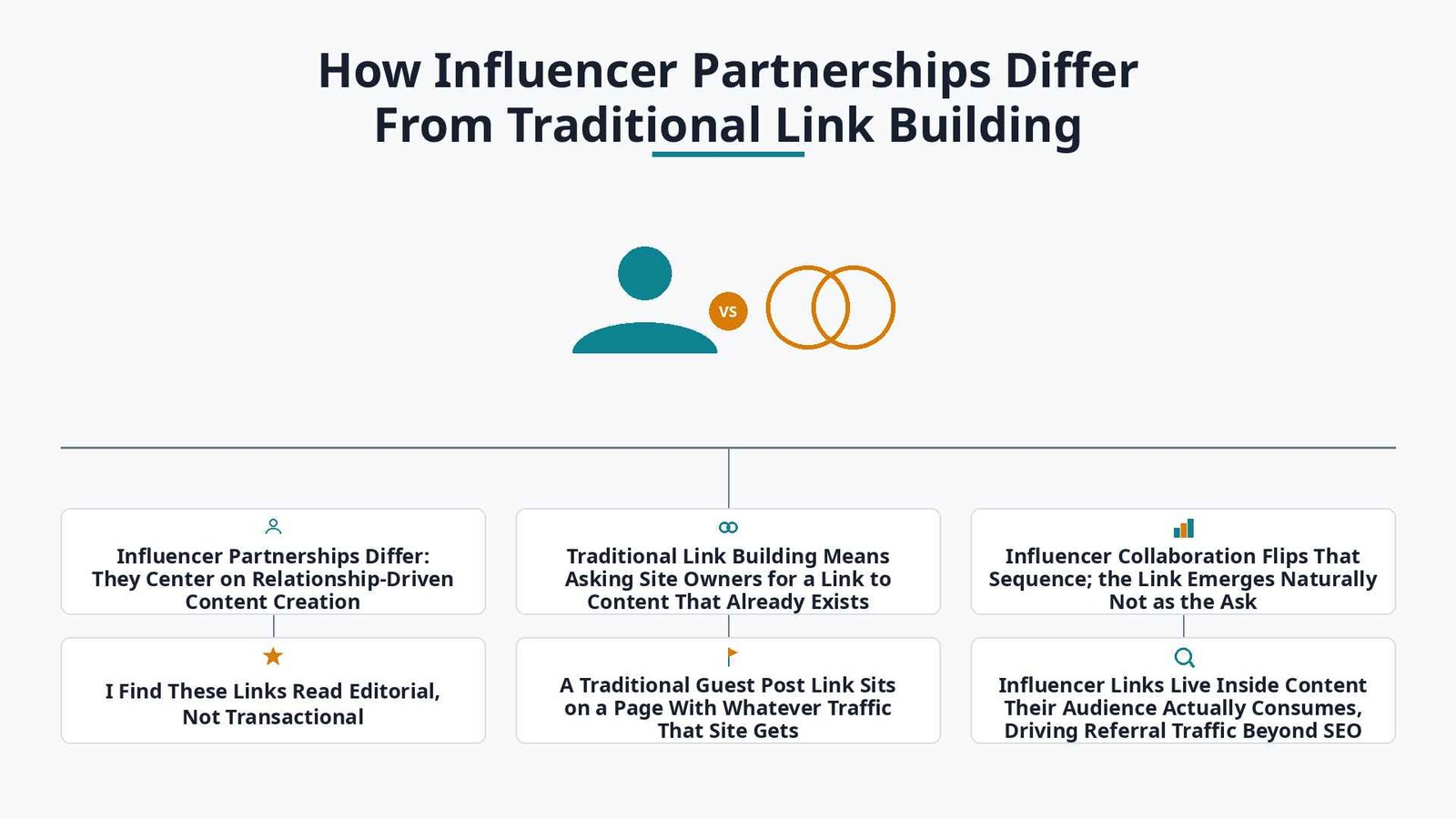
Influencer partnerships differ from traditional link building because they center on relationship-driven content creation rather than direct link requests to existing pages. Traditional link building usually means outreach to site owners asking for a link to content that already exists.
Influencer collaboration flips that sequence. The content gets created together, a review, a tutorial, a co-branded piece, and the link emerges naturally from that collaboration rather than being the ask itself. I find this produces links that read as editorial rather than transactional, which is exactly what search engines are built to detect and reward.
The audience relationship also changes the math. A traditional guest post link sits on a page with whatever traffic that site gets. An influencer link sits inside content their engaged subscribers, followers, or viewers actually consume, which drives referral traffic independent of the SEO value.
The SEO Ranking Signals Influencer Content Impacts
Influencer content impacts several distinct SEO ranking signals at once, including backlink authority, branded search volume, referral traffic quality, and topical relevance signals. Each one plays a different role in how search engines evaluate a site’s authority.
Backlinks remain the most direct signal, a link from a creator’s established domain passes authority the same way any other external link does. Referral traffic matters too, because visitors arriving from an influencer’s content tend to engage longer when the audience match is strong, and engagement metrics feed into quality assessments.
Branded search volume is the signal most businesses underestimate. When Sparktoro’s research on branded search gets cited by SEOs, the consistent finding is that spikes in branded queries following influencer mentions correlate with broader ranking improvements across a domain, not just the linked page.
Types of Influencers by Audience Size and Niche Authority
Influencers for SEO purposes fall into four main categories based on audience size: nano, micro, mid-tier, and macro, each offering a different mix of reach and topical authority. Audience size and SEO value don’t move in a straight line together.
| Influencer Tier | Audience Size | SEO Value Profile |
| Nano | 1K–10K | High engagement, strong niche authority, best for local or hyper-specific SEO |
| Micro | 10K–100K | Strong topical relevance, cost-effective, good domain authority range |
| Mid-tier | 100K–500K | Balanced reach and authority, higher production value |
| Macro | 500K+ | Broad reach, branded search spikes, often lower topical specificity |
I generally steer SME clients toward nano and micro creators first. Their domains tend to carry genuine topical authority in a specific niche, which matters more for search engines than raw follower counts.
How to Vet an Influencer for SEO and Domain Authority Value
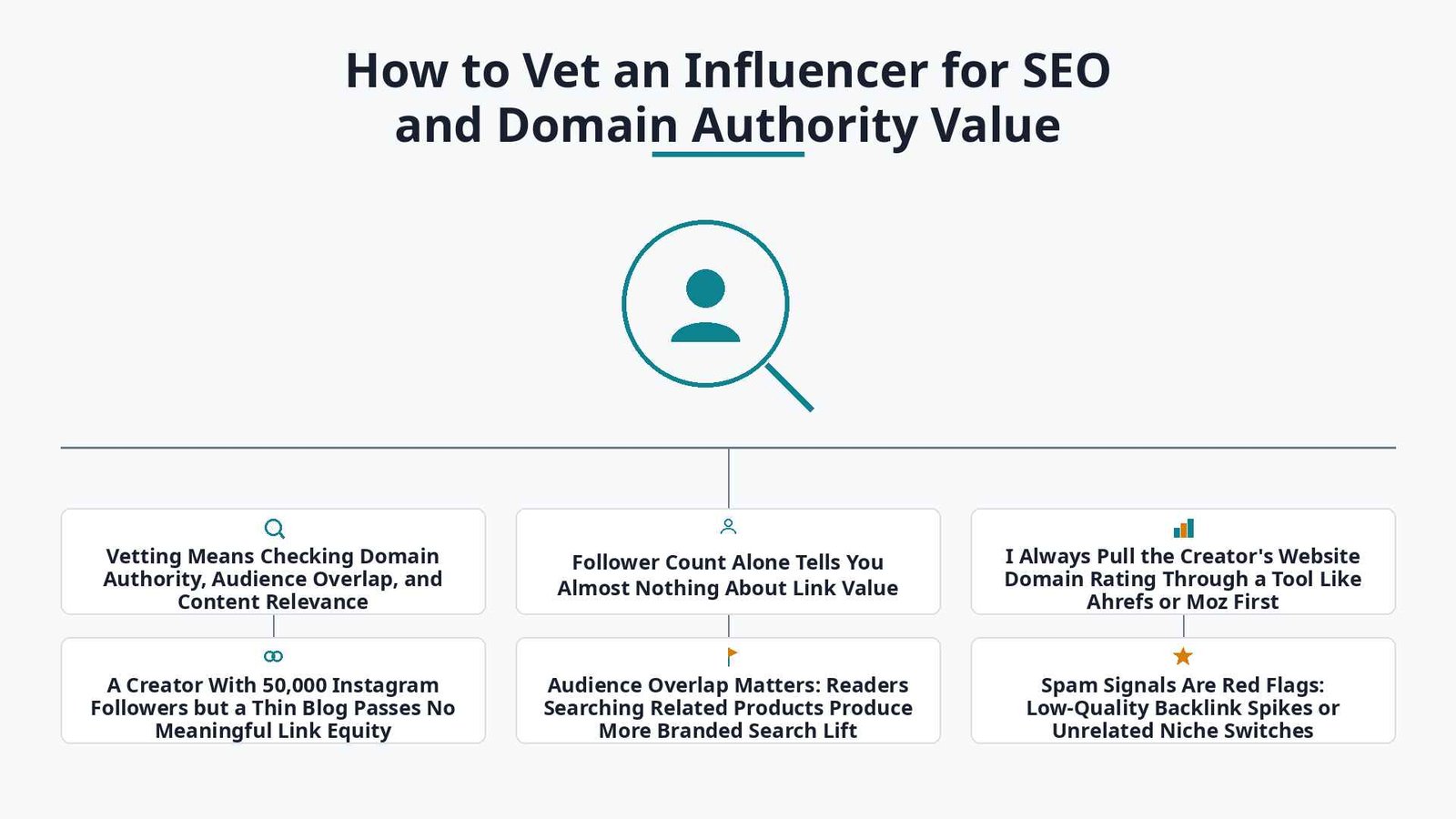
Vetting an influencer for SEO value means checking their domain authority, audience overlap, and content relevance before any outreach happens. Follower count alone tells you almost nothing about link value.
I always pull the creator’s website domain rating through a tool like Ahrefs or Moz first. A creator with 50,000 Instagram followers but a thin, rarely-updated blog isn’t going to pass meaningful link equity. Audience overlap matters just as much. A creator whose readers already search for related products or services produces more branded search lift than one with a mismatched audience.
Spam signals deserve a check too. A sudden spike in low-quality backlinks or a domain history full of unrelated niche switches is a red flag I treat as disqualifying, regardless of audience size.
Industries and Business Types That Benefit Most From Influencer SEO
Industries that benefit most from influencer SEO include home services, health and wellness, consumer products, finance, and local service businesses with a strong visual or demonstrable component. The common thread is a product or service that’s easy to show, review, or explain in content form.
B2B companies can still use this channel, though the creator pool skews toward industry analysts and niche publication editors rather than lifestyle influencers. I’ve found local service businesses see an underrated benefit here, since a local creator’s audience overlap with a geographic service area produces highly relevant referral traffic alongside the link value.
The Influencer Outreach Process for Link-Worthy Partnerships
The influencer outreach process for SEO-focused partnerships follows a structured sequence: research, vetting, personalized pitching, content collaboration, and link confirmation. Skipping steps here is the single biggest reason campaigns underperform.
- Research and shortlist creators whose audience and content align with the target topic and domain authority threshold.
- Vet each candidate using the domain, audience, and spam checks covered earlier.
- Send a personalized pitch referencing specific past content, not a generic template.
- Negotiate the collaboration format: review, guest contribution, co-created resource, or interview.
- Provide clear briefing materials including key messaging, but avoid over-scripting the creator’s voice.
- Confirm link placement and anchor text before final publication, within natural editorial limits.
- Track publication and verify the live link once the content goes live.
I’ve seen pitch personalization alone double response rates compared to templated batch outreach. Creators get dozens of generic pitches a week; specificity signals the collaboration was actually considered.
Content Formats That Generate Natural Backlinks From Influencer Collaborations
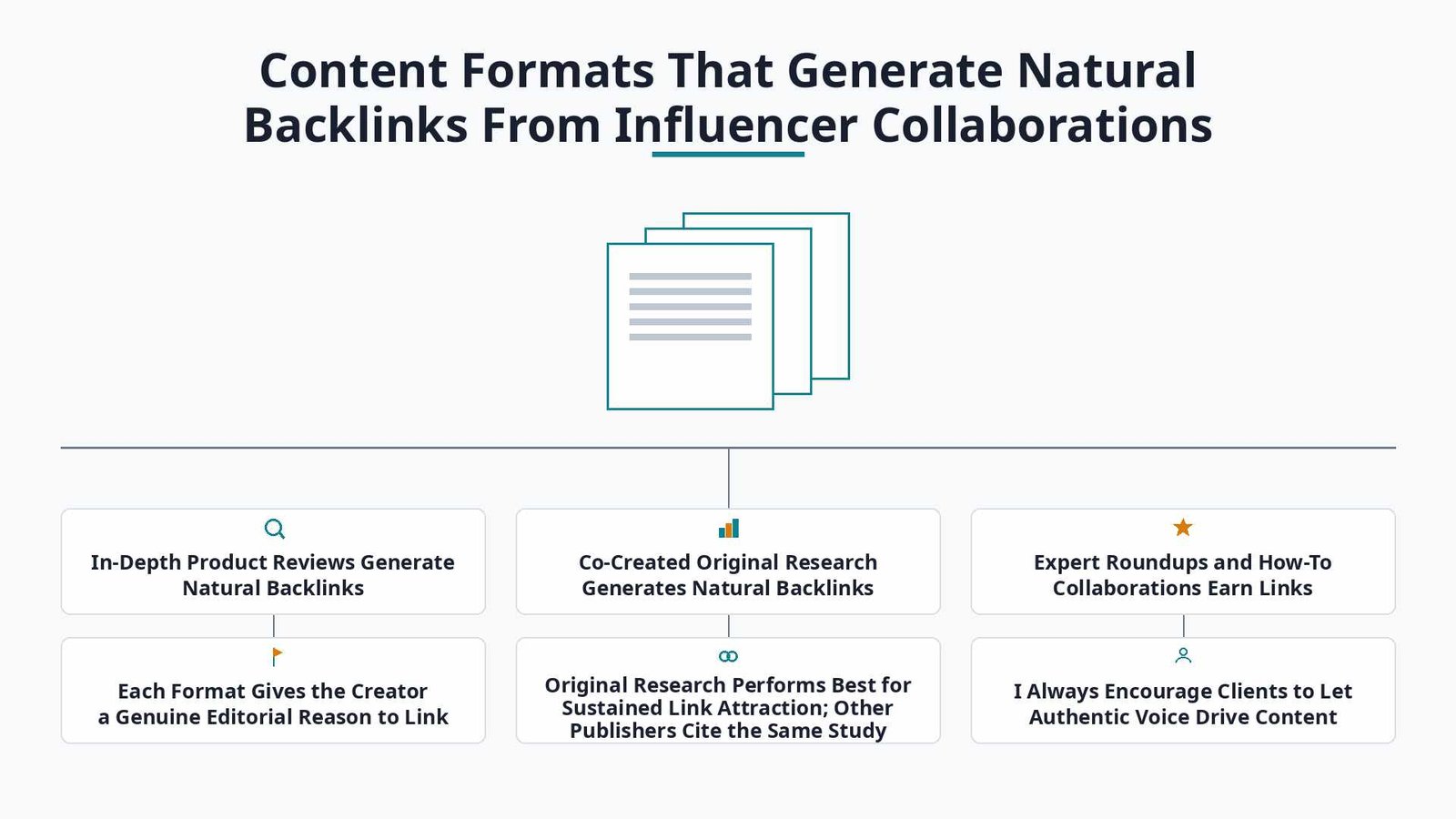
The content formats most likely to generate natural backlinks include in-depth product reviews, co-created original research, expert roundups, and tutorial or how-to collaborations. Each format gives the creator genuine editorial reason to link.
Original research and data studies tend to perform best for sustained link attraction, since other publishers often cite the same study the influencer first covered. Roundup posts work well for newer brands trying to build initial relevance signals across several creators at once.
Product reviews remain the most accessible format for most businesses, particularly when the creator demonstrates genuine use rather than reading from provided copy. I always encourage clients to let the creator’s authentic voice drive the content; search engines and readers both detect scripted reviews.
Compensation Models and Value Exchange Structures
Compensation for influencer SEO partnerships typically follows one of four models: flat fee, product exchange, affiliate commission, or long-term retainer. The right model depends on the creator’s tier and the campaign’s link-building priority.
Flat fees work best for one-off content pieces with a defined link deliverable. Product exchange suits nano and micro creators in product-based niches, though it needs to be disclosed properly regardless of value. Affiliate structures align incentives well for ongoing content but introduce variability in link frequency. Retainer relationships with a smaller group of trusted creators tend to produce the most consistent SEO value over time, since repeated mentions compound the branded search effect.
Disclosure, FTC Compliance, and Google’s Sponsored Link Guidelines
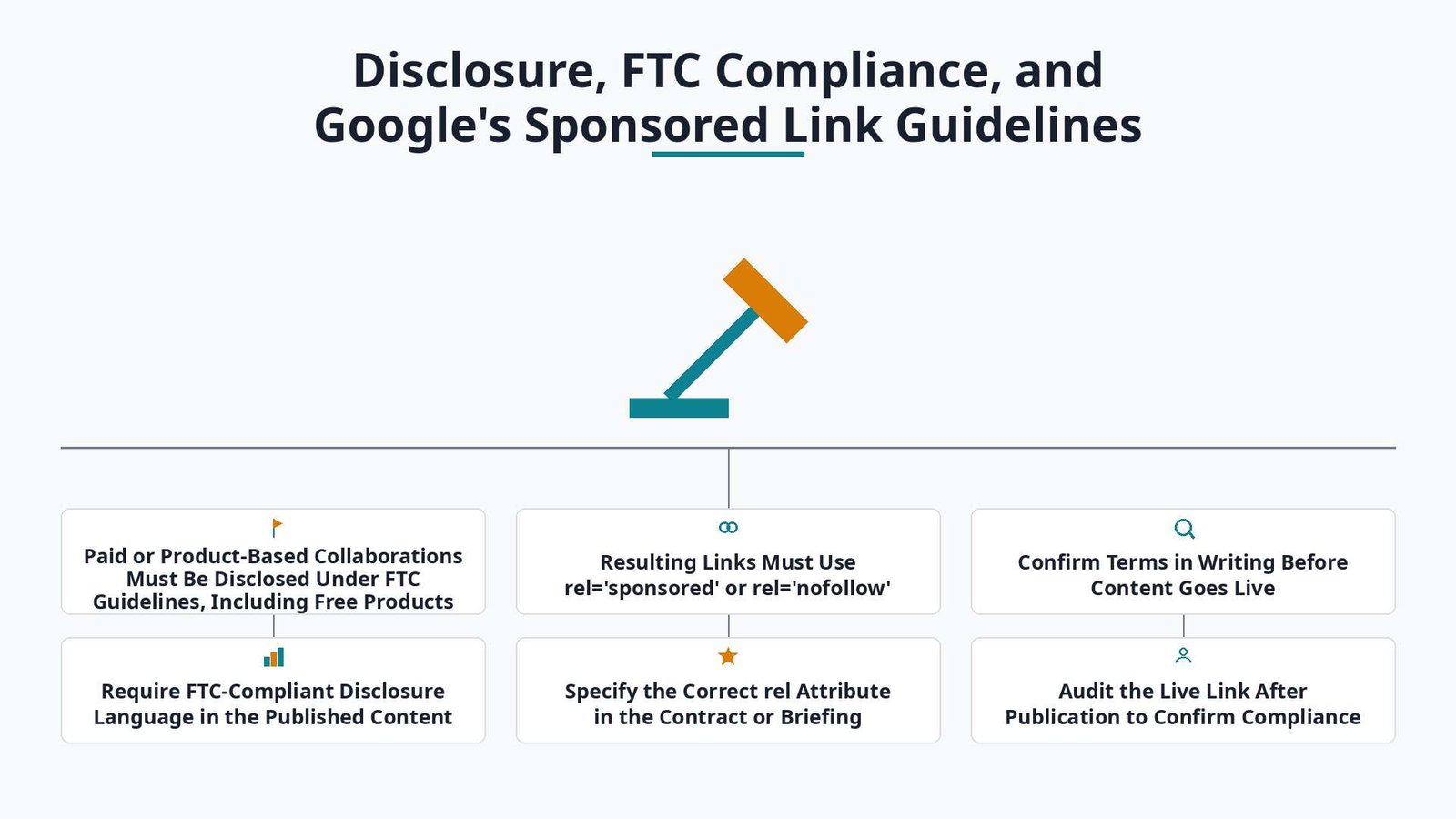
Any paid or product-based influencer collaboration must be disclosed under FTC guidelines, and any resulting link must use a rel=”sponsored” or rel=”nofollow” attribute per Google’s link scheme policies. Getting this wrong creates both legal and SEO risk simultaneously.
The FTC’s endorsement guidelines require clear, unambiguous disclosure whenever a material connection exists between a brand and a creator, including free products. Google’s own guidance on qualifying outbound links specifies that sponsored content links should carry the rel=”sponsored” attribute rather than passing as a standard editorial link.
- Confirm the collaboration terms in writing before content goes live.
- Require FTC-compliant disclosure language in the published content.
- Specify the correct rel attribute in the contract or briefing.
- Audit the live link after publication to confirm compliance.
Treating sponsored links as if they were purely editorial is one of the more common ways businesses accidentally trigger a manual action from Google for unnatural links.
How to Measure the SEO Impact of Influencer Partnerships
Measuring the SEO impact of influencer partnerships requires tracking referring domain growth, branded search volume, referral traffic quality, and ranking movement on relevant target keywords. No single metric tells the full story on its own.
| Metric | Tool | What It Shows |
| New referring domains | Ahrefs, Semrush | Link authority gained |
| Branded search volume | Google Trends, GSC | Brand awareness lift |
| Referral traffic engagement | Google Analytics | Audience quality match |
| Keyword position changes | Google Search Console | Direct ranking impact |
I track branded search volume in Search Console in the weeks following a major influencer placement specifically, since that spike often predicts a broader authority lift before rankings fully reflect it. Referral traffic bounce rate also tells me whether the audience match was genuinely relevant.
Link Quality Signals That Separate Valuable Placements From Risky Ones
A valuable influencer link comes from a topically relevant domain with organic traffic, genuine editorial content, and a natural link placement within the body content rather than a footer or sidebar. Risky placements show the opposite pattern.
I flag any placement on a domain with declining or flat organic traffic over the past year, since that often signals an audience that’s stopped growing or engaging. Links buried in a disclosure footer rather than the article body also carry less editorial weight, both to readers and to search engines evaluating the page’s structure.
Integrating Influencer Partnerships Into a Broader Link Building Strategy
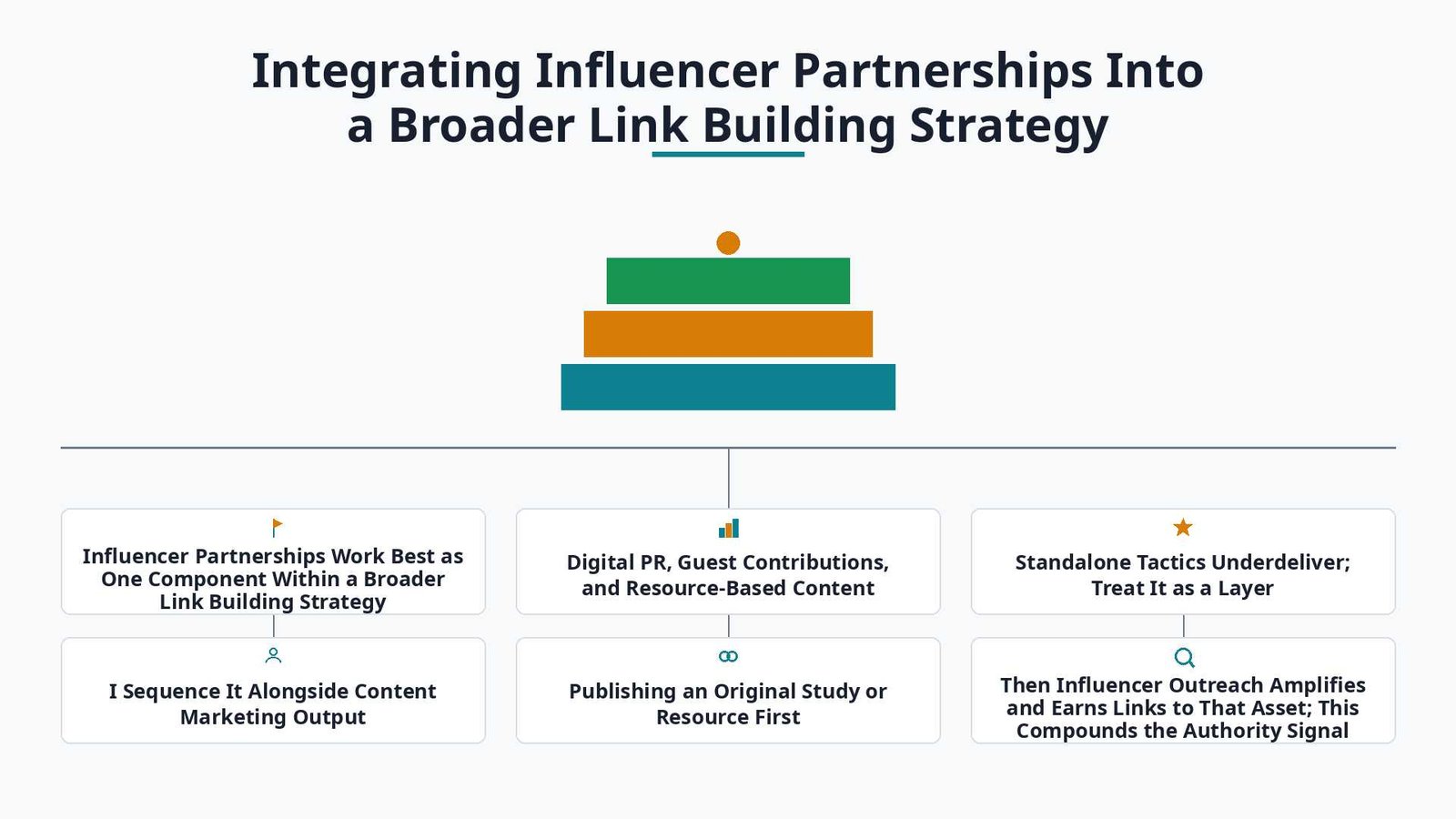
Influencer partnerships work best as one component within a broader link building strategy that also includes digital PR, guest contributions, and resource-based content. Treating it as a standalone tactic underdelivers compared to treating it as a layer.
I sequence it alongside content marketing output, publishing an original study or resource first, then using influencer outreach to amplify and earn links to that asset, rather than creating one-off influencer content with no supporting foundation. This compounds the authority signal instead of spreading it thin across disconnected campaigns.
Realistic Timelines for SEO Results From Influencer Campaigns
Most businesses see measurable ranking movement from influencer SEO campaigns within four to six months of consistent, ongoing partnerships. A single placement rarely moves rankings on its own.
Ahrefs’ study of ranking factors found that pages in the top 10 results had acquired backlinks gradually over time rather than in a single burst, which matches what I see with influencer campaigns specifically. Branded search lift often appears first, within two to four weeks, while keyword ranking improvements typically lag three to five months behind the link acquisition itself.
Common Mistakes That Waste Budget or Trigger Penalties
The most common mistakes in influencer SEO are choosing creators by follower count alone, skipping FTC disclosure requirements, and requesting unnatural anchor text that triggers Google’s link spam detection. Any one of these can undermine an otherwise solid campaign.
Over-optimized anchor text is a particularly avoidable error. A creator naturally linking with branded or descriptive text reads very differently to Google than a forced exact-match keyword anchor. I also see businesses chase one-off placements instead of building repeat relationships, missing the compounding branded search effect that comes from sustained visibility with the same audience over time.
Tools and Platforms for Managing Influencer SEO Campaigns at Scale
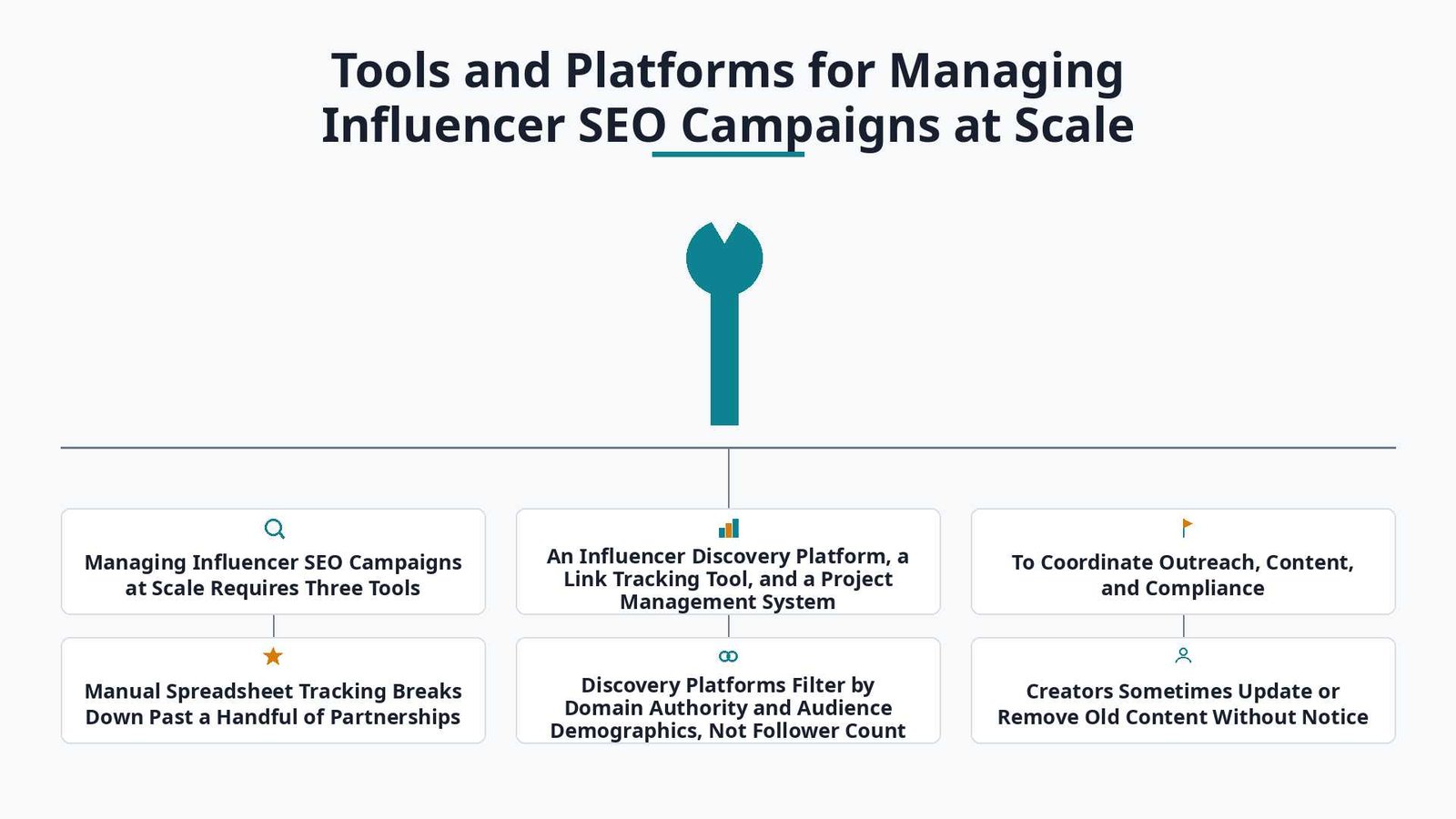
Managing influencer SEO campaigns at scale typically requires an influencer discovery platform, a link tracking tool, and a project management system to coordinate outreach, content, and compliance. Manual spreadsheet tracking breaks down past a handful of active partnerships.
Discovery platforms help filter by domain authority and audience demographics rather than follower count alone. Link tracking tools confirm placements stay live and retain the correct rel attributes over time, since creators sometimes update or remove old content without notice.
Conclusion
Influencer partnerships build SEO authority through backlinks, branded search signals, and referral trust that traditional outreach alone can’t replicate.
This works best layered into a broader link building and content strategy, with realistic four-to-six-month timelines for ranking impact.
We help businesses build these partnerships correctly from vetting through compliance. White Label SEO Service turns influencer relationships into sustainable organic growth.
Frequently Asked Questions
Does influencer marketing actually help SEO rankings?
Yes, influencer marketing helps SEO rankings when it generates genuine backlinks, branded search volume, and referral traffic from relevant audiences. The impact comes from the authority signals it creates, not the marketing exposure alone.
How much should a business budget for influencer SEO partnerships?
Budgets typically range from $500 to $5,000 per campaign depending on creator tier and content format. Nano and micro creator partnerships cost less while still delivering strong topical authority value.
Do nofollow links from influencers still help SEO?
Yes, nofollow links still help SEO indirectly through referral traffic, branded search lift, and brand visibility signals. Google has also confirmed nofollow links can factor into ranking systems as hints rather than being fully ignored.
How long does it take to see ranking results from influencer campaigns?
Most businesses see measurable ranking movement within four to six months of consistent partnerships. Branded search lift typically appears faster, within two to four weeks of a placement going live.
What’s the difference between influencer marketing and influencer SEO?
Influencer marketing focuses on brand awareness and sales conversion, while influencer SEO specifically targets backlinks, branded search volume, and authority signals. Influencer SEO is a subset of influencer marketing with search visibility as the primary goal.
Can small businesses use influencer partnerships for local SEO?
Yes, small businesses can use local influencer partnerships to generate geographically relevant links and referral traffic. Local creators often produce stronger audience overlap for location-based search visibility than national influencers.
How many influencer partnerships are needed to see measurable SEO impact?
Most campaigns need at least three to five active partnerships to generate a noticeable authority and branded search lift. Single placements rarely move rankings without a sustained, repeated presence.