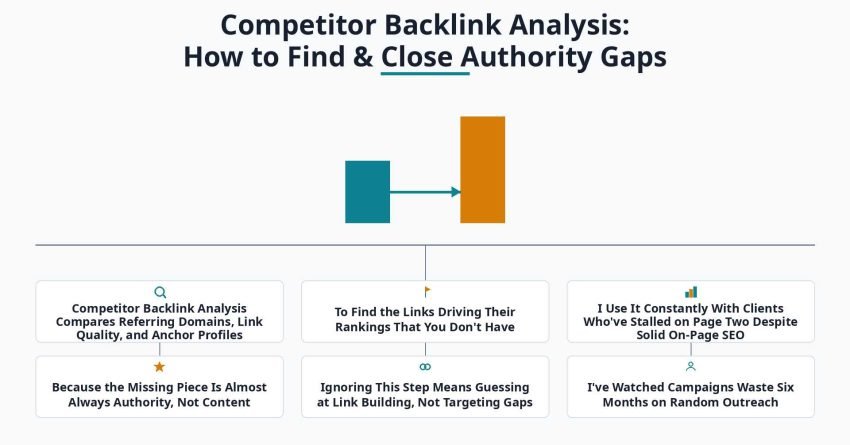
Competitor backlink analysis is the process of comparing your site’s referring domains, link quality, and anchor profiles against competitors to find the links driving their rankings that you don’t have. I use it constantly with clients who’ve stalled on page two despite solid on-page SEO, because the missing piece is almost always authority, not content.
Ignoring this step means guessing at link building instead of targeting the exact gaps holding rankings back. I’ve watched campaigns waste six months on random outreach that never touched the domains actually moving the needle.
This guide covers what authority gaps really measure, how to pick the right competitors and tools, the metrics that matter most, how to run a gap analysis step by step, and how to prioritize and close what you find.
What Competitor Backlink Analysis Actually Means
Competitor backlink analysis is a research process that identifies which referring domains link to a competitor’s site but not to yours. I treat it as a diagnostic, not a one-time report, because competitor link profiles shift every month.
Backlinks still function as a trust signal search engines use to gauge a page’s authority on a topic. A 2024 Backlinko study of 11.8 million Google search results found that the number of referring domains correlated more strongly with top rankings than any other single factor measured.
Why Backlinks Still Decide Rankings in 2026
Backlinks remain one of the clearest ranking signals because they’re difficult to fabricate at scale without detection. Google’s algorithms weigh link context, not just link existence, which is why two sites with identical link counts can rank completely differently.
I’ve seen clients with fewer total backlinks outrank competitors simply because their links came from more topically relevant domains.
Link Equity vs. Link Relevance
Link equity measures the authority passed through a backlink, while relevance measures how closely the linking page’s topic matches yours. A high-authority link from an unrelated industry often moves rankings less than a moderate-authority link from a directly relevant site.
I prioritize relevance first and authority second when I’m deciding which gap to close.
Why Authority Gaps Matter More Than Raw Link Counts
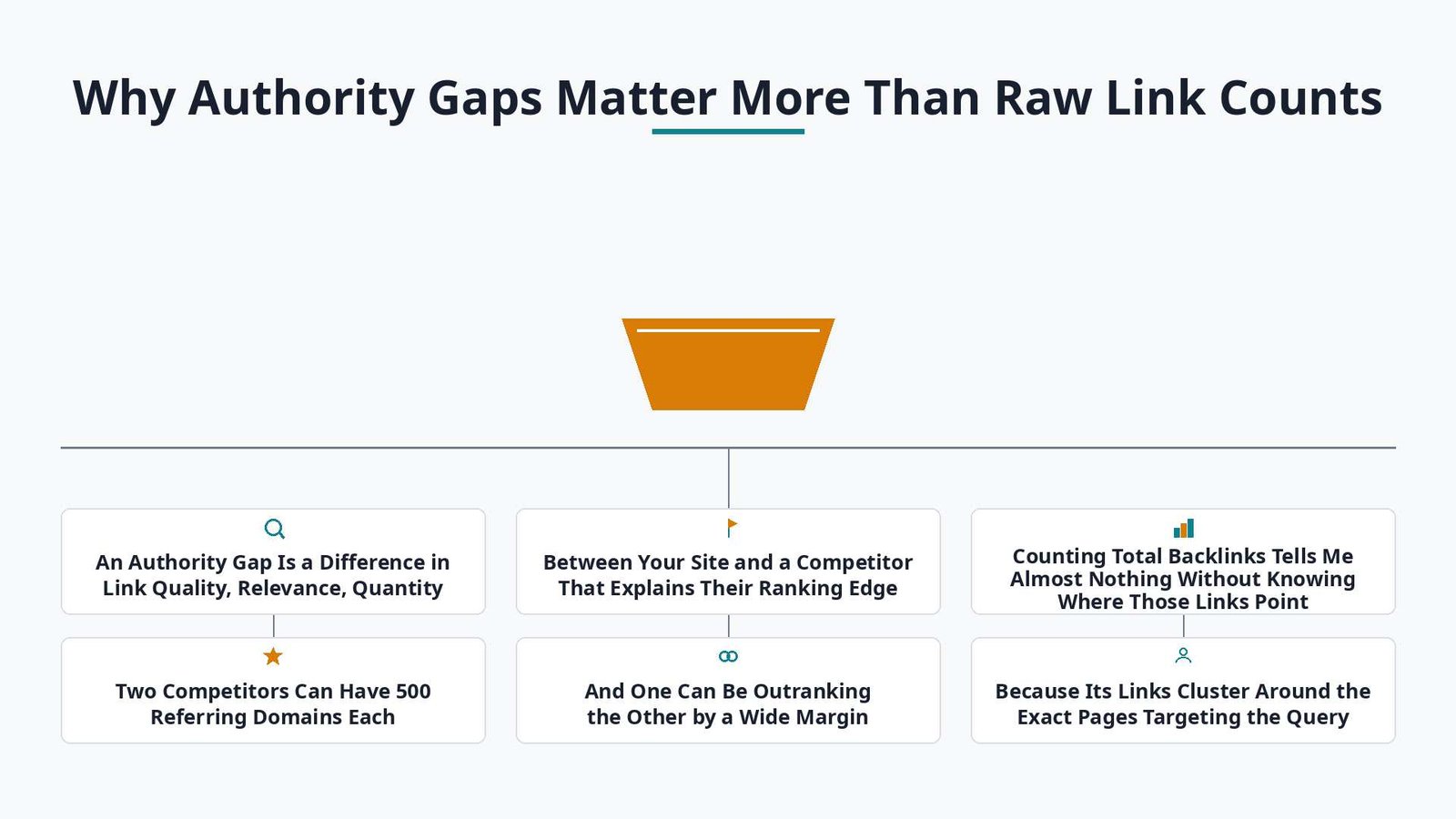
An authority gap is the specific difference in link quality, relevance, and quantity between your site and a competitor that explains their ranking advantage. Counting total backlinks tells me almost nothing without knowing where those links point and why they were earned.
Two competitors can have 500 referring domains each, and one can be outranking the other by a wide margin because its links cluster around the exact pages targeting the query.
Domain Authority vs. Topical Authority
Domain authority reflects a site’s overall link strength, while topical authority reflects how deeply a site has built links and content around one specific subject. A site with lower domain authority but concentrated topical authority in a niche often beats a generalist competitor with a higher overall score.
How to Identify the Right Competitors to Analyze
The right competitors for a backlink gap analysis are the sites currently ranking in the top 10 for your target keywords, not necessarily the businesses you consider your direct rivals. I pull my competitor list straight from the SERP rather than from a client’s mental list of “who we compete with.”
SERP Competitors vs. Business Competitors
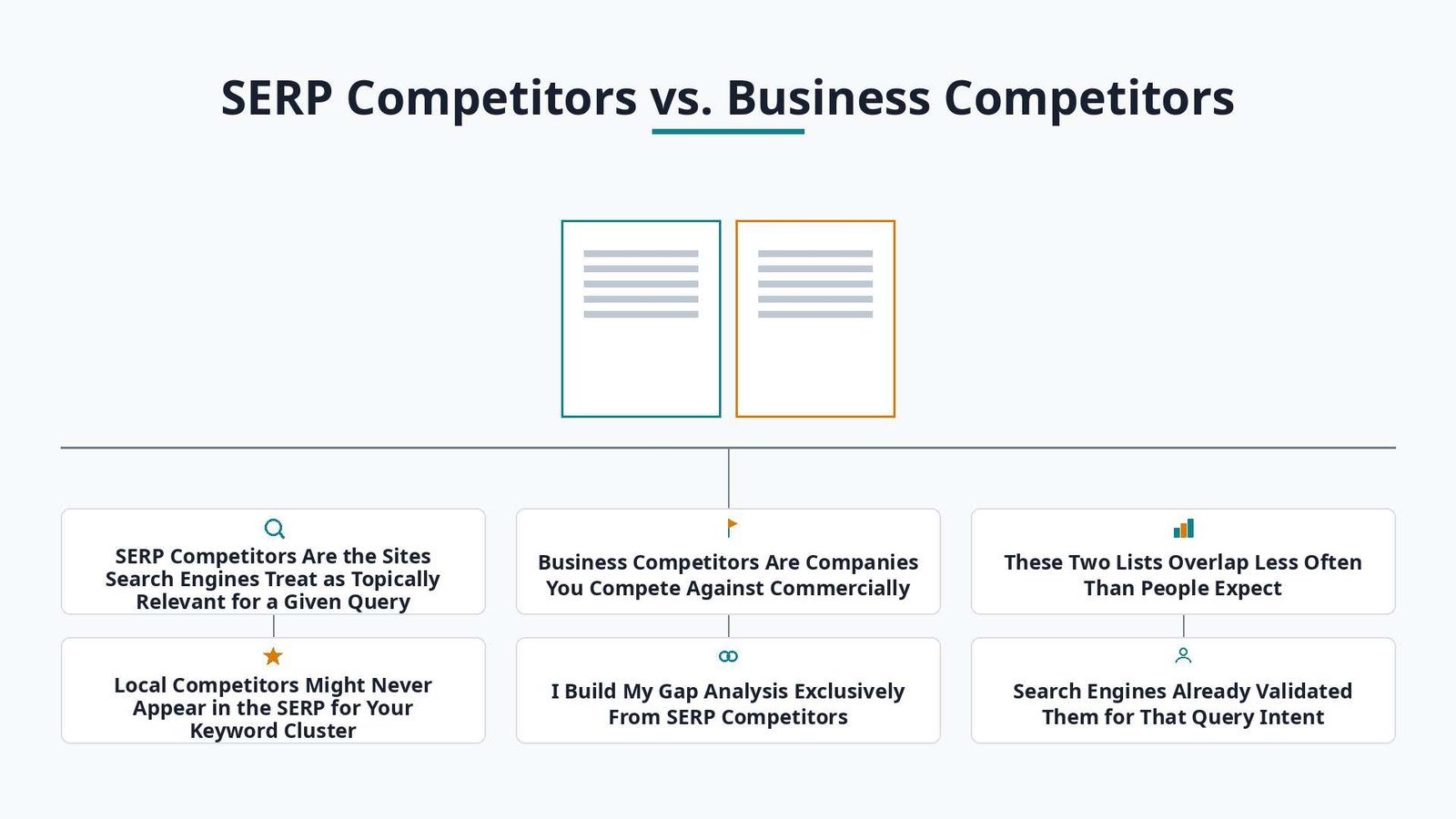
SERP competitors are the sites search engines treat as topically relevant for a given query, while business competitors are the companies you compete against commercially. These two lists overlap less often than people expect. A local competitor might never show up in the SERP for the exact keyword cluster you’re targeting.
I build my gap analysis exclusively from SERP competitors because they’re the ones search engines have already validated for that query intent.
Filtering Out False-Positive Competitors
A false-positive competitor is a site that ranks for your target keyword but serves a completely different search intent, like a Wikipedia page ranking alongside commercial pages. Including these in a gap analysis skews the data because their backlink profiles reflect an entirely different content type.
I remove any ranking page that isn’t the same content format, a tool, a product page, a guide, as the page I’m trying to improve.
Core Backlink Metrics to Evaluate
The core metrics in a competitor backlink analysis are domain authority, referring domain count, traffic value, link velocity, and anchor text distribution, and each one tells a different part of the story. Relying on just one metric, usually Domain Rating, is the most common mistake I see teams make.
| Metric | What It Measures | Why It Matters |
| Domain Rating / DA | Overall link authority strength | Indicates general trust signal strength |
| Referring Domains | Unique linking sites (not total links) | Diversity matters more than volume |
| Traffic Value | Estimated organic value of linking pages | Signals real audience reach, not just link juice |
| Link Velocity | Rate of new link acquisition over time | Reveals active vs. stagnant link building |
| Anchor Text Distribution | Spread of branded, exact-match, and generic anchors | Over-optimized anchors signal manipulation risk |
Domain Rating / Domain Authority
Domain Rating and Domain Authority are third-party metrics that estimate a site’s overall backlink strength on a logarithmic scale. Neither metric is a Google ranking factor directly, but both correlate reasonably well with actual ranking strength when compared across competitors in the same niche.
Referring Domains vs. Total Backlinks
Referring domains count the number of unique sites linking to a page, while total backlinks count every individual link including multiples from the same site. A competitor with 50 referring domains and 50 backlinks has a healthier profile than one with 50 referring domains and 400 backlinks concentrated on a handful of sites.
Traffic Value and Link Velocity
Traffic value estimates how much organic traffic a linking page itself receives, which signals whether a backlink sits on a page real users actually visit. Link velocity tracks how quickly a competitor’s referring domains have grown over a defined period, and a sudden spike often signals a digital PR campaign or product launch worth investigating.
Anchor Text Distribution
Anchor text distribution shows the percentage split between branded anchors, exact-match keyword anchors, partial-match anchors, and generic anchors like “click here” across a site’s backlink profile. A healthy, natural profile typically skews heavily branded and generic, with exact-match anchors making up a small minority.
Tools Used for Competitor Backlink Analysis
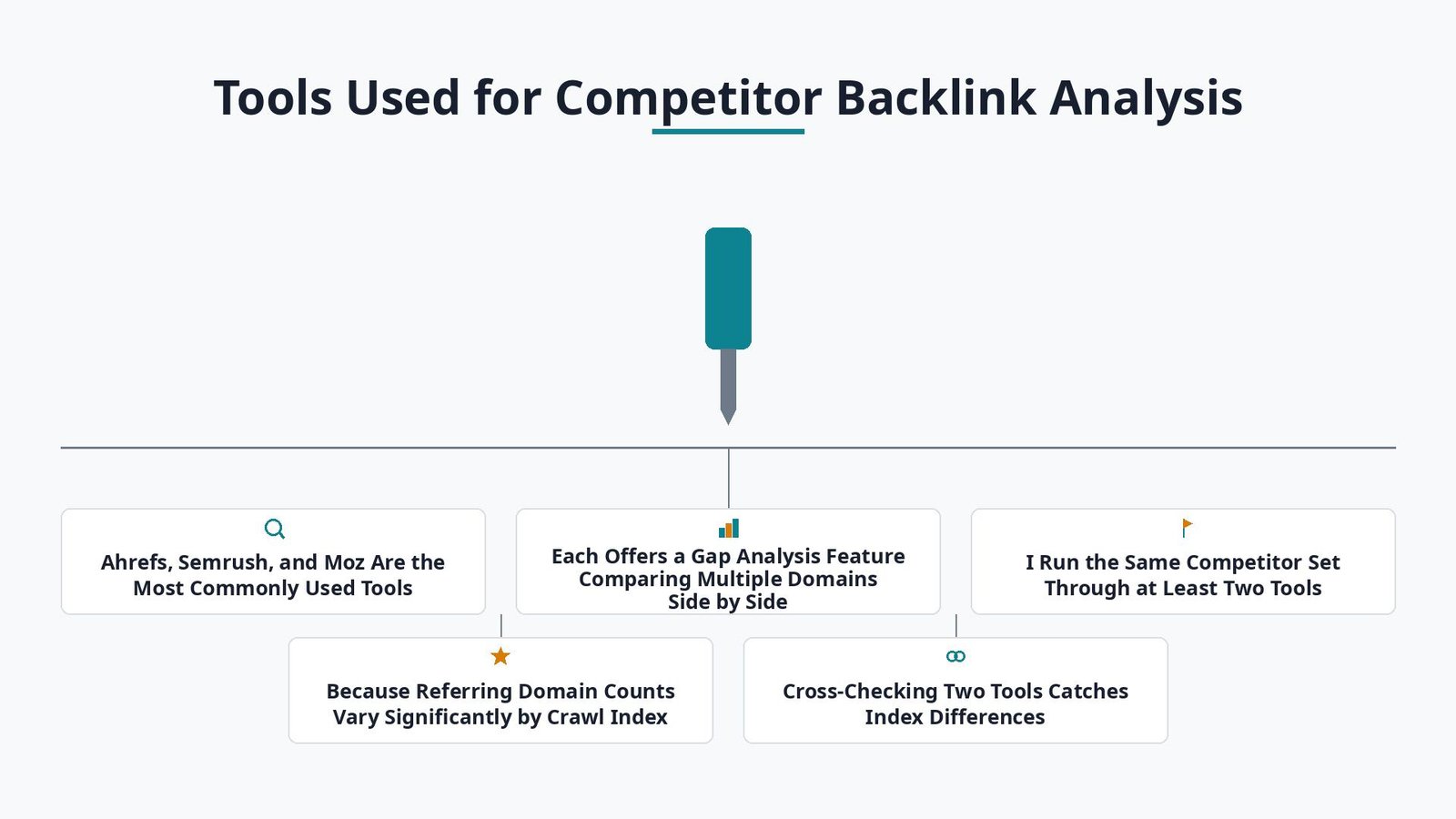
The most commonly used tools for competitor backlink analysis are Ahrefs, Semrush, and Moz, each offering a gap analysis feature that compares multiple domains side by side. I run the same competitor set through at least two tools because referring domain counts can vary significantly depending on each tool’s crawl index.
Free vs. Paid Tool Tradeoffs
Free tools like Google Search Console show your own backlinks but can’t show competitor data, while paid platforms index billions of pages specifically to support cross-domain comparison. I use Search Console to verify my own baseline, then rely on a paid platform for the actual competitive gap work.
How to Run a Backlink Gap Analysis Step by Step
Running a backlink gap analysis means entering your domain alongside two to four competitor domains into a link intersection tool and filtering for domains that link to them but not to you. The output is a prioritized list of link targets, not a finished strategy, so the real work starts after the export.
- Enter your domain and three to four SERP competitors into a link gap or “link intersect” tool
- Filter results to show domains linking to at least two competitors but not to you
- Sort the list by Domain Rating and traffic value, highest first
- Remove directories, spam domains, and irrelevant niches from the list
- Check each remaining domain’s linking page for topical relevance to your content
- Group the surviving domains by outreach difficulty: editorial, guest post, or directory
- Export the final list into a tracking sheet with contact information and link type
Exporting and Organizing Link Gap Data
I export every gap analysis into a spreadsheet with columns for domain, DR, link type, contact status, and outreach date, because a list without a tracking system turns into a one-time report nobody acts on.
Types of Authority Gaps You’ll Uncover
A backlink gap analysis typically surfaces three distinct gap types: content gaps, linkable asset gaps, and niche relevance gaps, and each one requires a different fix. Treating all gaps the same way is why many link building campaigns underperform their targets.
Content Gaps
A content gap exists when competitors earn links to a specific page format, like an original study or a comprehensive guide, that your site simply doesn’t have yet. No amount of outreach closes this gap until the underlying content exists.
Linkable Asset Gaps
A linkable asset gap means the competitor has created something inherently link-worthy, such as a free tool, a calculator, or original research, that naturally attracts unsolicited links. These assets tend to keep earning links for years with minimal ongoing outreach effort.
Niche Relevance Gaps
A niche relevance gap shows up when a competitor has built relationships or citations within a specific industry community, like local press or trade associations, that your site hasn’t yet penetrated. This gap closes through relationship building rather than content creation alone.
Evaluating Link Quality vs. Link Quantity
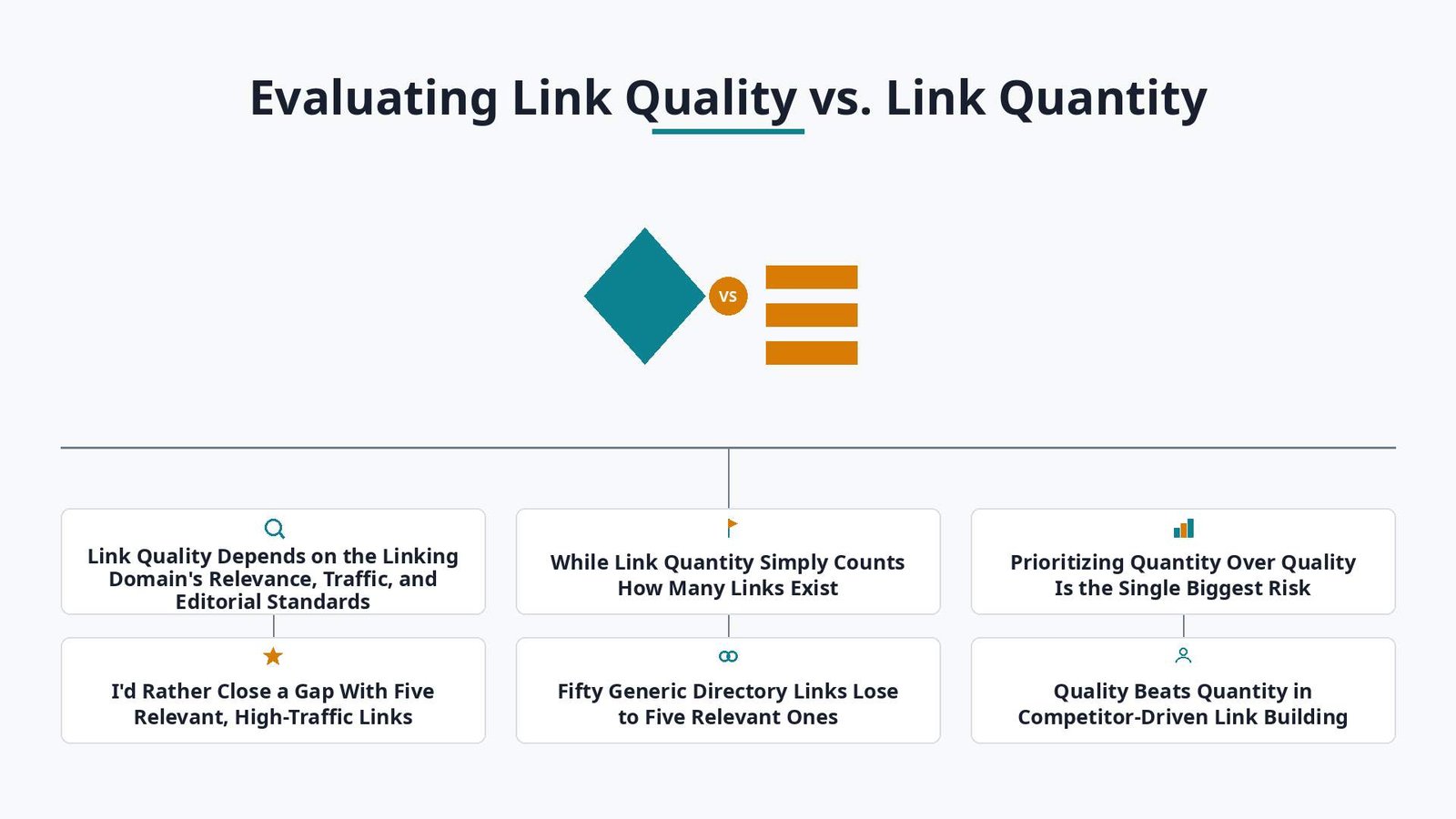
Link quality depends on the linking domain’s relevance, traffic, and editorial standards, while link quantity simply counts how many links exist, and prioritizing quantity over quality is the single biggest risk in competitor-driven link building. I’d rather close a gap with five relevant, high-traffic links than fifty generic directory links.
Red Flags of Toxic or Spammy Links
Toxic links typically come from link farms, expired domain networks, or sites with no real traffic and no topical connection to the linking content. Competitors sometimes carry these links as leftover risk from old campaigns, and copying them only imports the same risk into your own profile.
Prioritizing Which Gaps to Close First
Prioritizing authority gaps means scoring each opportunity against your effort to acquire it and its likely ranking impact, then working through the highest-impact, lowest-effort opportunities first. I score every gap on a simple matrix before any outreach begins.
| Priority | Effort | Impact | Example |
| Do First | Low | High | Broken link replacement on a relevant resource page |
| Plan Next | High | High | Original research or digital PR campaign |
| Fill Gaps | Low | Low | Niche directory submissions |
| Deprioritize | High | Low | Cold guest posting with no topical fit |
Scoring Opportunities by Effort vs. Impact
I score each prospective link on a 1–5 scale for both acquisition difficulty and projected ranking impact, then multiply the two scores to rank the full list. This turns a messy spreadsheet of hundreds of domains into a clear, sequenced action plan.
Link Acquisition Strategies to Close Authority Gaps
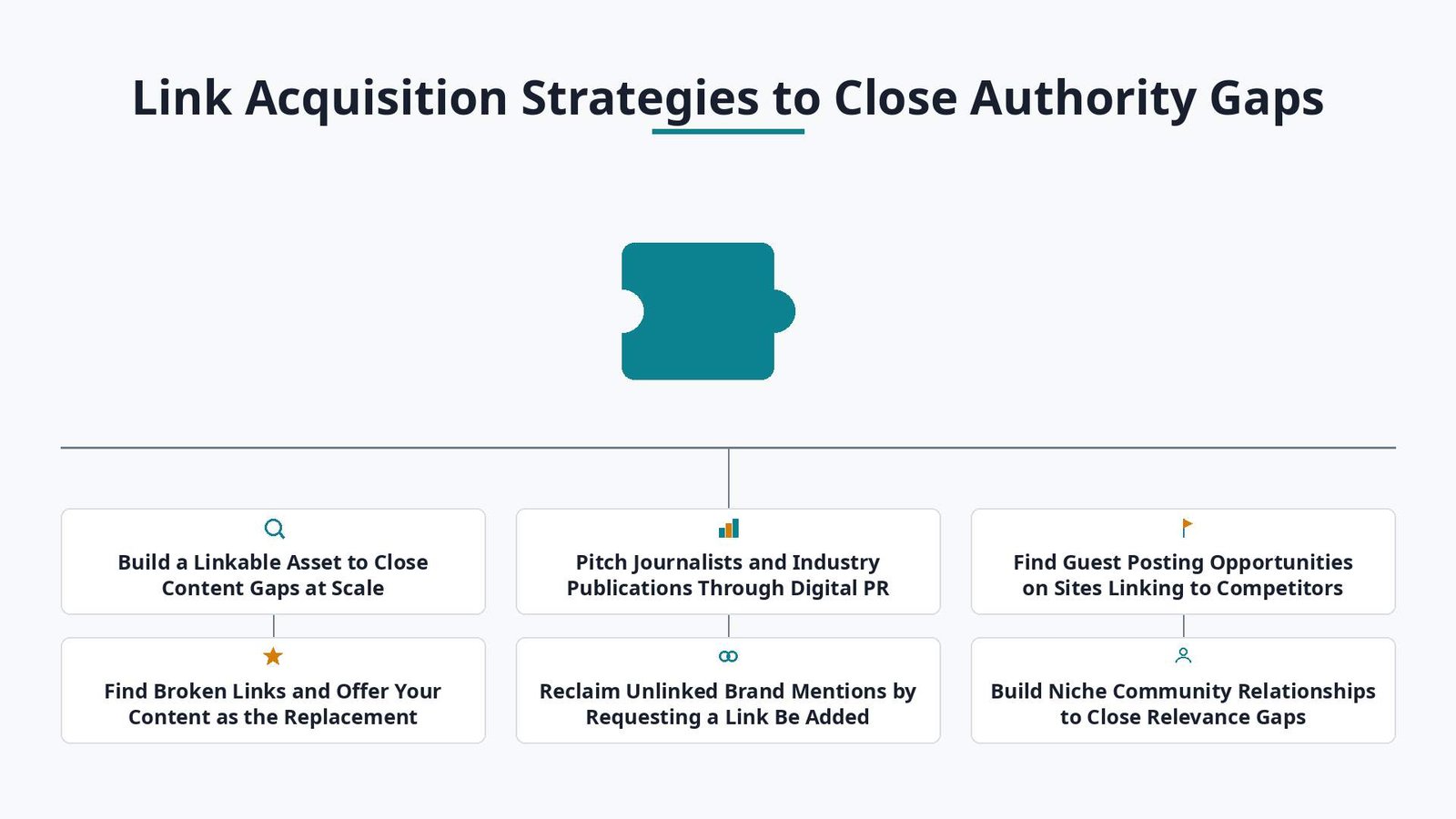
Closing an authority gap requires matching the acquisition strategy to the gap type: digital PR for linkable asset gaps, outreach and guest posting for content gaps, and broken link building for quick, low-effort wins. Using one tactic across every gap type wastes effort on prospects that were never going to respond to it.
- Build a linkable asset, an original data study, tool, or template, to close content gaps at scale
- Pitch journalists and industry publications through digital PR to earn editorial links naturally
- Identify guest posting opportunities on sites that already link to multiple competitors
- Find broken links on resource pages and offer your content as the replacement
- Reclaim unlinked brand mentions by requesting a link be added retroactively
- Build relationships within niche communities to close relevance gaps over time
Digital PR and Linkable Assets
Digital PR means pitching a newsworthy asset, usually original data or a unique angle on an industry trend, directly to journalists and publications in exchange for editorial coverage and a backlink. This approach tends to close multiple competitor gaps simultaneously because one strong placement often gets picked up by secondary outlets.
Guest Posting and Outreach
Guest posting means contributing an article to another site in exchange for a contextual backlink, and it works best when targeted at domains already proven to link to competitors in your space. I avoid guest posting on sites with no topical connection just because they accept content easily.
Broken Link Building and Resource Pages
Broken link building means finding dead links on resource pages that competitors have already earned a link from, then offering your own content as the replacement. It’s one of the fastest gap-closing tactics because the site owner already has an incentive to fix the broken link.
How Long It Takes to Close a Backlink Gap
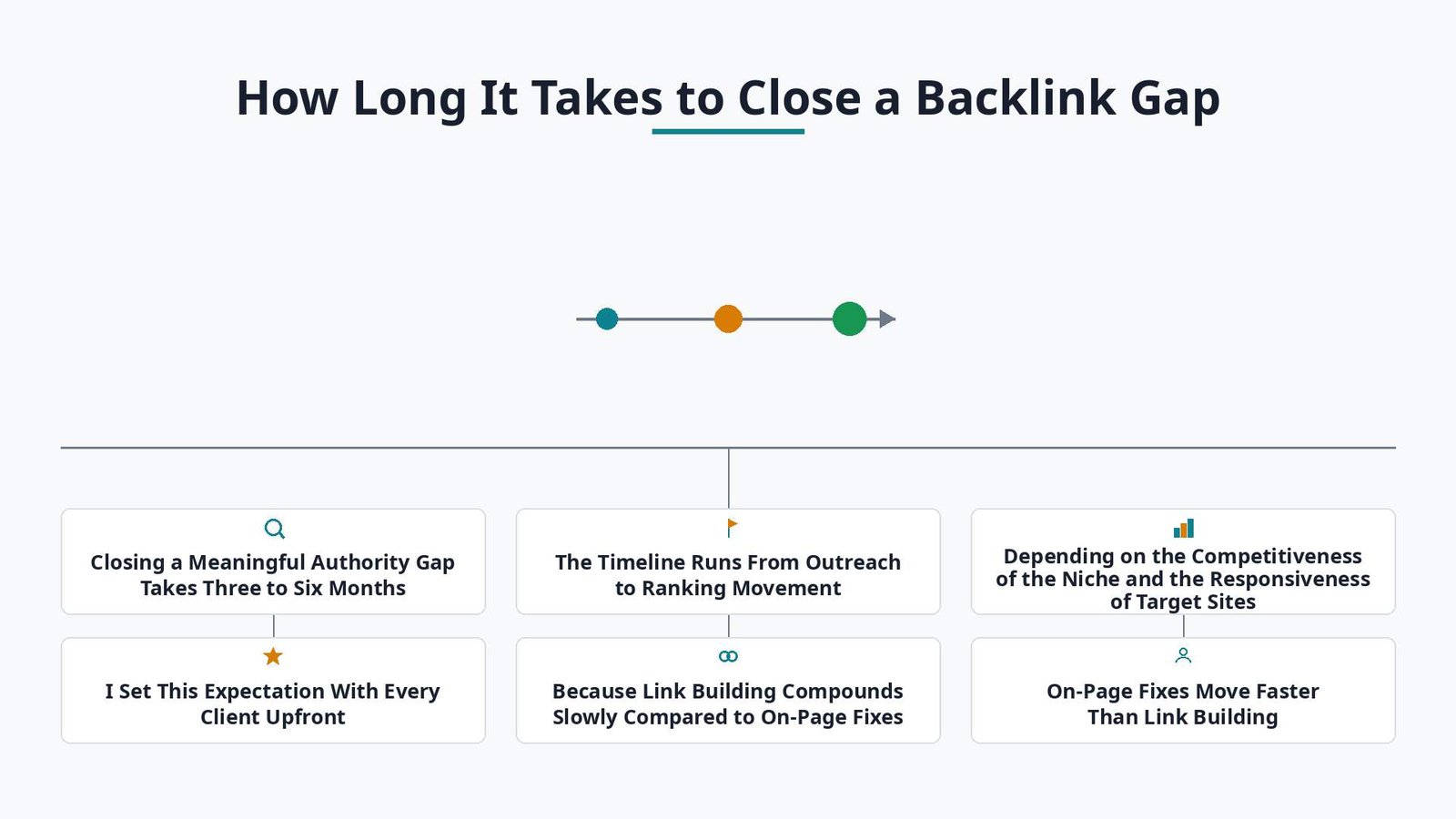
Closing a single meaningful authority gap typically takes three to six months from outreach to ranking movement, depending on the competitiveness of the niche and the responsiveness of target sites. I set this expectation with every client upfront because link building compounds slowly compared to on-page fixes.
Realistic Timelines by Competitive Difficulty
Low-competition niches often show ranking movement within six to eight weeks of new link acquisition, while highly competitive niches can take four to six months before the same volume of links produces a visible shift. I track link velocity against ranking position monthly to catch the inflection point as it happens.
Tracking Progress After Closing Authority Gaps
Tracking progress means monitoring referring domain growth, keyword position changes, and organic traffic on the specific pages targeted by the new links, checked on a consistent monthly cadence. Without this tracking, it’s impossible to tell which acquired links actually contributed to ranking movement.
Key KPIs to Monitor Monthly
| KPI | What to Watch |
| New referring domains | Net growth vs. competitor growth rate |
| Keyword position | Movement on pages targeted by new links |
| Organic traffic | Session growth on linked pages |
| Link retention | Confirm acquired links remain live |
Common Mistakes in Competitor Backlink Analysis
The most common mistakes are chasing raw link volume, ignoring topical relevance, copying toxic competitor links, and treating the analysis as a one-time project instead of an ongoing process. I see every one of these mistakes repeatedly in audits of campaigns that stalled out.
Chasing Volume Over Relevance
Chasing volume means prioritizing the total number of acquired links over whether each link comes from a topically relevant, trafficked domain. This mistake inflates vanity metrics while doing little to move the needle on actual rankings.
How Competitor Backlink Analysis Fits Into a Broader SEO Strategy
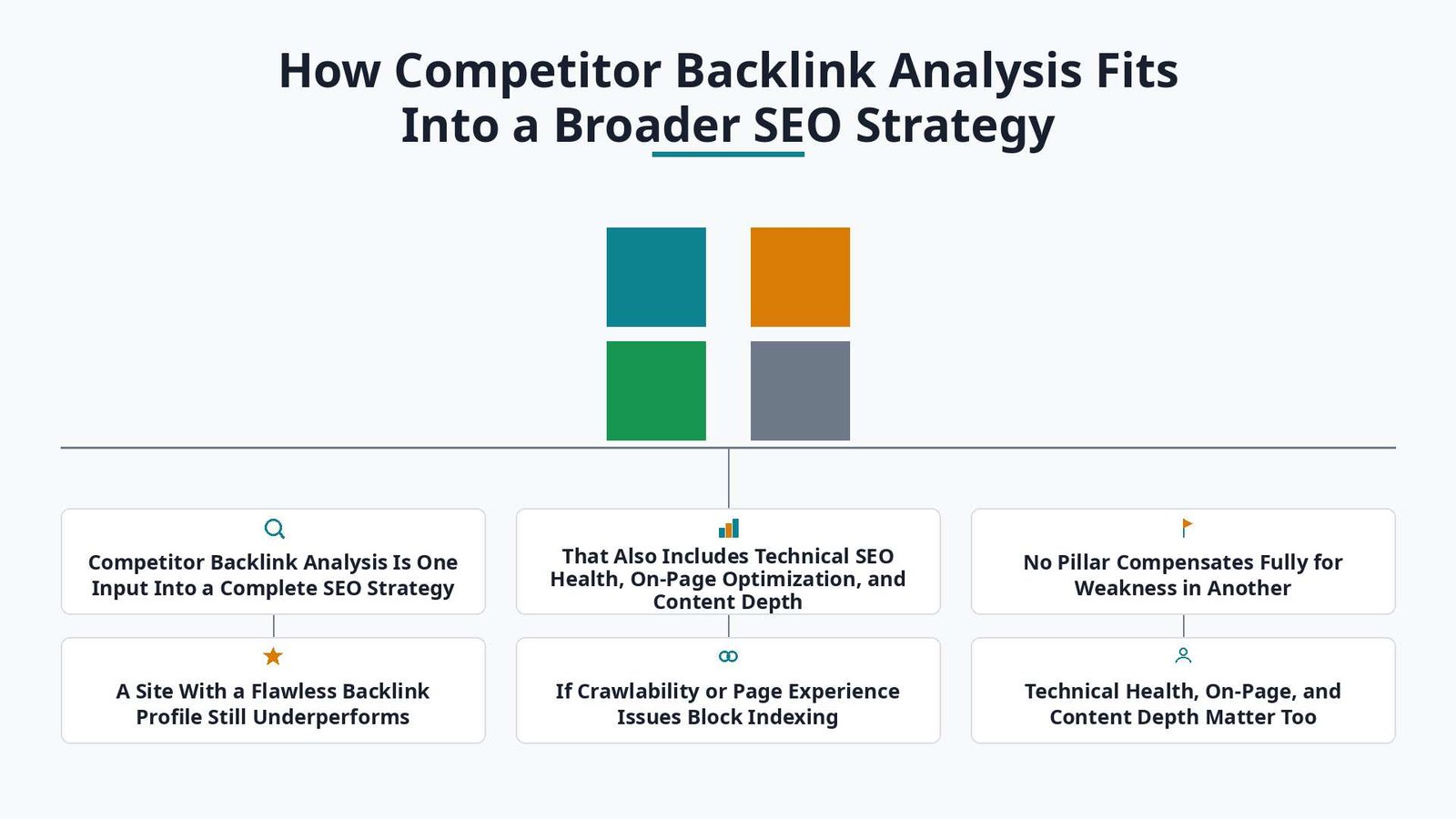
Competitor backlink analysis works as one input into a complete SEO strategy that also includes technical SEO health, on-page optimization, and content depth, and none of these pillars compensates fully for weakness in another. A site with a flawless backlink profile still underperforms if crawlability or page experience issues block indexing.
Connecting Link Building to Technical and Content SEO
Link building delivers its full ranking value only when the pages receiving links are technically sound and content-complete, because links pass authority to pages search engines can actually crawl, render, and match to query intent. I always confirm technical health and content quality before investing in outreach for a given page.
Conclusion
Competitor backlink analysis turns vague link building into a targeted plan built on referring domains, relevance, and authority gaps rather than guesswork.
We see it work best paired with technical SEO and content strategy, closing the gaps that keep rankings stuck on page two.
We help businesses find and close these exact gaps. Reach out to White Label SEO Service to build an authority strategy that compounds.
Frequently Asked Questions
What is competitor backlink analysis?
Competitor backlink analysis compares your referring domains and link quality against competitors to find authority gaps. It reveals which links are driving their rankings that your site hasn’t earned yet.
How many backlinks do I need to outrank a competitor?
There’s no fixed number. Relevance and quality matter more than count. A smaller number of topically relevant, high-traffic links often outperforms a much larger pile of weak ones.
Is Domain Rating the best metric to judge link gaps?
Domain Rating is useful but incomplete on its own. Referring domains, traffic value, and anchor distribution together give a far more accurate picture of a real authority gap.
How often should I run a backlink gap analysis?
Quarterly reviews work well for most competitive niches. Faster-moving industries with active competitor link building benefit from monthly tracking instead.
Can I close a backlink gap without building new content?
Some gaps close through outreach alone, like broken link building or unlinked mention reclamation. Content gaps and linkable asset gaps require new content to earn comparable links.
What’s a healthy referring domain growth rate?
Growth rate depends on niche competitiveness, but steady month-over-month gains matter more than sudden spikes. Spiky, unnatural growth patterns can actually raise red flags with search engines.
Do disavowed links affect competitor comparisons?
Yes, disavowed links still appear in third-party tools even though Google ignores them. Always check a competitor’s link profile for obvious toxic patterns before assuming it’s all contributing to their rankings.