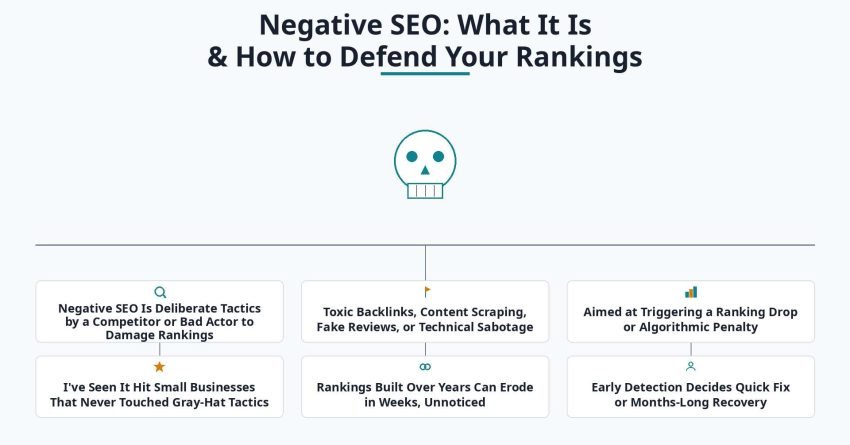
Negative SEO is a set of deliberate tactics used by a competitor or bad actor to damage another website’s search rankings without that site’s knowledge or consent. It typically involves toxic backlinks, content scraping, fake reviews, or technical sabotage aimed at triggering a ranking drop or algorithmic penalty. I’ve seen it hit small businesses that never touched a gray-hat tactic in their lives, and the damage can be real.
Rankings built over years can erode in weeks when an attack goes unnoticed. We treat early detection as the difference between a quick fix and a months-long recovery.
This guide covers what negative SEO actually looks like, the main attack types you need to watch for, how to spot the early warning signs, the tools we use to detect and audit suspicious activity, and the exact recovery and prevention steps that protect your rankings long term.
What Is Negative SEO?
Negative SEO refers to any external action taken against a website with the specific intent of lowering its search rankings or getting it penalized. It’s distinct from a site’s own SEO mistakes because the attacker isn’t you. It’s someone working against you.
Negative SEO attack exploit the same signals Google uses to rank sites fairly: backlinks, content originality, site speed, and user trust signals. I look at it as a mirror image of legitimate SEO. The same levers, pulled in the opposite direction.
Most business owners never think about this threat until they see a sudden drop they can’t explain. By then, the attack has usually been running for weeks.
Negative SEO vs. Algorithm Penalties
An algorithmic penalty comes from Google flagging your own site’s behavior, while negative SEO comes from someone else’s behavior pointed at your site. The distinction matters because the fix is completely different.
I always check referring domains first when a client reports a drop with no recent site changes. A spike in low-quality backlinks you never built is the clearest signal someone else is responsible.
Why Negative SEO Targets Specific Businesses
Competitive, high-value industries attract the most negative SEO activity because the financial incentive to knock a competitor down is highest there. Local service businesses, e-commerce stores, and lead-gen sites in expensive niches see this most often.
We’ve noticed a pattern: the moment a site breaks into a competitive top 3, attack risk rises sharply.
Why Negative SEO Happens — Motives Behind the Attacks
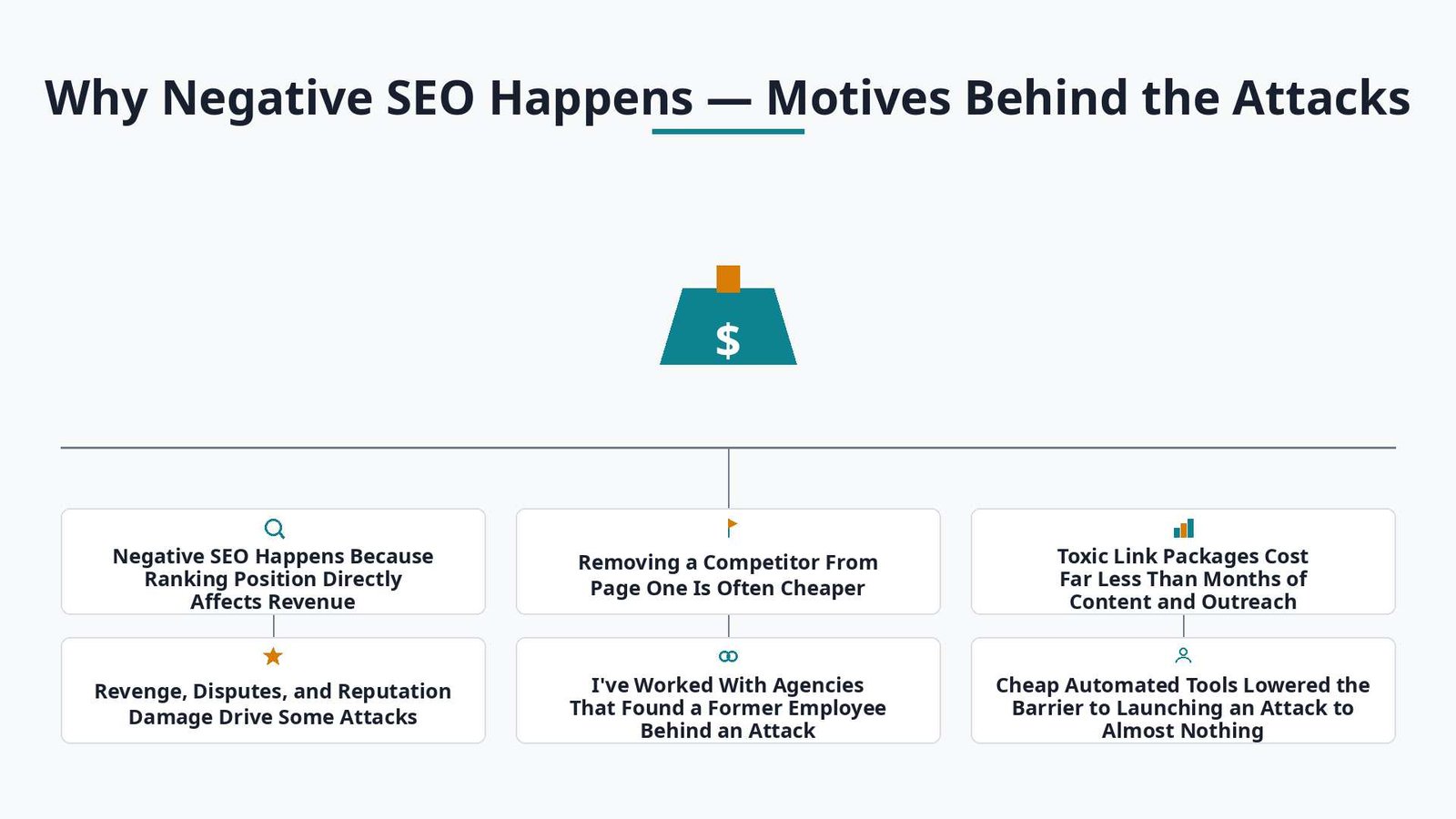
Negative SEO happens because ranking position directly affects revenue, and removing a competitor from page one is often cheaper than outranking them legitimately. Buying a toxic link package costs far less than months of content and outreach.
Revenge, personal disputes, and reputation damage drive some attacks too. I’ve worked with agencies that discovered a former employee or disgruntled customer behind an attack, not a competitor at all.
The economics make this a persistent threat rather than a rare occurrence. Cheap automated tools have lowered the barrier to launching an attack to almost nothing.
Types of Negative SEO Attacks
Negative SEO attacks fall into six primary categories, each exploiting a different ranking signal Google relies on to evaluate trust and quality.
| Attack Type | What It Targets | Primary Damage |
| Toxic link spam | Backlink profile | Manual action or algorithmic link devaluation |
| Content scraping | Content originality | Duplicate content confusion, diluted authority |
| Fake reviews | Reputation signals | Local trust and conversion rate |
| Hacking/malware | Site security | De-indexing, security warnings |
| Click fraud | Behavioral signals | Distorted engagement metrics |
| GBP sabotage | Local listing integrity | Local pack visibility loss |
Toxic Link Building / Negative Link Spam
Toxic link building involves pointing thousands of spammy, irrelevant, or penalized backlinks at a target site to trigger a manual action or algorithmic suppression. This is the most common and most damaging form of negative SEO because backlink profiles remain one of Google’s strongest ranking signals.
Attackers buy these links in bulk from private blog networks, comment spam, or foreign-language directories. The goal isn’t traffic. It’s guilt by association in Google’s eyes.
Content Scraping & Duplicate Content Attacks
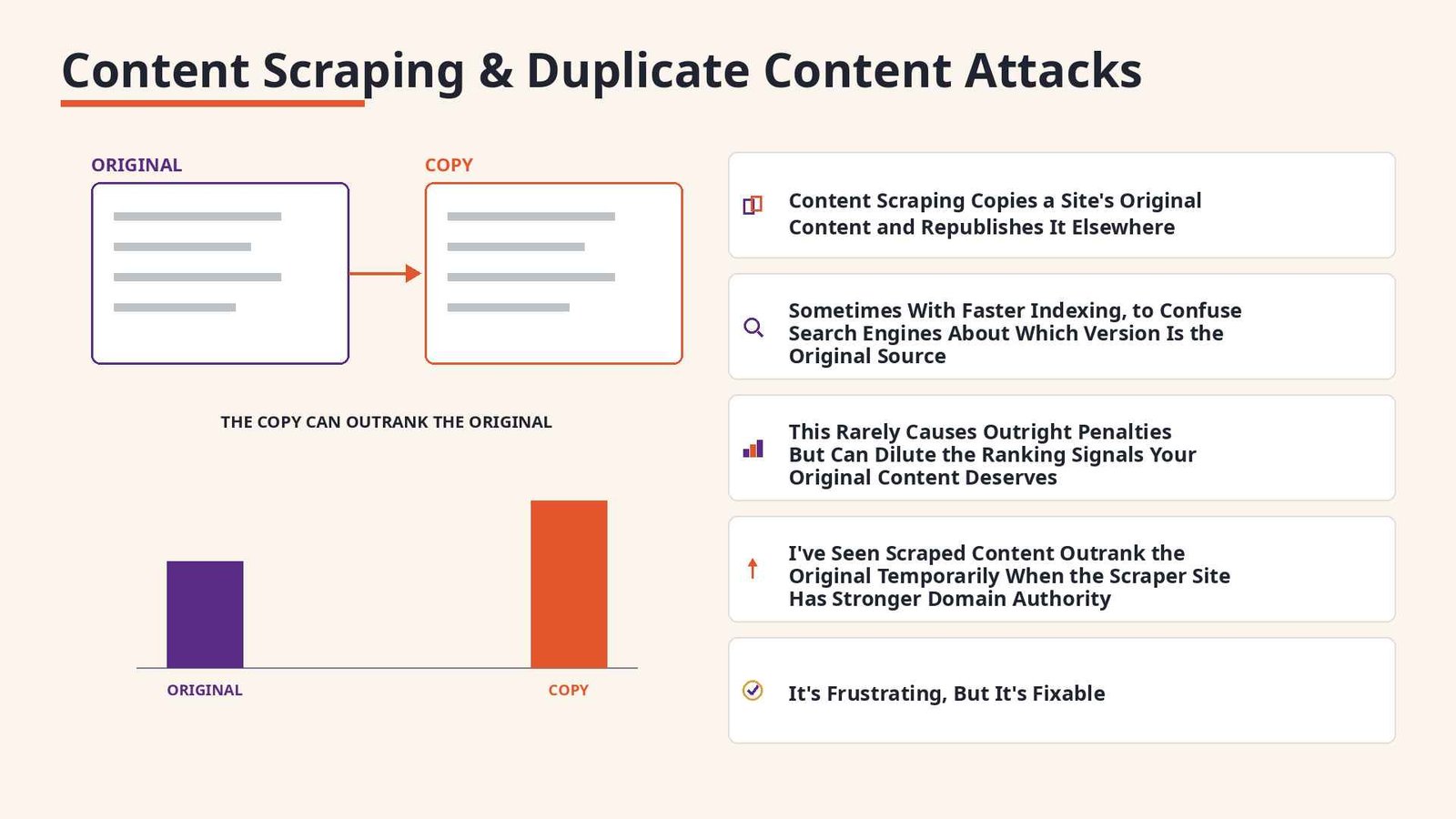
Content scraping copies a site’s original content and republishes it elsewhere, sometimes with faster indexing, to confuse search engines about which version is the original source. This rarely causes outright penalties but can dilute the ranking signals your original content deserves.
I’ve seen scraped content outrank the original temporarily when the scraper site has stronger domain authority. It’s frustrating, but it’s fixable.
Fake Reviews & Reputation Sabotage
Fake negative reviews flood a business’s Google Business Profile or third-party review sites to damage conversion rates and local trust signals. This tactic hits local service businesses especially hard since reviews directly influence local pack rankings.
A cluster of one-star reviews posted within days of each other is rarely organic. We flag that pattern immediately.
Hacking & Malware Injection
Hacking attacks compromise a website’s backend to inject spam content, malicious redirects, or malware that triggers Google’s security warnings and potential de-indexing. This is the most severe attack type because it can remove a site from search results entirely within hours.
An Ahrefs study of compromised sites found recovery from a security-related de-indexing event averages several weeks even after the malware is removed, since Google requires a manual security review before restoring full visibility.
Click Fraud & Fake Traffic Attacks
Click fraud involves bots or paid click farms generating artificial traffic and bounce patterns designed to signal low-quality user experience to Google’s algorithms. This tactic is harder to prove than link-based attacks because the signals look like organic bad engagement.
I treat sudden bounce rate spikes from unfamiliar geographic clusters as a red flag worth investigating.
Google My Business / Local Listing Sabotage
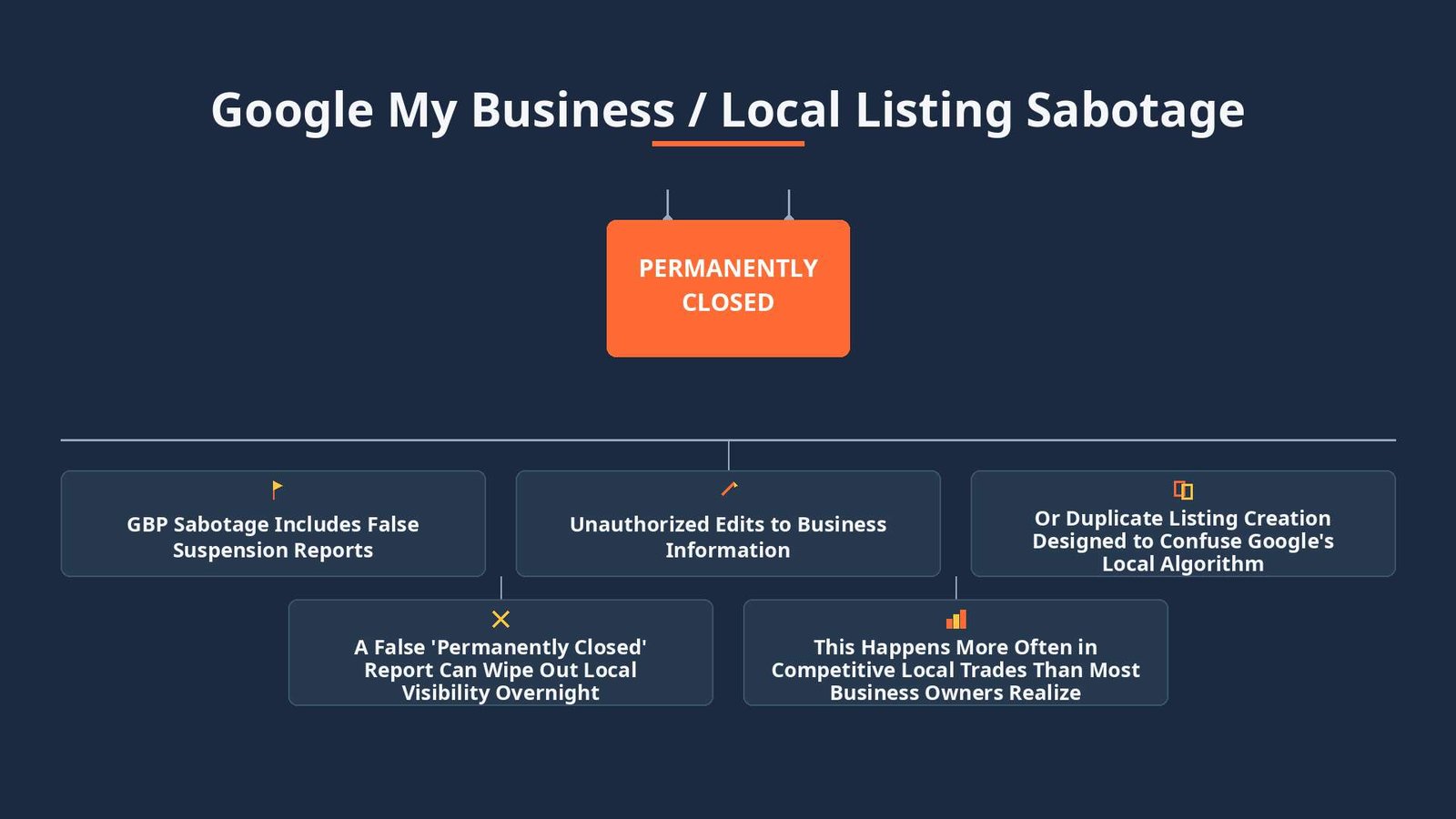
GBP sabotage includes false suspension reports, unauthorized edits to business information, or duplicate listing creation designed to confuse Google’s local algorithm. A competitor filing a false “permanently closed” report can wipe out local visibility overnight.
This happens more often in competitive local trades than most business owners realize.
How Negative Links Damage Rankings
Toxic backlinks damage rankings by signaling to Google’s algorithm that a site is associated with low-quality or manipulative link networks, which can trigger either a manual penalty or automatic devaluation. The algorithm doesn’t always distinguish between links you built and links someone built against you.
Google’s own link spam systems are designed to discount junk links automatically in most cases. But a sudden, concentrated spike can still overwhelm those automatic protections before they fully adjust.
The damage compounds when toxic links point at the same few pages repeatedly, since that pattern looks deliberately manipulative rather than natural.
Early Warning Signs of a Negative SEO Attack
The earliest and most reliable signs of a negative SEO attack are a sudden, unexplained ranking drop paired with a spike in unfamiliar referring domains in the same short window.
Catching these signals early typically determines whether recovery takes weeks or months. I run through this checklist with every client who reports an unexplained traffic change:
- Rankings drop 10+ positions across multiple keywords within days, not weeks
- Google Search Console shows a sudden spike in new referring domains
- Organic traffic falls while impressions in Search Console stay flat or rise
- Multiple negative reviews appear within a short, concentrated timeframe
- Server logs show unusual bot traffic or unfamiliar user agents
- Indexed page count drops unexpectedly in Search Console
Sudden Ranking Drops
A ranking drop qualifies as a negative SEO warning sign when it affects multiple unrelated keywords simultaneously rather than a single page losing position gradually. Gradual single-page drops usually point to content or relevance issues, not an attack.
Unusual Backlink Spikes
A legitimate link-building campaign adds links gradually over weeks, while an attack typically dumps hundreds or thousands of links within days. Backlink velocity that jumps far outside a site’s historical pattern is one of the clearest attack indicators available.
Traffic or Indexing Anomalies
Pages disappearing from the index without a corresponding site change usually points to either a technical crawl issue or a security compromise. I always check Search Console’s coverage report first since it shows exactly which pages dropped and when.
How to Detect Negative SEO Using Data Tools
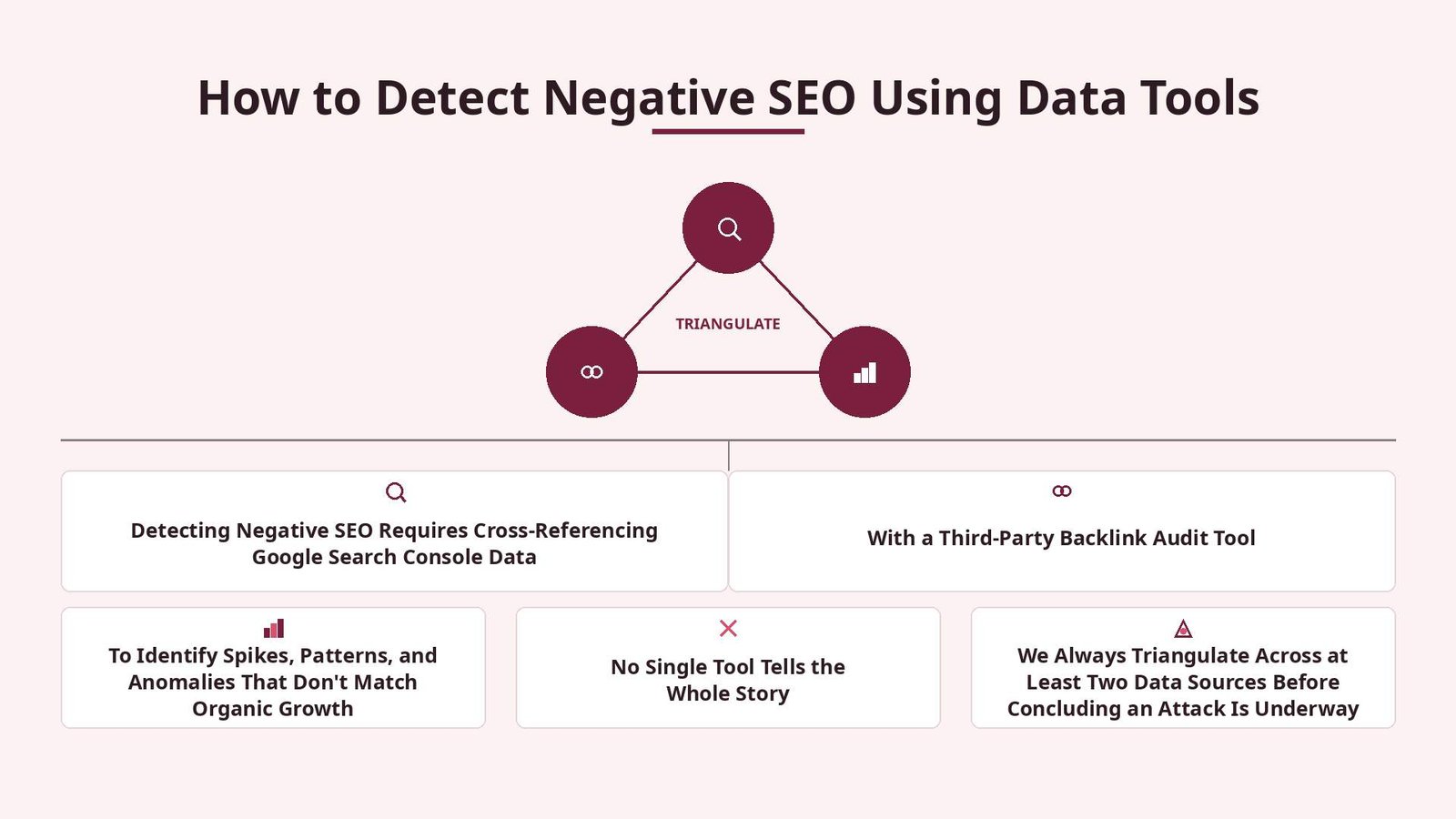
Detecting negative SEO requires cross-referencing Google Search Console data with a third-party backlink audit tool to identify spikes, patterns, and anomalies that don’t match organic growth.
No single tool tells the whole story, which is why we always triangulate across at least two data sources before concluding an attack is underway.
Google Search Console Signals
Search Console’s Links report shows every new referring domain Google has discovered, making it the first stop for spotting an unnatural spike. The Coverage report flags any pages Google has stopped indexing, which often correlates with a hacking attempt.
Backlink Audit Tools
Third-party platforms like Ahrefs, Semrush, and Moz track historical link velocity and flag toxic domains using spam score metrics that Search Console doesn’t calculate natively. Running a comparative audit across two tools catches links one platform might miss.
How to Audit Your Backlink Profile
A backlink audit involves exporting every referring domain, scoring each one for spam signals, and separating genuinely toxic links from links that simply look unfamiliar but pose no real risk.
Spam score, anchor text relevance, and domain authority are the three filters I apply first. Links from unrelated foreign-language sites with exact-match anchor text are almost always worth flagging.
Not every low-authority link is dangerous, and treating them all as threats leads to disavowing links that were never a problem in the first place.
How to Disavow Toxic Links the Right Way
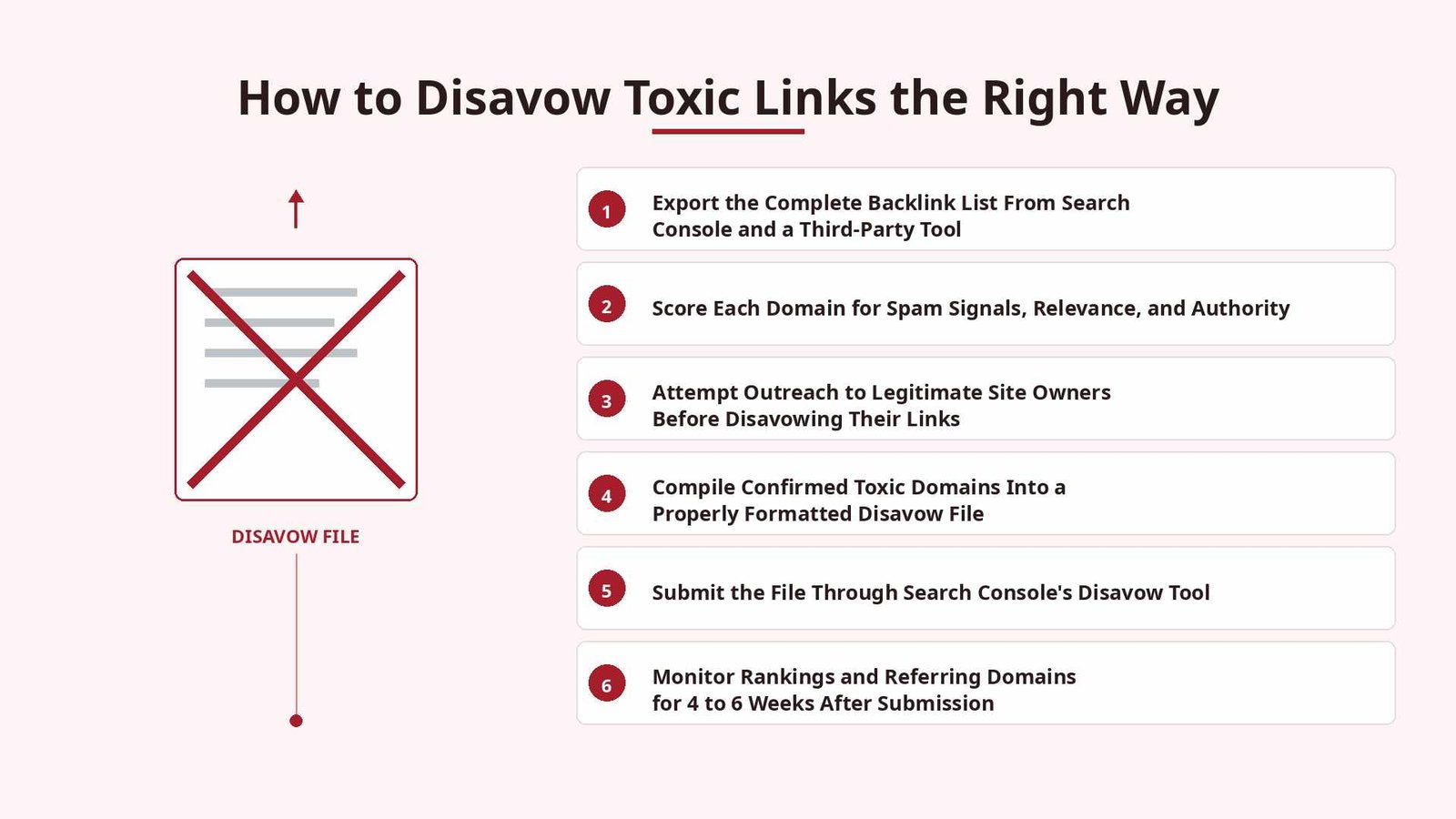
Disavowing toxic links means submitting a file to Google Search Console that tells Google’s algorithm to ignore specific domains or URLs when evaluating a site’s backlink profile. This tool exists specifically for negative SEO and spam link scenarios.
Used incorrectly, the disavow tool can strip away links that were actually helping a site rank. I follow the same sequence every time:
- Export the complete backlink list from Search Console and a third-party tool
- Score each domain for spam signals, relevance, and authority
- Attempt outreach to legitimate site owners before disavowing their links
- Compile confirmed toxic domains into a properly formatted disavow file
- Submit the file through Search Console’s disavow tool
- Monitor rankings and referring domains for 4 to 6 weeks after submission
Google has stated that most toxic links are discounted automatically, so the disavow tool should be reserved for cases where a manual action has already been issued or an attack is clearly ongoing.
Protecting Your Website From Hacking & Technical Sabotage
Protecting a site from hacking-based negative SEO starts with hardening the CMS, enforcing strong admin credentials, and running malware scans on a consistent schedule rather than only after something looks wrong.
Outdated plugins and weak passwords remain the two most common entry points attackers exploit. I recommend two-factor authentication on every admin account without exception.
A web application firewall catches most automated attack attempts before they ever reach the server. Regular backups mean a compromised site can be restored in hours instead of days.
Defending Against Fake Reviews & Reputation Sabotage
Defending against fake review attacks requires flagging suspicious reviews directly through Google’s reporting tool while documenting the pattern as evidence of coordinated abuse. Isolated negative reviews are normal; clustered ones within a short window are not.
Responding professionally and promptly to every flagged review signals to both Google and future customers that the business takes reputation seriously. I’ve seen flagged review clusters successfully removed within two weeks when the report included clear timestamp evidence.
Content Theft & Duplicate Content Defense
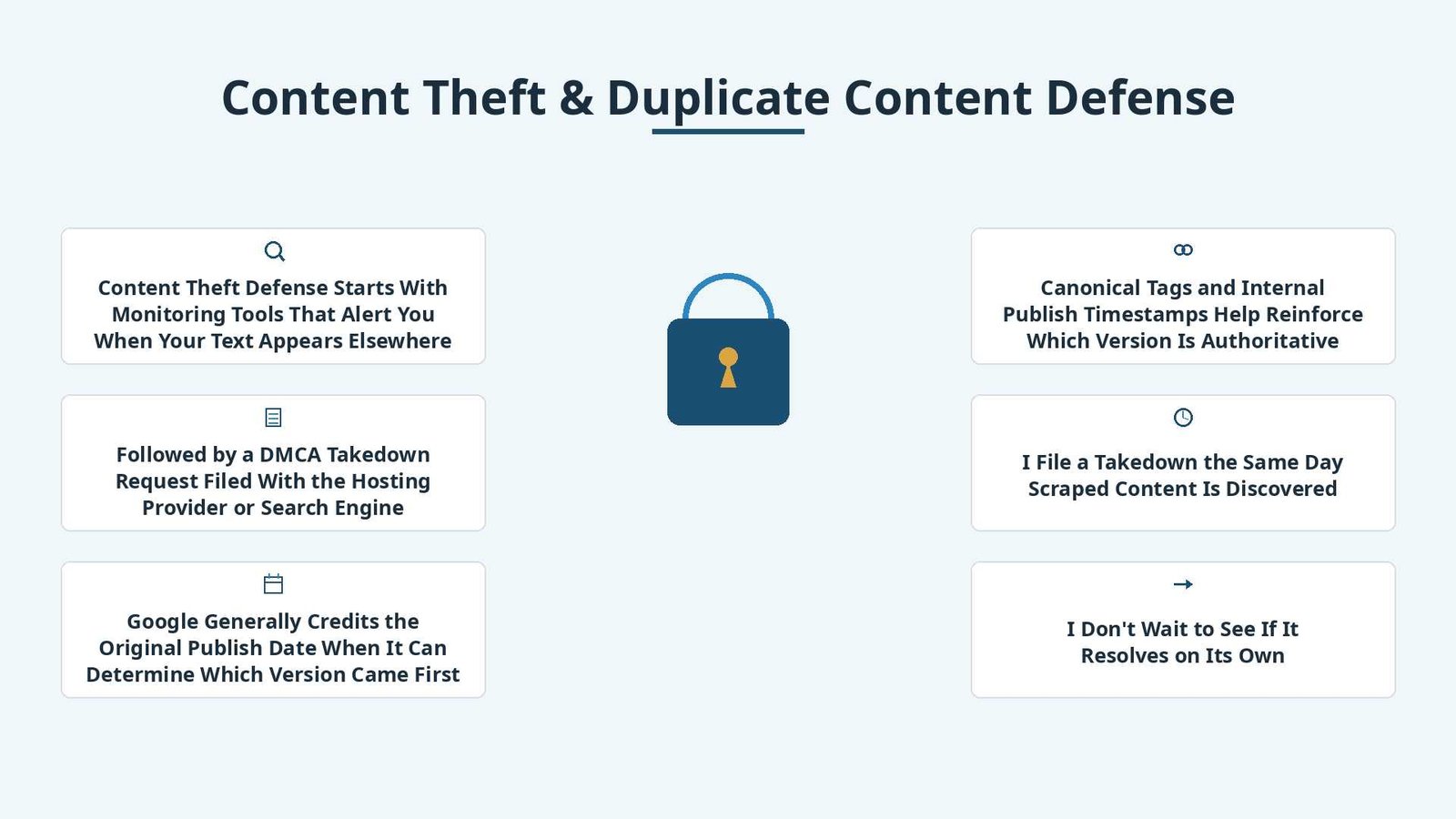
Content theft defense starts with monitoring tools that alert you when your text appears elsewhere, followed by a DMCA takedown request filed with the hosting provider or search engine. Google generally credits the original publish date when it can determine which version came first.
Canonical tags and internal publish timestamps help reinforce which version is authoritative. I file a takedown the same day scraped content is discovered rather than waiting to see if it resolves on its own.
Google’s Official Stance on Negative SEO
Google has publicly stated that its algorithms are designed to identify and nullify most negative SEO attempts automatically, without requiring site owners to take action. This doesn’t mean every attack gets caught in time.
Google’s John Mueller has repeatedly confirmed that manual actions resulting from someone else’s spam links against your site are rare but not impossible. That’s exactly why monitoring still matters even with these automated protections in place.
How Google’s Algorithm Handles Suspicious Link Patterns
Google’s link spam algorithms, including systems built on the SpamBrain framework, are designed to detect and discount unnatural link patterns in real time rather than waiting for a manual review. This automated layer catches the majority of low-effort negative SEO attempts before they cause visible damage.
Sophisticated or highly concentrated attacks can still slip past automated detection temporarily. That gap is exactly where proactive monitoring earns its value.
Building a Negative SEO Monitoring System
A negative SEO monitoring system combines automated backlink alerts, rank tracking, and uptime monitoring so an attack gets flagged within hours instead of discovered weeks later during a quarterly review.
The right monitoring stack depends on site size and competitive exposure, but a few components apply almost universally:
- Backlink alert tools that notify you the moment a new referring domain crosses a spam-score threshold
- Rank tracking software checking daily rather than weekly for high-value keywords
- Google Search Console email alerts for manual actions and security issues
- Review monitoring tools that flag review clusters across platforms in real time
- Uptime and malware scanners running continuous automated checks
Setting these up takes an afternoon and typically prevents the slow-discovery problem that turns a minor attack into a major recovery project.
What to Do If You’ve Been Hit — Recovery Action Plan
Recovering from a confirmed negative SEO attack requires identifying the attack type first, since a link-based attack, a hacking incident, and a review bombing campaign each require a completely different response sequence.
I run every recovery through the same five-stage framework regardless of attack type:
- Confirm the attack type using Search Console, backlink tools, and server logs
- Contain the damage: disavow links, remove malware, or flag fake reviews immediately
- Document everything with timestamps for potential Google appeals or legal action
- Request reconsideration through Search Console if a manual action was issued
- Monitor rankings weekly for 60 to 90 days to confirm full recovery
Recovery timelines vary significantly by attack severity, but most link-based attacks resolve within 4 to 8 weeks of a properly filed disavow request. Hacking-related de-indexing can take longer since Google requires a manual security review before restoring full visibility.
Negative SEO Prevention — Long-Term Defense Strategy
Long-term negative SEO prevention combines continuous monitoring, a hardened technical foundation, and a documented response plan so an attack gets caught and contained before it affects rankings. Prevention is always cheaper than recovery.
Building this into a standard SEO reporting cadence means backlink and ranking anomalies surface during routine check-ins rather than requiring a separate system. A quarterly backlink audit catches slow-building attacks that daily monitoring tools sometimes miss.
The businesses that recover fastest are the ones who already had a monitoring system running before the attack started.
Conclusion
Negative SEO works by exploiting the same signals that determine legitimate rankings, which means defense requires understanding backlinks, content integrity, and technical security as one connected system.
The threat landscape keeps shifting as attackers find new ways around Google’s automated protections, making ongoing vigilance part of any serious organic growth strategy.
We help businesses monitor, detect, and recover from these attacks every day. Reach out to White Label SEO Service and let’s protect the rankings you’ve worked hard to earn.
Frequently Asked Questions
Can negative SEO really hurt my rankings?
Yes, negative SEO can hurt rankings, primarily through toxic backlink spam or hacking attacks. The damage is usually temporary when caught early and addressed with proper detection and disavow steps.
How do I know if I’m a victim of negative SEO?
The clearest sign is a sudden ranking drop paired with an unexplained spike in new referring domains. Checking Google Search Console’s Links and Coverage reports confirms most cases within minutes.
Does Google penalize sites for negative SEO attacks?
Google rarely issues manual penalties for links you didn’t build, since its automated systems are designed to discount them. Manual actions still happen occasionally, which is why monitoring remains important.
How long does it take to recover from negative SEO?
Most link-based attacks resolve within 4 to 8 weeks after a disavow file is submitted correctly. Hacking-related recovery often takes longer due to Google’s manual security review process.
Is the disavow tool still effective in 2026?
Yes, the disavow tool remains effective for confirmed toxic link situations, though Google recommends it mainly after a manual action or clear ongoing attack. It should not be used preemptively on every unfamiliar link.
Can competitors legally use negative SEO against me?
Negative SEO tactics like fake reviews and hacking often violate platform policies and, in some cases, actual law. Documenting evidence strengthens any report filed with Google or legal action pursued separately.
How much does negative SEO defense typically cost?
Costs vary widely based on attack severity, ranging from a few hours of audit work for minor link spam to extensive technical recovery for hacking incidents. Ongoing monitoring typically costs far less than a single recovery project.