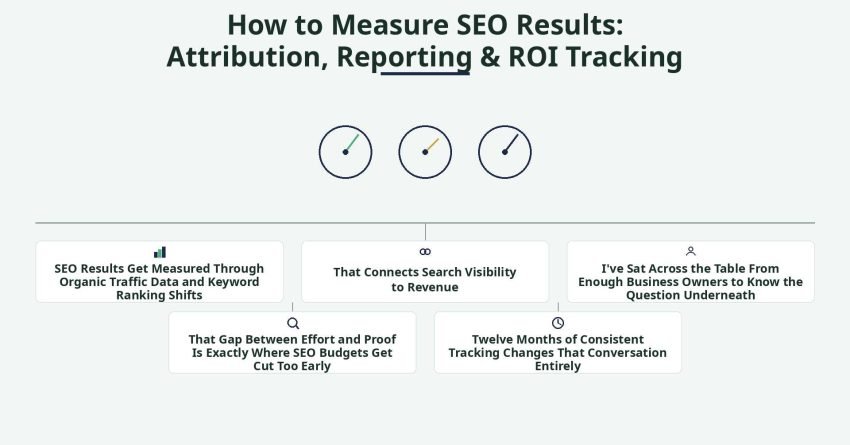
SEO results get measured through a combination of organic traffic data, keyword ranking shifts, conversion tracking, and attribution modeling that connects search visibility to revenue. I’ve sat across the table from enough business owners to know the question underneath “how do I measure SEO” is really “how do I know this is working.”
That gap between effort and proof is exactly where SEO budgets get cut too early. Twelve months of consistent tracking changes that conversation entirely.
This guide covers what separates real measurement from vanity metrics, how to set up Search Console and Analytics so the data actually means something, the attribution models that connect clicks to revenue, how to build a reporting rhythm that holds up to scrutiny, and the ROI math that turns rankings into a defensible budget line.
What “Measuring SEO Results” Actually Means
Measuring SEO results means tracking the metrics that show whether organic search is generating real business value, not just higher rankings. I split these into leading indicators and lagging indicators, and conflating the two is the single most common reporting mistake I see.
Leading vs. Lagging SEO Metrics
Leading metrics are the early signals: rankings, impressions, crawl stats, and indexation. Lagging metrics are the outcomes: traffic, leads, and revenue. Leading metrics tell me a campaign is on track. Lagging metrics tell the client whether it paid off.
Why Rankings Alone Don’t Prove ROI
A keyword hitting position one means nothing if that page converts at 0.2%. Rank tracking is a diagnostic tool, not a results report, and I’ve watched teams celebrate rankings on pages that never generated a single lead.
Setting Up SEO Measurement Foundations
SEO measurement starts with properly configured tracking in Google Search Console and Google Analytics 4, since every downstream report depends on this data being accurate from day one. I treat this setup as non-negotiable before any client conversation about results happens.
Google Search Console Setup Essentials
Search Console setup means verifying the domain property, submitting an XML sitemap, and confirming index coverage for every important URL. This is also where I catch crawl errors before they quietly suppress a page’s visibility for months.
Google Analytics 4 Configuration for SEO
GA4 configuration for SEO means defining conversion events, setting up channel grouping so organic traffic isn’t miscategorized, and linking the property to Search Console directly inside the admin panel. Event-based tracking in GA4 replaced the old session model, and a lot of older setups still carry that mismatch.
Connecting GSC and GA4 Data
Linking these two platforms lets me see which queries drove clicks and then trace those same sessions through to a conversion event. Without this connection, I’m stuck reporting on traffic in one tool and revenue in another with no bridge between them.
Key SEO Metrics That Matter
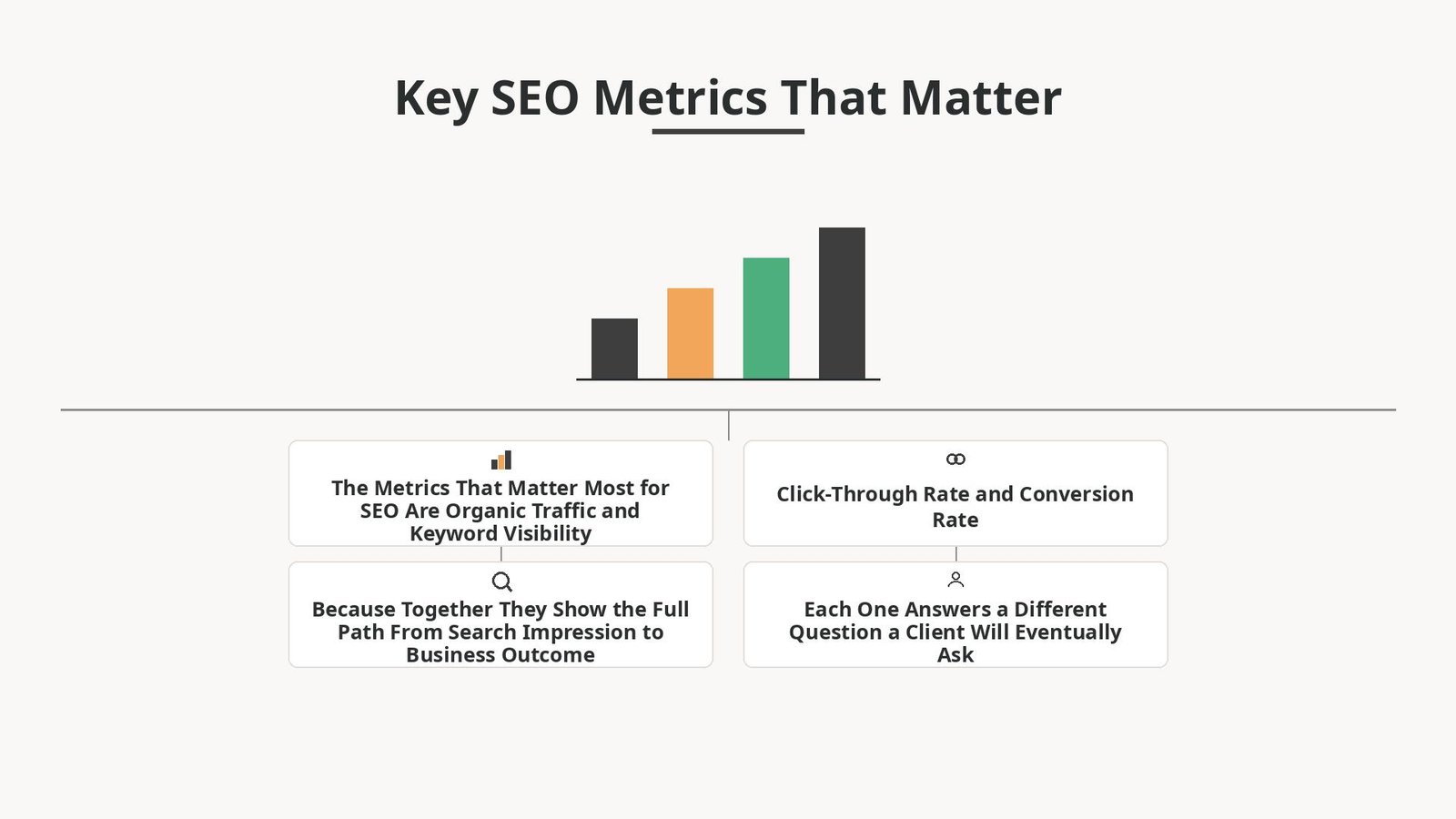
The metrics that matter most for SEO are organic traffic, keyword visibility, click-through rate, and conversion rate, because together they show the full path from search impression to business outcome. Each one answers a different question a client will eventually ask.
This table shows how each core metric maps to the question it answers:
| Metric | What It Measures | Question It Answers |
| Organic Traffic | Sessions from unpaid search | Is visibility growing? |
| Keyword Rankings | Position for target terms | Are we becoming more visible? |
| CTR | Clicks ÷ impressions | Are listings compelling? |
| Conversion Rate | Conversions ÷ organic sessions | Is traffic turning into business? |
Organic Traffic and Impressions
Organic traffic counts sessions arriving from unpaid search results, while impressions count how often a page appeared in search regardless of a click. I watch impressions rise months before traffic does, which is often the first real sign a strategy is working.
Keyword Rankings and Visibility Share
Visibility share aggregates ranking position and search volume across an entire keyword set rather than tracking one term in isolation. A domain can lose rankings on ten keywords and still grow visibility share if it gains positions on fifty others.
Click-Through Rate (CTR)
CTR measures the percentage of searchers who click a listing after seeing it in results, and it directly reflects how compelling the title tag and meta description are. Backlinko’s analysis of 5 million search results found the average CTR for position one sits around 39.8%, dropping sharply by position three.
Conversion Rate from Organic Traffic
Conversion rate from organic traffic divides the number of completed goal actions by total organic sessions, and this is the number that finally connects SEO to revenue. I’ve seen conversion rate vary by a factor of ten between informational and commercial-intent pages on the same domain.
SEO Attribution Models Explained
SEO attribution models determine how credit for a conversion gets assigned when a customer interacts with multiple marketing channels before buying. This matters because organic search rarely closes the deal alone; it usually opens it.
First-Click vs. Last-Click Attribution
First-click attribution gives full credit to the first channel a customer touched, which often favors organic search since it’s commonly the discovery channel. Last-click attribution gives full credit to the final touchpoint, which tends to favor paid search or direct traffic instead.
Multi-Touch Attribution for Organic Search
Multi-touch attribution splits conversion credit across every channel in the customer journey rather than assigning it entirely to one touchpoint. This model usually paints a fairer picture of SEO’s contribution, since search often influences a purchase long before the final session.
The Attribution Challenge: Why SEO Is Hard to Credit
SEO is hard to credit accurately because a large share of its influence happens outside what analytics platforms can directly observe, a phenomenon commonly called dark traffic. Someone searches a brand name after seeing it in organic results days earlier, and that session shows up as direct traffic instead.
Dark Traffic and Assisted Conversions
Dark traffic refers to sessions that analytics tools can’t trace back to their true originating source, often because of ad blockers, app referrals, or privacy settings stripping the referrer data. Assisted conversions attempt to account for this gap by showing every channel that touched a customer journey, not just the final one.
Building an SEO Reporting Dashboard
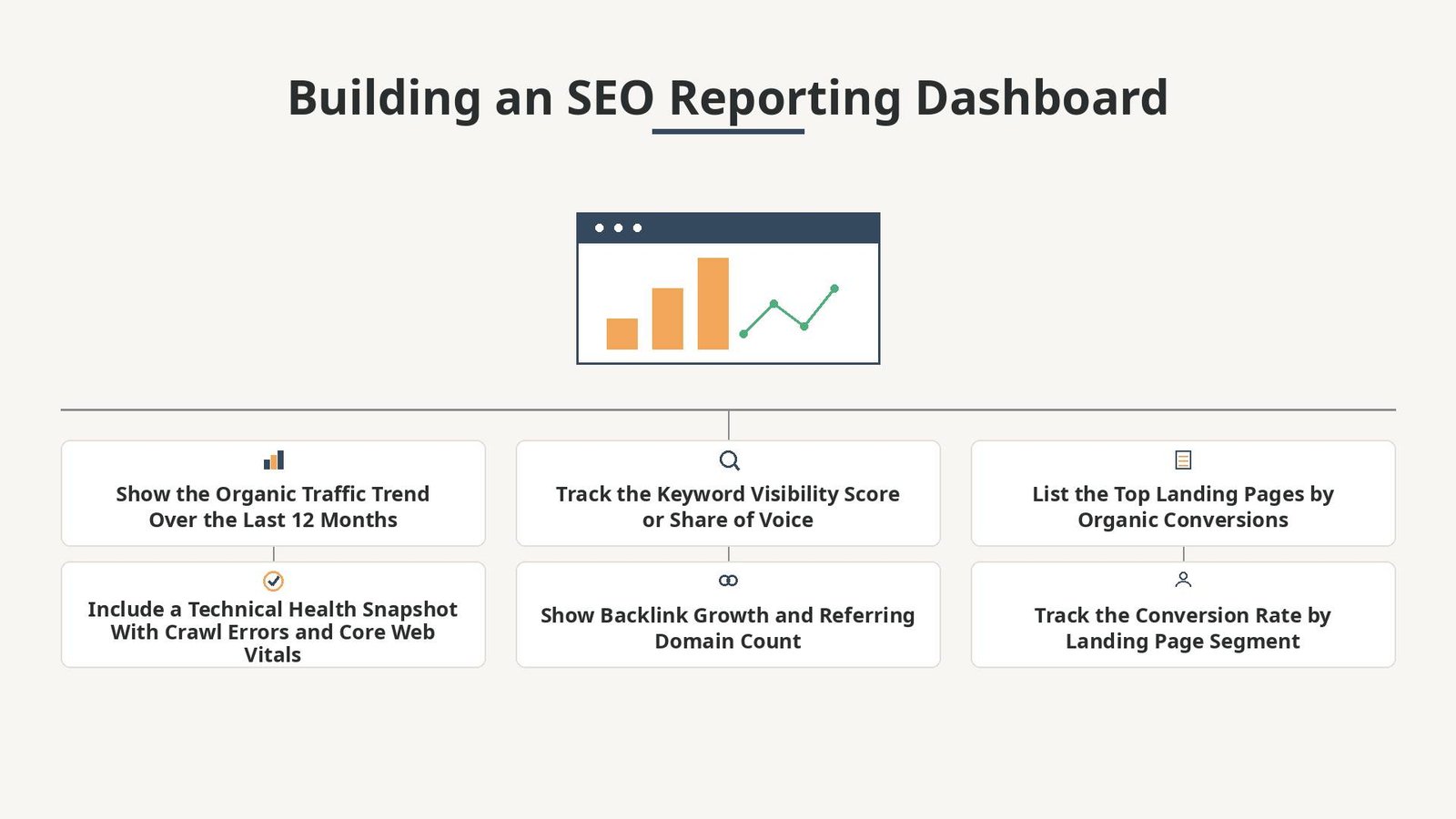
An SEO reporting dashboard pulls traffic, ranking, and conversion data into a single view so performance can be reviewed without jumping between five separate tools. I build mine around the questions a stakeholder actually asks, not around whatever metrics are easiest to export.
This list covers what belongs in a functional SEO dashboard:
- Organic traffic trend over the last 12 months
- Keyword visibility score or share of voice
- Top landing pages by organic conversions
- Technical health snapshot (crawl errors, Core Web Vitals)
- Backlink growth and referring domain count
- Conversion rate by landing page segment
Choosing the Right Reporting Tools
Looping Looker Studio, Search Console, and GA4 together covers most reporting needs without a dedicated enterprise platform. Larger sites with complex attribution needs often add a tool built specifically for multi-touch modeling on top of that base.
What to Include in a Monthly SEO Report
A monthly SEO report should include traffic trends, ranking movement, technical issues resolved, and conversions tied to organic sessions. I always add one sentence of context per metric, because a number without an explanation gets misread every time.
Reporting Cadence: Weekly, Monthly, Quarterly
SEO reporting cadence should match the pace at which each metric actually changes, which means weekly technical checks, monthly performance reports, and quarterly strategic reviews. Checking rankings daily just creates noise since normal algorithm volatility looks identical to a real problem on a short enough timeline.
Calculating SEO ROI
SEO ROI is calculated by dividing the net profit generated from organic search by the total cost of the SEO investment, then expressing that figure as a percentage. This single number is usually what determines whether a budget gets renewed.
The Basic SEO ROI Formula
The basic formula is (Revenue from Organic Traffic − SEO Cost) ÷ SEO Cost × 100. A campaign generating $50,000 in attributed revenue against a $10,000 monthly spend returns a 400% ROI by this calculation.
Factoring in Customer Lifetime Value
Factoring in customer lifetime value means calculating ROI against the total revenue a customer generates over their full relationship with the business, not just their first purchase. SEO ROI numbers often look unimpressive in month three and genuinely strong once lifetime value enters the equation at month eighteen.
Understanding SEO Timelines and Growth Curves
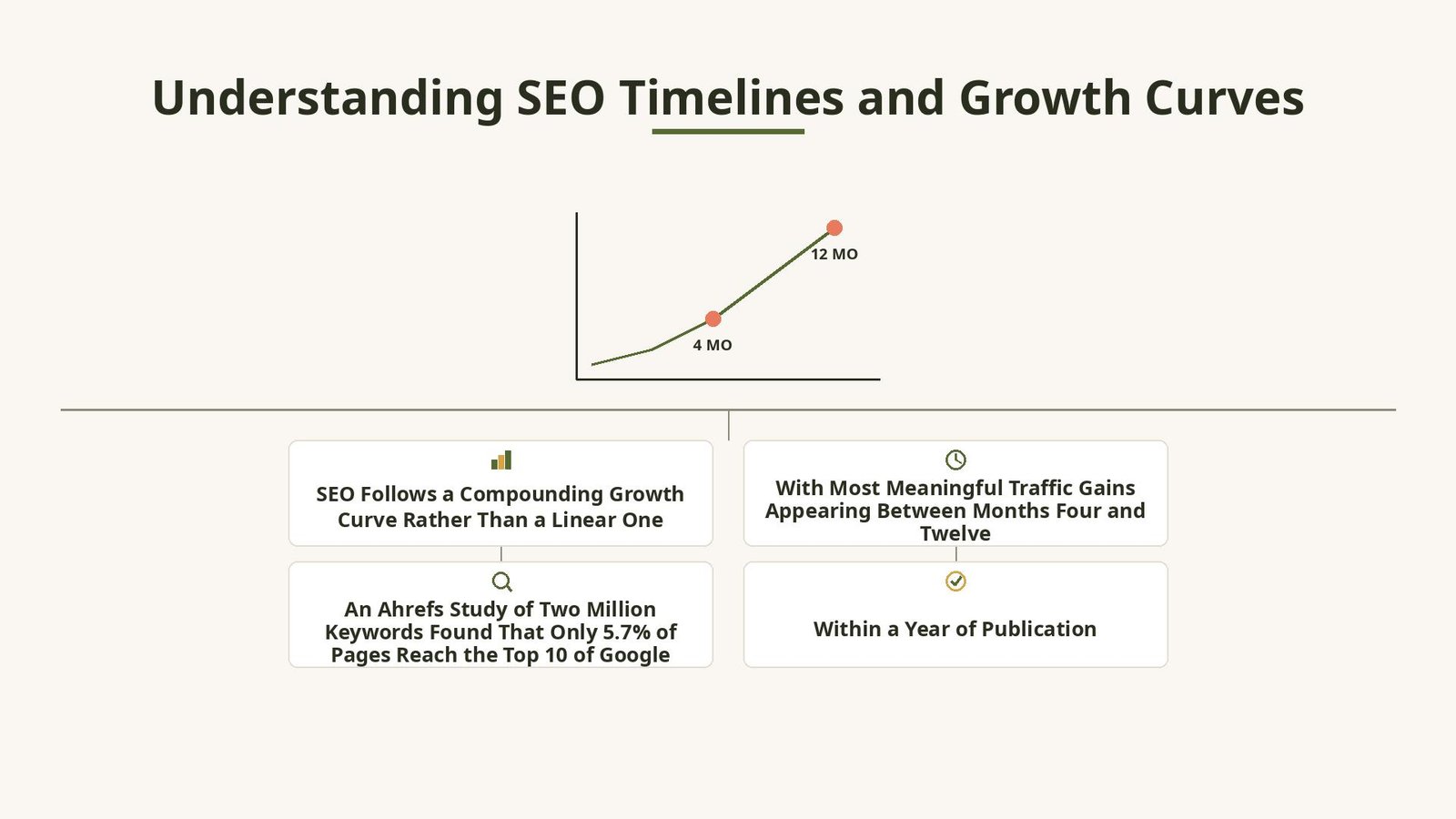
SEO follows a compounding growth curve rather than a linear one, with most meaningful traffic gains appearing between months four and twelve. An Ahrefs study of two million keywords found that only 5.7% of pages reach the top 10 of Google within a year of publication.
Why SEO Takes 4–12 Months to Show Results
Search engines need repeated crawling, indexing, and trust-building signals before a new or improved page earns a stable ranking position. Content published this month typically needs several months of accumulated engagement and backlink signals before it stabilizes anywhere near its ceiling.
Keyword Ranking Tracking Methods
Keyword ranking tracking methods range from manual spot-checks in incognito search to automated rank trackers that pull position data daily across thousands of terms. I rely on automated tracking for scale and manual checks for verifying anything that looks unusual.
Rank tracking tools typically report three things: current position, position change over a set period, and estimated search volume for the tracked term. Grouping tracked keywords by topic cluster, rather than reviewing them as a flat list, makes it much easier to see which content areas are gaining or losing ground.
Traffic Quality vs. Traffic Quantity
Traffic quality measures how well visiting sessions match buying intent, while traffic quantity simply counts total sessions regardless of fit. A page pulling 10,000 irrelevant visits a month is a weaker asset than one pulling 500 visits that convert at 8%.
Bounce rate, average session duration, and pages per session all help separate quality traffic from inflated numbers. A spike in raw traffic that isn’t accompanied by any movement in conversions is usually a sign the keyword targeting drifted off from commercial intent.
Conversion Tracking for SEO Campaigns
Conversion tracking for SEO campaigns means recording specific actions organic visitors complete, such as form fills, calls, or purchases, and tying each one back to the session’s source channel. Without this step, traffic growth and business growth stay two completely separate conversations.
Setting Up Goals and Events in GA4
Setting up conversion events in GA4 means marking specific user actions, like a form submission or a checkout completion, as key events inside the admin panel. Each event needs its own clear trigger condition, or the data ends up double-counting actions that don’t actually represent a real conversion.
Local SEO Measurement Considerations
Local SEO measurement adds metrics that standard organic tracking doesn’t capture, including map pack visibility, direction requests, and phone calls generated directly from a business listing. A business with strong local intent can look flat in standard GA4 reports while actually growing fast in ways that tool simply doesn’t track.
Google Business Profile Insights
Google Business Profile Insights reports views, search queries, and customer actions like calls or website clicks generated directly from a business’s local listing. This data sits completely outside GA4 and has to be pulled and reported on separately.
Common SEO Measurement Mistakes
Common SEO measurement mistakes include reporting rankings without conversions, ignoring branded search growth, and comparing month-over-month data without accounting for seasonality. I see the ranking-only report more than any other mistake, mostly because it’s the easiest number to show.
Confusing correlation with causation ranks close behind, especially when a traffic spike coincides with an unrelated event like a press mention or a viral social post. Attributing that spike to ongoing SEO work overstates the program’s real performance and sets an expectation that won’t repeat.
Benchmarking SEO Performance Against Competitors
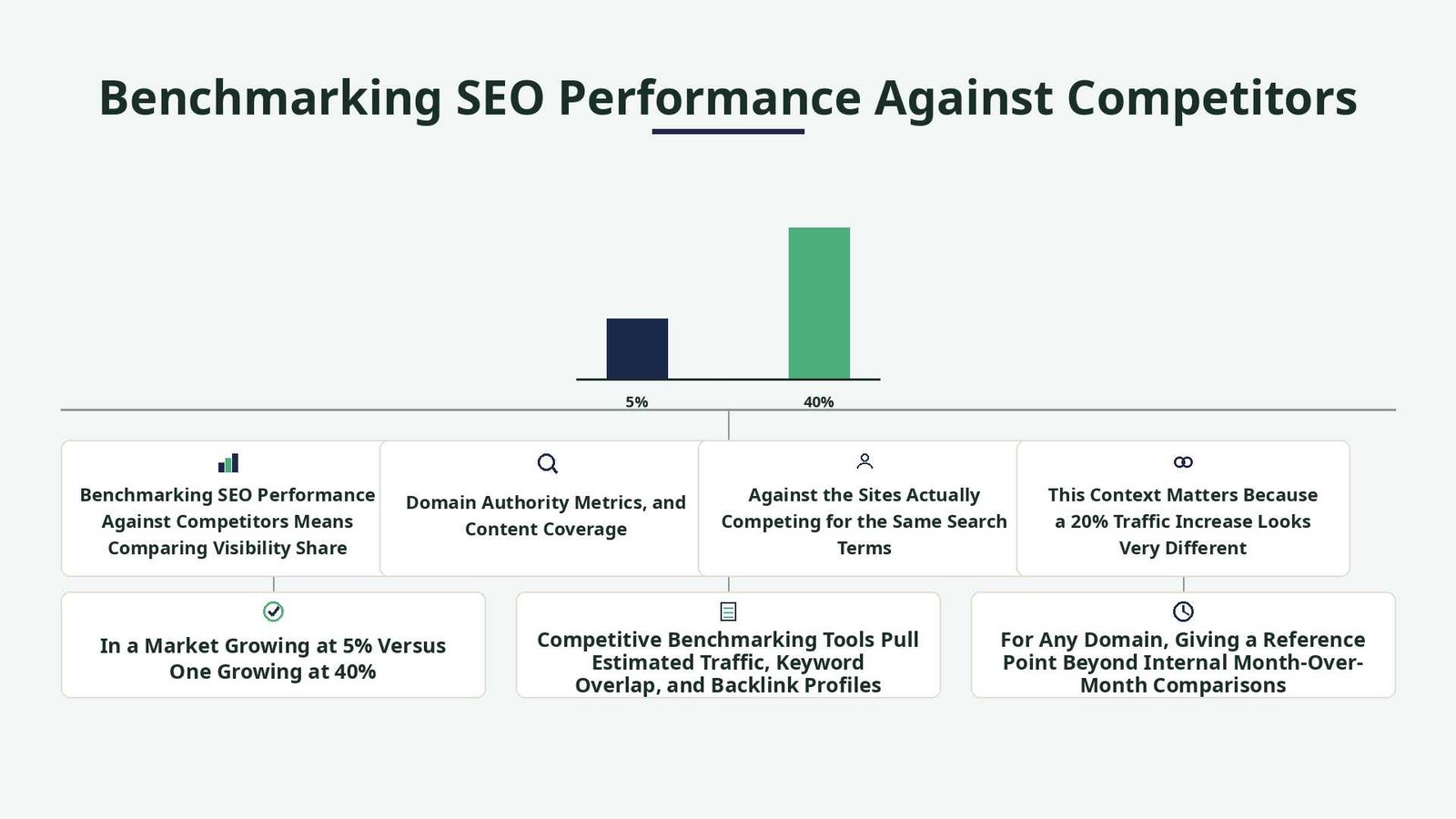
Benchmarking SEO performance against competitors means comparing visibility share, domain authority metrics, and content coverage against the sites actually competing for the same search terms. This context matters because a 20% traffic increase looks very different in a market growing at 5% versus one growing at 40%.
Competitive benchmarking tools pull estimated traffic, keyword overlap, and backlink profiles for any domain, giving a reference point beyond internal month-over-month comparisons.
Tools for SEO Reporting and Analytics
SEO reporting tools fall into a few core categories: analytics platforms, rank trackers, technical auditors, and backlink monitors, and most mature programs end up using at least one from each category.
| Tool Category | Primary Function | Example Use Case |
| Analytics Platform | Traffic and conversion data | GA4 |
| Rank Tracker | Keyword position monitoring | Daily SERP tracking |
| Technical Auditor | Crawl and site health | Core Web Vitals, indexation |
| Backlink Monitor | Link profile tracking | New/lost referring domains |
Conclusion
SEO results come down to connecting rankings, traffic, and attribution models to real conversions and revenue. Understanding this full chain keeps expectations realistic and budgets defensible.
Reporting and ROI tracking only get more important as search evolves toward AI-driven results. The fundamentals covered here remain the foundation regardless of how SERPs change.
We built our reporting process around exactly this kind of transparency. Partner with White Label SEO Service to get SEO measurement that actually proves its value.
Frequently Asked Questions
How long does it take to see SEO results?
Most SEO campaigns show measurable traffic growth between four and twelve months. Technical fixes can show faster signals, while competitive keywords take longer to stabilize.
What is a good conversion rate from organic traffic?
A good organic conversion rate typically falls between 2% and 5% for most industries. E-commerce sites often sit lower, while service businesses with strong intent pages often exceed this range.
How do you attribute revenue to SEO?
Revenue gets attributed to SEO by tracking organic sessions through to conversion events in GA4, then applying an attribution model like first-click or multi-touch. This connects specific keywords and pages to actual revenue outcomes.
What’s the difference between SEO reporting and SEO ROI?
SEO reporting tracks performance metrics like traffic and rankings over time. SEO ROI calculates the financial return generated relative to the cost of the SEO investment itself.
Which metrics matter most for SEO ROI?
Organic conversions, revenue per session, and cost per acquisition matter most for calculating SEO ROI. Rankings and traffic only matter insofar as they feed into these downstream numbers.
How do you track SEO performance without Google Analytics?
Search Console alone can track impressions, clicks, and average position for organic queries. Server log analysis and third-party rank trackers can fill in traffic and ranking gaps without GA4.
What is a realistic SEO ROI timeline for a small business?
Small businesses typically see initial ROI signals between six and nine months, with stronger returns compounding after twelve months. Budget and competition level both significantly affect this timeline.