
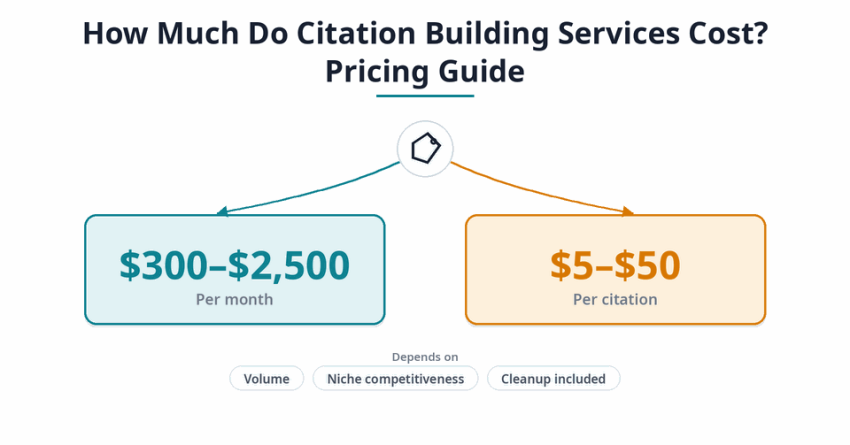
Citation building services typically cost between $300 and $2,500 per month, or $5 to $50 per individual citation, depending on volume, niche competitiveness, and whether cleanup work is included. I’ve seen businesses overpay for bloated packages and others underpay for citations that never actually get approved. Pricing in this space swings wildly because the work itself isn’t standardized.
Getting this wrong costs more than money. A business that picks the cheapest option often ends up with inconsistent NAP data across directories, which actively hurts local rankings instead of helping them.
This guide covers what actually drives citation pricing, the different pricing models providers use, how your industry and location change your costs, the hidden fees to watch for, and how to judge whether a provider’s price reflects real value or just a markup.
What Is Citation Building and Why Does It Cost Money?
Citation building is the process of creating and maintaining consistent listings of a business’s name, address, and phone number across directories, data aggregators, and industry-specific platforms. Local search engines use these listings to verify that a business is real, active, and located where it claims to be.
I think of citations as trust signals rather than backlinks. They don’t pass authority the way a link does, but they confirm legitimacy, and that confirmation directly affects whether a business shows up in the local map pack.
The cost exists because citation building isn’t just submitting a form. Someone has to research which directories matter for a given industry, manually enter accurate data, verify listings get approved, and monitor for duplicates or outdated information that creeps back in over time. That labor is what you’re actually paying for, not the listings themselves.
What Determines the Price of Citation Building Services?
The price of a citation building service depends on the number of citations needed, the niche’s directory landscape, whether cleanup of existing bad data is required, and how much ongoing monitoring is included. Several variables combine to set your final number:
- Volume of citations — more directories targeted means more hours of manual work
- Industry-specific directories — niches like legal, medical, or home services require paid submissions to specialty directories
- Existing data mess — businesses with years of inconsistent NAP data need cleanup before new citations even make sense
- Number of business locations — multi-location businesses multiply the work linearly
- Monitoring and maintenance — ongoing citation audits cost more than a one-time build
- Manual vs. automated submission — manually verified listings cost more than bulk-syndicated ones
Each of these factors stacks, which is why two businesses in the same city can get quotes that differ by hundreds of dollars a month for what looks like the same service on paper.
Types of Citations and How Each Affects Cost
Citations fall into a few distinct categories, and each one carries a different price tag based on how much manual effort it requires to list and verify a business correctly.
| Citation Type | Examples | Relative Cost | Why |
| Data aggregator citations | Data Axle, Foursquare, Neustar | Low | Bulk-submitted, feeds many smaller directories automatically |
| General business directories | Yelp, Yellow Pages, Bing Places | Low–Medium | Semi-automated but requires manual claiming |
| Industry-specific directories | Avvo (legal), Healthgrades (medical) | Medium–High | Niche platforms often charge their own listing fees |
| Local chamber/association listings | Local chambers of commerce | Medium | Requires individual outreach or membership |
| Niche high-authority citations | Apple Maps, major map platforms | Medium–High | Verification steps slow down submission |
A citation strategy built only on data aggregators will cost less than one that includes industry-specific directories, but it also tends to produce weaker local SEO results.
How Much Do Citation Building Services Cost on Average?

Citation building services generally cost $300 to $2,500 per month for ongoing packages, or $5 to $50 per citation when priced individually, with the final number depending heavily on scope and industry. Here’s how that breaks down by tier:
| Pricing Tier | Monthly Cost | What’s Typically Included |
| Basic/DIY-assisted | 100–400 | 20–40 core directory submissions, no cleanup |
| Mid-range | 400–1,200 | 50–100 directories, cleanup included, quarterly monitoring |
| Premium/Enterprise | 1,200–2,500+ | 100+ directories, industry-specific listings, ongoing audits, multi-location support |
I’ve found that most small, single-location businesses land comfortably in the mid-range tier. Anything priced far below $300 a month for genuine ongoing citation work usually means bulk-automated submissions with little quality control.
Per-Citation Pricing vs. Package Pricing
Citation services are priced either per individual citation or as a bundled package, and each model suits a different type of buyer. Per-citation pricing works well for businesses needing a small, targeted number of listings rather than full coverage.
| Model | Typical Range | Best For |
| Per-citation | 5–50 each | Businesses needing only specific high-value directories |
| Package (one-time) | 200–800 | New businesses needing full initial citation coverage |
| Package (monthly retainer) | 300–2,500/mo | Ongoing management and ranking maintenance |
Package pricing almost always works out cheaper per citation than paying individually, but it only makes sense if you actually need the volume included in the package.
Monthly Retainer Pricing for Ongoing Citation Management
Monthly retainers for citation management typically run $300 to $1,500 per month and cover continuous monitoring, duplicate removal, and updates whenever business information changes. This model exists because citations degrade over time.
Directories get acquired, data feeds break, and old information resurfaces even after it’s corrected. A retainer pays for someone to keep catching that drift before it affects rankings. Businesses that skip ongoing management often see their citation consistency score decline within a year of a one-time build.
One-Time Citation Cleanup vs. Ongoing Building Costs
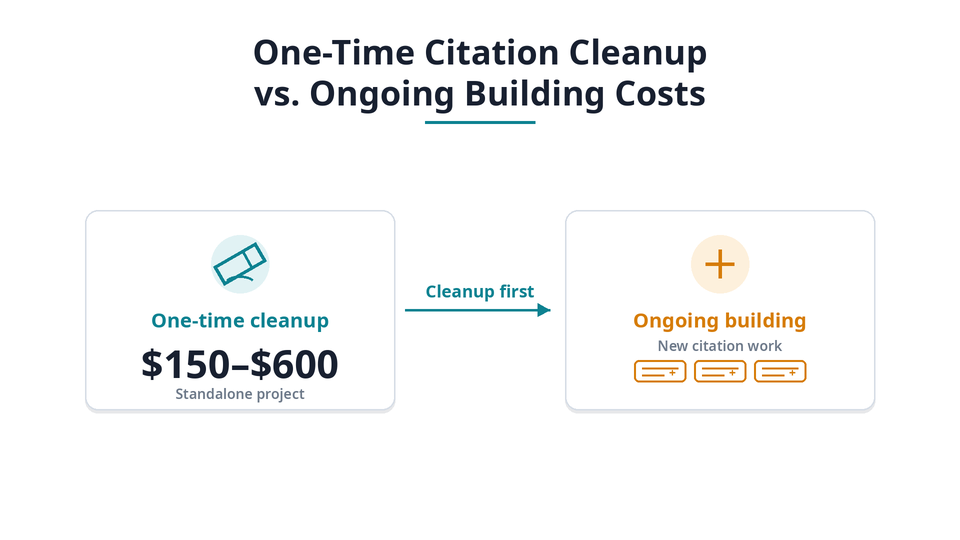
One-time citation cleanup addresses existing inconsistent or duplicate listings and typically costs $150 to $600 as a standalone project, separate from any new citation building work. This is a distinct service from building new citations, even though many providers bundle both.
Cleanup pricing depends on how many duplicate or incorrect listings already exist across the web, since each one needs to be claimed and corrected individually. A business that has rebranded, moved locations, or changed phone numbers usually needs cleanup before any new citation work delivers value.
DIY Citation Building vs. Hiring a Service — Cost Comparison
Building citations yourself costs little in direct fees but consumes significant time, while hiring a service costs more upfront but saves the hours needed to research, submit, and verify dozens of individual listings.
| Approach | Direct Cost | Time Investment | Risk |
| DIY | 0–100 (tools/fees) | 15–30 hours initially | Inconsistent data, missed directories |
| Hiring a service | 300–2,500/mo | 1–2 hours (oversight only) | Lower if provider is vetted properly |
If an owner’s time is worth more than roughly $20 an hour, the math usually favors hiring out the work rather than spending a weekend manually submitting to forty directories.
How Industry and Niche Affect Citation Pricing
Industry directly affects citation pricing because certain niches require paid submissions to specialty directories that general business categories never touch. Legal, medical, home services, and automotive businesses all have industry-specific platforms with their own listing fees.
A general retail business might only need standard directories, keeping costs on the lower end. A medical practice, by contrast, often needs listings on Healthgrades, Vitals, and insurance-network directories, each adding its own cost layer to the total project.
How Location and Number of Business Locations Affect Cost
The number of business locations multiplies citation costs directly, since each location requires its own full set of citations rather than sharing listings with the others. A ten-location business doesn’t pay ten times a single location’s price, but volume discounts rarely offset the added workload completely.
Geographic market also plays a role. Businesses in competitive metro areas often need deeper citation coverage, including hyperlocal directories, to compete with dozens of similar businesses already well-established in local search results.
How Many Citations Do You Actually Need?
Most businesses need somewhere between 40 and 80 core citations to establish solid local search credibility, though the exact number depends on industry and competition level. More isn’t automatically better past a certain point.
I’ve seen businesses spend money padding citation counts into the hundreds when forty well-chosen, accurate listings would have done the job. The real ceiling is diminishing returns — once the core data aggregators and top directories are covered, additional citations add less value per dollar spent.
Citation Quality vs. Quantity and Its Price Impact
Citation quality matters more than citation quantity for local search performance, and prioritizing quality typically costs more per listing because verification and accuracy checks take additional time. A provider charging less per citation often skips the verification step that confirms a listing actually went live correctly.
Low-quality citation building floods directories with submissions that may never get approved or may list slightly inconsistent information. That inconsistency is exactly what citation building is supposed to prevent, so cutting corners on quality undermines the entire purpose of the spend.
Hidden Fees and Costs to Watch For in Citation Services

Hidden costs in citation building often show up as setup fees, per-directory premium charges, or cancellation penalties that aren’t disclosed until after a contract is signed. I always tell business owners to ask for a full itemized breakdown before paying anything.
Common hidden fees include charges for “premium” directory placements billed separately from the base package, fees for correcting data the provider entered incorrectly, and automatic renewal clauses that lock in pricing for a full year without an easy exit.
Signs a Citation Building Service Is Overpriced or Low Quality
A citation building service is likely overpriced or low quality if it can’t provide a list of exact directories included, refuses to show before-and-after proof of listings going live, or charges premium rates for fully automated bulk submissions.
Vague reporting is the biggest warning sign. A provider should be able to show specific URLs where citations were created, not just a summary count claiming “50 citations built” with no way to verify any of them actually went live correctly.
Is Citation Building Worth the Cost? ROI and Local SEO Impact
Citation building is worth the cost for most local businesses because consistent NAP data is a confirmed local ranking factor, and the fix is typically far cheaper than the lost revenue from poor map pack visibility. A BrightLocal survey found that 98% of consumers search online for local businesses, making local pack visibility directly tied to revenue.
The ROI calculation is straightforward for most businesses. A few hundred dollars a month in citation management is small compared to the cost of losing potential customers who can’t find consistent, trustworthy information about a business across the directories they actually check.
How Citation Building Fits Into Total Local SEO Budget

Citation building usually represents 10% to 20% of a comprehensive local SEO budget, with the remainder going toward on-page optimization, review management, and content. It’s rarely meant to be the entire strategy on its own.
Businesses that treat citations as their sole local SEO investment tend to plateau quickly, since citations establish baseline trust but don’t actively build the ongoing authority signals that reviews, content, and local link building contribute over time.
How to Choose a Citation Building Service Based on Price and Value
Choosing the right citation building service means comparing itemized directory lists, verification processes, and reporting transparency rather than picking the lowest monthly price alone. A cheaper provider that delivers thirty verified, accurate citations often outperforms an expensive one that delivers a hundred unverified ones.
I’d rather see a detailed sample report before signing anything. The providers worth paying for will readily show proof of past work, explain exactly which directories they target for a given industry, and give a realistic timeline for when citations typically go live.
Conclusion
Citation pricing depends on volume, industry, and whether cleanup is needed, not a flat rate. Package and retainer models dominate the market, with quality verification driving most price differences.
Local SEO budgets should treat citations as one piece of a broader visibility strategy, not the whole plan. Consistent data compounds in value over time.
We help businesses build accurate, verified citation profiles that support real local rankings. Reach out to White Label SEO Service to get a transparent citation pricing breakdown today.
Frequently Asked Questions
How much does citation building cost per citation?
Individual citations typically cost $5 to $50 each, depending on whether the directory is a general aggregator or an industry-specific platform. Specialty directories with manual verification sit at the higher end.
Is citation building a one-time cost or ongoing expense?
Citation building works best as an ongoing expense because listings drift out of sync over time. A one-time build without monitoring typically degrades within 12 months.
What’s included in a typical citation building package price?
A typical package includes directory submissions, data verification, duplicate removal, and basic monthly reporting. Higher-tier packages add industry-specific directories and multi-location support.
Why do citation building prices vary so much between providers?
Prices vary because of differences in directory volume, manual verification versus bulk automation, and whether cleanup of existing bad data is included. Providers doing genuine manual work charge more than those using automated syndication.
Are cheap citation building services worth the lower cost?
Cheap services are rarely worth it because they often rely on unverified bulk submissions that never go live correctly. Inconsistent data from failed submissions can actively hurt local rankings.
Does citation building cost more for multi-location businesses?
Yes, multi-location businesses pay more because each location needs its own complete set of citations. Costs scale with location count, though bulk discounts sometimes reduce the per-location rate.
How much should a small business budget for citation building?
Most small, single-location businesses should budget $300 to $800 per month for ongoing citation management. This typically covers verified submissions plus basic monitoring.


