

A local citation service provider is a company that builds, manages, and corrects business name, address, and phone number (NAP) listings across directories, data aggregators, and industry sites to strengthen local search visibility. I’ve watched businesses waste months chasing rankings while their NAP data sat scattered across forty inconsistent directory listings, and no amount of content or backlinks fixed that underlying problem. We built this guide because most business owners don’t know what a good citation provider actually does differently from a bad one.
Inconsistent citations confuse search engines and erode local trust signals fast. Hiring the wrong provider wastes budget and can actively damage rankings for months.
This guide covers what citation providers actually do and why citations still matter, the different citation types and core services on the market, the qualities and red flags that separate reliable providers from risky ones, how pricing and contracts typically work, and how to evaluate results before and after you sign.
What Is a Local Citation Service Provider?
A local citation service provider is a company that creates, verifies, and maintains consistent business listings across online directories, data aggregators, and niche platforms. I think of them as the team responsible for making sure your business name, address, and phone number say the exact same thing everywhere Google looks.
That consistency matters more than most business owners realize going in. Search engines cross-reference citation data to confirm a business is real, active, and located where it claims to be.
NAP Consistency — Why It Matters
NAP consistency means a business’s name, address, and phone number appear identically across every directory and platform where it’s listed. Even small variations — “St.” versus “Street,” a missing suite number — create doubt for ranking algorithms. I’ve seen a single mismatched phone number hold back an otherwise strong local profile for months.
Citation Providers vs. DIY Citation Building
Citation providers typically have existing relationships with data aggregators and submission workflows that individual business owners don’t have access to. DIY citation building means manually submitting and verifying listings one directory at a time, which works fine for a handful of sites but becomes unmanageable past fifteen or twenty. We’ll get into DIY citation building vs. hiring a professional in more depth further down.
Why Local Citations Still Matter for Local SEO in 2026

Local citations remain one of the core trust and relevance signals search engines use to validate a business’s location and legitimacy for local search results. I still see agencies claim citations are “dead,” and then watch their clients plateau in the map pack for no obvious reason.
Citations haven’t lost their weight. They’ve just become table stakes rather than a differentiator on their own.
Citations and the Local Pack / Map Pack
The local pack is the map-based block of three business listings Google shows above organic results for location-based searches. Consistent, accurate citations feed directly into the data Google uses to rank and display businesses there. A business with scattered or outdated listings is working against itself before it ever gets to content or links.
Citations as a Trust Signal for Search Engines
Search engines treat corroborated business data from multiple independent sources as a trust signal, similar to how they treat backlinks from different domains. An Ahrefs study of local ranking factors found citation consistency correlated strongly with map pack visibility across the markets tested. I treat that correlation as a floor requirement, not a growth lever on its own.
Types of Local Citation Services Explained
Citation services generally fall into structured, unstructured, and niche-specific categories, each targeting a different kind of online listing. Knowing which type a provider focuses on tells you a lot about what results to expect.
Structured Citations (Data Aggregators)
Structured citations are standardized listings on directories like data aggregators, where business information appears in a consistent, predictable format. These typically include major data aggregator platforms that redistribute business data to dozens of smaller directories downstream. A good provider manages aggregator submissions first because errors there multiply everywhere else.
Unstructured Citations (Mentions & Editorial Links)
Unstructured citations are mentions of a business’s name, address, or phone number that appear in articles, blog posts, or press coverage without a standardized listing format. These carry weight because they’re harder to manufacture and read as organic. Most citation packages don’t include unstructured citation outreach, so I always ask directly if it’s part of the scope.
Niche & Industry-Specific Citation Sites
Niche citation sites are directories built around a specific industry, such as legal, medical, or home services platforms, rather than general business listings. A contractor listed on three relevant trade directories often gets more local ranking benefit than the same contractor spread across twenty generic directories. Providers with real industry and location experience usually know which niche sites actually move the needle for a given trade.
Core Services Offered by Citation Providers

Citation providers typically offer three core services: building new listings, cleaning up existing inaccurate ones, and ongoing monitoring to catch future drift. Most providers bundle these, but the depth of each service varies significantly between companies.
Citation Building
Citation building is the process of creating new, accurate business listings across relevant directories and data aggregators. A thorough build typically covers the major aggregators first, then expands into niche and local directories based on the business’s industry and service area.
Citation Cleanup & Correction
Citation cleanup is the process of finding and correcting inaccurate, duplicate, or outdated business listings that already exist online. This work is often more time-consuming than building from scratch, especially for businesses that have rebranded, moved, or changed phone numbers. I’ve seen cleanup projects take twice as long as the original build because old data doesn’t disappear on its own.
Citation Monitoring & Reporting
Citation monitoring is ongoing tracking of a business’s listings to catch new inconsistencies, duplicate entries, or unauthorized edits as they appear. Directories get scraped, re-scraped, and occasionally edited by third parties, so a one-time cleanup without monitoring tends to decay within a year.
Key Qualities to Look for in a Citation Service Provider
The strongest citation providers combine direct data aggregator relationships, transparent submission processes, and genuine experience in your specific industry and location. These three qualities predict reliability better than price or package size.
Data Aggregator Relationships
Direct relationships with major data aggregators let a provider push corrections upstream rather than fixing listings one by one downstream. Providers without these relationships are often just manually submitting to the same public forms you could use yourself.
Manual vs. Automated Submission Process
Automated submission tools push listing data to directories using software rather than human review at each step. Manual processes involve a person verifying each listing’s accuracy before and after submission. I prefer a hybrid: automation for scale, manual review for the listings that actually matter most to local rankings.
Industry & Location Experience
Providers with direct experience in your trade and target metro area already know which niche directories carry weight and which are ignored by search engines. A provider who’s built citations for three hundred plumbers in the Midwest brings pattern recognition a generalist agency won’t have.
Questions to Ask Before Hiring a Citation Provider

Asking the right questions upfront exposes whether a provider does real citation work or just runs automated submissions and calls it a service. I keep a short list of questions that separate serious providers from the rest within the first conversation.
Ask how many directories they actually submit to manually versus through automated tools, and request a sample report from a past client in a similar industry. Ask directly whether cleanup of existing bad data is included, since many providers quote cleanup as a costly add-on after the fact.
Red Flags That Signal a Low-Quality Citation Provider
Vague deliverables, unverifiable directory counts, and no mention of existing citation cleanup are the clearest signs of a low-quality citation provider. I’ve reviewed contracts promising “500+ directory submissions” where fewer than fifty directories carried any real local search value.
A provider who can’t explain their aggregator relationships or submission process in plain language is usually reselling a generic automated tool. Watch for guaranteed ranking promises tied directly to citation work alone, since citations are one input among many ranking factors.
How Citation Services Price Their Packages
Citation service pricing typically ranges from a few hundred dollars for a one-time cleanup to several hundred dollars monthly for ongoing management across multiple locations. Price scales with the number of locations, the amount of existing bad data, and whether monitoring is included.
One-Time vs. Ongoing Citation Management
One-time citation packages handle an initial build or cleanup with no continued monitoring afterward. Ongoing management includes regular audits and corrections as directories update their data over time. I generally recommend ongoing management for any business with more than one location, since drift compounds faster than most owners expect.
Citation Services vs. Full Local SEO Services
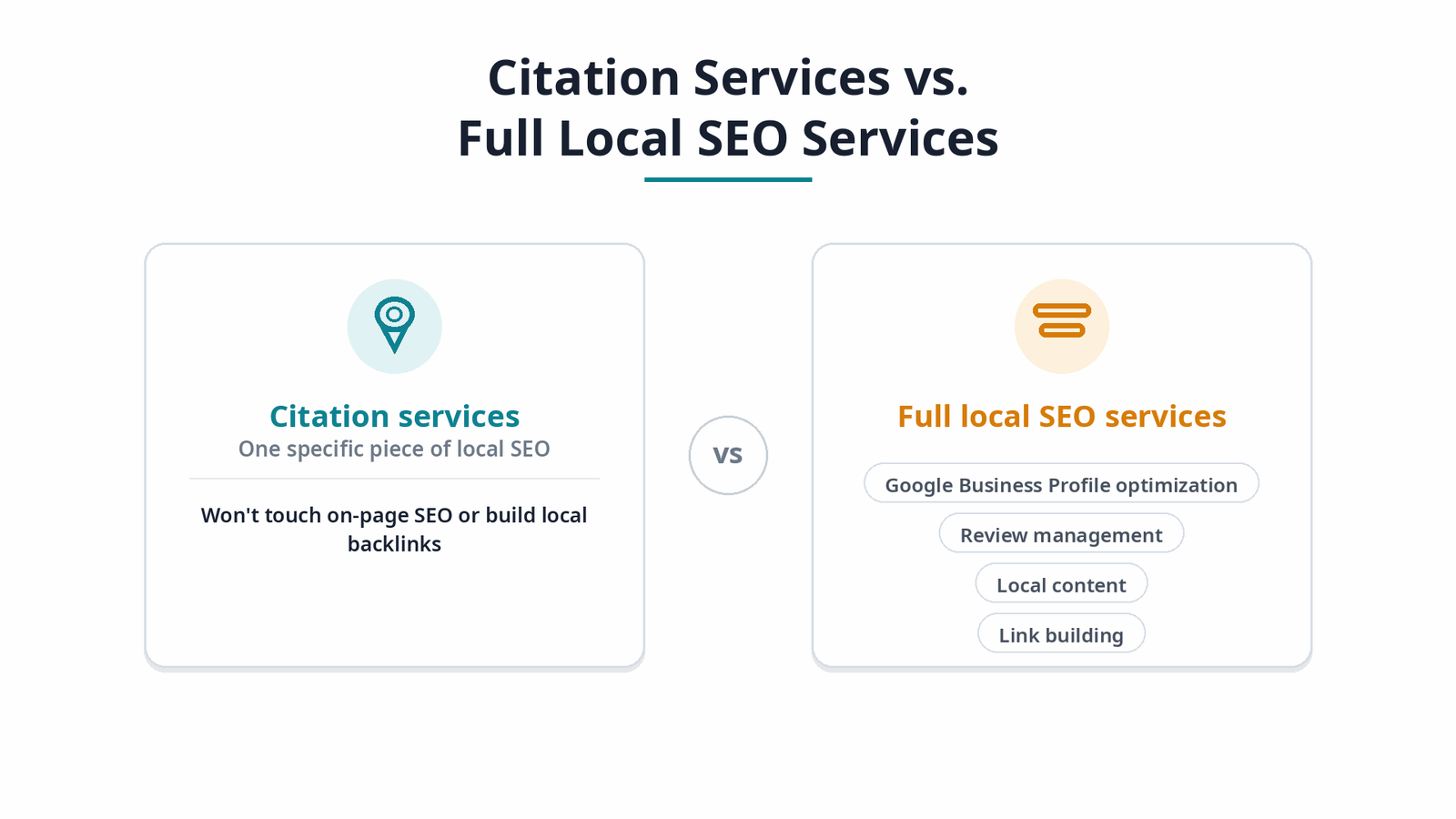
Citation services handle one specific piece of local SEO, while full local SEO services bundle citations with Google Business Profile optimization, review management, local content, and link building. A standalone citation provider won’t touch your website’s on-page SEO or build local backlinks. Businesses needing broader local visibility typically need full local SEO services rather than citation work in isolation.
How Citation Accuracy Impacts Google Business Profile Rankings
Citation accuracy directly influences Google’s confidence in a business’s location and contact data, which feeds into Google Business Profile ranking signals. A mismatched phone number across even a handful of major directories can suppress visibility in the local pack without any obvious warning inside the profile itself.
Google cross-references citation data against the business’s self-reported profile information to validate legitimacy. Inconsistencies don’t usually cause a visible penalty — they just quietly reduce ranking confidence over time.
DIY Citation Building vs. Hiring a Professional
DIY citation building works reasonably well for a single-location business with the time to manually submit and verify ten to twenty listings. Hiring a professional makes more sense once a business has multiple locations, existing bad data to clean up, or no internal bandwidth to track directory changes over time.
The real cost of DIY isn’t the submission time itself — it’s the ongoing monitoring most business owners stop doing after the first few months. A professional provider builds that monitoring into the service by default, which is where most of the long-term value actually sits.
How to Evaluate a Citation Provider’s Past Results
Evaluating past results means asking for before-and-after citation audits from real clients, not just generic case study summaries. A provider confident in their work will show you a sample citation audit demonstrating specific corrections made and the timeline involved.
Cross-reference any claimed results against the client’s actual current listings where possible. A provider unwilling to share verifiable examples is giving you a reason to keep looking elsewhere.
Common Citation Platforms Providers Submit To

Citation providers typically submit to major data aggregators, general business directories, and industry-specific platforms relevant to the client’s trade. The exact mix depends heavily on the business type and target market.
- Major data aggregator platforms that redistribute to dozens of secondary sites
- General business directories with broad search visibility
- Map and navigation-based listing platforms
- Social platforms with business profile features
- Industry-specific directories relevant to the business’s trade
- Local chamber of commerce and regional business associations
How Long Citation Building Takes to Show Results
Citation building typically takes four to twelve weeks to show measurable local ranking movement, depending on how many inconsistent listings existed beforehand. Data aggregator updates can take several weeks to propagate down to smaller directories, which naturally slows the timeline.
Businesses with extensive existing bad data usually see a longer timeline, since cleanup has to happen before new consistent data can take effect. I tell clients to expect the local pack impact closer to the three-month mark rather than looking for changes in week two.
Red Flags in Contracts and Service Agreements
Vague directory counts, no cleanup guarantee, and automatic renewal clauses buried in fine print are the most common contract red flags with citation providers. I read every citation contract looking specifically for what happens if a submitted listing gets rejected or needs resubmission.
A contract that doesn’t specify reporting frequency or provide a cancellation path within a reasonable notice period usually favors the provider, not the client.
Steps to Successfully Onboard a Citation Service Provider
Successful onboarding starts with handing over accurate, finalized NAP data before any submissions begin, since corrections after the fact slow the entire process down. I always recommend confirming the exact business name, address format, and phone number internally first.
Next, request a baseline audit of existing citations before new work starts, so progress can be measured against a real starting point. Setting a review checkpoint at the sixty-day mark keeps the engagement accountable to the timeline discussed upfront.
Conclusion
Citation accuracy, provider transparency, and realistic timelines determine whether a citation investment actually strengthens local rankings. Citations work alongside Google Business Profile optimization, reviews, and local content as one piece of a larger local SEO strategy. We help businesses evaluate and execute citation strategy correctly from day one — reach out to White Label SEO Service to get started.
Frequently Asked Questions
What does a local citation service provider do?
A local citation service provider builds, corrects, and monitors business NAP listings across directories and data aggregators. This keeps business information consistent everywhere search engines check it. Inconsistent data otherwise undermines local ranking confidence over time.
How much does it cost to hire a citation service provider?
Pricing typically ranges from a few hundred dollars for a one-time cleanup to several hundred monthly for ongoing multi-location management. Cost scales with location count and existing data quality. Monitoring add-ons usually increase the monthly rate.
How many citations does a business actually need?
Most businesses need accurate listings on the major data aggregators plus a handful of relevant niche directories, rather than hundreds of generic ones. Quality and consistency matter more than raw volume. Irrelevant directory submissions add little ranking value.
Can bad citations hurt my local SEO rankings?
Yes, inconsistent or duplicate citations reduce search engine confidence in a business’s location data. This can suppress local pack visibility without triggering a visible penalty. Cleanup typically resolves this within a few months.
How long does it take to build or clean up citations?
Citation building and cleanup typically take four to twelve weeks to show ranking impact. Data aggregator updates need time to propagate to smaller directories. Businesses with heavy existing bad data usually see longer timelines.
Should I hire a citation specialist or a full-service SEO agency?
A citation specialist suits businesses needing only listing accuracy fixed. A full-service agency fits businesses wanting citations bundled with content, links, and Google Business Profile work. The right choice depends on how broad the local visibility gap actually is.
How do I know if a citation provider is using spammy tactics?
Look for vague directory counts, automated-only submissions with no manual review, and no mention of cleaning up existing bad data. Guaranteed ranking promises tied solely to citations are another warning sign. Transparency about process is the clearest indicator of quality.


