Link building for ecommerce product pages is the process of earning backlinks that point directly at commercial pages rather than blog content, using tactics built around a page’s transactional intent. Most link building advice targets blog posts, and product pages get left out of the conversation entirely. I’ve watched too many ecommerce teams build beautiful content hubs while their actual money pages sit with zero external authority.
This gap matters because product pages carry the commercial weight of a store, yet they rarely earn organic links on their own merit.
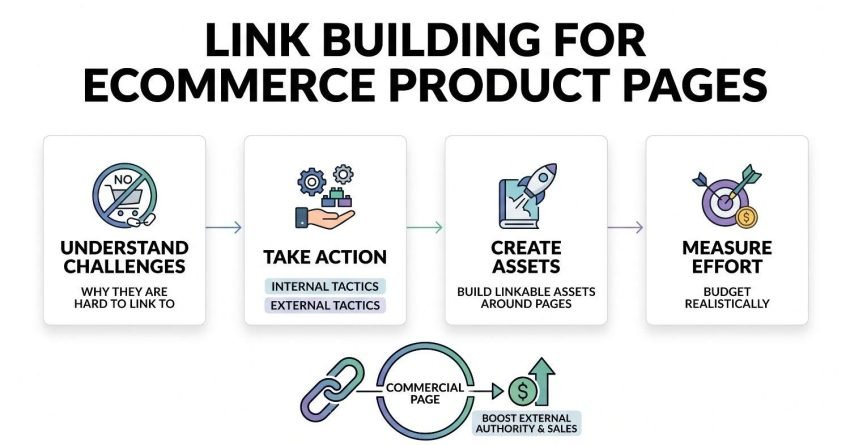
This guide covers what makes product pages uniquely hard to link to, the internal and external tactics that actually work for them, the linkable assets worth building around them, and how to measure and budget for the whole effort realistically.
What Makes Product Page Link Building Different From Blog Link Building
Product page link building requires different tactics than blog link building because product pages sell something, while blog posts inform something, and outside sites almost never link to a page whose sole purpose is a transaction. A blogger will happily cite a statistic. Nobody links to a product listing the way they cite a research finding.
I treat product pages as pages that need to borrow authority rather than earn it directly. That reframing changes the entire strategy, and it’s the lens I use throughout this guide.
The practical result is that most successful ecommerce link building routes authority to product pages indirectly, through internal linking, category structures, and supporting content, rather than expecting a journalist to link straight to a checkout page.
Why Product Pages Struggle to Earn Links Naturally
Product pages struggle to earn natural links because they lack the informational hook that makes a page worth citing, sharing, or referencing from another website. A page describing a fabric and a price point doesn’t answer a question anyone was searching to have answered.
The Commercial Intent Problem
Commercial intent is the signal search engines and other webmasters use to identify a page as transactional rather than informational, and it actively discourages other sites from linking to it. Site owners avoid linking to pages that look like they’re trying to sell the visitor something, since it can appear self-serving or spammy to their own readers.
I’ve found this is exactly why Ahrefs’ backlink study of 1 billion pages found that product and category-level pages receive dramatically fewer referring domains than blog or resource content on the same domains.
Internal Linking Strategies That Strengthen Product Pages
Internal linking strengthens product pages by funneling authority collected on high-linking pages, like blog posts and category hubs, down to the transactional pages that actually convert. This is the single most controllable lever in the entire strategy, because it doesn’t depend on anyone else agreeing to link to you.
Linking From Category Pages to Products
Category pages sit closer to the top of a site’s architecture and usually collect more external links than individual products, which makes them a natural authority source to pass downward. I always check that every category page links to its top products using descriptive text, not just a thumbnail grid a crawler might weight less.
Linking From Blog Content to Product Pages
Blog content earns the bulk of a store’s natural backlinks, and directing some of that collected authority toward relevant product pages through contextual links inside the article body is how that value gets redistributed. A buying guide comparing ceramic and ceramic-coated pans, for instance, should link to the specific pans it recommends, not just to the general cookware category.
I keep this rule simple: every blog post that mentions a product by name links to it exactly once, in the sentence where the product is most relevant, not as a footer list.
Digital PR Strategies for Ecommerce Product Pages
Digital PR earns links for ecommerce product pages by pitching journalists a newsworthy angle tied to the product rather than pitching the product itself. Reporters don’t cover items for sale. They cover stories, trends, and data that happen to involve a product.
Product-Led Story Angles Journalists Actually Cover
Journalists respond to angles built around seasonal relevance, unusual product usage, expert commentary, or original survey data, rather than angles built around product features or pricing. A story about “why sock sales spike every January” gets picked up. A press release announcing a new sock color rarely does.
I’ve had the best success pitching data-backed trend stories where the product is mentioned as supporting evidence, not the headline.
Using Original Data and Studies to Earn Product Page Links
Original data earns links to ecommerce sites because it gives other publishers something concrete to cite, and citations often flow to the page hosting the data rather than to a generic homepage. Running a small survey of your own customers, or aggregating your own sales data into a trend report, creates something genuinely new that didn’t exist before.
Backlinko’s analysis of 11.8 million Google search results found that pages hosting original statistics attract substantially more referring domains than pages without any unique data.
Resource Page and Roundup Link Building for Product Pages
Resource page link building works for ecommerce by finding existing “best of” and roundup pages in a niche and pitching a specific product for inclusion, rather than pitching the whole store. These pages already exist to link out to specific products, which removes the biggest obstacle in ecommerce link building: finding a page willing to link to something for sale.
I search for phrases like “best gifts for” or “top rated” combined with the product category, then check which of those pages accept outreach pitches.
Influencer and Creator Outreach for Product Link Acquisition
Influencer and creator outreach earns product page links when a creator publishes a review, unboxing, or roundup post that includes a direct link back to the specific product rather than the brand’s homepage. This tactic works particularly well for niche products where a smaller creator’s engaged audience matters more than raw follower count.
I prioritize creators whose existing content already links out to other products in the same category, since that behavior signals they’ll do the same for you.
Affiliate and Partner Links as an Ecommerce Link Building Channel
Affiliate programs generate product page links as a side effect of the commission structure, since affiliates need to link directly to the product to earn a sale credit. Every affiliate link is technically a backlink, and at scale, an active affiliate program becomes one of the most reliable ongoing link sources a store has.
I’ve seen stores with a few hundred active affiliates accumulate more product-level backlinks in a year than a dedicated outreach team would generate manually.
Supplier, Manufacturer, and Brand Partnership Links
Manufacturers and suppliers often maintain “where to buy” or retailer directory pages that link out to stores carrying their products, and claiming a listing there produces a direct, relevant link to the exact product page. This is one of the easiest wins in ecommerce link building because the relationship already exists.
I always ask new suppliers directly whether they maintain a retailer or stockist page, since many never think to offer it proactively.
Comparison and “Best Of” Content as a Link Magnet for Products
Comparison content earns links because other publishers frequently link out to well-built comparison pages as a reference point when writing their own “best of” content in the same category. A page titled “Ceramic vs. Stainless Steel Cookware Compared” becomes a citation source for other sites covering the same decision.
Building this kind of content around your own product lineup gives outside writers a reason to link to a page that ultimately still points toward a purchase.
Broken Link Building and Competitor Backlink Gap Analysis
Broken link building for ecommerce involves finding dead links on other websites that once pointed to a competitor’s discontinued product and pitching your equivalent product as the replacement. Competitor backlink gap analysis involves identifying which sites link to a competitor’s product pages but not yours, then pitching those same sites directly.
Both tactics work because they target sites that have already demonstrated a willingness to link to a product in your exact category.
How to Build Linkable Assets That Support Product Pages
Linkable assets are standalone pieces of content built specifically to attract external links, which then pass authority down to product pages through internal linking rather than being linked to directly themselves. Buying guides, sizing charts, and interactive tools all fall into this category.
Buying Guides and Comparison Tools
Buying guides and interactive comparison tools attract external links because they solve a genuine research problem, and once built, they can link internally to every relevant product in the store. A size-comparison calculator for furniture, for example, is the kind of tool other sites reference and link to on its own merit.
Common Ecommerce Link Building Mistakes That Waste Budget
The most common ecommerce link building mistake is pursuing links from low-relevance, high-spam directories that pass little to no meaningful authority and can trigger manual action risk. Buying links in bulk from private blog networks falls into this same category, and search engines have gotten considerably better at detecting the pattern.
Another frequent mistake is ignoring internal linking entirely while spending the full budget on external outreach, which leaves earned authority stranded on blog pages instead of reaching the products that need it.
How to Measure Link Building ROI on Ecommerce Product Pages
Link building ROI on ecommerce product pages is measured by tracking organic traffic, keyword ranking movement, and revenue attributed to the specific product pages that received new links, compared against the cost of acquiring those links. Referring domain count alone doesn’t tell you whether the effort worked.
I track this using Google Search Console for ranking and impression changes, paired with Google Analytics revenue attribution for the linked pages specifically, not the site as a whole. A product page that gains ten new referring domains but no ranking or revenue movement over three months signals the links were low quality, regardless of the quantity earned.
Building a Realistic Ecommerce Link Building Timeline and Budget
A realistic ecommerce link building timeline runs four to twelve months before ranking, and revenue movement becomes measurable, since new links need time to get crawled, indexed, and factored into ranking calculations. Budget requirements vary widely by competition level, but consistent monthly investment outperforms one-time bursts of outreach activity.
I set client expectations around month four for early signals and month nine for compounding results, because rushing this timeline usually leads to tactics that create risk instead of authority.
Conclusion
Product page link building succeeds when internal linking, digital PR, and linkable assets work together, routing authority from high-linking content down to transactional pages that convert.
The strongest ecommerce sites treat this as an ongoing system, not a one-time project, continuously feeding new authority into their product catalog.
We build these systems for clients every day, and White Label SEO Service can help your product pages start earning the authority they deserve.
Frequently Asked Questions
How long does link building take to impact ecommerce rankings?
Link building typically takes four to twelve months to produce measurable ranking movement on ecommerce pages. Search engines need time to crawl, index, and weigh new links. Faster results are possible but rare.
Do product pages need different links than category pages?
Product pages generally benefit more from internal linking and affiliate links, while category pages attract more natural external backlinks. Both page types need link support, but the sourcing strategy differs by intent and existing link volume.
How many backlinks does a product page need to rank?
There’s no fixed backlink number required for a product page to rank well. Relevance and authority of each linking domain matter more than raw count. A handful of strong, relevant links often outperforms dozens of weak ones.
Can internal links replace the need for external link building?
Internal links alone cannot replace external link building for competitive keywords. Internal linking redistributes authority already on the site, while external links bring new authority in. Both work together in a complete strategy.
Is guest posting still effective for ecommerce link building?
Guest posting remains effective when the target site is genuinely relevant, and the content adds real value beyond a product mention. Low-quality guest posting on unrelated sites carries more risk than benefit for ecommerce brands.
How much should a business budget for ecommerce link building?
Ecommerce link building budgets vary widely based on competition and market size, but consistent monthly investment outperforms sporadic large spends. Smaller stores often start with a modest recurring budget focused on digital PR and content assets.
What is the safest link building strategy for online stores?
The safest strategy combines internal linking, original data, and digital PR outreach targeting genuinely relevant publishers. Avoiding bulk-purchased links and low-relevance directories reduces the risk of search engine penalties significantly.