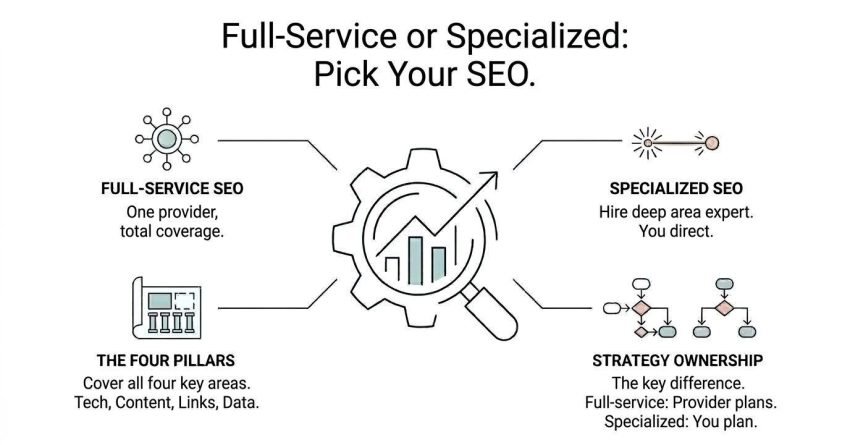
Full-service SEO is an engagement model where one provider owns technical SEO, content strategy, link acquisition, and reporting under a single strategy. Specialized SEO is a model where you hire narrow expertise for one discipline and retain strategic ownership yourself. The difference decides who is accountable when rankings stall.
I watch businesses pick the wrong model constantly. They buy deliverables when they needed a strategy owner, or they hire a generalist when a crawl crisis needed a technical specialist last quarter.
This guide covers what each model actually delivers and how they differ, how search engines rank pages and why partial coverage stalls growth, the four disciplines of SEO and who should own each one, realistic timelines and pricing under both models, a five-question diagnostic for your business stage, and how to vet, switch, or combine providers as you scale.
What Full-Service SEO Actually Includes
Full-service SEO is an engagement model where a single provider owns every discipline required to move organic rankings, from technical infrastructure through to performance reporting. One strategy governs all the work, and one team carries accountability for the outcome.
The appeal is coordination. When the same team fixes your site architecture, builds the topical map, and earns the links, nothing falls between briefs.
The Four Pillars Bundled Into One Engagement
I think of full-service coverage as four pillars operating on one roadmap. Each pillar fails without the others, which is the entire argument for bundling them.
- Technical SEO: crawlability, indexation, site speed, structured data, and architecture
- On-page and content SEO: keyword research, topical mapping, briefs, production, and optimization
- Off-page SEO: link acquisition, digital PR, brand mentions, and authority signals
- Analytics and reporting: measurement setup, attribution, forecasting, and monthly interpretation
A Backlinko analysis of 11.8 million Google results found the number of referring domains correlated with rankings more strongly than almost any other factor, which is why authority work cannot be treated as optional inside a bundle.
Who Sits On A Full-Service Team
A genuine full-service engagement staffs a strategist, a technical SEO, a content lead, an outreach or digital PR function, and an analyst. Smaller agencies compress these into two or three people wearing multiple hats.
The staffing question matters more than the pitch deck. Ask who specifically does the technical audit, because a content-heavy agency selling full-service SEO often subcontracts that pillar quietly.
What Full-Service SEO Does Not Cover
Full-service rarely includes paid search, conversion rate optimization, email, or brand design, even though all four influence organic performance. Scope creep in these areas is the most common source of contract friction I see.
Get the boundary written down before signing. A model that claims to cover everything usually covers nothing deeply.
What Specialized SEO Means In Practice
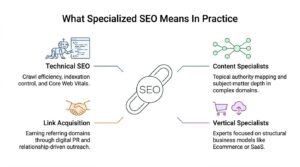
Specialized SEO is an engagement model where you hire a provider with deep expertise in one discipline and retain strategic ownership internally. You buy depth in a single lane rather than breadth across all of them.
This model assumes someone on your side sets direction. Without that person, specialists optimize their own lane while the overall strategy drifts.
Technical SEO Specialists
Technical SEO specialists handle crawl efficiency, indexation control, JavaScript rendering, log file analysis, migrations, and Core Web Vitals. They are the right call when your pages are not being crawled, indexed, or rendered correctly.
I bring in a technical specialist for migrations without exception. A botched migration erases years of equity in weeks, and generalists underestimate redirect mapping at scale.
Content And Editorial Specialists
Content specialists own keyword research, topical authority mapping, editorial briefs, and production quality in a specific subject domain. Their value compounds when your industry has real complexity: finance, healthcare, legal, or deep technical B2B.
Subject-matter depth is the differentiator here. Generic content production at volume stopped working once helpful content signals matured.
Link Acquisition And Digital PR Specialists
Link acquisition specialists earn referring domains through digital PR, data studies, partnerships, and relationship-driven outreach. This is the pillar most often outsourced, and the pillar where cheap providers cause lasting damage.
Authority building is the slowest and riskiest lever in SEO. A specialist with genuine media relationships is worth several times the cost of a link vendor selling placements by the unit.
Vertical Specialists (Local, Ecommerce, SaaS, Enterprise)
Vertical specialists organize around a business model rather than a discipline, because local SEO, ecommerce SEO, and enterprise SEO each carry structural problems a generalist rarely sees. A multi-location service business and a 200,000-SKU catalogue need different playbooks entirely.
I default to a vertical specialist whenever the problem is structural rather than tactical. Faceted navigation on a large ecommerce site is not a keyword problem.
Full-Service vs Specialized SEO: The Core Differences
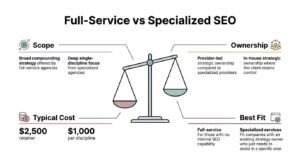
Full-service SEO differs from specialized SEO in one decisive way: who owns the strategy and carries accountability for results. Everything else cost, speed, staffing, reporting follows from that single distinction.
Both models work. Choosing badly is what fails.
Scope Of Ownership
In a full-service engagement, the provider owns diagnosis, prioritization, execution, and measurement. In a specialized engagement, you own diagnosis and prioritization while the specialist owns execution in one discipline.
That ownership line is where most disappointing engagements break. Businesses hire specialists expecting strategic direction, then discover nobody was sequencing the work.
Accountability And Reporting Lines
Full-service providers report against business outcomes: organic traffic, qualified leads, revenue, and pipeline. Specialists report against discipline outputs: crawl errors resolved, briefs delivered, referring domains earned.
Neither reporting style is wrong. Mismatched expectations about which one you are buying cause the friction.
Comparison Table
The table below compares both models across the five factors that actually change the decision.
| Factor | Full-Service SEO | Specialized SEO |
| Scope | All four pillars under one strategy | One discipline, deep |
| Strategy ownership | Provider | You or your in-house lead |
| Typical monthly cost | $2,500–$15,000+ retainer | $1,000–$8,000 per discipline |
| Speed to first results | 4–6 months, broad compounding | 1–3 months in-lane, slower overall |
| Primary risk | Uneven depth across pillars | Uncoordinated strategy, gaps between lanes |
| Best fit | No internal SEO capability | Existing strategy owner, one clear bottleneck |
How Search Engines Rank Pages And Why Model Choice Matters
Search engines rank pages through three sequential stages: crawling, indexing, and ranking, and a failure at any stage makes work at later stages worthless. Model choice matters because each stage sits in a different discipline.
Your model must cover the stage where you are actually failing.
Crawling, Indexing, Ranking
- Crawling: search engine bots discover and request URLs on your site
- Indexing: the engine parses, renders, and stores each page it decides to keep
- Ranking: stored pages are scored against a query using relevance, authority, and experience signals
Google’s own documentation confirms that not every crawled page gets indexed, which is why publishing volume alone never guarantees visibility.
Why Partial Coverage Stalls Results
Partial coverage stalls results because the weakest pillar caps the entire outcome. Excellent content on an unindexable site earns nothing, and a flawless technical setup with no authority ranks for nothing competitive.
I audit for the binding constraint before recommending a model. Find the pillar that is capping performance, then decide whether you need breadth or depth to fix it.
The Technical SEO Requirement In Both Models
Technical SEO is the discipline that makes a site crawlable, indexable, fast, and structurally coherent to search engines. Both engagement models require it, and neither can skip it without capping every other investment.
The question is never whether you need technical SEO. It is whether your situation needs a generalist maintaining it or a specialist rebuilding it.
Crawl Budget, Site Architecture, Core Web Vitals
Crawl budget is the number of URLs a search engine requests from a site within a given period. I watch it closely on any site above roughly 10,000 URLs, where wasted crawl on parameters and duplicates starves the pages that matter.
Site architecture and internal linking determine how authority flows between pages, and Core Web Vitals govern the experience signals Google measures directly. All three sit upstream of content performance.
When Technical Debt Forces A Specialist
Technical debt forces a specialist when you face a migration, a JavaScript-rendered site, an indexation collapse, or a catalogue large enough that log file analysis becomes the only reliable diagnostic. Full-service generalists handle maintenance well and crises poorly.
Bring the specialist in early on migrations. Recovery costs several times more than prevention.
Content Strategy Ownership: Bundled Or Standalone
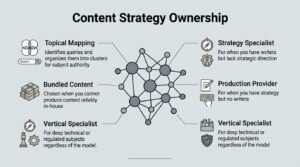
Content strategy ownership is the decision about who defines what gets written, in what order, and against which queries. Bundling it into a full-service engagement buys coordination; keeping it standalone buys subject-matter depth.
Production capacity usually settles this question faster than strategy preference does.
Keyword Research And Topical Mapping
Keyword research identifies the queries your audience uses, and topical mapping organizes those queries into clusters that build subject authority rather than isolated pages. Doing the second badly is why large content libraries underperform.
I sequence clusters by commercial intent and competitive gap. Publishing order changes results as much as publishing quality.
Production Capacity As The Deciding Factor
Choose bundled content when you cannot produce reliably in-house, and choose standalone specialists when you can produce but lack strategic direction.
- No writers, no strategy → full-service bundled content
- Writers, no strategy → content strategy specialist
- Strategy, no writers → production-focused provider
- Deep technical or regulated subject → vertical content specialist regardless of model
Link Acquisition And Authority Building
Link acquisition is the discipline of earning referring domains and brand mentions that signal authority to search engines. It is the slowest pillar to show results and the only one where poor execution creates lasting risk.
Treat it as a long-horizon investment, never a monthly quota.
Why Authority Is The Slowest Lever
Authority is the slowest lever because links must be earned, discovered, and then trusted over time before they influence rankings. An Ahrefs study of 2 million randomly selected keywords found only 5.7% of pages reached the top 10 within a year of publication.
Expect quarters, not weeks. Any provider promising fast authority gains is describing a risk, not a result.
Risk Profile Of Outsourced Link Building
Outsourced link building carries the highest downside of any SEO activity because manipulative link schemes violate Google’s spam policies and can trigger ranking suppression. Cheap volume providers are the single most common cause of self-inflicted damage I clean up.
Ask for the acquisition method before the price. Placement fees on unrelated sites are a different product from earned editorial coverage.
Local, Ecommerce, And Enterprise SEO Considerations
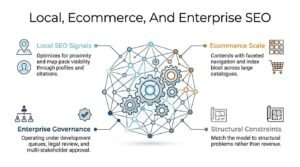
Business model changes which SEO problems dominate, so local SEO, ecommerce SEO, and enterprise SEO each demand a different mix of the four pillars. The right engagement model follows from that mix.
Match the model to your structural constraint, not to your revenue.
Local SEO Signals
Local SEO optimizes for proximity-weighted results and map pack visibility through business profile management, citations, reviews, and location-specific pages. Multi-location businesses face a scaling problem single-location businesses never encounter.
Specialists earn their fee fast here. Map pack mechanics diverge sharply from classic organic ranking.
Ecommerce Scale Problems
Ecommerce SEO contends with faceted navigation, duplicate parameter URLs, out-of-stock handling, and category-versus-product intent across thousands of pages. These are technical and architectural problems wearing a content costume.
I treat large catalogues as a technical engagement first. Product copy improvements cannot outrun index bloat.
Enterprise Governance
Enterprise SEO operates under constraints that have nothing to do with search: development ticket queues, legal review, brand governance, and multi-stakeholder approval. Execution speed, not tactical knowledge, is the bottleneck.
Full-service coordination usually wins at enterprise scale. Somebody needs to own the sequencing across five departments.
SEO Timelines: How Each Model Affects Speed To Results
SEO typically produces measurable movement in 4 to 6 months and meaningful compounding growth between 9 and 12 months, with the exact curve shaped by site authority, competition, and how much technical debt exists at the start. Model choice changes the shape of that curve, not the physics behind it.
Specialized engagements move faster in one lane. Full-service engagements move more evenly across all of them.
Month-By-Month Milestone Expectations
The table below shows what I expect to see under each model at each stage.
| Timeframe | Full-Service SEO | Specialized SEO |
| Month 1–2 | Audit, strategy, technical fixes begin | Rapid progress in the hired lane only |
| Month 3–4 | Content shipping, first indexation gains | Lane complete, other gaps now visible |
| Month 5–6 | Ranking movement on mid-tail queries | Results plateau without a second lane |
| Month 7–9 | Authority gains compound across clusters | Second specialist typically added |
| Month 10–12+ | Broad, defensible organic growth | Coordination overhead becomes the constraint |
Where Each Model Compounds Faster
Full-service compounds faster over 12 months because all four pillars advance together. Specialized compounds faster over 90 days because all capacity concentrates on one constraint.
Pick the horizon that matches your runway. Short runway favours depth on the binding constraint; long runway favours breadth.
SEO Pricing And Budget Structures Compared
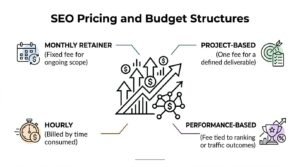
SEO pricing in the US generally runs $1,000 to $5,000 per month for small business engagements and $5,000 to $20,000+ per month for competitive or enterprise programs, structured as retainers, projects, hourly work, or performance agreements. Full-service carries a higher single invoice; specialized often costs more in total once you stack lanes.
Compare total cost of coverage, never the line item.
Retainer, Project, Hourly, Performance
| Structure | How it works | Best fit |
| Monthly retainer | Fixed fee for ongoing scope | Continuous programs, either model |
| Project-based | One fee for a defined deliverable | Audits, migrations, one-off builds |
| Hourly | Billed by time consumed | Advisory, in-house team support |
| Performance-based | Fee tied to ranking or traffic outcomes | Rare, high-risk, scrutinize terms carefully |
Cost Per Outcome, Not Cost Per Hour
Judge SEO spend by cost per qualified lead or cost per incremental revenue dollar, not by hours logged or deliverables counted. A $6,000 retainer producing 40 qualified leads beats a $2,000 retainer producing four.
I ask providers to model expected outcomes at their proposed spend. An unwillingness to forecast is itself an answer.
In-House, Agency, Freelancer, Or White Label
The resourcing question sits alongside the model question, because full-service and specialized SEO can each be delivered in-house, by an agency, by freelancers, or through a white label partner. Capability and capacity are separate constraints.
Diagnose which one you are short on before shopping.
Capacity vs Capability
Capacity is how much work your team can execute; capability is whether they know what work to execute. In-house teams commonly have capability without capacity, while agencies bring both at a premium.
Freelancers solve narrow capability gaps cheaply. They rarely solve strategy ownership.
The White Label Middle Path
White label SEO is an arrangement where an agency delivers SEO under another company’s brand, letting the client-facing team sell full-service coverage without staffing every discipline internally. It suits marketing agencies and consultancies whose clients expect organic results they cannot currently deliver.
I see this work best when the reselling partner owns the client relationship and strategy translation. The delivery depth comes from the partner.
How To Diagnose Which Model Your Business Needs
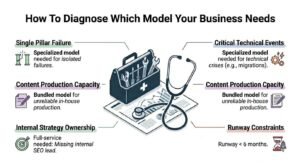
Diagnose your SEO model by identifying your binding constraint, then choosing the model that removes it fastest. Five questions resolve this for almost every business I assess.
Answer them honestly before reading any proposal.
The Five-Question Diagnostic
- Does anyone internally own SEO strategy? No → full-service. Yes → specialized is viable.
- Is one pillar clearly failing while others are healthy? Yes → specialist on that pillar.
- Can you produce content reliably without help? No → bundled content matters more than you think.
- Are you facing a migration, replatform, or indexation collapse? Yes → technical specialist first, regardless of model.
- Is your runway under six months? Yes → concentrate spend on the binding constraint, not on breadth.
Decision Matrix By Business Stage
| Business stage | Typical constraint | Recommended model |
| Startup, pre-product-market-fit | No strategy, no capacity | Full-service, lean scope |
| SME with marketing manager | Capacity, partial capability | Full-service or hybrid |
| Scaling ecommerce | Technical and architectural | Technical specialist, then content |
| Agency serving clients | Delivery capacity | White label partnership |
| Enterprise with in-house team | Execution speed, governance | Specialists coordinated by in-house lead |
Measuring Performance Under Either Model
Measure SEO performance through leading indicators that predict movement and lagging indicators that confirm business impact. The same metric set applies to both models; only the accountability line changes.
Agree on the metric set before month one, not after month six.
Leading vs Lagging SEO Metrics
| Type | Metrics | What they tell you |
| Leading | Indexation rate, crawl stats, impressions, average position, referring domains | Whether the work is landing |
| Lagging | Organic sessions, qualified leads, assisted revenue, organic pipeline | Whether the work is paying |
Impressions in Google Search Console move weeks before clicks do, which makes them the earliest honest signal that a strategy is working.
Attribution And Reporting Cadence
Report monthly on trends, quarterly on strategy, and never weekly on rankings. Rank tracking at weekly intervals produces noise that pushes teams into reactive decisions.
I insist on one shared dashboard. Separate provider reporting hides the gaps between lanes.
Can I switch between full-service and specialized SEO later?
Common Mistakes When Choosing An SEO Model
The most expensive mistakes happen at the selection stage, before any work begins. Two errors account for most of the failed engagements I review.
Both are avoidable with one clarifying conversation.
Buying Deliverables Instead Of Outcomes
Buying deliverables means paying for a fixed count of articles, links, or audit pages rather than for a result. Deliverable-based contracts reward output volume and punish nothing, which is why they persist.
Tie scope to outcomes and let the provider choose the tactics. If they cannot work that way, that is information.
Hiring A Specialist Without A Strategy Owner
Hiring a specialist without an internal strategy owner creates motion without direction, because nobody sequences the lanes or decides what happens next. This is the single most common reason specialized engagements disappoint.
Appoint the owner first, even part-time. A specialist with no counterpart optimizes in isolation.
Switching Or Combining Models Over Time
Most businesses do not stay in one model permanently, and moving between them is normal as capability and constraints change. Hybrid arrangements are increasingly the default rather than the exception.
Plan the transition deliberately so equity and context survive the handover.
Hybrid Models That Work
- Full-service core plus technical specialist for migrations and platform work
- In-house strategy plus specialized execution across two or three lanes
- Full-service provider plus in-house content team producing at volume
- White label delivery plus in-house account management for agencies
Transition Checklist
- Document current strategy, roadmap, and rationale before notice is given
- Export all account access, dashboards, and tracking configurations
- Transfer keyword maps, content briefs, and link prospect lists
- Confirm ownership of assets created during the engagement
- Overlap old and new providers by two to four weeks where possible
How To Vet An SEO Partner In Either Model
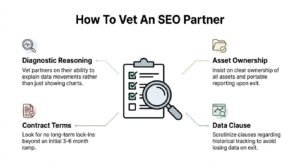
Vet SEO partners on diagnostic reasoning rather than on case studies, because anyone can present a winning chart without explaining why it moved. The questions below separate genuine practitioners from packagers.
Use the same questions for full-service providers and specialists.
Questions That Expose Weak Providers
- What would you diagnose first on my site, and what data would you pull?
- Which pillar is currently capping my results, and how do you know?
- How do you acquire links, specifically, and who approves each placement?
- What would make you tell me not to hire you?
- What does month three look like if the strategy is working?
Contract And Exit Terms
Insist on clear asset ownership, portable reporting, a defined notice period, and no lock-in beyond an initial ramp of three to six months. A provider confident in results does not need a twelve-month cliff.
Read the data clause carefully. Losing historical tracking on exit sets you back a full measurement cycle.
Conclusion
You now understand how full-service and specialized SEO differ across ownership, scope, timelines, pricing, risk, and fit by business stage.
Each model succeeds when matched to your binding constraint, and dedicated guides go deeper on every pillar referenced above.
We match businesses to the right delivery model every week. Talk to White Label SEO Service about which fits you.
Frequently Asked Questions
Is full-service SEO better than hiring specialists?
Neither is better universally. Full-service wins when nobody internally owns strategy, and specialists win when you have a strategy owner and one clearly failing pillar.
How much does full-service SEO cost per month?
Full-service SEO typically costs $2,500 to $15,000 per month in the US. Pricing scales with competition, site size, and how much technical debt exists at the start.
How long before SEO produces measurable results?
Measurable movement usually appears in four to six months, with meaningful compounding growth between nine and twelve months. Existing authority and technical health shorten or extend that curve.
Can one specialist handle all of my SEO?
Rarely. Genuine depth in technical SEO, content strategy, and link acquisition takes years each, so one person covering all three is usually shallow in two.
Do I need technical SEO before content SEO?
Yes, if pages are not being crawled or indexed correctly. Content investment cannot outperform an indexation problem, so fix the foundation first.
What is white label SEO?
White label SEO is an arrangement where one agency delivers SEO under another company’s brand. It lets client-facing teams offer full coverage without staffing every discipline.
How do I know if my SEO partner is underperforming?
Watch impressions, indexation, and referring domains monthly. Flat leading indicators after four months of work signal execution problems, not normal patience.