I’ve watched businesses lose 60% of their organic traffic overnight after a Google update, and the panic that follows usually leads to bad hiring decisions. An SEO penalty recovery specialist is a professional who diagnoses, resolves, and helps prevent Google penalties by auditing backlink profiles, content quality, and technical site issues that trigger manual actions or algorithmic ranking drops. Businesses that get hit rarely know whether they’re dealing with a manual action or an algorithm shift, and hiring the wrong person wastes months.
Getting this decision right protects revenue, rankings, and the trust you’ve built with search engines over years. We built this guide because most business owners don’t know what separates a real specialist from someone guessing.
This guide covers what SEO penalties actually are and how they differ, the skills and qualifications a real specialist needs, where to find and vet qualified help, what recovery timelines and pricing realistically look like, and how to prevent penalties once you’re back on track.
What Is an SEO Penalty and Why It Requires a Specialist
An SEO penalty is a deliberate ranking demotion applied by Google, either manually by a human reviewer or automatically through an algorithm, in response to violations of its Webmaster Guidelines. I’ve seen site owners confuse normal ranking fluctuation with an actual penalty, and that confusion alone can cost weeks of wasted effort.
Manual actions show up directly inside Google Search Console under the Manual Actions report, naming the exact violation Google found. Algorithmic penalties never show a notification at all; they surface only as a sudden, unexplained traffic cliff that lines up with a known Google core update.
Recognizing which type you’re facing determines your entire recovery strategy from that point forward. A manual action recovery specialist needs different skills than someone unwinding damage from a broad core algorithm update.
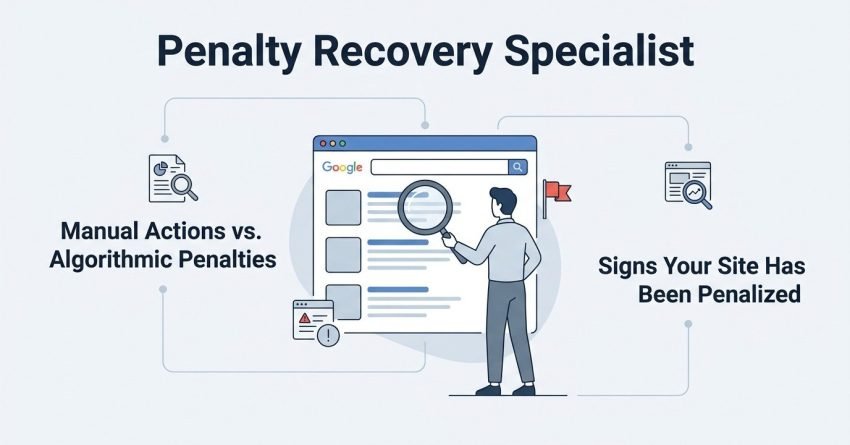
Manual Actions vs. Algorithmic Penalties
Manual actions are penalties applied by a human reviewer at Google after a manual review flags a violation. Algorithmic penalties are automatic ranking suppressions triggered by systems like the Penguin or Helpful Content updates without any human review involved.
I always check Search Console first because manual actions come with a specific reason attached. Algorithmic drops require comparing your traffic graph against Google’s public update timeline to build a case.
Signs Your Site Has Been Penalized
A sudden drop of 40% or more in organic traffic within a short window is usually the first visible sign. Rankings disappearing entirely for branded terms is a more severe signal than a single keyword losing position.
I look at Search Console’s Manual Actions report before anything else during initial diagnosis. If that report is empty, the drop is very likely algorithmic rather than manual.
Types of Google Penalties You Might Be Facing
Google penalties generally fall into three categories: link-based penalties, content-based penalties, and technical penalties, each requiring a distinctly different recovery approach. Understanding which bucket your situation falls into shapes how a specialist prioritizes their audit.
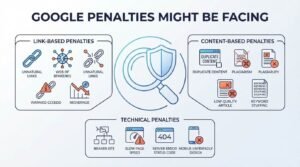
The table below shows how these categories differ and what typically causes each one.
| Penalty Type | Common Cause | Typical Recovery Focus |
| Link-Based | Paid links, link schemes, unnatural anchor text | Backlink audit and disavow |
| Content-Based | Thin content, duplicate content, spam | Content pruning and rewriting |
| Technical | Cloaking, hacked content, sneaky redirects | Site security and code audit |
Link-Based Penalties (Unnatural Links)
Link-based penalties happen when Google’s algorithms or reviewers identify unnatural link patterns pointing to a domain, often from paid placements or link exchange networks. I’ve unwound dozens of these, and the backlink audit is always the slowest part of the process.
An Ahrefs backlink audit typically reveals hundreds or thousands of low-quality links that need reviewing before any disavow file gets submitted. This part of the work cannot be rushed without risking further damage.
Content-Based Penalties (Thin/Duplicate/Spam)
Content-based penalties target pages Google judges to be thin, duplicated, auto-generated, or unhelpful to searchers under its Helpful Content system. These penalties often hit sites that scaled content production too fast without editorial oversight.
Recovery here means auditing every indexed page against genuine user value, not just word count. I’ve seen sites recover simply by removing thousands of thin pages entirely rather than rewriting them.
Technical Penalties (Cloaking, Hacked Content)
Technical penalties arise from cloaking, sneaky redirects, or a site being compromised and used to serve hacked or spam content to visitors. These are often the fastest to fix once identified, because the fix is a security and code issue rather than a content strategy problem.
A specialist here needs server log access and malware scanning tools, not just SEO software. This is one area where general SEO knowledge alone isn’t enough.
Core Skills an SEO Penalty Recovery Specialist Must Have
A qualified SEO penalty recovery specialist needs expertise in backlink auditing, Google Search Console diagnostics, content quality evaluation, and technical site auditing. I’ve interviewed dozens of “SEO experts” who could optimize a title tag but had never actually filed a reconsideration request.
Real penalty recovery work leans heavily on forensic analysis rather than standard optimization tactics. Someone who only knows keyword research and on-page tweaks isn’t equipped for this kind of diagnostic work.
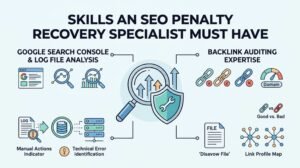
Google Search Console & Log File Analysis
Google Search Console analysis involves reading crawl stats, manual action reports, and index coverage data to pinpoint exactly what triggered a penalty. Server log file analysis shows specialists exactly how Googlebot crawled a site before and after a suspected penalty event.
I rely on both together because Search Console alone doesn’t always show the full crawl behavior pattern. A specialist who can’t read raw log files is missing half the diagnostic picture.
Backlink Auditing Expertise
Backlink auditing expertise means being able to distinguish a genuinely toxic link from a merely low-authority but harmless one. This distinction matters enormously because over-disavowing healthy links can suppress rankings further rather than help.
Tools alone won’t make this call correctly every time. Judgment built from reviewing thousands of link profiles is what actually separates a competent auditor from a mediocre one.
How to Diagnose Whether You Actually Have a Penalty
Diagnosing an SEO penalty starts by checking the Manual Actions report inside Google Search Console, then cross-referencing any traffic drop against known algorithm update dates. Skipping this step leads directly to wasted recovery spend on the wrong problem.
Here’s the sequence I walk through with every new case:
- Check Google Search Console’s Manual Actions report for an explicit notice
- Overlay your organic traffic graph against Google’s confirmed update timeline
- Segment traffic loss by page type, template, or content category
- Compare indexed page count before and after the drop
- Review recent site changes, migrations, or content pushes near the drop date
This process usually reveals within a day or two whether you’re facing a manual or algorithmic issue. Everything downstream depends on getting this diagnosis right first.
Where to Find Qualified SEO Penalty Recovery Specialists
Qualified SEO penalty recovery specialists are typically found through specialized recovery agencies, referred freelance consultants with documented case studies, and vetted industry communities rather than general marketplace listings. General freelance marketplaces rarely surface people with genuine penalty recovery depth.
I’ve found the strongest specialists tend to publish detailed case studies showing before-and-after traffic recovery data. That transparency is a meaningful signal in a space full of vague promises.
Specialized Agencies vs. Freelance Consultants
Specialized agencies bring a team with layered expertise across link auditing, content, and technical SEO, while independent consultants often bring deeper personal hands-on experience at a lower cost. I’ve seen both models work well, and the right choice depends on how complex your penalty situation actually is.
A multi-penalty situation involving both links and content usually benefits from an agency’s broader skill coverage. A single, well-defined manual action might be handled efficiently by an experienced solo consultant.
Referral Networks and Industry Communities
Industry communities built around technical SEO, like private forums and conference networks, are where experienced recovery specialists tend to be discussed and recommended. I trust referrals from people who’ve actually been through a recovery far more than any marketing page.
Asking in these spaces for someone’s actual documented results tends to filter out inexperienced operators quickly. This filtering step alone saves considerable wasted time.
Key Questions to Ask Before Hiring a Recovery Specialist
Before hiring an SEO penalty recovery specialist, ask about their specific experience with your penalty type, their diagnostic process, expected timeline, and whether they can show documented case studies with real traffic data. Vague answers to any of these should be treated as a warning sign.
These are the questions I consider non-negotiable during any vetting conversation:
- Have you handled this exact penalty type (link, content, or technical) before?
- Can you walk me through your diagnostic process step by step?
- What does a realistic recovery timeline look like for my situation?
- Can you share case studies with before-and-after traffic data?
- How do you handle the reconsideration request writing process?
- What ongoing monitoring do you provide after recovery?
A specialist who can’t answer these clearly and specifically probably hasn’t done this work at real depth. I’d treat hesitation on the case study question as a particularly strong red flag.
Red Flags and Warning Signs of Unqualified Specialists
Warning signs of an unqualified SEO penalty recovery specialist include guaranteed recovery timelines, refusal to share past case studies, and reliance on automated disavow tools without manual link review. Nobody can guarantee a specific recovery date because Google controls the reconsideration timeline entirely.
I walk away immediately from anyone promising a fixed number of days for reconsideration approval. That promise reveals either inexperience or dishonesty, and neither is acceptable for this kind of work.
Other red flags worth watching for include vague pricing structures, no mention of Search Console diagnostics, and pushback when asked for references. A genuine specialist welcomes scrutiny because their track record supports it.
Understanding the Reconsideration Request Process
A reconsideration request is a formal submission to Google explaining what violation occurred, what actions were taken to fix it, and what steps prevent recurrence, filed directly through Search Console after a manual action. Getting rejected once makes each subsequent attempt harder to approve.
The process typically takes one round of preparation, submission, and then a waiting period before Google’s review team responds.
What Goes Into a Strong Reconsideration Request
A strong reconsideration request documents every remediation step taken, including specific links removed or disavowed, with evidence attached for each claim. Vague statements like “we cleaned up our links” tend to result in rejection.
I always include a disavow file summary and dated screenshots showing the cleanup work performed. Specificity here is what convinces a human reviewer the problem is genuinely resolved.
Typical Penalty Recovery Timelines and What Affects Them
Manual action recovery typically takes 2 to 6 weeks after submitting a reconsideration request, while algorithmic penalty recovery can take anywhere from one to twelve months depending on the next relevant core update. This timeline difference is one of the most misunderstood parts of the entire process.
Algorithmic recovery timelines depend heavily on Google’s release schedule rather than the effort applied. A Search Engine Land analysis of recovery cases found that sites recovering from Helpful Content-related demotions often waited through two or more subsequent update cycles before seeing meaningful improvement.
Site age, the severity of the original violation, and how thoroughly the remediation work was documented all affect how quickly trust rebuilds. Rushed or incomplete fixes tend to extend timelines rather than shorten them.
Pricing Models and What Recovery Services Should Cost
SEO penalty recovery services typically cost between $1,500 and $15,000 depending on penalty complexity, site size, and whether the engagement includes ongoing monitoring after recovery. Pricing below this range often signals a surface-level audit rather than genuine forensic work.
| Penalty Complexity | Typical Cost Range | Scope Included |
| Single manual action, small site | $1,500–$4,000 | Audit, disavow, reconsideration request |
| Multiple penalties, mid-size site | $4,000–$8,000 | Full link + content audit, multiple requests |
| Enterprise, algorithmic + manual | $8,000–$15,000+ | Ongoing monitoring, technical audit, content overhaul |
I’d be cautious of anyone charging a flat low rate for a large enterprise site with years of accumulated backlink history. The audit work alone at that scale takes considerably more hours than a small site engagement.
What the Recovery Process Looks Like Step by Step
A typical SEO penalty recovery engagement follows a sequence of diagnosis, backlink or content audit, remediation, reconsideration submission, and post-recovery monitoring. Skipping any one of these steps tends to produce incomplete or temporary results.
- Initial diagnosis confirming penalty type and scope
- Full backlink or content audit depending on penalty category
- Remediation work: disavowing links, rewriting or removing content
- Documentation of every remediation action taken
- Reconsideration request submission (for manual actions only)
- Post-recovery monitoring for at least 60 to 90 days
I always insist on that final monitoring step because rankings can slip again if underlying issues weren’t fully addressed. Treating recovery as a one-time event rather than a process is a common and costly mistake.
Preventing Future Penalties After Recovery

Preventing future SEO penalties requires ongoing backlink monitoring, regular content quality audits, and staying current with Google’s publicly announced guideline updates. Recovery without a prevention plan tends to be temporary.
I set up quarterly backlink profile reviews for every client that’s been through a recovery, since new toxic links can accumulate again from negative SEO attacks or old link schemes resurfacing.
Ongoing Monitoring and Link Profile Maintenance
Ongoing monitoring means checking new referring domains monthly and flagging any pattern resembling the original penalty cause before it accumulates. Link profile maintenance also includes periodically reviewing anchor text distribution for unnatural over-optimization.
This consistent oversight is what separates businesses that recover once from those that stay recovered permanently. I treat this as a standing line item, not an optional extra.
How Penalty Recovery Fits Into Your Broader SEO Strategy
Penalty recovery is a foundational prerequisite to any broader SEO strategy, since rankings and content investments built on top of an unresolved penalty rarely produce sustainable returns. Trying to layer new content or link building on top of an active penalty wastes budget.
I always sequence recovery work before any new growth initiatives begin. Once a site is stable again, the same technical and content discipline used in recovery becomes the foundation for sustainable long-term growth.
Evaluating Recovery Specialist Case Studies and Track Records
A credible SEO penalty recovery case study shows specific before-and-after organic traffic data, the exact penalty type addressed, and the actual timeline from diagnosis to recovery. Generic testimonials without traffic graphs or dates should be treated skeptically.
I look for case studies that disclose what didn’t work initially, not just the eventual success. That kind of honesty tends to indicate a specialist who understands the nuance of this work rather than one repeating a marketing script.
Conclusion
Recovering from an SEO penalty means correctly diagnosing the violation, auditing links or content with precision, and rebuilding trust with Google methodically. This foundation protects every future ranking and traffic investment you make.
The broader path forward involves ongoing monitoring, prevention, and treating recovery as the starting point for a sustainable organic growth strategy.
We help businesses navigate penalty recovery and long-term SEO growth together. Reach out to White Label SEO Service to get your rankings back on track.
Frequently Asked Questions
What does an SEO penalty recovery specialist actually do?
An SEO penalty recovery specialist diagnoses the cause of a ranking drop, audits backlinks or content, and executes remediation to restore search visibility. Their work includes filing reconsideration requests when manual actions are involved.
How much does SEO penalty recovery cost?
SEO penalty recovery typically costs between $1,500 and $15,000 depending on complexity. Larger sites with multiple penalty types and extensive backlink histories fall toward the higher end.
How long does it take to recover from a Google penalty?
Manual action recovery usually takes 2 to 6 weeks after submitting a reconsideration request. Algorithmic penalty recovery can take one to twelve months depending on Google’s update schedule.
Can I recover from a penalty without hiring a specialist?
Recovery is technically possible without a specialist if you have strong technical SEO knowledge and time to conduct a thorough audit. Most businesses lack the forensic experience needed to do this accurately and end up delaying recovery.
What is the difference between a manual action and an algorithmic penalty?
A manual action is applied by a human Google reviewer and appears in Search Console with a specific reason. An algorithmic penalty is automatic and shows no notification, only a traffic drop tied to an update.
Will my rankings fully recover after a penalty is lifted?
Rankings often recover substantially but not always to pre-penalty levels immediately. Full recovery depends on how completely the underlying issue was resolved and how much trust was lost.
How do I know if my site has a penalty versus a ranking drop?
Check Google Search Console’s Manual Actions report first for an explicit notice. If nothing appears there, compare your traffic drop timing against known algorithm update dates to assess an algorithmic cause.