I’ve audited hundreds of backlink profiles, and the same mistake shows up almost every time. Link quality is the measure of how much trust, relevance, and authority a backlink transfers to a website, based on the linking site’s credibility, topical relevance, and the way the link is placed. Most site owners chase link volume instead, and it costs them.
A single bad backlink rarely sinks a site on its own. But a pattern of manipulative links invites algorithmic suppression or a manual penalty that can erase years of ranking progress in weeks.
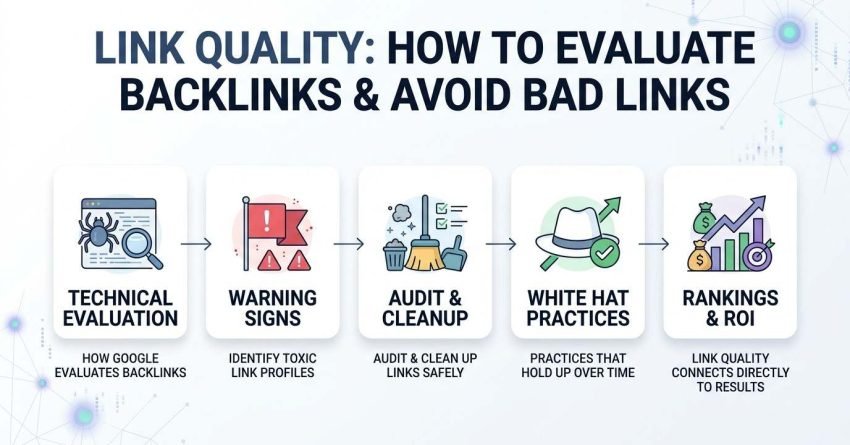
This guide covers what actually separates high-quality links from harmful ones, how Google evaluates backlinks technically, the warning signs of a toxic link profile, and how to audit and clean up your links safely. I’ll also walk through white hat practices that hold up over time and how link quality connects directly to rankings and ROI.
What Makes a Backlink “High Quality”?
A high-quality backlink comes from a trustworthy, topically relevant website and passes authority through a natural, editorially placed link. Three factors decide that quality: the linking domain’s own trustworthiness, how closely its topic matches yours, and where on the page the link sits.
I look at trust signals before anything else. A site with a long publishing history, real traffic, and editorial standards passes more value than a freshly registered domain stuffed with outbound links.
Domain Authority vs. Real Relevance
Domain authority scores estimate a site’s overall strength, but they don’t capture whether that site actually relates to your topic. A high-authority gardening blog linking to a cybersecurity company passes far less real value than a mid-tier cybersecurity publication would.
I’ve seen sites with dozens of high-DR links stall in rankings because none of those links came from topically connected sources. Relevance, not just authority score, is what search engines weigh most heavily in context.
Trust Signals Search Engines Actually Use
Search engines look at the linking site’s age, its own backlink profile, content consistency, and whether real users interact with it. A domain that publishes thin, AI-generated content with no editorial oversight rarely carries meaningful trust, regardless of its authority metrics.
I treat trust signals as a filter before I even look at anchor text or placement. A link from an untrustworthy site can do more harm than good.
How Google Evaluates Link Quality
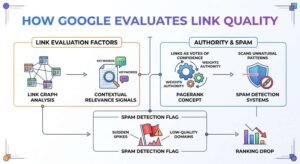
Google evaluates link quality through a combination of link graph analysis, spam detection systems, and contextual relevance signals rather than a single authority score. The system looks at who links to you, who links to them, and how naturally those connections formed.
PageRank’s Role in Modern Algorithms
PageRank is a link analysis algorithm that estimates a page’s importance based on the quantity and quality of pages linking to it. It’s no longer the standalone ranking signal it was in the early 2000s, but the underlying concept, links as votes of confidence, still shapes how modern systems weigh authority.
Google’s own documentation on how search ranking works confirms that link analysis remains one of several hundred signals used together, not a single deciding factor.
Link Graphs and Spam Detection Systems
A link graph maps the relationships between websites based on who links to whom, and Google’s spam systems scan this graph for unnatural patterns like link farms or reciprocal schemes. Sudden spikes in low-quality referring domains are one of the clearest signals these systems flag.
I watch for exactly this pattern during audits. A client site once gained 200 referring domains in a single month from unrelated foreign-language blogs, and that spike triggered a ranking drop within weeks.
Domain Authority and Domain Rating Explained
Domain Authority and Domain Rating are third-party metrics from Moz and Ahrefs that estimate a website’s overall ranking strength on a 1-100 scale based on its backlink profile. Neither metric is used by Google directly, but both correlate loosely with how competitive a site’s link profile is.
Why DA/DR Are Not Google Metrics
DA and DR are proprietary scores built by SEO tool companies, not ranking factors inside Google’s own algorithm. I use them as a quick filter when scanning link prospects, but I never treat a high score as proof that a specific link will help rankings.
Site owners often get fixated on hitting a DA number instead of building genuine topical relevance, which is a mistake I try to correct early in any engagement.
Topical Relevance in Link Evaluation
Topical relevance measures how closely a linking site’s subject matter matches the content it links to, and it’s one of the strongest predictors of whether a backlink will move rankings. A link from a directly relevant industry site tends to outperform a dozen links from unrelated general-interest blogs.
I prioritize relevance over raw authority in almost every link building campaign I run. A mid-authority site in the exact same industry passes more useful context than a massive general news site ever will.
Anchor Text Quality and Over-Optimization Risks
Anchor text is the clickable, visible text of a hyperlink, and its wording tells search engines what the linked page is about. Over-optimized anchor text, where exact-match keywords appear too frequently across a link profile, is one of the clearest manipulation signals algorithms detect.
I aim for a natural mix: branded anchors, generic phrases like “this guide,” partial matches, and only occasional exact-match keywords. A link profile where 40% of anchors use the identical target keyword phrase reads as manufactured, not earned.
Referring Domain Diversity vs. Link Volume
Referring domain diversity refers to the number of unique websites linking to a page, and it matters more for rankings than the total count of individual backlinks. Ten links from ten different relevant domains carry more weight than fifty links from a single site.
I’ve watched sites with thousands of backlinks from only a handful of domains underperform against competitors with a fraction of the link count but far broader domain diversity.
Link Placement and Contextual Value
Link placement describes where on a page a backlink appears, and links embedded within the main body content pass more value than links buried in footers, sidebars, or author bios. Search engines weigh contextual placement because it reflects genuine editorial intent rather than automated insertion.
Editorial Links vs. Sidebar/Footer Links
An editorial link is one a writer places naturally within an article because it adds value to the reader, while sidebar and footer links are typically site-wide placements with little contextual connection to specific content. I’ve seen sitewide footer link packages get flagged in manual reviews specifically because they lack this editorial context.
Dofollow vs. Nofollow: Do Nofollow Links Still Matter?
A nofollow link includes an HTML attribute that tells search engines not to pass ranking credit through that link, while a dofollow link passes authority by default. Nofollow links still matter because they drive referral traffic, build brand visibility, and contribute to a natural-looking link profile that mixes both types.
A backlink profile made up entirely of dofollow links from guest posts actually looks suspicious. Real websites earn a healthy mix of both link types over time, which is part of what search engines expect to see.
Common Types of Bad or Toxic Backlinks
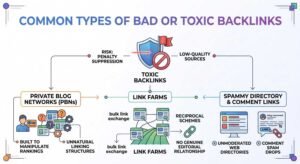
A toxic backlink is one that risks triggering a penalty or algorithmic suppression because it originates from spammy, manipulative, or low-quality sources. The most damaging types include private blog networks, link farms, and spam-generated directory or comment links.
Private Blog Networks (PBNs)
A private blog network is a group of websites built or acquired specifically to link back to a single money site and manipulate its rankings. Google’s spam detection systems have gotten increasingly effective at identifying PBNs through shared hosting IPs, similar content patterns, and unnatural linking structures.
Link Farms and Reciprocal Link Schemes
A link farm is a network of websites that exist purely to exchange links with each other in bulk, with no genuine editorial relationship between the sites. Excessive reciprocal linking, where two sites link back and forth specifically to inflate authority, falls under the same category of manipulation.
Spammy Directory and Comment Links
Spam directory links come from low-quality, unmoderated web directories that accept any submission for a fee, while comment spam links are dropped into blog comment sections purely for SEO value with no relevance to the discussion. Neither type carries meaningful trust, and both are common in outdated link building campaigns.
Warning Signs of a Manipulative Link Profile
The clearest warning signs of a manipulative link profile include sudden spikes in referring domains, an unnatural concentration of exact-match anchor text, and links from clearly unrelated or foreign-language sites with no topical connection. Any one of these alone isn’t necessarily damaging, but the combination raises real risk.
I also watch for links from sites with no organic traffic, thin or spun content, and hosting patterns that suggest a single owner runs dozens of “independent” sites.
How to Audit Your Backlink Profile
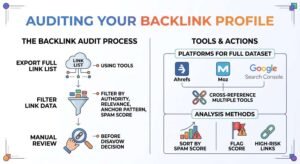
A backlink audit is the process of reviewing every link pointing to a website to identify which ones support rankings and which ones create penalty risk. The process starts with exporting a full link list, then filtering it by domain authority, relevance, anchor text pattern, and spam score.
Tools Used in a Link Audit
Google Search Console, Ahrefs, and Moz’s Link Explorer are the most commonly used platforms for pulling a complete backlink dataset. I cross-reference at least two tools during any audit, since no single crawler captures every link across the web.
After exporting the data, I sort links by spam score and referring domain quality, then manually review anything flagged as high-risk before making a disavow decision.
Google Penalties and Algorithmic Link Devaluation
A link-related penalty happens when Google either manually flags a site for unnatural links or algorithmically devalues suspicious links without any manual notice at all. Algorithmic devaluation is far more common today and simply means the toxic links stop passing value rather than triggering a visible penalty.
Manual Actions vs. Algorithmic Suppression
A manual action is a penalty applied by a human reviewer at Google after a site is flagged for violating webmaster guidelines, and it appears directly inside Google Search Console under the Manual Actions report. Algorithmic suppression, by contrast, happens silently through systems like SpamBrain and simply reduces a site’s visibility without any formal notice.
How to Disavow Toxic Backlinks Safely
The disavow tool is a Google Search Console feature that lets site owners tell Google to ignore specific backlinks when assessing their site. I use it only after a thorough audit confirms a link is genuinely harmful, since disavowing a mediocre-but-harmless link accomplishes nothing.
The process involves compiling a text file of the toxic domains or URLs, uploading it through Search Console’s disavow tool, and waiting for Google to recrawl and reprocess the data. This can take several weeks to show any measurable effect on rankings.
White Hat Link Building Practices That Hold Up
White hat link building refers to earning backlinks through legitimate methods like creating genuinely useful content, digital PR, and real relationship-based outreach rather than paying for or manipulating links. These practices take longer to show results but don’t carry the penalty risk that manipulative tactics do.
Guest posting on genuinely relevant, editorially strict publications still works when the content adds real value rather than existing purely to house a link. Digital PR campaigns built around original research or data studies tend to earn the strongest, most naturally diverse link profiles I’ve seen in recent years.
How Link Quality Impacts Rankings and ROI
Link quality directly impacts both organic rankings and the return on investment of an SEO campaign, because high-quality links compound in value over time while toxic links create hidden liability. A Backlinko study of 11.8 million Google search results found a clear correlation between the number of unique referring domains and higher rankings.
I’ve watched clients spend months chasing cheap, high-volume link packages only to see rankings stagnate or drop, while a smaller number of genuinely relevant links moved the needle within a single quarter.
Conclusion
Link quality comes down to trust, relevance, and natural placement working together, not raw volume or a vanity metric score. Auditing your profile regularly and disavowing genuinely toxic links protects the authority you’ve already earned.
We build every link building campaign around these same principles: relevance first, authority second, safety always. If your current link profile needs a professional audit, White Label SEO Service can help you build one that actually holds up.
Frequently Asked Questions
What is considered a high-quality backlink?
A high-quality backlink comes from a trustworthy, topically relevant site and is placed naturally within editorial content. Trust, relevance, and placement matter more than the linking domain’s raw authority score.
How many bad backlinks does it take to hurt rankings?
There’s no fixed number, since Google weighs the overall pattern rather than counting individual bad links. A high concentration of toxic links relative to your total profile is what typically triggers algorithmic suppression.
Does Domain Authority affect Google rankings?
Domain Authority is a third-party Moz metric, not a factor Google uses directly in its ranking algorithm. It’s useful as a rough benchmarking tool but shouldn’t guide link building decisions on its own.
Should I disavow all nofollow links?
No, nofollow links shouldn’t be disavowed since they don’t pass ranking authority and pose no penalty risk. Disavowing is reserved specifically for toxic or spammy links that could trigger algorithmic or manual penalties.
How often should I audit my backlink profile?
Most sites benefit from a full backlink audit every three to six months, or immediately after a sudden ranking drop. Ongoing monitoring between audits helps catch spam links before they accumulate into a larger risk.
Can one bad backlink cause a Google penalty?
A single bad backlink almost never triggers a penalty on its own, since Google evaluates link patterns rather than isolated links. Manual actions and algorithmic suppression typically result from a broader pattern of manipulative linking.
What’s the difference between link building and link buying?
Link building earns backlinks through content, outreach, and genuine relationships, while link buying pays directly for placements, which violates Google’s guidelines. Paid links that pass ranking value without a nofollow or sponsored tag carry real penalty risk.