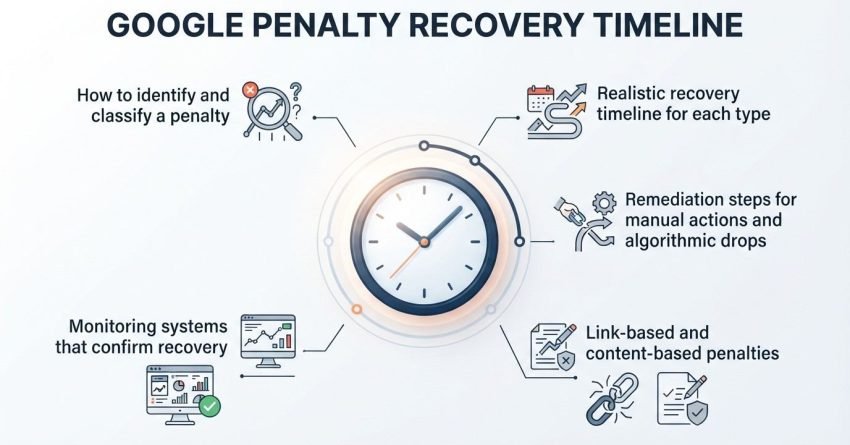
Google penalty recovery typically takes anywhere from a few days to twelve months, depending on the penalty type, its severity, and how quickly the underlying issue gets fixed. Manual actions tend to resolve faster once corrected and resubmitted, while algorithmic penalties tied to broad core updates can take multiple update cycles to lift. I’ve watched both play out, and the timeline always comes down to root-cause accuracy, not luck.
Guessing at the fix wastes months of traffic and revenue you can’t get back. A wrong diagnosis means reapplying for reconsideration with the same problem still live. That delay compounds fast for lead-dependent businesses.
This guide covers how to identify and classify a penalty, the realistic recovery timeline for each type, the exact remediation steps for manual actions and algorithmic drops, how to handle link-based and content-based penalties specifically, and the monitoring systems that confirm recovery is holding rather than temporary.
What Is a Google Penalty?
A Google penalty is a deliberate reduction in a website’s search visibility, applied either manually by a human reviewer or automatically by an algorithm, in response to a violation of Google’s quality guidelines. I think of it less as “bad luck” and more as Google actively deciding a site shouldn’t rank where it currently does.
Manual Actions vs. Algorithmic Penalties
A manual action is a penalty applied by a member of Google’s search quality team after a human review flags a guideline violation. An algorithmic penalty, by contrast, happens automatically when a broad ranking system reassesses a site’s quality signals during a core or spam update. We treat these two very differently in recovery planning because one has a formal appeals process and the other doesn’t.
How Penalties Affect Rankings and Traffic
Rankings typically drop sharply and traffic follows the same curve within days of the triggering update or manual review. Some pages fall out of the top 100 entirely rather than sliding a few positions. I’ve seen sites lose 70% of organic sessions inside a single week when a manual action hits a large portion of the site.
Types of Google Penalties
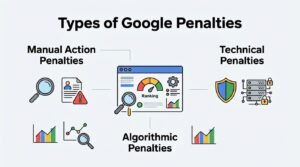
Google penalties fall into three broad categories: manual actions, algorithmic penalties, and technical penalties tied to indexing or security failures. Each behaves differently, recovers on a different timeline, and requires its own fix.
Manual Action Penalties
Manual action penalties are issued directly by Google’s search quality reviewers and appear as a formal notice inside Google Search Console. Common triggers include unnatural links, thin content, cloaking, and structured data spam. These are the clearest penalties to diagnose because Google names the exact violation.
Algorithmic Penalties (Core Updates, Spam Updates)
Algorithmic penalties occur when a broad update, such as a core update or a dedicated spam update, recalculates how a site’s quality signals compare to the rest of the web. Unlike manual actions, algorithmic penalty causes require pattern analysis of what changed sitewide around the update’s rollout date. I usually cross-reference the timing against Google’s official search ranking updates history before drawing conclusions.
Technical Penalties (Security, Indexing Issues)
Technical penalties stem from security breaches, malware infections, or severe crawling and indexing failures rather than content quality issues. A hacked site injected with spam links is a textbook example, and Search Console flags this under Security Issues rather than Manual Actions. Fixing the technical vulnerability is the entire remedy here; there’s no content rewrite involved.
How to Know If You’ve Been Penalized
You know you’ve been penalized when a sharp, sudden traffic or ranking drop coincides with a Google update or a Search Console notification, rather than a gradual decline. Distinguishing a real penalty from a normal fluctuation is the first diagnostic step, and it changes everything downstream.
Traffic Drop Patterns That Signal a Penalty
A penalty-driven drop is usually sharp and dated, often losing 50% or more of organic traffic within a one-to-two-week window tied to a specific update. A gradual decline over several months usually points to competitive erosion or content decay instead. I always overlay the traffic graph against Google’s confirmed update timeline before calling it a penalty.
Google Search Console Manual Action Reports
The Manual Actions report inside Google Search Console is the definitive source confirming whether a human reviewer penalized your site. It names the specific violation type, the affected pages or the entire site, and gives direct access to the reconsideration request form. If this report shows nothing, you’re dealing with an algorithmic shift instead.
Google Penalty Recovery Timeline by Penalty Type
Recovery timelines range from a few days for minor manual actions to six to twelve months for severe algorithmic penalties tied to core updates. The type of penalty is the single biggest variable determining how long recovery actually takes.
| Penalty Type | Typical Recovery Timeline | Recovery Trigger |
| Minor manual action | 1–4 weeks | Reconsideration request approval |
| Severe manual action (sitewide) | 1–3 months | Full remediation + reconsideration |
| Core update penalty | 1–3 update cycles (3–9 months) | Next confirmed core update |
| Spam/link-based penalty | 2–6 months | Disavow processing + link cleanup |
| Technical/security penalty | Days to 2 weeks | Security fix + reindexing |
Manual Action Recovery Timeline
Manual action recovery typically takes one to four weeks from the moment you submit a reconsideration request, assuming the underlying issue is fully fixed. Google’s review team manually reassesses the site rather than waiting for an automated crawl cycle. Sitewide manual actions affecting large link networks can stretch to three months.
Core Update Recovery Timeline
Recovering from a core update penalty typically takes one to three subsequent core update cycles, which usually span three to nine months. Google doesn’t reassess core update impacts continuously it waits for the next broad update to reprocess quality signals. This is the most frustrating timeline for business owners because there’s no appeals button to speed it up.
Spam/Link-Based Penalty Recovery Timeline
Link-based penalty recovery generally takes two to six months, accounting for outreach response times, disavow file processing, and the next Google crawl of the affected backlink profile. Manual link removal outreach alone often takes four to six weeks before results show. I budget for the slowest link removals rather than the fastest ones when setting client expectations.
Factors That Influence Recovery Speed
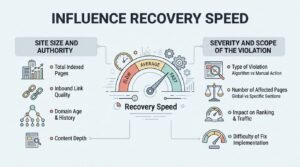
Recovery speed depends primarily on site authority, the severity and scope of the violation, and how quickly the root cause gets identified and fixed. Two sites with the same penalty type can recover at completely different speeds because of these variables.
Site Size and Authority
Larger, more established sites with stronger domain authority tend to recover faster because Google already has a deeper trust baseline to fall back on. A newer site with thin authority sits in a more fragile position after any quality signal drop. This isn’t favoritism; it’s a byproduct of how trust signals accumulate over time.
Severity and Scope of the Violation
A penalty affecting a handful of pages resolves faster than one affecting the entire domain’s link profile or content base. Scope determines how much remediation work exists before a reconsideration request can even be submitted. I always map the full scope before touching the timeline conversation with a client.
Step-by-Step Google Penalty Recovery Process
The Google penalty recovery process follows four core steps: diagnose the root cause, fix the underlying issue completely, document the remediation, and submit a reconsideration request if a manual action applies. Skipping the diagnosis step is the single most common reason recovery drags on far longer than it should.
- Diagnose the root cause – Cross-reference traffic drop dates against Search Console notices and update timelines.
- Audit the full scope – Identify every affected page, link, or technical issue, not just the obvious ones.
- Fix the underlying issue – Remove or disavow bad links, rewrite thin content, or patch security vulnerabilities.
- Document every change – Keep a detailed record for the reconsideration request narrative.
- Submit a reconsideration request – Only for manual actions; algorithmic penalties have no equivalent form.
- Monitor for confirmation – Track rankings and traffic for sustained recovery, not just a temporary bounce.
Diagnose the Root Cause
Diagnosing the root cause means matching the exact date of the traffic drop against confirmed Google update rollouts and any Search Console manual action notices. A misdiagnosis here wastes the entire recovery window on the wrong fix. I never start remediation work until this step produces a confident, dated conclusion.
Fix the Underlying Issue
Fixing the underlying issue means fully resolving whatever triggered the penalty, removing unnatural links, rewriting thin or duplicate content, or patching a security exploit before requesting any reassessment. Partial fixes almost always result in a rejected reconsideration request. Google’s reviewers can tell the difference between a genuine fix and a cosmetic one.
Submit a Reconsideration Request
A reconsideration request is a formal submission through Google Search Console asking a human reviewer to reassess a site after a manual action has been fully remediated. The request should document exactly what was found, what was changed, and evidence proving the fix. Reconsideration requests only apply to manual actions; algorithmic penalties have no submission process at all.
Recovering From Algorithmic Penalties
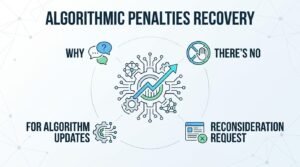
Recovering from an algorithmic penalty means improving the underlying quality signals a core or spam update is evaluating, then waiting for the next update cycle to reassess the site. There’s no direct appeal, which makes this the most patience-testing recovery type.
Why There’s No Reconsideration Request for Algorithm Updates
Algorithmic penalties are calculated by automated systems reassessing sitewide quality signals, not by a human reviewer, so there’s no manual review process to appeal to. The only path forward is genuinely improving the signals the algorithm evaluates and waiting for reprocessing. This is exactly why Google’s own guidance on core updates frames recovery as ongoing quality improvement rather than a one-time fix.
Link-Based Penalty Recovery
Link-based penalty recovery centers on identifying unnatural or manipulative backlinks, removing or disavowing them, and rebuilding a clean link profile. This penalty type has one of the longest recovery windows because it depends on cooperation from other webmasters.
Using the Disavow Tool
The disavow tool is a Google Search Console feature that tells Google’s algorithm to ignore specific backlinks when assessing a site’s link profile. It’s meant as a last resort after direct removal outreach has failed, not a first step. Uploading a disavow file doesn’t guarantee immediate reprocessing; it waits for Google’s next crawl of those referring domains.
Link Removal Outreach
Link removal outreach involves directly contacting webmasters of low-quality or unnatural linking domains and requesting the link be taken down. Response rates are typically low, which is why most recovery plans run outreach and disavow filing in parallel rather than sequentially. Documenting every outreach attempt strengthens the eventual reconsideration request too.
Content-Related Penalty Recovery
Content-related penalty recovery involves identifying and rewriting or removing thin, duplicate, or low-value pages that triggered the quality violation. This is one of the more controllable penalty types because the fix lives entirely within the site itself.
Rewriting or Removing Thin and Duplicate Content
Thin content pages typically offer little original value and closely mirror content found elsewhere, which is exactly what triggers this penalty type. The fix means either substantially rewriting the page with unique, useful information or removing and redirecting it entirely. I generally recommend consolidation over deletion whenever the page still holds any residual link equity.
Monitoring Strategies During Recovery
Monitoring during recovery means tracking rankings, traffic, and Search Console signals continuously to confirm the fix is holding rather than producing a temporary bounce. Recovery isn’t confirmed the moment a reconsideration request is approved; it’s confirmed when the metrics stabilize over multiple weeks.
Tracking Rankings and Traffic in Google Analytics
Google Analytics shows whether organic sessions are recovering in the specific pages and directories that were originally affected, not just in aggregate site traffic. Segmenting by landing page prevents a false sense of recovery driven by unrelated traffic sources. I check this weekly during any active recovery period.
Using Google Search Console for Recovery Signals
Google Search Console confirms whether a manual action has been formally lifted and shows whether previously penalized pages are being recrawled and reindexed. The Manual Actions report will explicitly show “No issues detected” once a reconsideration request succeeds. This is the single most reliable recovery confirmation available.
Setting Up Alerts for Ranking Fluctuations
Rank tracking alerts notify you automatically when monitored keywords move significantly, which catches both relapses and genuine recovery signals in real time. Setting thresholds around your previously penalized pages specifically, rather than the whole site, produces far more useful alerts. This kind of early warning system also catches a second penalty before it does real damage.
How to Prevent Future Google Penalties
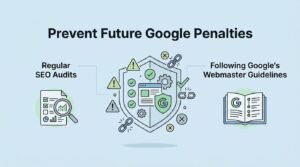
Preventing future penalties means maintaining ongoing compliance with Google’s quality guidelines through regular audits and a clean, natural link and content profile. Recovery is expensive enough in lost time and traffic that prevention is always the cheaper strategy.
Regular SEO Audits
Regular SEO audits catch thin content, unnatural link patterns, and technical vulnerabilities before they accumulate into a full penalty. A quarterly audit cadence is generally enough for most mid-sized sites, though larger or more aggressive link-building operations warrant monthly reviews. Catching drift early is dramatically cheaper than recovering from a triggered penalty.
Following Google’s Webmaster Guidelines
Google’s Webmaster Guidelines outline explicitly which tactics, including link schemes, cloaking, and automatically generated content, will trigger a manual action if detected. Reviewing these guidelines whenever a major update rolls out keeps a site’s practices aligned with current enforcement priorities. Guidelines shift more often than most teams realize, particularly around AI-generated content and structured data.
Common Mistakes That Delay Penalty Recovery
The most common mistake that delays recovery is submitting a reconsideration request before the underlying issue is fully and verifiably fixed. Google rejects incomplete remediation attempts, and each rejected request adds weeks back onto the timeline.
Another frequent mistake is disavowing links too aggressively without attempting direct removal first, which can strip away link equity that wasn’t actually harmful. Misdiagnosing an algorithmic penalty as a manual action, and vice versa, also wastes significant time chasing the wrong remedy entirely.
When to Work With an SEO Professional for Recovery

Working with an SEO professional makes sense when the penalty scope is sitewide, the diagnosis is unclear, or in-house resources lack experience with reconsideration request documentation. Complex link profile cleanups in particular benefit from a specialist who has handled disavow filings across many prior cases.
The cost of a prolonged recovery, measured in lost leads and revenue, typically outweighs the cost of specialist support by a wide margin. A second opinion on root-cause diagnosis alone can save months of pursuing the wrong fix.
Conclusion
Google penalty recovery depends entirely on penalty type, scope, and how accurately the root cause gets diagnosed and fixed. Manual actions, algorithmic updates, and link-based penalties each follow distinct timelines and remediation paths.
Sustainable recovery means pairing the correct fix with disciplined monitoring across Search Console and analytics platforms. Prevention through regular audits remains the most reliable long-term protection available.
We help businesses diagnose, recover from, and prevent Google penalties with data-driven strategy. Partner with White Label SEO Service to protect and rebuild your organic visibility.
Frequently Asked Questions
How long does it take to recover from a Google penalty?
Recovery typically takes anywhere from a few days to twelve months, depending on penalty type and severity. Manual actions resolve faster once fixed and resubmitted. Algorithmic penalties require waiting for the next update cycle.
Can you recover from a Google penalty without professional help?
Yes, many manual action penalties can be resolved in-house with accurate diagnosis and thorough remediation. Complex sitewide or link-based penalties often benefit from specialist experience. The complexity of the violation determines how much expertise is genuinely needed.
Will my rankings fully return after a penalty?
Rankings often return close to pre-penalty levels once the issue is fully fixed and confirmed. Full recovery isn’t guaranteed if competitors improved during the penalty period. Sustained monitoring confirms whether recovery is holding.
How do I know if my traffic drop is a penalty or an algorithm update?
Check Google Search Console’s Manual Actions report first, since penalties always appear there. If nothing shows, cross-reference the drop date against confirmed core update rollouts. A sharp, dated drop with no manual action notice usually points to an algorithmic shift.
Does submitting a reconsideration request guarantee recovery?
No, a reconsideration request only guarantees a human review, not automatic approval. Approval depends entirely on whether the underlying issue was fully and verifiably fixed. Incomplete fixes are commonly rejected.
How often should I check for Google penalties?
Checking Google Search Console weekly is a reasonable baseline for most sites. Sites with aggressive link-building history or frequent content changes benefit from more frequent monitoring. Setting up automated alerts reduces the manual checking burden significantly.
Can a penalty happen again after recovery?
Yes, a second penalty can occur if the same violation pattern reemerges or a new one develops. This is why ongoing audits and guideline compliance matter even after successful recovery. Recurring penalties typically take longer to resolve than first-time violations.