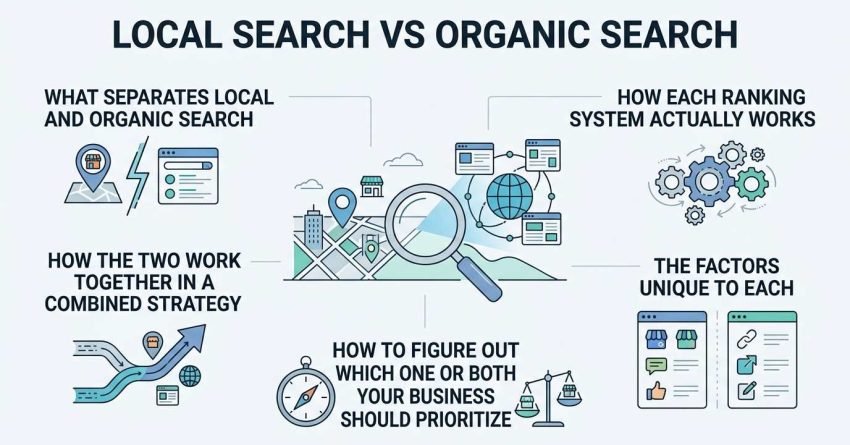
Local search shows results tied to a specific geographic area, while organic search ranks pages based on relevance and authority regardless of location. I see business owners confuse the two constantly, and it costs them real traffic. Understanding which one drives your visibility changes how you invest your SEO budget.
Getting this wrong means chasing the wrong tactics for months. We’ve watched businesses pour budget into blog content when a Google Business Profile fix would’ve moved the needle faster, or vice versa.
This guide covers what separates local and organic search, how each ranking system actually works, the factors unique to each, and how to figure out which one or both your business should prioritize. We’ll also show you how the two work together in a combined strategy.
What Is Organic Search?
Organic search refers to unpaid website listings that rank in search engine results based on relevance, authority, and content quality rather than location or paid placement. I think of it as the “default” version of search: no map, no local pack, just ranked pages competing on merit. It’s what most people picture when they think of SEO.
Organic search results appear as the traditional blue links beneath any ads and local packs on the page. Google evaluates hundreds of signals to decide where a page lands, and geography is only one small piece of that puzzle for most queries.
Someone searching “best project management software” is going to see organic results built around content depth, backlink profiles, and topical authority. There’s no map pin involved because the query has no local intent behind it.
How Organic Search Rankings Work
Organic rankings work through crawling, indexing, and ranking a three-stage process where Google’s bots first discover a page, then store it in a searchable index, and finally rank it against competing pages using hundreds of algorithmic signals. I always tell clients this process runs continuously in the background, not once and done.
A page has to pass through all three stages successfully before it can rank for anything. If a page can’t be crawled, it’s invisible no matter how good the content is.
Key Ranking Factors in Organic Search
The main ranking factors in organic search are content relevance, backlink authority, technical site health, and user experience signals. Google weighs these together rather than picking a single winner. I’ve seen sites with weaker content outrank better-written pages purely on backlink strength, and I’ve seen the reverse happen too.
There’s no fixed formula Google publishes, which is exactly why organic search rewards sustained, well-rounded effort over shortcuts.
What Is Local Search?
Local search is a subset of search results that prioritizes proximity, relevance, and prominence to connect users with businesses near their physical location. This is the map pack you see above organic results when you search for something like “plumber near me” or “coffee shop downtown.”
Local search exists because a huge share of queries carry implicit location intent, even without the word “near me” attached. Someone typing “dentist” while standing in Austin wants an Austin dentist, not a general definition of dentistry.
How the Local Search Algorithm Works
Google’s local algorithm ranks businesses using three core factors: relevance, distance, and prominence, weighing all three together for every local query. I explain this to clients as Google trying to answer “which nearby business best matches what this person needs, and how credible is it?”
Distance gets calculated against the searcher’s actual location or the location specified in the query, which is why the same business can rank differently for two people searching the identical term from different neighborhoods.
The Role of the Google Business Profile
A Google Business Profile is the free business listing that powers a company’s appearance in the local pack, Google Maps, and local knowledge panels. I consider this the single most important local ranking asset a business controls directly.
An incomplete or unclaimed profile often explains why a business is invisible in local results despite having a solid website. Categories, hours, photos, and posts all feed directly into how the algorithm evaluates relevance.
Local Search vs Organic Search: The Core Differences
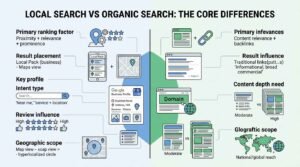
Local search and organic search differ primarily in intent matching, ranking factors, and result placement. Local search prioritizes proximity for geographically-tied queries, while organic search prioritizes topical authority regardless of location. The table below breaks down where the two diverge most.
| Attribute | Local Search | Organic Search |
| Primary ranking factor | Proximity + relevance + prominence | Content relevance + backlinks |
| Result placement | Local pack, Maps | Traditional blue links |
| Key profile | Google Business Profile | Website domain |
| Intent type | “Near me,” service + location | Informational, broad commercial |
| Review influence | High | Low to moderate |
| Content depth need | Moderate | High |
| Geographic scope | Hyperlocal | National/global |
Reading this table side by side, the split usually comes down to one question: does the searcher’s location change the answer they need? If yes, local search takes over.
How the Local Pack and Map Results Work
The local pack is the block of three business listings, accompanied by a map, that appears at the top of search results for queries with local intent. I’ve had clients call this the “3-pack,” and ranking inside it is often worth more than ranking #1 organically for the same term.
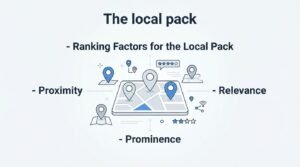
Google generates the pack dynamically based on the searcher’s exact location, so two people in different parts of the same city can see completely different businesses for an identical search.
How Traditional Organic (Blue Link) Results Work
Traditional organic results are the ranked list of webpages shown beneath any local pack or ads, ordered by Google’s assessment of relevance and authority for the query. These results aren’t tied to a searcher’s physical position the way local pack listings are.
A page ranking organically for “how to choose a CRM” will show the same result to someone in Denver and someone in Miami, because the query itself carries no location dependency.
Ranking Factors Unique to Local Search
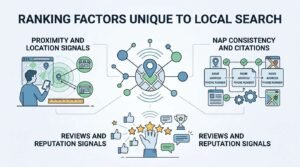
Local search rankings depend heavily on proximity signals, citation consistency, and review volume factors that carry little to no weight in traditional organic rankings. These three elements work together to build what Google calls “prominence.”
Proximity and Location Signals
Proximity refers to how close a business is to the searcher’s location or the location term used in their query, and it’s a factor organic search does not use at all. A business a mile away with a weaker profile can still outrank a stronger competitor five miles further out.
NAP Consistency and Citations
NAP consistency means a business’s name, address, and phone number match exactly across every online directory and citation source, which builds the trust signal Google uses to verify legitimacy. Mismatched suite numbers or old phone numbers scattered across directories quietly undermine local rankings.
Reviews and Reputation Signals
Review count, review recency, and average rating all factor directly into local pack rankings, unlike organic search where reviews play a much smaller role. BrightLocal’s 2024 consumer survey found that 98% of consumers read online reviews for local businesses, and Google treats that same review data as a ranking input.
Ranking Factors Unique to Organic Search
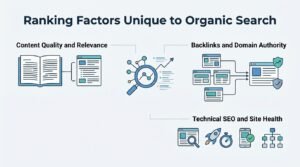
Organic search rankings lean on content depth, backlink authority, and technical site performance factors that matter far less inside the local pack. These signals compound over time in a way local prominence factors typically don’t.
Content Quality and Relevance
Content quality measures how thoroughly a page satisfies search intent compared to competing pages, judged through depth, accuracy, and structure rather than keyword repetition. Thin pages rarely sustain organic rankings even with strong backlinks propping them up.
Backlinks and Domain Authority
Backlinks are links from other websites pointing to a page, and they remain one of the strongest ranking signals in organic search according to Google’s own search quality guidelines. A site with consistent, relevant backlinks typically outranks a comparable site without them.
Technical SEO and Site Health
Technical SEO covers the crawlability, site speed, mobile usability, and structural elements that let search engines properly access and understand a website. A technically broken site can hold back even the strongest content and backlink profile from ranking.
How Search Intent Determines Which Result Type Appears
Search intent is the underlying goal behind a query, and Google uses it to decide whether to show local pack results, organic results, or both. A query like “shoe stores” typically triggers a local pack because most searchers want a nearby store, while “history of running shoes” triggers pure organic results.
Some queries sit in a gray zone and show both result types stacked on the same page, which usually signals mixed intent across the searcher population.
Who Should Prioritize Local SEO vs Organic SEO
Businesses with a physical location or defined service area should prioritize local SEO, while businesses selling nationally or purely online should prioritize organic SEO. The right split depends entirely on how customers find and choose a business like yours.
Local SEO Priority Businesses
Restaurants, contractors, medical practices, retail stores, and any business relying on nearby foot traffic or service calls should treat local SEO as the primary channel. These businesses win or lose almost entirely inside the local pack.
Organic SEO Priority Businesses
SaaS companies, e-commerce brands, media publishers, and national service providers should prioritize organic SEO since their customers aren’t searching by proximity. Location plays little to no role in how these businesses get discovered.
How Local SEO and Organic SEO Work Together
Local and organic SEO reinforce each other because Google factors overall domain authority into local rankings, and a strong local presence builds the reviews and citations that support broader brand visibility. I rarely recommend treating them as separate budgets.
A business with strong organic content authority often sees its local pack rankings improve too, since Google weighs the wider domain signals even inside geographically-filtered results.
Measuring Success: Local Search vs Organic Search Metrics
Local search success is measured through local pack rankings, Google Business Profile views, and call/direction clicks, while organic search success is measured through keyword rankings, organic sessions, and backlink growth. Mixing these metrics up leads to misreading performance.
Google Search Console and Google Analytics track both, but the reports live in different views, and a marketer pulling the wrong report can easily misjudge whether a campaign is working.
Common Mistakes When Confusing Local and Organic Strategies
The most common mistake is applying organic SEO tactics, like heavy blog content, to a business that needs local pack visibility instead, or vice versa. I’ve seen local businesses spend budget on national keyword content that never converts a single nearby customer.
Another frequent error is ignoring the Google Business Profile entirely while investing heavily in the website, which leaves an easy local ranking opportunity untouched.
Building a Combined Local and Organic SEO Strategy
A combined strategy pairs a fully optimized Google Business Profile and local citation building with a strong organic content and backlink program, so a business captures both proximity-based and non-local search demand. This dual approach covers the full range of how customers might search.
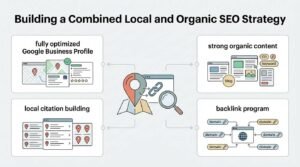
Businesses running both strategies typically see organic content support brand credibility that strengthens local trust signals, while local visibility drives the reviews that feed back into overall domain authority.
Conclusion
Local and organic search rank on different signals: proximity and prominence versus authority and relevance. Knowing which one your customers actually use changes where your SEO budget belongs.
Most businesses need both working together, not one instead of the other, especially as search results increasingly blend local and organic elements.
We help businesses build strategies that cover both sides properly. Talk to White Label SEO Service about a plan built around how your customers actually search.
Frequently Asked Questions
What is the difference between local SEO and organic SEO?
Local SEO targets geographically-tied searches through the local pack and Maps, while organic SEO targets broader searches through traditional ranked webpage listings. The two use different ranking factors and serve different search intents.
Does my business need both local and organic SEO?
Most businesses with a physical location benefit from both, since customers search with and without location intent. A restaurant needs local pack visibility but also benefits from organic content that builds broader authority.
Why does my business show up in Maps but not in regular search results?
This usually happens because your Google Business Profile is stronger than your website’s organic authority. Local pack rankings and organic rankings use different signals, so strength in one doesn’t guarantee strength in the other.
How long does local SEO take to show results?
Local SEO typically shows measurable movement within 1-3 months, faster than organic SEO in most cases. Profile optimization and citation fixes tend to produce quicker gains than content-driven organic growth.
Can a business without a physical location rank in local search?
Service-area businesses without a storefront can still rank in local search if they properly configure their Google Business Profile’s service area settings. Google does support this listing type for mobile or remote service providers.
Do backlinks matter for local search rankings?
Backlinks matter less for local pack rankings than for organic rankings, but they still contribute to overall domain authority, which influences local prominence. A locally-relevant backlink can help both local and organic visibility simultaneously.
What is the biggest ranking factor difference between local and organic search?
Proximity is the single biggest differentiator, since it’s a major local ranking factor with no equivalent in organic search. Organic search instead relies most heavily on backlink authority and content depth.