Resource page link building is the practice of getting your website listed on curated pages that already exist to collect useful links for a specific audience or topic, and it works because it targets pages built specifically to link out rather than pages that have to be convinced to link at all. I’ve used it as a foundation tactic for years because it produces links that are genuinely editorial, not paid or manipulated.
This matters right now because Google’s algorithms have gotten sharper at spotting manipulative link patterns. Resource pages sidestep that risk entirely since the page owner already wants to link out.
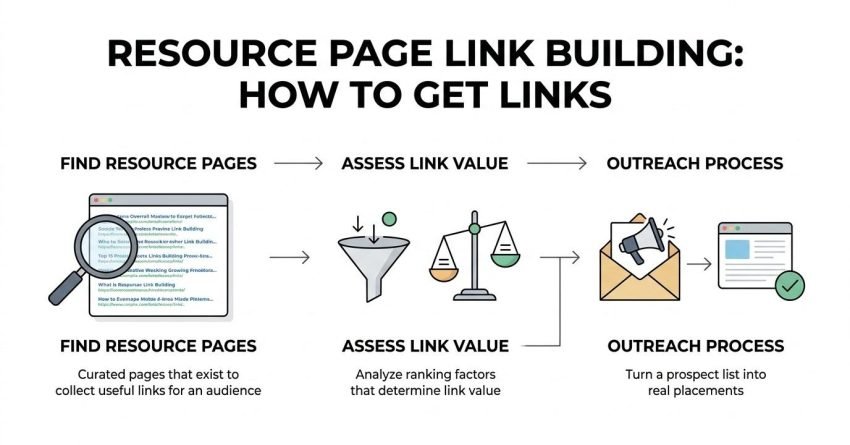
This guide covers what resource pages actually are and why they carry weight, how to separate high-authority directories from low-value ones, the ranking factors that determine a page’s link value, and the outreach process that turns a prospect list into real placements.
What Are Resource Page Links and Why Do They Matter?
A resource page link is a link placed on a page whose sole purpose is to curate helpful external links for visitors researching a specific topic. These pages exist on university sites, nonprofit sites, industry associations, blogs, and business directories.
Resource pages differ from guest posts because you’re not creating new content anywhere. You’re getting added to a list that already exists and already ranks for the topic it covers.
How Resource Pages Differ From Guest Posts and Directories
A guest post link sits inside content you wrote for someone else’s site, buried in a paragraph you had to author. A resource page link sits inside a static list the site owner maintains, and I never have to write anything the destination site publishes.
Directories are often mistaken for resource pages, but a directory typically exists to list businesses by category, while a resource page exists to curate genuinely useful links around one narrow topic. The distinction matters because directory submissions often carry less topical relevance than a well-matched resource page in your exact niche.
Why Search Engines Value Editorial Resource Links
Search engines weigh a link partly on whether the linking page had a genuine reason to include it. A Backlinko study of 11.8 million search results found that referring domain relevance correlates more strongly with rankings than raw link volume. Resource pages score well here because their entire structure signals editorial intent.
How High-Authority Directories Fit Into a Resource Page Strategy
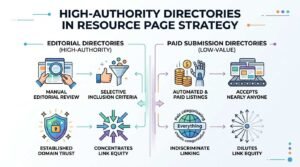
High-authority directories fit into resource page strategy as one category of resource page, distinguished by strict editorial review, established domain trust, and selective inclusion criteria rather than automated or paid listing. I treat them as a subset, not a separate tactic entirely.
Editorial Directories vs. Paid Submission Directories
An editorial directory reviews every submission manually and rejects sites that don’t meet relevance or quality standards. A paid submission directory accepts nearly anyone who pays a listing fee, and search engines have learned to discount that link type over the past decade.
The practical difference shows up in directory authority signals: editorial directories maintain lower total outbound link counts relative to their domain authority, which concentrates equity rather than diluting it.
Signals That Separate High-Authority Directories From Low-Value Ones
A high-authority directory typically shows consistent traffic, a manual review process, topical focus rather than “everything” categorization, and outbound links that go to genuinely relevant sites. Low-value directories accept any submission and link out indiscriminately.
I check whether a directory has been updated in the last twelve months before I bother submitting anything. Stale directories rarely carry the trust they once did.
Core Ranking Factors That Determine Directory and Resource Page Value
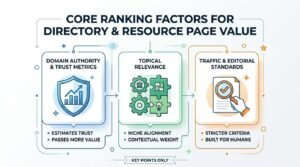
The core ranking factors that determine a resource page or directory’s link value are domain authority, topical relevance, and editorial standards, and a page can fail on any single factor even if it scores well on the other two. I run every prospect through all three before adding it to an outreach list.
Domain Authority and Trust Metrics
Domain-level trust metrics estimate how much a search engine trusts a given site based on its own backlink profile and history. A page sitting on a domain with strong trust metrics passes more value through its outbound links than a brand-new or thin domain.
I don’t chase a single metric blindly, since third-party authority scores are estimates, not Google’s actual internal signals. But they’re a useful proxy when comparing hundreds of prospects quickly.
Relevance to Your Niche or Industry
A link from a page tightly matched to your industry carries more contextual weight than a link from an unrelated high-authority page. Topical relevance in link building has become one of the strongest differentiators between links that move rankings and links that just sit there.
A general business directory linking to a plumbing company means less than a home services resource page doing the same thing.
Traffic and Editorial Standards
A resource page that receives real visitor traffic tends to have stricter inclusion criteria, since site owners protect pages that actual readers see. I look at whether a page reads like it was built for humans first or for SEO manipulation first; the difference is usually obvious within thirty seconds.
How to Find High-Authority Resource Pages Worth Targeting
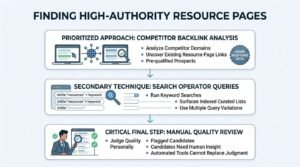
Finding high-authority resource pages worth targeting starts with search operator queries designed to surface pages that explicitly function as curated link lists in your niche. This is faster and more reliable than manually browsing directories one by one.
Search Operator Techniques for Resource Page Discovery
Queries like intitle: “resources” + [keyword], inurl: links + [keyword], and “helpful resources” + [keyword] consistently surface resource pages that Google has already indexed as relevant. I run a dozen variations per niche because phrasing differs across industries.
Each result needs manual review afterward; automated tools flag candidates, but they don’t replace judgment on quality.
Competitor Backlink Analysis for Resource Page Opportunities
Running a competitor’s domain through a backlink tool reveals which resource pages already link to sites like yours, and those pages are pre-qualified prospects since they’ve already demonstrated a willingness to link to your exact niche. An Ahrefs analysis of resource page campaigns found this approach produces meaningfully higher acceptance rates than cold prospecting from search queries alone.
I build my first outreach list almost entirely from competitor backlink gaps before I ever touch search operators.
How to Evaluate a Directory or Resource Page Before Pitching
Evaluating a directory or resource page before pitching means checking its outbound link ratio, update frequency, and link neighborhood to confirm it still functions as a genuine editorial resource rather than a decayed or repurposed link farm. Skipping this step wastes outreach effort on pages that won’t move rankings.
Checking Outbound Link Ratios and Link Neighborhoods
A page linking out to 20 relevant resources carries more per-link value than a page linking out to 500 unrelated ones. I scan the existing outbound links on a prospect page before pitching, since a page full of spammy, unrelated links signals the page itself may carry a penalty risk.
Reviewing Update Frequency and Editorial Activity
A resource page last updated three years ago with dead links throughout usually means nobody is actively maintaining it, and getting added won’t happen quickly even if the pitch is accepted. I prioritize pages showing edits within the last six to twelve months.
How to Build a Resource Page Outreach List
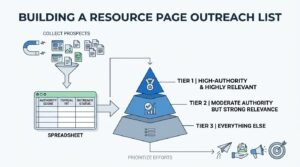
Building a resource page outreach list means collecting qualified prospects into a single tracked sheet organized by authority score, topical fit, and outreach status so nothing gets pitched twice or forgotten. I keep this simple; a spreadsheet works better than complex software for most teams.
Organizing Prospects by Authority, Relevance, and Fit
I sort prospects into three tiers: high-authority and highly relevant first, moderate authority but strong relevance second, and everything else last. This ordering means outreach time goes toward the placements that will move the needle most, rather than working through the list alphabetically.
How to Write an Outreach Email That Gets Resource Page Links
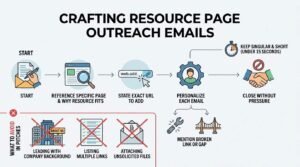
An outreach email that gets resource page links opens by referencing the specific page and why your resource fits it, states the exact URL you’re suggesting, and closes without pressure or a follow-up threat. Generic templates get ignored because site owners recognize mass outreach instantly.
Personalization Elements That Increase Reply Rates
Mentioning something specific about the existing resource list a broken link you noticed, or a gap in coverage your page fills increases reply rates measurably. A study by Pitchbox on outreach campaigns found personalized subject lines nearly doubled open rates compared to generic ones.
I never send the same subject line to more than a handful of prospects in a single campaign.
What to Avoid in Resource Page Pitches
Pitches that lead with company background, list multiple links to add, or attach unsolicited files usually go straight to spam folders or get ignored. Keep the ask singular and the email short enough to read in fifteen seconds.
What Makes a Page Worthy of a Resource Page Link
A page worthy of a resource page link solves a specific problem thoroughly enough that the linking site’s own visitors benefit from finding it, rather than existing purely to receive links. Resource page owners can tell the difference between genuinely useful content and thin pages built only for outreach.
Content Formats That Attract Resource Page Placements
Original research, free tools, comprehensive guides, and data visualizations attract resource page placements more consistently than promotional or sales-oriented pages. I’ve seen simple calculators and checklists outperform ten-thousand-word guides for this specific link type because they solve one problem completely.
Common Mistakes That Get Resource Page Pitches Rejected
Pitching a page that doesn’t match the resource list’s existing topic is the most common rejection reason I see, followed closely by mass-blasting identical emails to hundreds of prospects without any personalization. Both signal the same thing to the recipient: low effort, low relevance.
Asking for a link in exchange for something (a “link swap,” a small payment, or a reciprocal listing) also gets flagged more often now, since site owners have grown wary of anything that resembles paid placement given Google’s stated stance on unnatural links.
How to Track and Measure Resource Page Link Building Results
Tracking resource page link building results means monitoring placement rate, referring domain growth, and any resulting ranking or traffic movement on the pages that received the new links. Without tracking, it’s impossible to know whether the campaign earned its time investment.
Metrics That Indicate a Resource Link Is Working
A rising number of referring domains in a backlink tool confirms placements went live. Movement in organic visibility for the linked page over the following two to three months confirms the links carried actual ranking weight, not just a vanity placement.
Resource Page Link Building vs. Other Link Building Methods
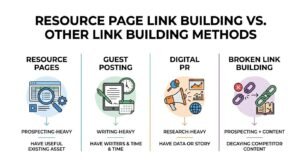
Resource page link building differs from guest posting, digital PR, and broken link building primarily in effort distribution: it requires less content creation but more prospecting and list-building work upfront. Each method fits a different resource constraint.
| Method | Content Required | Typical Effort | Best Fit When |
| Resource pages | None (existing page) | Prospecting-heavy | You have a genuinely useful existing asset |
| Guest posting | Full article per placement | Writing-heavy | You have strong writers and time |
| Digital PR | Newsworthy asset/campaign | Research-heavy | You have data or a unique story |
| Broken link building | Replacement content | Prospecting + content | Competitor content is decaying |
When Resource Pages Are the Right Strategy vs. When They Are Not
Resource pages work best when you already have a genuinely useful asset sitting on your site with no links pointing to it yet. They work poorly when your only pages are commercial or sales-focused, since resource page owners rarely link to anything that reads as a pitch for a purchase.
How Many Resource Page Links Do You Actually Need?
There’s no fixed number of resource page links needed, since link building value depends on the relevance and authority of each placement rather than a target count. A handful of highly relevant, high-authority placements outweigh dozens of weak ones.
I generally aim for quality over a specific quota, treating every accepted placement as one part of a broader link profile rather than a milestone number.
Conclusion
Resource page link building connects genuinely useful content with sites already built to link outward. It rewards research, relevance, and patient outreach over shortcuts or paid placement schemes.
Combined with guest posting, digital PR, and broken link building, resource pages round out a diversified, sustainable backlink profile built for long-term visibility.
We help businesses build authority-driven link profiles that hold up over time. Reach out to White Label SEO Service to start building yours.
Frequently Asked Questions
What is a resource page in link building?
A resource page is a page built specifically to curate helpful external links around one topic. Site owners maintain them for visitor value, not for SEO manipulation.
Are directory links still valuable for SEO?
Editorial, manually reviewed directories still carry value for SEO. Paid or automated submission directories carry little to no ranking value today.
How long does resource page outreach take to show results?
Most campaigns take four to eight weeks to see placements go live. Ranking impact from those links typically appears two to three months after placement.
What’s a good response rate for resource page outreach?
A response rate between 5% and 15% is typical for well-targeted resource page outreach. Personalized, relevant pitches consistently land at the higher end.
Do resource page links pass the same value as editorial content links?
Resource page links generally pass strong value because they’re genuinely editorial placements. They can match or exceed guest post links when the referring page has strong authority and relevance.
How do I know if a directory is high-authority or spammy?
Check whether the directory reviews submissions manually and links out to relevant, reputable sites. Spammy directories accept nearly any submission and show little topical focus.
Can resource page link building hurt my site if done wrong?
Resource page link building rarely hurts a site since the links are typically natural and editorial. Risk only appears if you pursue low-quality, spammy directories at scale or pay for placements that violate search engine guidelines.