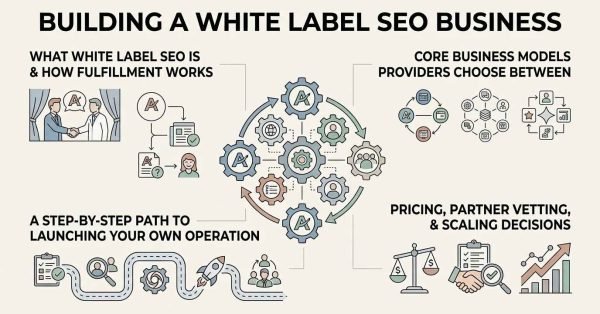
White label SEO is an outsourcing arrangement in which a specialist provider performs search engine optimisation work that another company resells under its own brand, with the provider remaining anonymous to the end client. The reselling agency owns the relationship, the pricing, and the invoice. The provider owns the execution.
I see the same pattern every month. An agency wins an SEO retainer it cannot staff, tries to learn on the client’s budget, and loses the account by month five.
This guide covers what the model actually is and how a partnership runs day to day, the deliverables and pricing structures behind it, the margin maths agencies use to profit from it, realistic timelines and how to set expectations, how to vet and contract with a provider safely, and where the model breaks down or fails outright.
What White Label SEO Actually Means
White label SEO is a B2B service model in which one company delivers SEO work that a second company sells to the end client under its own name. The delivery partner never appears in reports, calls, or contracts. The client sees one brand.
I want to be precise about this, because the term gets used loosely. The defining feature is not that work is outsourced. The defining feature is that the outsourcing is invisible.
White Label SEO vs. SEO Outsourcing
Outsourcing simply means paying someone else to do the work. White labelling means paying someone else to do the work and presenting it as your own. Every white label arrangement is outsourcing. Most outsourcing is not white label.
A freelancer who joins your client calls and signs their own emails is a subcontractor. A partner who delivers unbranded reports you rebrand and send is a white label provider.
Who Sits On Each Side of the Arrangement
Three parties exist and only two ever meet. The reseller signs the client and sets the retail price. The provider builds the strategy and executes it. The end client pays the reseller and never learns the provider exists.
I have worked on both sides. The friction almost always comes from the middle layer, not the delivery layer.
Why the Model Exists
The model exists because SEO capability is expensive to build and slow to hire for, while demand for it arrives in unpredictable bursts. An agency that adds SEO in-house needs a technical specialist, a content team, and a link acquisition function before it can serve one client properly.
White labelling collapses that build into a purchase order. Capability arrives the week you need it.
How a White Label SEO Partnership Works Step by Step
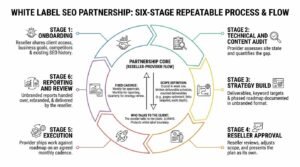
A white label SEO partnership runs through six repeatable stages: onboarding, audit, strategy approval, execution, reporting, and review. The provider works on an anonymous or client-branded basis throughout, and all client-facing communication routes through the reseller.
Here is the sequence I use with partner agencies:
- Onboarding: the reseller shares client access, business goals, competitors, and any existing SEO history.
- Technical and content audit: the provider assesses the site’s current state and quantifies the gap.
- Strategy build: deliverables, keyword targets, and a phased roadmap are documented in unbranded format.
- Reseller approval: the reseller reviews, adjusts scope, and presents the plan as its own.
- Execution: the provider ships work against the roadmap on an agreed monthly cadence.
- Reporting and review: unbranded reports are handed over, rebranded, and delivered by the reseller.
Onboarding and Scope Definition
Scope definition is where most partnerships succeed or fail, and it happens in week one. Vague scopes produce vague deliverables and arguments in month three.
I insist on a written deliverable schedule before any work starts. Number of pages optimised, articles published, links targeted, and audit depth all get counted, not described.
Strategy, Execution and Reporting Flow
Work flows one direction and information flows the other. The provider ships deliverables upward to the reseller. The reseller ships client context, approvals, and site access downward.
Both directions need a fixed cadence. Weekly for approvals, monthly for reporting, quarterly for strategy review.
Who Talks to the Client
The reseller talks to the client. Always. That single rule protects the white label boundary and prevents the provider from being pulled into scope negotiations it cannot price.
Some partnerships allow the provider to join calls under the reseller’s brand, using a reseller email address. That works when handled deliberately and collapses when handled casually.
White Label SEO vs. Reselling vs. Referral Partnerships
White label SEO, SEO reselling, and referral partnerships differ in who owns the client relationship, who sets pricing, and how the revenue is split. White labelling gives the agency full ownership and full margin control, while referral gives it a commission and no control.
This table shows how the three models compare across the factors that determine profitability and risk:
| Factor | White Label | Reseller Programme | Referral Partnership |
| Client relationship | Agency owns fully | Agency owns, provider visible | Provider owns |
| Provider visibility | Invisible | Sometimes disclosed | Fully visible |
| Pricing control | Agency sets retail | Fixed packages, agency marks up | Provider sets, agency gets commission |
| Typical agency margin | 30–60% | 20–40% | 10–20% commission |
| Delivery risk carried | Agency | Shared | Provider |
| Setup effort | High | Medium | Low |
Margin, Control and Risk Compared
Margin and risk move together in this model. Referral is the safest and least profitable arrangement, since the agency carries no delivery obligation and captures no delivery margin.
White labelling inverts that. The agency captures the spread between wholesale and retail, and also absorbs every complaint about work it did not perform.
Who Uses White Label SEO and Why
Agencies, web studios and consultants use white label SEO to offer search services without hiring an SEO team, protect existing client relationships from competitors, and increase revenue per account. The common thread is demand that already exists inside a client base the business owns.
The three groups below each buy the model for a different reason.
Digital and Creative Agencies
Digital and creative agencies white-label SEO to defend accounts. When a paid media or brand client asks about organic search, referring them out invites a competitor into the relationship.
Adding SEO to an existing retainer typically raises account value without new business development cost. That is the entire commercial logic.
Web Design and Development Studios
Web studios sit closest to the buying moment. A client commissioning a new site is already thinking about traffic, and technical SEO overlaps directly with build decisions.
I have seen studios add a recurring SEO line to roughly a third of their build clients simply by asking during scoping. Build revenue is one-off. SEO revenue recurs.
Consultants, Freelancers and In-House Teams
Solo consultants use white labelling to take on work that exceeds their personal capacity, particularly link acquisition and content production at volume. In-house marketing teams use it to add execution muscle without opening a headcount request.
Both groups keep strategic ownership and buy delivery capacity. That split works well.
What Services Are Included in a White Label SEO Programme
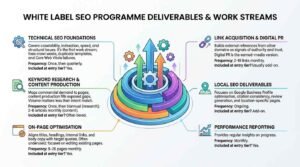
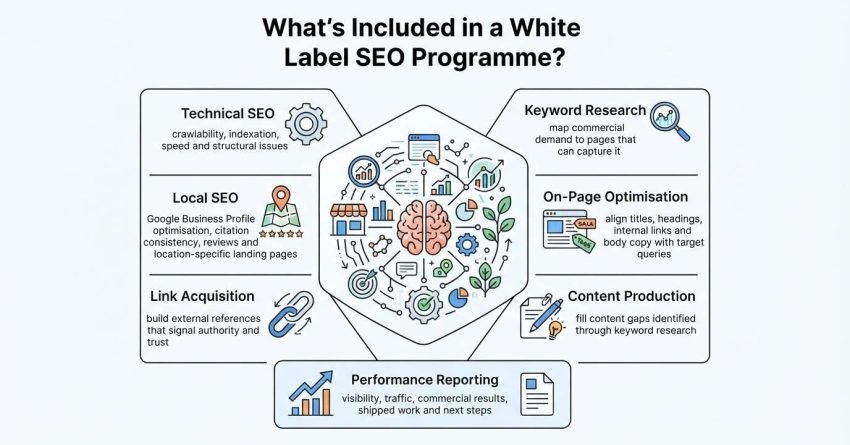
A white label SEO programme typically includes technical auditing, keyword research, on-page optimisation, content production, link acquisition, and monthly performance reporting. Local SEO deliverables are added for businesses serving a defined geography.
This table shows the standard deliverable set and how often each item recurs:
| Deliverable | Typical frequency | Included at entry tier? |
| Technical audit | Once, then quarterly | Yes |
| Keyword research and mapping | Once, then biannually | Yes |
| On-page optimisation | 5–20 pages monthly | Yes |
| Content production | 2–8 articles monthly | Often tiered |
| Link acquisition | 2–10 links monthly | Usually add-on |
| Local SEO and citations | Ongoing | Add-on |
| Performance reporting | Monthly | Yes |
Technical SEO Foundations
Technical SEO covers the crawlability, indexation, speed, and structural issues that limit how effectively search engines access and interpret a site. It is the first work stream in almost every programme because content and links underperform on a broken foundation.
Audits usually surface crawl waste, duplicate templates, thin indexation,n and Core Web Vitals failures. Fixing those raises the ceiling on everything that follows.
Keyword Research and Content Production
Keyword research maps commercial demand to the pages that can capture it, and content production fills the gaps that the map exposes. I treat these as one work stream, not two.
Volume matters less than intent match. Twenty pages aimed at genuine buying questions outperform two hundred aimed at vanity terms.
On-Page Optimisation
On-page optimisation aligns titles, headings, internal links, and body copy with the query each page targets. It is the cheapest lever in SEO and the most consistently underused.
Most sites I audit have existing pages ranking on page two that need editing, not replacing.
Link Acquisition and Digital PR
Link acquisition builds external references to a site from other domains, which search engines use as a signal of authority and trust. Digital PR is the earned-media version of that work.
This is the deliverable with the widest quality spread in the white label market. Cheap links are cheap for a reason.
Local SEO Deliverables
Local SEO focuses on Google Business Profile optimisation, citation consistency, review generation and location-specific landing pages. Businesses serving a physical catchment need it, and national e-commerce brands do not.
White Label SEO Reporting and Client Communication
White label SEO reporting delivers unbranded performance data that the reselling agency rebrands and presents as its own work. Reports arrive without provider logos, footers, or contact details, usually in editable or dashboard format.
The reseller adds interpretation. The provider supplies the numbers and the technical narrative behind them.
What Belongs in a Monthly Report
A monthly report earns its place by answering four questions in order:
- What changed in visibility rankings, impressions, and indexed pages.
- What changed in traffic: organic sessions segmented by page type and intent.
- What changed commercially: conversions, leads, or revenue attributed to organic.
- What was shipped and what ships next: deliverables completed against the roadmap.
Reports that lead with rankings and stop there train clients to value the wrong metric.
Handling Client Questions You Did Not Execute
Questions you cannot answer immediately are the main operational risk in white labelling. A client asks why a specific page dropped, and the reseller has no technical context to reply.
I solve this with a standing 24-hour escalation channel to the provider. The reseller buys a day, gets a proper answer, and the boundary holds.
White Label SEO Pricing Models Explained
White label SEO is priced through monthly retainers, fixed-scope projects, or à la carte deliverables, with monthly retainers dominating the market. Wholesale retainers commonly run from a few hundred to several thousand per client per month depending on scope and market competitiveness.
The table below sets out the three structures and where each fits:
| Model | Structure | Best suited to |
| Monthly retainer | Fixed deliverable set, recurring | Ongoing client programmes |
| Fixed-scope project | One-off, defined output | Audits, migrations, site launches |
| À la carte | Per-unit pricing on individual items | Topping up in-house capacity |
Retainer, Project and À La Carte Pricing
Retainers suit SEO because the work compounds and the results lag. A three-month project rarely produces the outcome the client actually wanted.
Projects work well for discrete technical jobs. À la carte pricing works well for agencies that already do strategy and need only content or links.
Typical Wholesale Price Bands
Wholesale pricing generally tracks three tiers. Entry programmes cover audits, on-page work and light content. Mid programmes add consistent content volume and link acquisition. Enterprise programmes add digital PR, migration support and dedicated strategist time.
Ask what each tier includes in counted units. A “content package” without a page count is not a price.
How Agencies Price and Profit From White Label SEO
Agencies profit from white label SEO by charging a retail price above the wholesale cost, with markups commonly ranging from 40% to 100% of the provider’s fee. The spread pays for account management, reporting presentation, client communication, and commercial risk.
Margin is not free money. It is compensation for owning the relationship.
Markup Benchmarks and Margin Maths
The maths is straightforward. Wholesale cost of 1,000 sold at 2,000 produces a 50% gross margin and 1,000 of contribution per client per month.
Ten clients at that spread produce 10,000 monthly gross profit with no delivery headcount. That is why the model scales.
I would keep gross margin above 40% after account management time. Below that, the account is buying you revenue and costing you attention.
Packaging SEO With Existing Services
Bundling raises perceived value and reduces price scrutiny. An SEO line inside a broader digital retainer gets compared to the retainer, not to the cheapest SEO quote online.
Web studios bundle SEO with hosting and maintenance. Paid media agencies bundle it with reporting and CRO. Both bundles hold price better than a standalone SEO invoice.
Realistic Timelines and What Results to Expect
White label SEO typically produces measurable ranking movement within three to four months and meaningful traffic growth within six to twelve months, with competitive markets sitting at the longer end. Compounding results continue well past the twelve-month mark.
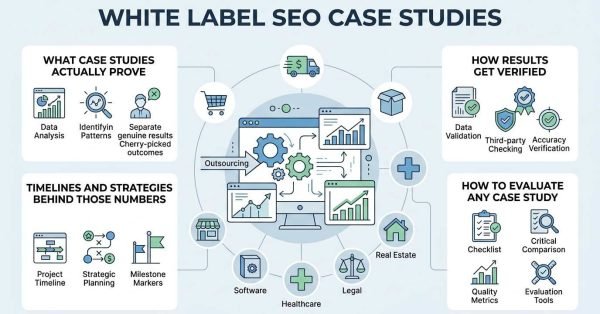
An Ahrefs study of two million keywords found only 5.7% of pages reach the top 10 for any keyword within a year of publication. That figure is the single most useful expectation-setting number in this entire guide.
Month-by-Month Progression
This table shows the progression I plan against for a typical mid-competition site:
| Phase | Months | What happens | What the client sees |
| Foundation | 1–2 | Audit, technical fixes, keyword mapping | Little to nothing |
| Build | 3–4 | Content ships, on-page work lands | Impression and long-tail movement |
| Traction | 5–8 | Links accumulate, pages mature | Ranking gains, traffic rising |
| Compounding | 9–12+ | Authority builds across the site | Lead volume and revenue impact |
Setting Client Expectations Early
Expectations set in month one determine whether month four is a review or an argument. I put the timeline in the proposal, in writing, before signature.
The honest framing works better than the optimistic one. Clients forgive slow progress they were warned about and never forgive fast progress they were promised.
How to Choose a White Label SEO Provider
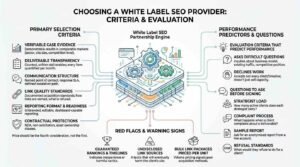
Choosing a white label SEO provider comes down to verifiable case evidence, deliverable transparency, communication structure, and link quality standards. Price should be the fourth consideration, not the first.
Assess candidates against these criteria, in this order:
- Demonstrable results in comparable markets; sector, site size, and competition level matter more than logo quality.
- Counted, written deliverables: every item quantified per month.
- Named point of contact and response SLA with a defined escalation path.
- Documented link acquisition standards: how links are earned, and what is refused.
- Reporting format and white-label readiness: unbranded, editable, dashboard-capable.
- Contractual protections: NDA, non-solicitation, asset ownership.
Evaluation Criteria That Predict Performance
Two signals predict performance better than the rest. The first is whether the provider asks difficult questions during the sales process about your client’s business model, existing traffic, and competitive position.
The second is whether they decline anything. A provider that accepts every client and promises every timeline is selling capacity, not outcomes.
Questions to Ask Before Signing
Ask how many active clients each strategist carries. Ask what happens when a client complains about a deliverable. Ask for an anonymised report from a live account.
Then ask what they would refuse to do for a client. The answer reveals their standards faster than any case study.
Red Flags and Warning Signs
Guaranteed rankings, guaranteed timelines, and undisclosed link sources are the three clearest warning signs. Each one indicates either inexperience or a tactic that will eventually harm the client’s site.
Bulk link packages priced per unit belong in the same category. Volume pricing on links is a signal about how those links are acquired.
Contracts, White Labelling and Legal Considerations
A white label SEO contract should define deliverable scope, confidentiality, non-solicitation, asset ownership, liability limits, and termination terms. The confidentiality and non-solicitation clauses are what make the arrangement genuinely white label rather than merely quiet.
I would not run a partnership on a purchase order alone. The exposure sits in the gaps.
NDAs and Non-Solicitation Clauses
A mutual NDA protects both directions of information flow, and a non-solicitation clause prevents the provider from approaching your clients directly. The second clause matters more than most agencies realise.
Your provider knows your client list, your pricing, and your margins. Paper that relationship properly.
Ownership of Assets and Accounts
Asset ownership determines who keeps the content, links, and analytics access when the partnership ends. Default to the end client owning everything, with the reseller holding administrative control.
Accounts registered under provider emails create a hostage situation at renewal. Register every property under client or reseller credentials at onboarding.
Risks, Limitations and Common Failure Points
The main risks in white label SEO are quality inconsistency, accountability gaps, communication delay, and reputational exposure when work you did not perform underdelivers. Every one of these is a management problem rather than a model problem.
I have watched all four sink partnerships that should have worked.
Quality Control and Accountability Gaps
Quality control fails when nobody on the reseller side reviews deliverables before they reach the client. The reseller becomes a forwarding address and discovers problems at the same moment the client does.
Build a review step. Even a fifteen-minute check catches the errors that cost accounts.
Communication Lag and Scope Creep
Every question now travels through two organisations, which doubles response time by default. Clients experience that lag as disinterest.
Scope creep arrives the same way. A client asks for “one small thing,” the reseller agrees, and the provider was never consulted about whether it was small.
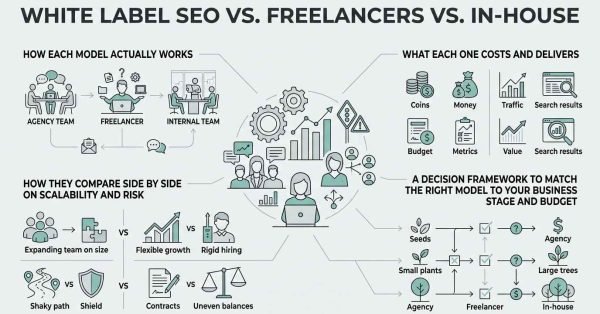
White Label SEO vs. Hiring In-House
White label SEO delivers capability faster and at lower fixed cost than hiring in-house, while in-house teams offer deeper client context and full quality control. The decision usually turns on how many SEO clients the agency can realistically sustain.
This table compares the two routes across the factors that actually decide it:
| Factor | White Label | In-House |
| Time to capability | Days to weeks | 3–6 months |
| Fixed cost | None, scales with clients | Salary, tools, training |
| Quality control | Indirect | Direct |
| Scalability | Immediate | Limited by headcount |
| Client context depth | Lower | Higher |
| Break-even point | Profitable from client one | Needs sustained volume |
Cost, Speed and Capability Compared
The crossover point arrives somewhere around consistent multi-client volume with predictable scope. Below that, white labelling wins on economics. Above it, an in-house strategist paired with white-labelled execution usually wins on both.
Hybrid is the endpoint for most agencies that grow. Strategy inside, production outside.
How to Onboard and Scale a White Label SEO Partnership
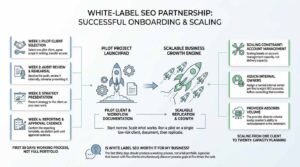
Onboarding a white-label SEO partnership successfully means running a pilot on a single low-risk client, documenting the workflow, then replicating it. Agencies that launch with five clients simultaneously discover process gaps at five times the cost.
Start narrow. Scale what works.
First 30 Days
The first thirty days should produce a working process, not a full portfolio:
- Week 1: select one pilot client, agree scope in writing, transfer access.
- Week 2: receive the audit, review it internally, rehearse presenting it.
- Week 3: present strategy to the client as your own work.
- Week 4: confirm the reporting template, escalation path, and approval cadence.
Scaling From One Client to Twenty
Scaling breaks on account management capacity, not delivery capacity. The provider absorbs volume easily. The reseller’s ability to review, present, and field questions is the constraint.
Assign a named internal owner per five to eight SEO accounts before you exceed that number, not after.
Is white label SEO worth it for my business?
White Label SEO Tools, Software and Dashboards
White label SEO tools are reporting and analytics platforms that allow an agency to present SEO data under its own branding, with the software vendor hidden from the end client. They handle the presentation layer, not the strategy layer.
Most providers supply reporting inside their fee. Agencies wanting live client dashboards usually add their own platform on top.
I would not buy tooling before you have three clients. The dashboard is not the differentiator, and an unused licence is pure cost.
The Future of White Label SEO in an AI Search Landscape
AI Overviews and generative search interfaces are shifting white-label SEO delivery toward content that can be cited by AI systems rather than only ranked by traditional search engines. Extractable answers, entity clarity, and cited data are becoming delivery requirements rather than optional extras.
Demand for white-labelled delivery is likely to hold, because AI has raised the strategic bar rather than lowering it. Producing content is cheaper than ever. Producing content that earns citations is not.
Providers that still sell word counts will struggle. Providers selling measurable visibility across both search and AI answer surfaces will not.
Conclusion
White label SEO gives agencies delivery capability, retained clients,s and margin without headcount, provided scope, contracts, and quality control are handled deliberately from day one.
Every model discussed here connects back to one question: whether your agency owns the client relationship, and whether your delivery partner strengthens it or quietly erodes it.
We help agencies build partnerships that hold up under client scrutiny. Talk to White Label SEO Service about scoping your first programme.
Frequently Asked Questions
Is white label SEO the same as private label SEO?
Yes, the terms are used interchangeably in the industry. Both describe a provider delivering SEO work that another company resells under its own brand.
How much does white label SEO cost per month?
Wholesale retainers commonly run from a few hundred to several thousand per client monthly. Cost scales with content volume, link acquisition targets,s and market competitiveness.
Will my client find out I use a white label provider?
Not if the partnership is structured correctly. Reports arrive unbranded, all communication routes through your team, and a mutual NDA protects both sides.
How long before white label SEO shows results?
Expect measurable ranking movement in three to four months and meaningful traffic growth between six and twelve months. Competitive markets sit at the longer end.
What markup should an agency charge on white label SEO?
Markups of 40% to 100% over wholesale are standard. I would keep gross margin above 40% after accounting for your own account management time.
Who owns the content and links created?
The end client should own all assets by default, with the reseller holding administrative control. Confirm this in the contract before work starts.
Can white label SEO work for local businesses?
Yes, and it often works faster than national campaigns. Local programmes centre on Google Business Profile optimisation, citations, reviews and location landing pages.