Search engine optimization (SEO) is the practice of improving a website so search engines rank its pages higher in unpaid results. SEO works by aligning technical health, content relevance, and external authority with how search engines crawl, index, and rank pages for a given query.
I have watched businesses spend five figures on SEO without ever being told how it works. That gap costs money, wastes months, and makes every reporting call feel like an argument nobody can settle.
This guide covers how search engines actually rank pages, the four disciplines of SEO and where each one fits, how keyword research and intent shape content, what timelines and budgets look like in practice, how to measure results honestly, and how to sequence all of it into a working strategy.
What Is SEO?
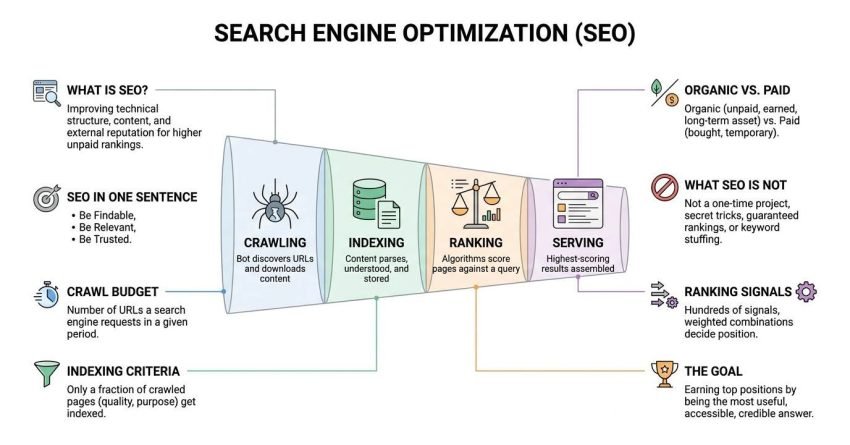
SEO is the practice of improving a website’s technical structure, content, and external reputation so search engines rank its pages higher in unpaid search results. Everything else in this guide is a subdiscipline of that one sentence.
The word “unpaid” is doing heavy lifting there. You are not buying placement. You are earning it by being the most useful, most accessible, most credible answer available for a given query.
SEO in One Sentence
Search engine optimization is a marketing discipline that makes a website easier for search engines to understand and more deserving of the top positions. I explain it to clients as three jobs: be findable, be relevant, be trusted.
Miss any one of those and rankings stall. A perfectly written page on a site Google cannot crawl earns nothing. A technically flawless site with thin content earns nothing either.
Organic Results vs. Paid Ads
Organic results are the unpaid listings a search engine returns based on relevance and quality, while paid ads are placements bought through an auction. Both appear on the same page, and both can win the same click.
The economics differ sharply. Ads stop the moment the budget runs out. Organic rankings keep delivering after the work is done, which is why I treat SEO as an asset and ads as a tap.
Neither replaces the other. I run both for most clients, using ads to test which keywords convert before committing content budget to them.
What SEO Is Not
SEO is not a one-time project, a list of secret tricks, or a guaranteed ranking position. Anyone promising a number one spot on a competitive term is selling something they cannot deliver.
It is also not just keywords. Keyword stuffing stopped working over a decade ago and now actively hurts pages.
How Search Engines Actually Work
Search engines work in four stages: crawling, indexing, ranking, and serving. Understanding those stages tells you exactly where your site is failing when rankings will not move.
Here is the sequence every page goes through before anyone can find it:
- Crawling: a bot discovers the URL and downloads its content
- Indexing: the content is parsed, understood, and stored in a searchable database
- Ranking algorithms score every indexed page against a specific query
- Serving: the highest-scoring results are assembled into a results page
Skip stage one and nothing downstream matters. That is why diagnosis always starts at the top.
Crawling
Crawling is the process where a search engine bot discovers URLs and downloads their content for analysis. Googlebot finds new pages through links, sitemaps, and previously known URLs.
Crawl budget is the number of URLs a search engine requests from a site in a given period. I watch it closely on any site above 10,000 pages, because wasted crawls on filtered URLs and duplicates starve the pages that matter.
Indexing
Indexing is the stage where a search engine parses a crawled page, extracts its meaning, and stores it in a database of candidate results. A page that is crawled but not indexed cannot rank for anything.
Google indexes only a fraction of what it crawls. Thin content, near-duplicates, and pages with no clear purpose get discovered, evaluated, and quietly dropped.
Ranking and Retrieval
Ranking is the scoring process where algorithms evaluate indexed pages against a query and order them by expected usefulness. Google has publicly described using hundreds of signals in this evaluation.
No single signal decides a position. Rankings emerge from the combination, weighted differently depending on what the query appears to want.
Where AI Overviews Fit In
AI Overviews are generated summaries that appear above organic results and cite the pages they draw from. They sit on top of the same index, which means the ranking work still applies.
The change is what gets rewarded. Pages that state facts cleanly in self-contained sentences get quoted. Pages that bury the answer in three paragraphs of preamble do not.
What Google Actually Ranks: The Core Ranking Signals
Google’s ranking signals fall into three groups: relevance, authority, and experience. Every specific factor you have read about belongs to one of these three families.
This table shows what each group measures and how you influence it:
| Signal group | What it measures | Primary levers |
| Relevance | How well the page matches the query’s meaning and intent | Keyword coverage, topical depth, intent match, entity clarity |
| Authority | How credible the page and domain are | Backlinks, brand mentions, editorial reputation, E-E-A-T signals |
| Experience | How usable the page is once landed on | Page speed, mobile rendering, layout stability, intrusive interstitials |
Relevance Signals
Relevance signals measure how closely a page’s content matches the meaning behind a search query. Google evaluates this semantically now, not by counting keyword instances.
That means a page about “cheap flights” competes on covering fares, booking timing, budget airlines, and route alternatives. Repeating the phrase itself adds almost nothing.
Quality and Authority Signals
Authority signals measure how credible a page and its domain appear based on external validation. Backlinks remain the strongest publicly confirmed authority input.
Google’s quality raters assess pages on Experience, Expertise, Authoritativeness, and Trust, described across its Search Quality Rater Guidelines. Those guidelines do not directly set rankings, but they describe what the algorithms are built to approximate.
Experience and Usability Signals
Experience signals measure how well a page performs for a real visitor after the click. Core Web Vitals form the measurable core of this group.
They act as a tiebreaker more than a lever. A slow page with the best answer usually still wins, but between two equal answers, speed decides.
The Four Disciplines of SEO
SEO divides into four disciplines: technical SEO, on-page SEO, off-page SEO, and local SEO. Every task you will ever run belongs to one of them, and each maps to a different stage of how search works.
This table shows what each discipline controls and which ranking stage it affects:
| Discipline | Controls | Stage affected |
| Technical SEO | Site architecture, speed, crawl access, indexation | Crawling and indexing |
| On-page SEO | Content, headings, metadata, internal links | Relevance scoring |
| Off-page SEO | Backlinks, mentions, digital PR, brand signals | Authority scoring |
| Local SEO | Business profile, citations, reviews, proximity | Local pack ranking |
I sequence them deliberately. Technical work comes first because it gates everything, then on-page, then authority building once there is something worth linking to.
Local SEO runs parallel rather than sequentially, and it only applies to businesses serving a defined geographic area.
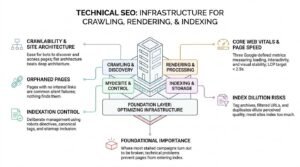 Technical SEO: Making a Site Crawlable and Indexable
Technical SEO is the practice of optimizing a website’s infrastructure, so search engines can crawl, render, and index its pages efficiently. It is the foundation layer, and it is where most stalled campaigns turn out to be broken.
A site with technical problems does not rank badly. It often does not rank at all, because the pages never enter the index in the first place.
Crawlability and Site Architecture
Crawlability is the ease with which a search engine bot can discover and access a site’s pages. Flat architecture beats deep architecture, and I aim to keep every important page within three clicks of the homepage.
Orphaned pages with no internal links pointing to them are the most common silent failure. They exist, they are published, and nothing ever finds them.
Indexation Control
Indexation control is the deliberate management of which pages a search engine stores in its index. Robots directives, canonical tags, and sitemap inclusion are the primary instruments.
Most sites index too much rather than too little. Tag archives, filtered product URLs, and paginated duplicates dilute a site’s perceived quality.
Core Web Vitals and Page Speed
Core Web Vitals are three Google-defined metrics measuring loading speed, interactivity, and visual stability. Google specifies a Largest Contentful Paint target of 2.5 seconds or less for a good experience.
The gains come from unglamorous work: compressing images, deferring scripts, and cutting third-party tags nobody remembers installing.
Keyword Research: Finding What Your Buyers Search
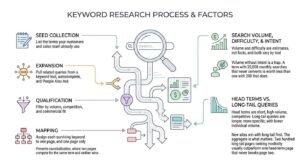
Keyword research is the process of identifying the actual phrases people type when looking for what a business offers. It converts assumptions about demand into evidence.
I run it in four steps:
- Seed collection: list the terms your customers and sales team already use
- Expansion: pull related queries from a keyword tool, autocomplete, and People Also Ask
- Qualification: filter by volume, competition, and commercial fit
- Mapping: assign each surviving keyword to one page, and one page only
That last step prevents cannibalization, where two pages compete for the same term and neither wins.
Search Volume, Difficulty, and Intent
Search volume is the estimated number of monthly searches for a keyword, and difficulty estimates how hard the current top results are to displace. Both are estimates, not facts, and both vary by tool.
Volume without intent is a trap. A term with 20,000 monthly searches that never converts is worth less than one with 200 that does.
Head Terms vs. Long-Tail Queries
Head terms are short, high-volume, highly competitive keywords, while long-tail queries are longer, more specific phrases with lower individual volume. New sites win with long-tail first.
The aggregate is what matters. Two hundred long-tail pages ranking modestly usually outperform one head-term page that never breaks page two.
Search Intent: The Signal That Decides Everything
Search intent is the underlying goal behind a query, and matching it correctly is the single highest-leverage decision in content creation. Mismatch the intent, and no amount of optimization saves the page.
This table shows the four intent types and what each one demands:
| Intent type | What the searcher wants | Winning format |
| Informational | To learn or understand something | Guide, explainer, tutorial |
| Navigational | To reach a specific site or brand | Homepage, branded landing page |
| Commercial | To compare options before deciding | Comparison, review, best-of list |
| Transactional | To buy, book, or sign up now | Product page, pricing page, booking page |
The Four Intent Types
The four intent types are informational, navigational, commercial investigation, and transactional. Every query maps primarily to one, though some sit on a boundary.
I diagnose intent by searching the term and reading what already ranks. Google has already tested thousands of format variations. The results page is the answer sheet.
Matching Content Format to Intent
Format matching means producing the content type that the ranking results already demonstrate the query wants. A commercial query answered with a 3,000-word explainer loses to a comparison table every time.
The reverse fails too. An informational query answered with a product page reads as a sales pitch and gets bounced.
On-Page SEO and Content Optimization
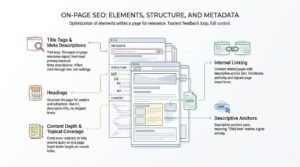
On-page SEO is the optimization of elements within a page its content, structure, and metadata to improve relevance for target queries. It is the discipline with the fastest feedback loop.
You control every input here. No outreach, no negotiation, no waiting on third parties.
Title Tags, Meta Descriptions, and Headings
A title tag is the HTML element defining a page’s headline in search results, and it remains one of the strongest on-page relevance signals. I front-load the primary keyword and keep it under 60 characters.
Meta descriptions do not directly affect rankings. They affect click-through rate, which is why I still write them deliberately rather than letting Google generate one.
Headings structure the page for both readers and extraction. One H1, descriptive H2s, and no skipped levels.
Content Depth and Topical Coverage
Content depth means covering every subtopic a searcher needs to fully resolve their query on one page. Depth beats length, and the two are not the same thing.
The test I use: could a reader finish this page and still need to search again for something obvious? If yes, the coverage has a hole.
Internal Linking
Internal linking is the practice of connecting related pages within the same site using descriptive anchor text. It distributes authority and tells search engines which pages matter most.
Descriptive anchors carry meaning. “Click here” carries none, and wastes the signal entirely.
Off-Page SEO and Link Building
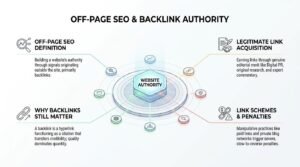
Off-page SEO is the practice of building a website’s authority through signals originating outside the site itself, primarily backlinks. It is the slowest discipline and the hardest to fake.
Google’s original ranking system was built on links, and despite decades of refinement, external validation still carries enormous weight.
Why Backlinks Still Matter
A backlink is a hyperlink from one website to another, functioning as a citation that transfers credibility. Quality dominates quantity by a wide margin.
One editorial link from a respected industry publication outperforms hundreds of directory listings. I would rather spend a quarter earning three real links than a week buying three hundred.
Legitimate Link Acquisition Methods
Legitimate link building earns links through genuine editorial merit rather than payment or manipulation. Digital PR, original research, expert commentary, and genuinely useful free tools generate the majority of links I see stick.
Broken link building still works. So does being quotable: publishing a statistic nobody else has gets cited repeatedly without any outreach at all.
Link Schemes That Trigger Penalties
Link schemes are manipulative practices designed to inflate a site’s link profile artificially, and Google explicitly prohibits them. Paid links, private blog networks, and large-scale link exchanges all qualify.
The penalties are severe and slow to reverse. I have seen sites lose 80% of organic traffic overnight and spend a year clawing it back.
Local SEO for Businesses With a Service Area
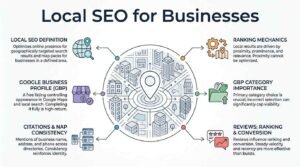
Local SEO is the practice of optimizing a business’s online presence to appear in geographically targeted search results and map packs. It applies to any business serving customers in a defined area.
The ranking mechanics differ from standard organic search. Proximity, prominence, and relevance drive local results, and proximity is the one you cannot optimize.
Google Business Profile
A Google Business Profile is a free business listing that controls how a company appears in Google Maps and local search results. Completing it fully is the highest-return hour in local SEO.
Categories matter most. Choosing the wrong primary category caps visibility regardless of how well everything else is executed.
Citations, Reviews, and Local Relevance
Citations are online mentions of a business’s name, address, and phone number across directories and platforms. Consistency across them reinforces the business’s identity to search engines.
Reviews influence both ranking and conversion. Review velocity and recency carry weight, which is why a steady trickle beats a burst of fifty followed by silence.
Topical Authority and Content Clusters
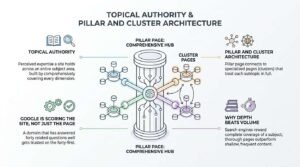
Topical authority is the perceived expertise a site holds across an entire subject area, built by comprehensively covering every dimension of that topic. It explains why some sites rank for new terms almost immediately.
Google is scoring the site, not just the page. A domain that has answered forty related questions well gets trusted on the forty-first.
Pillar and Cluster Architecture
A pillar page is a comprehensive hub covering a broad topic at orientation depth and linking to specialized pages that treat each subtopic in full. The pages it links to are called clusters.
This page is a pillar. Every section here introduces a subject and stops at the point where a dedicated page should take over.
Why Depth Beats Volume
Depth beats volume because search engines reward complete coverage of a subject rather than partial coverage of many. Twenty thorough pages on one topic outperform two hundred shallow pages across ten.
I have watched sites publish daily for a year and rank for nothing. The problem was never output. It was that no topic was ever finished.
How SEO, AI Search, and Answer Engines Interact
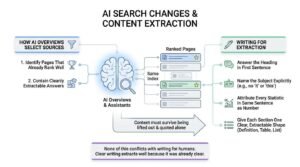
AI search changes how results are presented, not how pages are evaluated. AI Overviews and assistants draw from the same index, which means ranking work remains the prerequisite for being cited.
What shifts is the writing standard. Content must survive being lifted out of the page and quoted alone.
How AI Overviews Select Sources
AI Overviews select sources by identifying pages that already rank well and contain cleanly extractable answers to the query. Being cited requires ranking first, then being quotable second.
I check which sentence from a competitor got lifted. It is almost always a short, self-contained statement with the subject named explicitly.
Writing for Extraction
Writing for extraction means constructing sentences that remain complete and accurate when removed from their surrounding context. Four rules cover most of it:
- Answer the heading in the first sentence beneath it
- Name the subject explicitly rather than using “it” or “this”
- Attribute every statistic inside the same sentence as the number
- Give each section one clear, extractable shape: a definition, table, or numbered list
None of this conflicts with writing for humans. Clear writing extracts well because it was already clear.
How Long Does SEO Take to Work?
SEO typically takes four to twelve months to produce meaningful traffic gains, with competitive markets and new domains landing at the longer end. An Ahrefs study of two million keywords found only 5.7% of pages reached the top 10 within a year of publication.
That number reframes expectations honestly. Ranking is not slow because agencies are slow. It is slow because trust accrues gradually.
Realistic Month-by-Month Timeline
This table shows what typically happens across the first year of a well-executed campaign:
| Months | Typical activity | Expected outcome |
| 0–2 | Technical audit, fixes, keyword mapping | Indexation improves, no traffic change |
| 3–5 | Content publication, on-page optimization | Long-tail impressions begin rising |
| 6–8 | Authority building, content expansion | First meaningful traffic and lead growth |
| 9–12 | Iteration, competitive term targeting | Compounding gains, head terms move |
What Speeds Results Up or Slows Them Down
Domain age, existing authority, competition level, content velocity, and technical debt determine where a campaign lands inside that range. An established domain with clean architecture moves considerably faster than a new one.
Budget affects pace more than outcome. Doubling spend does not halve the timeline, but it does widen how much ground gets covered in each phase.
How Much Does SEO Cost?
SEO pricing in the US commonly ranges from $1,500 to $10,000 per month for agency retainers, with project work and hourly consulting priced separately. Cost tracks scope, competition, and market size rather than any fixed formula.
This table shows the common pricing models and where each fits:
| Model | Typical range | Best suited to |
| Monthly retainer | $1,500–$10,000/mo | Ongoing programs needing consistent output |
| Project-based | $5,000–$30,000 | Audits, migrations, one-time builds |
| Hourly consulting | $100–$300/hr | Advisory support for in-house teams |
| White label | Wholesale rates | Agencies reselling under their own brand |
Common Pricing Models
A retainer is a recurring monthly fee covering an agreed scope of ongoing SEO work. It suits SEO better than project pricing because the work compounds rather than concluding.
Beware anything priced far below market. Cheap SEO is usually automated link building, and that risk lands on your domain rather than the vendor’s.
In-House vs. Agency vs. White Label
In-house teams offer control and product knowledge, agencies offer breadth and specialist depth, and white label partners let agencies deliver SEO without building the capability internally. Each solves a different constraint.
Most SMEs start with an agency because hiring a competent in-house SEO costs more than the retainer would.
Measuring SEO Performance: Metrics That Matter
SEO performance is measured through organic traffic, keyword rankings, impressions, conversions, and revenue attributed to organic search. Measuring the wrong ones is how campaigns get killed prematurely.
This table separates the metrics that predict outcomes from the ones that confirm them:
| Metric | Type | What it tells you |
| Impressions | Leading | Whether visibility is growing |
| Average position | Leading | Whether rankings are moving |
| Organic sessions | Lagging | Whether visibility became traffic |
| Conversions | Lagging | Whether traffic became business |
| Revenue from organic | Lagging | Whether the investment returned |
Google Search Console and Google Analytics
Google Search Console is a free Google tool reporting how a site performs in organic search, including impressions, clicks, positions, and indexing status. It is the only source of first-party ranking data.
Google Analytics measures what happens after the click. I pair them: Search Console for acquisition, Analytics for behavior and conversion.
Leading vs. Lagging Indicators
Leading indicators are early metrics that predict future outcomes, while lagging indicators confirm results after they have occurred. Impressions and average position move months before traffic does.
That distinction saves campaigns. A client seeing flat traffic at month three is usually seeing impressions climb steadily underneath it.
Attribution and ROI
Attribution assigns credit for a conversion to the marketing channels that contributed to it. Organic search is systematically undercredited because it often appears early in a journey that closes elsewhere.
I recommend last non-direct as a baseline and a data-driven model once volume supports it. Neither is perfect. Both beat guessing.
Common SEO Mistakes and Black Hat Tactics to Avoid
Black hat SEO is any practice that violates search engine guidelines in an attempt to manipulate rankings. The tactics change constantly. The consequence a penalty or algorithmic suppression does not.
The most common mistakes I see are not black hat at all. They are impatience, no keyword mapping, and abandoning a strategy at month four.
Tactics That Cause Manual Actions
A manual action is a penalty applied by a human Google reviewer after confirming a guideline violation. Paid links, cloaking, doorway pages, scaled AI content produced without oversight, and hidden text all trigger them.
The cost is asymmetric. The upside of these tactics is temporary. The downside can end a domain.
Recovering From a Traffic Drop
Traffic recovery starts with diagnosing whether the drop came from a manual action, a core algorithm update, a technical failure, or seasonality. Search Console reports manual actions directly, which rules out the worst case in one minute.
Algorithmic drops take longer. Recovery usually requires improving the content quality that triggered the demotion, then waiting for the next update to reassess.
Building Your First SEO Strategy: A Sequenced Roadmap
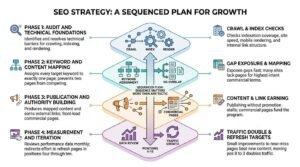
An SEO strategy is a sequenced plan that fixes technical foundations, maps content to demand, builds authority, and measures results in a defined order. Sequence matters more than any individual tactic.
Here is the order I run every engagement in:
- Audit and fix e: establish that pages can be crawled and indexed
- Map: connect keywords to pages with no overlap
- Publish and promote: create the content, then earn links to it
- Measure and iterate: read the data, double down on what moved
Phase 1: Audit and Technical Foundations
The audit phase identifies and resolves the technical barriers preventing pages from being crawled, indexed, or rendered correctly. It runs first because every later phase depends on it.
I check indexation coverage, site speed, mobile rendering, and internal link structure. Nothing gets published until crawling is clean.
Phase 2: Keyword and Content Mapping
Content mapping assigns every target keyword to exactly one page and identifies which pages need creating. The output is a spreadsheet, and it prevents two pages from ever competing for the same term.
This phase exposes gaps fast. Most sites discover they have no page at all for their highest-intent commercial terms.
Phase 3: Publication and Authority Building
The publication phase produces the mapped content and then earns external links to the strongest assets. Publishing without promotion is where most programs quietly stall.
I front-load the pages closest to revenue. Informational content matters, but commercial pages fund the program that produces it.
Phase 4: Measurement and Iteration
The measurement phase reviews performance data monthly and redirects effort toward what is working. Pages that reach positions four through ten are the highest-return refresh targets.
Small improvements to near-miss pages beat new content almost every time. Moving position eight to position three often doubles that page’s traffic.
The SEO Tool Stack for Beginners
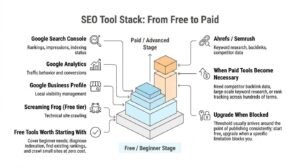
An SEO tool stack is the combination of software used to research keywords, monitor rankings, audit technical health, and report performance. Start free, upgrade when a specific limitation blocks you.
This table shows what to use at each stage:
| Tool | Cost | Primary use |
| Google Search Console | Free | Rankings, impressions, indexing status |
| Google Analytics | Free | Traffic behavior and conversions |
| Google Business Profile | Free | Local visibility management |
| Screaming Frog | Free tier | Technical site crawling |
| Ahrefs / Semrush | $99+/mo | Keyword research, backlinks, competitor data |
Free Tools Worth Starting With
Google Search Console, Google Analytics, and Screaming Frog’s free tier cover the majority of beginner needs at zero cost. Between them, you can diagnose indexation problems, find your existing rankings, and crawl a small site completely.
Most businesses I audit have Search Console installed and have never opened it.
When Paid Tools Become Necessary
Paid tools become necessary when you need competitor backlink data, large-scale keyword research, or rank tracking across hundreds of terms. That threshold usually arrives around the point of publishing consistently.
Below that point, paid tools mostly generate reports nobody acts on.
Conclusion
SEO combines technical health, content relevance, and earned authority. Search engines crawl, index, and rank pages, and each discipline influences a different stage of that process.
Results compound over months rather than weeks. The businesses that win treat organic search as an asset they build, not a campaign they run.
We help agencies and brands deliver sustainable organic growth. Talk to White Label SEO Service about building a program that lasts.
Frequently Asked Questions
Is SEO still worth it in 2026?
Yes, SEO remains worth it because organic search still drives the largest share of trackable website traffic for most industries. AI Overviews changed presentation, not the underlying value of ranking well.
Can I do SEO myself without hiring anyone?
Yes, small business owners can handle foundational SEO themselves using free Google tools. Competitive markets and technical migrations usually require specialist support to avoid costly mistakes.
How is SEO different from paid search?
SEO earns unpaid rankings through relevance and authority, while paid search buys placement through an auction. SEO compounds over time; paid search stops the moment spending stops.
How many keywords should I target?
Target one primary keyword per page, supported by five to fifteen closely related variations. Assigning multiple pages to one keyword causes cannibalization and splits ranking signals.
Do backlinks still matter?
Yes, backlinks remain one of Google’s strongest confirmed ranking signals. Quality dominates quantity now, so a few editorial links outperform hundreds of low-value directory placements.
Will AI search kill organic traffic?
No, AI search reduces clicks on some informational queries but still cites source pages. Commercial and transactional queries continue sending traffic directly to websites.
How often should content be updated?
Update important pages every six to twelve months, and immediately when facts, pricing, or statistics change. Refreshing near-miss pages usually returns more than publishing new ones.