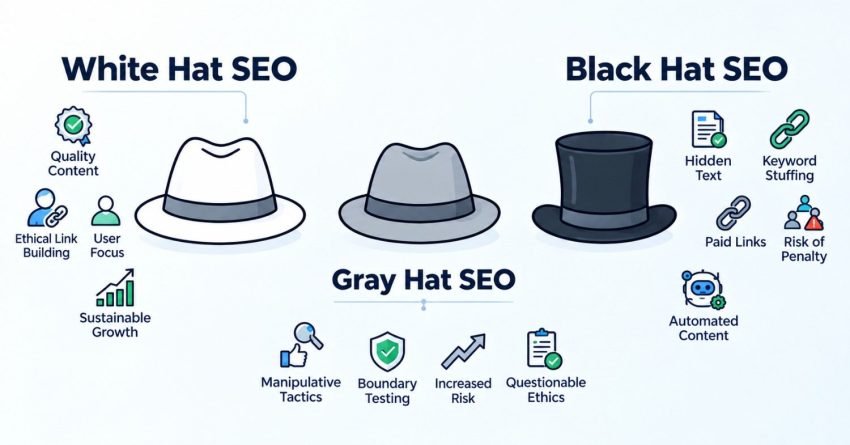
I’ve spent years watching businesses chase quick ranking wins, only to lose everything overnight. White hat SEO uses tactics that align with search engine guidelines to build sustainable rankings, while black hat SEO exploits loopholes for fast but temporary gains, and gray hat SEO sits in the ambiguous middle, using tactics that aren’t explicitly banned but still carry real risk. Every website owner eventually has to decide which side of that line they want to operate on.
This decision shapes everything that follows. Get it wrong, and years of work can disappear in a single algorithm update or manual penalty.
This guide covers what separates the three approaches, how their tactics compare side by side, what penalties and recovery actually look like, and how to evaluate whether your current strategy is built to last.
What Is White Hat SEO?
White hat SEO is an approach to search optimization that strictly follows search engine guidelines, focusing on genuine value for users rather than manipulation of ranking signals. I think of it as the “boring but durable” path- nothing flashy, but nothing that keeps me up at night either.
It includes quality content creation, legitimate link earning, clean technical structure, and honest on-page optimization. The tradeoff is patience: white hat results build gradually rather than overnight, but they compound instead of evaporating.
Because this approach never tries to trick the algorithm, algorithm updates rarely cause the kind of damage that keeps black hat practitioners up at night.
What Is Black Hat SEO?
Black hat SEO is a set of tactics that violate search engine guidelines in order to manipulate rankings artificially, often producing fast but short-lived results. Think cloaking, hidden text, link farms, and content scraped from other sites.
I’ve reviewed sites that ranked in weeks using these methods, then vanished from search results just as fast. The tactics work by exploiting weaknesses in ranking algorithms rather than earning genuine relevance or authority.
Search engines invest heavily in detecting this behavior, and manual actions and algorithmic penalties exist specifically to catch and punish it.
What Is Gray Hat SEO?
Gray hat SEO refers to tactics that fall into a gray area not explicitly banned by search engine guidelines, but not fully endorsed either, carrying moderate risk depending on execution and context. Buying expired domains for their backlink profiles is a classic example.
I’d describe gray hat as tactics practitioners use while telling themselves it’s “technically not against the rules.” The problem is that guidelines evolve, and what’s gray today can become black tomorrow after an update.
Gray hat tactics exist because the SEO industry constantly probes the edges of what search engines will tolerate, and search engine guidelines don’t cover every possible tactic explicitly.
How Search Engines Distinguish Between the Three
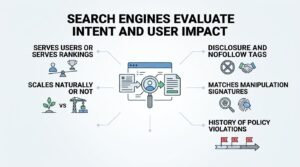
Search engines evaluate intent and user impact, not just the tactic itself, to determine which category a practice falls into. A link earned through genuine outreach and a link bought through a private network can look identical on the surface, but the intent behind each is different.
Google’s systems, including its spam detection algorithms, weigh several signals to make this distinction:
- Whether the content or link primarily serves users or primarily serves rankings
- Whether the tactic scales in a way that mimics natural behavior or clearly doesn’t
- Whether disclosure exists (like nofollow tags on sponsored content)
- Whether the pattern matches known manipulation signatures
- Whether the site has a history of policy violations
This is why two sites doing similar things can see very different outcomes; context and pattern matter as much as the tactic itself.
White Hat vs Black Hat SEO: Key Differences
White hat and black hat SEO differ primarily in risk tolerance, timeline expectations, and long-term sustainability, with white hat trading speed for durability and black hat trading durability for speed. I’ve never seen a black hat site survive more than a couple of years without a major setback.
| Factor | White Hat SEO | Black Hat SEO |
| Guideline compliance | Fully compliant | Violates guidelines |
| Results timeline | 4–12 months | Days to weeks |
| Longevity | Sustainable | Temporary, high collapse risk |
| Penalty risk | Low | High |
| Investment type | Content, technical fixes, outreach | Automated tools, link networks |
| Recovery difficulty | Rarely needed | Often severe, sometimes unrecoverable |
The pattern holds across every niche I’ve analyzed: black hat wins the sprint, white hat wins the marathon.
Gray Hat SEO: Where It Fits Between the Two
Gray hat SEO occupies the space between compliant and manipulative tactics, offering some of black hat’s speed with somewhat less of its risk, though the risk never disappears entirely. Private blog networks, aggressive guest post exchanges, and AI-generated content without editorial review all live here.
I treat gray hat as a spectrum rather than a fixed category. A single tactic can shift from “acceptable” to “penalized” the moment Google rolls out a targeted update, which has happened repeatedly with link schemes and thin content.
Common Tactics Classified by Hat Type
Different SEO tactics carry different risk classifications depending on how they’re executed and disclosed. This table shows how identical goals can be pursued through white, gray, or black hat methods.
| Tactic | Category | Google Guideline Status |
| Earning links through original research | White Hat | Fully compliant |
| Buying expired domains for redirects | Gray Hat | Discouraged, situational risk |
| Private blog network links | Black Hat | Explicit violation |
| Guest posting with genuine editorial value | White Hat | Compliant |
| Mass guest post exchanges for links only | Gray Hat | Risky, borderline |
| Hidden text or cloaking | Black Hat | Explicit violation |
| Keyword-optimized content for real queries | White Hat | Compliant |
| AI content published without review | Gray Hat | Discouraged |
| Scraped or duplicate content | Black Hat | Explicit violation |
Once you see tactics mapped this way, the pattern becomes obvious: the closer a tactic gets to deceiving either users or search engines, the further it slides toward black hat.
Google Penalties: Manual Actions vs Algorithmic Actions
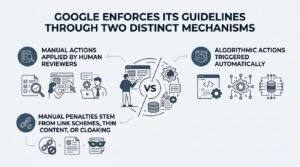
Google enforces its guidelines through two distinct mechanisms: manual actions applied by human reviewers and algorithmic actions triggered automatically by ranking systems. I check Search Console’s Manual Actions report first whenever a client site suddenly drops in rankings.
Manual actions come with explicit notifications and specific reasons, like “unnatural links to your site.” Algorithmic actions are silent by comparison; a site simply stops ranking as well after an update, with no notification explaining why.
Google’s own documentation on manual actions confirms that most manual penalties stem from link schemes, thin content, or cloaking, which lines up with what I see across penalized sites.
Risks of Black Hat SEO
Black hat SEO carries the highest risk of any approach, including manual penalties, algorithmic devaluation, and in severe cases, complete removal from search results. I’ve seen entire domains deindexed overnight after aggressive link scheme detection.
Beyond the ranking loss, there’s a business cost: rebuilding trust with search engines takes far longer than the time it took to accumulate the violations. Some domains never fully recover their previous authority even after remediation.
Risks of Gray Hat SEO
Gray hat SEO carries moderate but unpredictable risk, since tactics that are tolerated today can become explicitly penalized after a future algorithm update. This unpredictability is the defining risk of the entire category.
I’ve watched clients get burned by tactics that worked fine for years, right up until a targeted update specifically addressed that exact behavior. The uncertainty makes gray hat harder to plan around than either white or black hat.
Can You Recover From a Penalty?
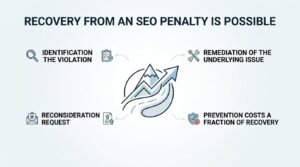
Recovery from an SEO penalty is possible in most cases, typically requiring identification of the violation, remediation of the underlying issue, and in manual action cases, a reconsideration request submitted through Search Console. Algorithmic penalties usually resolve on their own once the offending signals are cleaned up and the next relevant update runs.
Recovery timelines vary widely depending on severity, from a few weeks for minor issues to over a year for extensive link scheme cleanups. I always tell clients that prevention costs a fraction of what recovery does, in both time and money.
Why White Hat SEO Builds Sustainable Growth
White hat SEO builds sustainable growth because it aligns with what search engines are actually trying to reward: genuine relevance, authority, and user satisfaction. Every piece of compliant work compounds instead of resetting to zero after an update.
I’ve tracked white hat client sites through more than a dozen major algorithm updates now, and the pattern is consistent. Sites built on real content and earned authority tend to hold steady or even gain ground, while sites relying on manipulation see wild swings.
The Real Cost of Cutting Corners in SEO
Cutting corners in SEO often costs more in the long run than doing it correctly from the start, once you factor in penalty recovery, lost traffic, and rebuilding damaged trust. A cheap black hat campaign might cost a fraction of a proper strategy upfront.
But I’ve seen the follow-up invoices: emergency link disavowals, content rewrites, months of lost revenue, and sometimes a full domain migration to escape a penalty history that won’t shake loose.
How to Evaluate If Your SEO Strategy Is Compliant
Evaluating SEO compliance starts with an honest audit of your backlink profile, content sourcing, and any automated tools currently in use. I run this check by pulling a site’s backlink data and manually reviewing the highest-risk-looking links first.
A few questions expose most compliance issues quickly:
- Were links earned through outreach, or purchased through a network?
- Is content written for users, or generated purely to rank?
- Are there any hidden elements, redirects, or cloaking scripts?
- Has the site received any manual action notices in Search Console?
- Does keyword usage read naturally, or does it feel forced?
Running through this list honestly usually reveals which category a site’s current strategy actually falls into.
How to Choose an Ethical SEO Partner
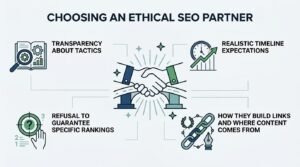
Choosing an ethical SEO partner means looking for transparency about tactics, realistic timeline expectations, and a refusal to guarantee specific rankings. Any agency promising a page-one ranking within days is signaling a black hat approach, whether they use that label or not.
I always recommend asking a prospective partner directly how they build links and where their content comes from. Vague or evasive answers to those two questions tell you almost everything you need to know.
Red Flags That Signal Black or Gray Hat Practices
Red flags for risky SEO practices include guaranteed rankings, suspiciously fast results, unclear reporting, and reluctance to explain specific tactics being used. I treat any of these as an immediate reason to ask more questions.
Other warning signs include sudden spikes in low-quality backlinks, content that reads like it was written for robots instead of people, and an unwillingness to share which sites are linking back to yours.
Conclusion
White hat, black hat, and gray hat SEO differ in compliance, risk, and longevity. Understanding these categories helps you evaluate tactics, penalties, and recovery paths with real clarity.
Search engines keep refining how they detect manipulation, so sustainable strategies increasingly outperform shortcuts. We see this pattern repeat across every industry.
We build organic growth the compliant way. Partner with White Label SEO Service for sustainable rankings that last.
Frequently Asked Questions
Is gray hat SEO illegal?
Gray hat SEO is not illegal, but it does violate the spirit of search engine guidelines in ways that carry risk. It exists in a legal gray area rather than a criminal one.
Will Google always catch black hat SEO?
Not always, but detection systems improve constantly, and Google catches most black hat tactics eventually. Sites relying on these methods face ongoing, compounding risk over time.
Can white hat SEO still get penalized?
Yes, white hat sites can occasionally see ranking drops from algorithm updates. This differs from a penalty, though, since compliant sites recover naturally without manual intervention.
How long does it take to recover from a black hat penalty?
Recovery time ranges from a few weeks to over a year, depending on penalty severity. Extensive link scheme cleanups and reconsideration requests typically take the longest.
Are gray hat tactics worth the risk?
Generally not, since the moderate speed gains rarely outweigh the unpredictable penalty risk. Most gray hat tactics eventually get targeted by an algorithm update.
What’s the safest SEO approach for a new website?
White hat SEO is the safest approach for new websites building long-term authority. It avoids the penalty risk that can permanently damage a young domain’s trust.
Do algorithm updates target gray hat tactics specifically?
Yes, many major updates specifically target tactics that were previously considered gray hat. This is why gray hat risk increases the longer a tactic remains popular.