Link building is the practice of acquiring hyperlinks from other websites back to your own, so search engines can discover your pages and judge how trustworthy they are. Search engines treat each link as a vote of confidence, and pages with more high-quality votes tend to rank higher in organic results.
I have watched businesses pour months into content that never ranked, purely because nobody else on the internet vouched for it through a single link.
This guide covers what a link actually is and how links shape rankings, the anatomy and quality signals that separate valuable links from harmful ones, the strategies and outreach mechanics that earn them, the tools and competitor analysis that guide targeting, the risks and penalties to avoid, and the timelines, costs, measurement, and staffing decisions that turn all of it into a working strategy.
What Link Building Actually Means
Link building is the process of getting other websites to link to yours, using tactics that range from publishing research worth citing to directly asking site owners for a placement. It sits inside the broader discipline of off-page SEO, which covers every ranking signal that originates outside your own domain.
I think of it less as “building” and more as earning citations. Nobody links to a page because you asked nicely. They link because the page gave them something to reference.
The confusing part for beginners is that link building blends marketing, PR, and sales into one workflow. You produce something worth mentioning, you find people who mention things like it, and you make the case.
The difference between a link, a backlink, and a citation
A backlink is an inbound hyperlink pointing from an external website to a page on your site. The same link is simply an outbound link from the perspective of the site that published it.
A citation is a mention of your brand or business without a clickable hyperlink attached. Citations still carry weight, particularly for local search, but they pass no direct link equity.
I chase both. Unlinked mentions are the easiest links you will ever convert, and I cover that later.
Why links became a ranking signal in the first place
Links became a ranking signal because early search engines needed a way to judge quality that authors could not fake by stuffing keywords into a page. Google’s founders solved it by treating the web’s existing link graph as a reputation system, an idea published in the original PageRank paper in 1998.
The logic held up. A page that thirty independent sites reference is usually more useful than one nobody references.
That single decision shaped twenty-five years of SEO, and it is why a beginner cannot skip this topic.
How Links Influence Search Rankings
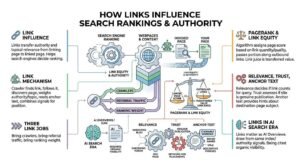
Links influence rankings by transferring authority and topical relevance from the linking page to the linked page, which helps search engines decide which of many similar pages deserves the top spot. Google has repeatedly confirmed that links remain among its most important ranking signals, alongside content quality and user intent matching.
Here is the mechanism in sequence:
- A crawler finds a link on an already-indexed page
- It follows that link and discovers your page
- It weighs the linking page’s own authority and topic
- It reads the anchor text as a hint about your page’s subject
- It combines that signal with hundreds of others to set your position
The practical takeaway is that a link does three jobs at once. It brings crawlers, it brings referral traffic, and it brings ranking weight.
PageRank and link equity in plain terms
PageRank is an algorithm that assigns every page a score based on the quantity and quality of links pointing to it, then passes a portion of that score along its own outbound links. SEOs call the transferred value link equity or link juice.
A link from a page with fifty outbound links passes less equity than a link from a page with three. That is why a mention buried in a 200-link directory is worth close to nothing.
I stopped chasing raw link counts years ago for exactly this reason.
Relevance, trust, and anchor text
Relevance decides whether a link counts for the query you care about. A link from a marketing blog to my SEO page carries more weight for SEO queries than a link from a gardening forum, even at identical authority.
Trust is the second filter. Google’s systems assess whether a linking site behaves like a genuine publication or like a network built to sell placements.
Anchor text is the clickable wording of the link, and it tells search engines what the destination page is about. Natural profiles contain a wide spread of brand names, URLs, and descriptive phrases rather than the same exact keyword repeated.
Why links still matter in an AI search era
Links still matter in AI search because large language models and AI Overviews draw from the same index and the same authority signals that power traditional rankings. Being cited in an AI answer generally requires already being visible in the organic results feeding it.
I have seen no evidence that AI summaries reduce the value of a strong backlink profile. If anything, they concentrate visibility among fewer, more authoritative sources.
The Anatomy of a Backlink
A backlink has four components that determine its value: the source page, the anchor text, the link attribute, and the placement within the page. Each component sends a separate signal, and weakness in any one reduces what the link is worth.
This table shows what each component signals to a search engine:
| Component | What it signals |
| Source page authority | How much equity is available to pass |
| Anchor text | What the destination page is about |
| Link attribute | Whether equity should pass at all |
| Placement | How editorially deliberate the link is |
Beginners tend to obsess over the first row and ignore the other three. That is backwards more often than not.
Anchor text
Anchor text is the visible, clickable text of a hyperlink, and it functions as a short description of the page being linked to. Google reads it as a relevance hint, which is why over-optimized anchors trigger scrutiny.
I aim for anchors that a normal editor would have written without any SEO knowledge. Brand names, URLs, and natural phrases dominate healthy profiles.
Dofollow, nofollow, sponsored, and UGC attributes
A dofollow link is a standard hyperlink with no restricting attribute, and it passes ranking equity by default. A nofollow link carries rel=”nofollow”, telling search engines not to pass equity, though Google now treats these as hints rather than directives.
Two newer attributes exist. The sponsored attribute marks paid placements, and ugc marks user-generated content such as forum posts and blog comments.
A profile of only dofollow links looks manufactured. Real websites accumulate a mix.
Placement, surrounding context, and link position
Placement refers to where the link sits on the page, and links inside the main body content carry more weight than links in footers, sidebars, or author bios. Google’s systems assess whether the link appears to be an editorial choice or a template-wide insertion.
Surrounding context matters too. A link wrapped in three sentences discussing the topic reads very differently from a link dropped into an unrelated list.
What Separates a Good Link From a Bad One
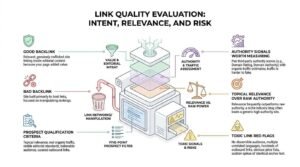
A good backlink comes from a relevant, genuinely trafficked site that links to you inside editorial content because your page added value, while a bad backlink comes from a site built primarily to host links. The distinction is about intent and audience, not just metrics.
I qualify every prospect against these criteria before spending a minute on outreach:
- Topical relevance to my page’s subject, at either site or page level
- Real organic traffic rather than authority scores alone
- Editorial standards visible in the site’s existing published work
- A believable audience that would plausibly click the link
- Outbound link patterns that look curated rather than industrial
Fail two of those, and I move on. There is always another prospect.
Authority signals worth measuring.
Third-party authority scores estimate a domain’s link strength on a 0–100 scale, with Ahrefs calling theirs Domain Rating and Moz calling theirs Domain Authority. Neither is a Google metric, and neither should be your only filter.
I pair authority with organic traffic estimates. A site with a Domain Rating of 70 and 200 monthly visitors is almost always a link network.
Traffic is harder to fake than links.
Topical relevance over raw authority
Topical relevance is the degree to which the linking site covers subjects related to your page, and it frequently outperforms raw authority as a predictor of ranking impact. A niche industry blog beats a generic high-authority news site for most commercial queries.
I would take five relevant links over fifty irrelevant ones without hesitating. The relevant five compound.
Red flags that signal a toxic link
A toxic backlink is one from a site whose primary purpose is manipulating rankings, and it risks devaluation or, in severe patterns, a manual penalty. Certain signals appear consistently across these sites.
Watch for sites with no discernible audience, content written in multiple unrelated languages, hundreds of outbound links per page, or an obvious price list for placements. Sudden spikes of identical anchor text pointing at your money pages are another warning sign.
The Main Types of Backlinks
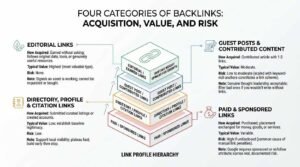
Backlinks fall into four broad categories based on how they were acquired: editorial links, contributed links, structural links, and paid links. Each carries a different risk profile and a different level of ranking value.
This table compares them at a glance:
| Type | How acquired | Typical value | Risk |
| Editorial | Earned without asking | Highest | None |
| Guest post | Contributed article | Moderate | Low to moderate |
| Directory/profile | Submitted | Low | Low |
| Paid/sponsored | Purchased | Variable | High if undisclosed |
Most beginner profiles skew heavily toward the bottom two rows. Growth comes from shifting weight upward.
Editorial and earned links
An editorial link is one a writer includes voluntarily because your page supported their point, and it is the most valuable link type because it cannot be requested or bought. These links usually follow original data, tools, or genuinely useful resources.
I treat every earned link as a signal that an asset is working. Two editorial links usually mean twenty more are available with promotion.
Guest posts and contributed content.
A guest post is an article you write for another publication, typically including one or two links back to your own site. Google’s stance is that guest posting at scale with keyword-rich anchors constitutes a link scheme, though genuine contributed thought leadership remains acceptable.
The difference is whether you would write the article if links were removed from the deal. That question filters most of the bad ones out.
Directory, profile, and citation links
Directory links come from curated business listings, and profile links come from accounts you create on platforms that display your URL. Both carry modest ranking value, but they establish baseline legitimacy and support local visibility.
I build these early on a new site and then stop. They plateau fast.
Paid and sponsored links
A paid link is any placement exchanged for money, goods, or services, and Google requires these to carry a sponsored or nofollow attribute. Undisclosed paid links violate Google’s spam policies and are the most common cause of manual link penalties.
The industry buys links constantly and pretends otherwise. I would rather tell you plainly that the practice carries real, documented risk.
Core Link Building Strategies That Still Work
The strategies that consistently earn links share one trait: they give the linking site a reason to publish beyond doing you a favor. Tactics built purely on asking have collapsing reply rates, while asset-led approaches hold up.
These are the four I return to:
- Digital PR: newsworthy stories pitched to journalists
- Linkable assets: original research, tools, and reference pages
- Broken link building: replacing dead links with your equivalent
- Unlinked mention reclamation: converting brand mentions into links
Each one suits a different stage. A brand-new site cannot run PR effectively, but it can absolutely reclaim mentions.
Digital PR and newsworthy assets
Digital PR is the practice of creating stories or data that journalists want to cover, then pitching them to publications for coverage that includes a link. It produces the highest-authority links available to most businesses, and the links arrive in clusters rather than one at a time.
Original survey data works particularly well. Journalists need a number to hang a headline on.
The catch is that PR requires a genuine angle, and most product announcements do not have one.
Linkable content assets
A linkable asset is a page created specifically to attract links rather than convert traffic, such as a statistics roundup, a free calculator, or a definitive industry reference. These pages accumulate links passively for years once they rank.
I plan them separately from commercial pages. Mixing the two objectives usually produces a page that does neither job.
Broken link building and resource pages
Broken link building is the process of finding dead outbound links on relevant pages, then suggesting your working page as a replacement. It converts better than cold pitching because you are solving a problem the site owner already has.
Resource page link building applies the same logic to curated lists that exist specifically to link out. The pitch practically writes itself when the page is literally a directory of recommendations.
Unlinked brand mention reclamation
An unlinked mention is any instance where a publication names your brand, product, or research without hyperlinking to you. Converting these into links has the highest success rate of any outreach tactic, because the editor already decided you were worth mentioning.
I run a monthly sweep for these. It takes an hour and produces links no cold pitch could.
How Outreach Works in Practice
Link building outreach is the process of identifying relevant sites, finding the right contact, and pitching a specific reason for them to link to your page. Reply rates for cold outreach typically sit in the low single digits, so volume and targeting both matter.
The workflow runs in five steps:
- Build a prospect list from competitor backlinks and topical searches
- Qualify each prospect against your relevance and traffic criteria
- Find a named contact rather than a generic inbox
- Send a short, specific pitch naming the exact page and reason
- Follow up once, then close the thread
Step four is where most campaigns fail. Templates that could have been sent to a thousand sites get deleted by all thousand.
Prospecting and qualifying targets
Prospecting is the process of assembling a list of sites that plausibly would link to your page, usually sourced from competitor backlink profiles and topic-based searches. Qualification then removes anything that fails your quality criteria.
I qualify hard and pitch small. A list of forty genuinely relevant sites outperforms a list of four hundred scraped ones.
Pitching, follow-up, and reply rates
A good pitch names the specific page you want linked, states why it improves the recipient’s article, and stays under 120 words. Personalization beyond the first line rarely improves results as much as relevance of the ask does.
One follow-up is standard. Beyond two, you are training people to ignore your domain.
Building Links Without an Existing Audience
A new website builds its first links through tactics that do not require existing authority: business directories, industry associations, supplier and partner pages, podcast appearances, and expert quote platforms. These establish a baseline profile before content-led tactics become viable.
The order matters. Nobody links to a site with three pages and no track record, so foundational links come first.
I would spend the first ninety days on:
- Foundational listings in relevant industry directories
- Relationship links from partners, suppliers, and clients
- Expert commentary through journalist request platforms
- Podcast and interview appearances in your niche
None of these will transform rankings alone. They make the next tier possible.
Internal Links and Their Role in Link Building
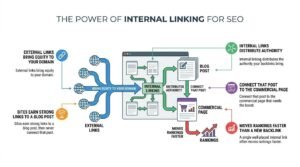
Internal linking is the practice of linking between pages on your own site, and it distributes the authority your backlinks bring to wherever it is most useful. External links bring equity to your domain, and internal links decide where that equity ends up.
I see this ignored constantly. Sites earn strong links to a blog post, then never connect that post to the commercial page that needs the boost.
A single well-placed internal link from a high-authority page often moves rankings faster than a new backlink. It costs nothing and takes a minute.
Link Building Tools and What Each One Does
Link building tools fall into two functional groups: backlink index tools that show which sites link where, and outreach tools that manage prospecting, sending, and tracking. Most teams need one from each group rather than a single all-in-one platform.
This table maps categories to the job each performs:
| Tool category | Job it performs |
| Backlink index | Reveals existing links and competitor profiles |
| Prospecting | Finds and filters relevant target sites |
| Contact finding | Locates verified email addresses |
| Outreach management | Sends sequences and tracks replies |
| Rank and link monitoring | Confirms links stay live and rankings move |
Budget-constrained teams can run the entire process on one index tool plus a spreadsheet. The tooling is not the constraint.
Backlink index and analysis tools
A backlink index tool crawls the web and maintains a database of links between sites, letting you see who links to any domain. Ahrefs, Semrush, and Majestic maintain the largest commercial indexes, and Google Search Console provides your own site’s links for free.
Every index is incomplete. I cross-check important findings across two sources.
Prospecting, outreach, and tracking tools
Prospecting and outreach tools handle the volume side of the workflow: building lists, finding contact details, sending sequenced emails, and logging replies. Platforms such as Pitchbox, BuzzStream, and Hunter cover different portions of that chain.
I would not buy any of them before proving the manual process works. Automation multiplies whatever you already have, including bad targeting.
How to Analyze a Competitor’s Backlink Profile
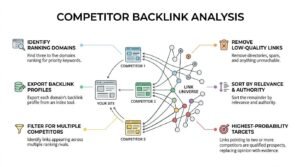
Competitor backlink analysis is the process of examining which sites link to your ranking rivals, then identifying which of those links you could realistically earn too. It is the fastest way to build a qualified prospect list without guessing.
Run it in five steps:
- Identify the three to five domains ranking for your priority keywords
- Export each domain’s backlink profile from an index tool
- Filter to links appearing across multiple competitors
- Remove directories, spam, and anything unreachable
- Sort the remainder by relevance and authority
Links that point to two or more competitors are your highest-probability targets. That site clearly links to companies like yours.
I run this before planning any campaign. It replaces opinion with evidence.
Black Hat Link Building and Google Penalties
Black hat link building covers any tactic designed to manipulate rankings through artificial links, and Google’s spam policies explicitly prohibit these practices. Consequences range from silent devaluation of the links to a manual action that removes pages from search results entirely.
The tactics Google names directly include:
- Buying or selling links that pass ranking credit
- Excessive link exchanges and reciprocal schemes
- Automated link generation through software or services
- Large-scale guest posting with keyword-rich anchors
- Private blog networks built solely to link out
I have cleaned up sites hit by every one of these. Recovery always costs more than the shortcut saved.
Link schemes Google explicitly names
A link scheme is any arrangement intended to manipulate PageRank rather than serve users, as defined in Google’s link spam policies. The policy covers paid links, excessive exchanges, automated generation, and low-value directory submissions.
The line is intent. Would this link exist if search engines did not?
Manual actions vs. algorithmic devaluation
A manual action is a human-issued penalty applied by a Google reviewer, and it appears as a notification inside Google Search Console. Algorithmic devaluation is automated and silent, simply causing the offending links to stop counting.
Manual actions require a reconsideration request to lift. Algorithmic devaluation just requires better links going forward.
Most sites suffering from bad links never receive a manual action. Their links quietly stopped working.
Disavow and recovery basics
The disavow tool lets you tell Google to ignore specific backlinks pointing at your site, and Google advises using it only when you have a manual action or a genuine history of paid links. Most sites should never touch it.
I have watched more damage done by careless disavow files than by the links they targeted. Removing legitimate links is a self-inflicted penalty.
How Long Link Building Takes to Show Results
Link building typically shows measurable ranking movement within three to six months, with competitive commercial terms often requiring nine to twelve months of consistent acquisition. The delay comes from crawl and indexing time, plus Google’s assessment period for newly discovered links.
Three variables drive the timeline: your site’s existing authority, the competitiveness of your target keywords, and the pace of quality link acquisition.
I set expectations at six months minimum for any new campaign. Anyone promising thirty-day results is describing a tactic that will not last.
Early signals appear before rankings do. Crawl frequency rises, impressions climb, and long-tail positions move first.
What Link Building Costs
Link building in the US typically costs between $2,000 and $10,000 per month for agency-managed campaigns, with individual link acquisition costs commonly landing between $300 and $1,500 depending on the authority and relevance of the placement. Digital PR campaigns sit at the higher end.
Cost drivers break down as follows:
| Cost driver | Effect on price |
| Target site authority | Rises steeply above DR 60 |
| Niche competitiveness | Finance and legal cost the most |
| Tactic used | PR costs more than reclamation |
| Content production | Required for contributed placements |
The cheapest links are almost always the ones with no value. I would rather buy four good links than forty bad ones at the same price.
How to Measure Link Building Performance
Link building performance is measured by tracking referring domains gained, the authority and relevance of those domains, and the resulting movement in target keyword rankings and organic traffic. Link count alone tells you almost nothing.
This table separates the metrics that matter from the ones that flatter:
| Metric | What it tells you |
| Referring domains gained | Genuine profile growth |
| Average authority of new links | Quality direction |
| Target keyword positions | Whether links are working |
| Organic traffic to linked pages | Commercial impact |
| Referral traffic from links | Real audience value |
I report referring domains rather than total links. A hundred links from one site is one vote.
Metrics that indicate progress
Referring domains, or the count of unique websites linking to you, is the single most reliable indicator of link building progress. Ranking movement on target keywords and organic traffic growth to the linked pages confirm the links are doing commercial work.
Watch the trend line, not the weekly number. Link acquisition is lumpy by nature.
Vanity metrics to ignore
Total backlink count is the most misleading metric in link building, because a single site-wide footer link can generate thousands of backlinks from one referring domain. Domain Authority movement is similarly noisy over short periods.
I ignore both in monthly reporting. They create pressure toward the wrong behavior.
Common Link Building Mistakes Beginners Make
The most common beginner mistakes are prioritizing link quantity over quality, over-optimizing anchor text, and buying cheap links from marketplaces. Each one produces short-term numbers that either stop working or actively cause harm.
The recurring five I see:
- Chasing volume instead of relevance and traffic
- Repeating exact-match anchors across dozens of links
- Buying bulk links from Fiverr-tier marketplaces
- Linking only to the homepage instead of specific pages
- Stopping after three months before results compound
The last one costs the most. Campaigns abandoned at month three were usually two months from working.
Building Your First Link Building Strategy
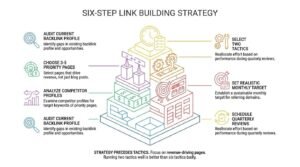
A first link building strategy defines which pages need links, which tactics you can realistically execute, and what monthly acquisition pace you can sustain. Strategy precedes tactics, and skipping it produces scattered links pointing at the wrong pages.
Build it in six steps:
- Audit your current backlink profile and identify gaps
- Choose three to five priority pages that drive revenue
- Analyze competitor profiles for those pages’ target keywords
- Select two tactics matched to your resources and niche
- Set a realistic monthly target for referring domains
- Schedule quarterly reviews to reallocate effort
I keep the tactic count at two deliberately. Teams running six tactics badly always lose to teams running two well.
The pages you pick in step two determine everything downstream. Most businesses pick blog posts when they should pick the pages that make money.
Should you build links yourself or hire someone to do it?
In-House vs. Agency vs. Freelance Link Building
The choice between in-house, agency, and freelance link building depends on your monthly link volume target, your existing relationships, and whether you have someone who can own outreach consistently. Each model trades cost against speed and expertise.
This table compares the three:
| Model | Best for | Typical monthly cost |
| In-house | Ongoing programs with existing content teams | Salary plus tooling |
| Agency | Scale, PR access, and established relationships | $2,000–$10,000 |
| Freelance | Specific tactics and lower volume | $500–$3,000 |
I have seen all three work. The failures usually came from unclear ownership rather than the model itself.
How Link Building Fits Into a Wider SEO Strategy
Link building is one of three pillars of SEO, working alongside technical SEO and content strategy, and it delivers almost nothing on its own. Links amplify pages that already deserve to rank; they cannot rescue thin content or a site search engines cannot crawl.
The sequence I follow is technical foundations first, content second, links third. Building links to a broken site wastes the links.
That said, in competitive niches, technical and content work alone plateau quickly. Links are what break the ceiling once the foundations hold.
Conclusion
Link building earns citations from other sites, and those citations tell search engines your pages carry authority, relevance, and enough trust to rank.
The tactics change constantly, but the principle holds: create things worth referencing, then make sure the right people find them.
We help brands build sustainable authority through white-label campaigns. Talk to White Label SEO Service about scaling your link acquisition.
Frequently Asked Questions
Is link building still relevant in 2026?
Yes, link building remains one of Google’s core ranking signals. AI search results draw from the same index, so authority built through links still determines visibility.
How many backlinks do I need to rank?
There is no fixed number. Competitive analysis of the current top-ranking pages for your keyword gives a realistic benchmark, which varies enormously by niche.
Can I buy backlinks safely?
No method of buying links is fully safe. Google’s spam policies prohibit undisclosed paid links, and enforcement ranges from silent devaluation to manual penalties.
What domain rating should I target?
Target sites with real organic traffic and topical relevance rather than a specific score. A relevant DR 30 site often outperforms an irrelevant DR 70 one.
Do nofollow links have any value?
Yes. Google treats nofollow as a hint rather than a directive, and these links still drive referral traffic and contribute to a natural-looking profile.
How many links should I build per month?
Consistency matters more than volume. Five to fifteen quality referring domains monthly suits most small businesses better than sporadic bursts of fifty.
Can link building damage my website?
Yes, if you acquire links from spam networks or over-optimize anchor text. Poor-quality links can trigger manual actions or algorithmic devaluation.