A white-label SEO partner is a third-party provider that delivers SEO services under another agency’s brand, letting that agency offer search optimization without building an in-house team. I’ve watched agencies pick partners on price alone and regret it within two quarters. Picking the right one determines whether your clients stay or leave.
Getting this decision wrong costs client trust, wastes months of budget, and damages your agency’s reputation with the businesses you serve.
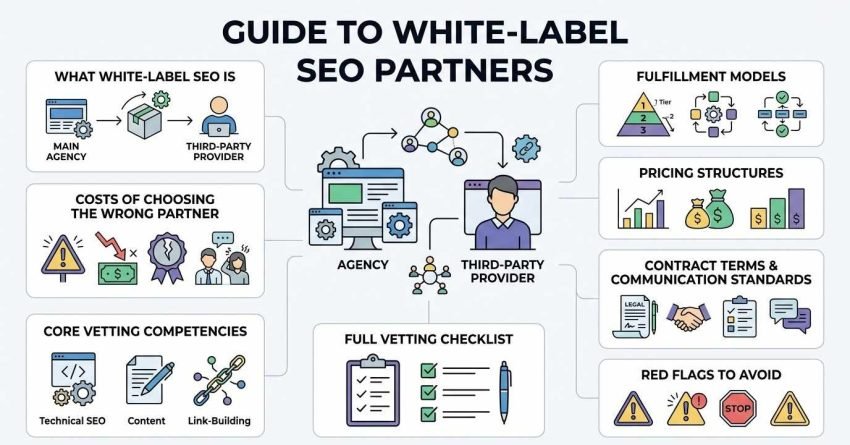
This guide covers what white label SEO actually involves and what it costs to get it wrong, the core technical, content, and link-building competencies worth vetting, how fulfillment models and pricing structures differ, and the contract terms, communication standards, and red flags that separate reliable partners from risky ones. We close with a full vetting checklist.
What Is White Label SEO and Why Agencies Use It
White label SEO is a service arrangement where one company performs SEO work that another company sells and reports as its own. Agencies use it to expand service offerings without hiring specialists in technical SEO, content, or link building.
I’ve seen small agencies double their service catalog this way in under six months. The arrangement works because the end client never sees the subcontractor’s name on any report or invoice.
How White Label SEO Differs From In-House Delivery
In-house delivery means an agency’s own employees perform every task, from keyword research to link outreach. White label delivery outsources that execution while the agency retains the client relationship and billing.
The difference matters most when scaling. An agency can take on ten new SEO clients in a month without hiring ten new specialists.
Who Typically Needs a White Label Partner
Marketing agencies, web design firms, and PR shops without dedicated SEO staff are the most common buyers of white label services. Freelancers managing more clients than they can personally service also rely on this model.
I work with agencies at every stage of this decision: some testing SEO as a new offering, others scaling past what their internal team can handle.
The Real Cost of Choosing the Wrong White Label Partner
Choosing the wrong white label SEO partner risks client churn, wasted ad and content spend, and long-term damage to search rankings that can take months to reverse. A study by Ahrefs found that over 90% of pages get zero organic traffic, and much of that failure traces back to poor execution rather than an unbeatable niche.
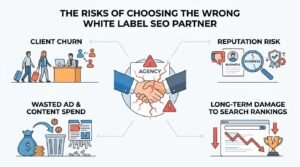
I’ve taken over accounts where the previous white-label vendor built spammy backlink profiles. Recovering from a manual action or algorithmic penalty routinely takes three to six months of remediation work before any growth resumes.
Client Churn and Reputation Risk
A client who discovers their rankings dropped because of low-quality subcontracted work rarely stays quiet about it. Word spreads fast in small business communities, and one bad account can cost an agency multiple referral relationships.
Wasted Budget on Ineffective Tactics
Money spent on thin content, low-quality directory links, or keyword-stuffed pages produces no lasting ranking value. That spend is gone whether or not the client ever notices the problem.
Core Vetting Criteria: Technical SEO Capability
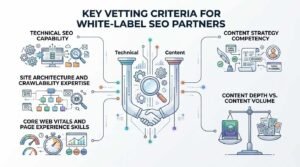
Technical SEO capability is a white-label provider’s ability to fix crawlability, indexation, site speed, and structural issues that block search engines from ranking a site. I ask every prospective partner to walk through a real technical audit before signing anything.
A provider who can’t explain crawl budget in plain terms usually can’t diagnose deeper indexation problems either.
Site Architecture and Crawlability Expertise
Site architecture is how a website’s internal pages are organized and linked, and it directly affects whether search engines can find and index every important page. A partner should be able to identify orphaned pages, broken internal links, and thin category structures within the first audit.
Core Web Vitals and Page Experience Skills
Core Web Vitals are Google’s official set of page experience metrics measuring loading speed, interactivity, and visual stability. Google’s own documentation confirms these signals factor into ranking, so a competent partner should show before-and-after performance data from past clients.
Core Vetting Criteria: Content Strategy and Execution

Content strategy competency means a partner can research search intent, map topics to a client’s business goals, and produce content that satisfies both readers and ranking algorithms. I look for writers who understand a niche, not just generalists cranking out generic 500-word posts.
Content Depth vs. Content Volume
Content depth refers to how thoroughly a single piece covers a topic, while volume refers to how many pieces get published. A partner chasing volume over depth often produces thin, interchangeable content that never earns rankings or backlinks.
Editorial Quality and Brand Voice Matching
Editorial quality covers grammar, factual accuracy, and structural clarity, while brand voice matching ensures content sounds consistent with a client’s existing tone. A provider unwilling to review brand style guides before writing is a warning sign.
Core Vetting Criteria: Link Building and Authority Development
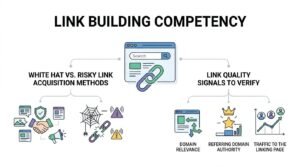
Link building competency is the ability to earn backlinks from relevant, authoritative websites without violating search engine guidelines. This is the single area where I’ve seen the most damage done by low-quality white-label vendors.
White Hat vs. Risky Link Acquisition Methods
White hat link building earns links through genuine outreach, guest content, and digital PR, while risky methods rely on paid link networks or automated directory submissions that violate Google’s spam policies. A partner using risky tactics puts every client site at risk of a manual penalty.
Link Quality Signals to Verify
Domain relevance, referring domain authority, and traffic to the linking page are the three signals worth checking on any backlink a partner reports. Ask for a sample of live links before committing to a long-term contract.
Core Vetting Criteria: Reporting and Performance Transparency
Reporting transparency is a white-label partner’s willingness to give full, unfiltered access to the data behind their work rather than a polished summary. I’ve walked away from partnerships the moment a provider resisted sharing raw analytics access.
What a Trustworthy SEO Report Includes
A trustworthy report includes ranking movement by keyword, organic traffic trends, technical issues found and fixed, and links acquired with their source URLs. Reports missing any of these categories usually hide weak performance.
Access to Google Search Console and Analytics
Direct access to Google Search Console and Google Analytics lets an agency verify a partner’s claims independently rather than trusting a summary slide. Any provider refusing this access should be treated as an immediate red flag.
Evaluating White-Label Fulfillment Models
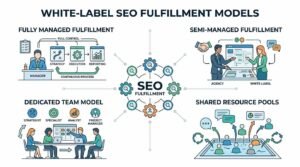
Fulfillment model refers to how a white-label provider structures the team and process for delivering the actual SEO work. This affects consistency, communication speed, and how well the work matches a specific client’s industry.
I’ve used both models across different agency partnerships, and each fits a different scale of business.
Fully Managed vs. Semi-Managed Fulfillment
Fully managed fulfillment means the white-label partner handles strategy, execution, and reporting entirely, while semi-managed fulfillment has the agency staying involved in strategic decisions. Agencies newer to SEO usually benefit from fully managed setups until they build internal expertise.
Dedicated Team vs. Shared Resource Pools
A dedicated team model assigns the same specialists to an agency’s accounts every month, while a shared resource pool rotates staff across many clients. Dedicated teams tend to produce more consistent brand voice matching and fewer communication gaps over time.
Questions to Ask Before Signing a White Label SEO Contract
The right questions before signing reveal a partner’s actual capabilities faster than any sales pitch or portfolio review. I keep a standing list of eight questions I ask every prospective vendor.
Red Flag Answers vs. Reassuring Answers
A red flag answer avoids specifics, cites “proprietary methods” instead of explaining tactics, or guarantees a specific ranking position. A reassuring answer walks through the actual process step by step and cites realistic, evidence-based timelines.
Pricing Models and What They Signal About Quality
A pricing model refers to how a white label provider structures fees, typically flat monthly retainers, hourly rates, or performance-based percentages. Price alone tells you little, but the structure behind it reveals a lot about how the partner operates.
Flat-Fee vs. Performance-Based Pricing
Flat-fee pricing charges a consistent monthly rate regardless of results, while performance-based pricing ties fees to ranking or traffic milestones. Performance-based models sound appealing but often incentivize short-term tactics that risk long-term penalties.
Why Unusually Low Pricing Is a Warning Sign
Unusually low pricing almost always means a provider cuts corners on content quality, link vetting, or technical audit depth. I’ve traced multiple penalty recoveries back to bargain-priced vendors using automated, low-quality tactics.
Communication, Onboarding, and Account Management Standards
Communication standards cover how quickly a partner responds, how clearly they explain progress, and how well they handle problems when campaigns underperform. Weak communication compounds every other weakness on this list.
Turnaround Times and Escalation Processes
Turnaround time is how long a partner takes to respond to requests or resolve issues, and an escalation process defines what happens when something goes wrong. A partner without a documented escalation path leaves agencies stuck during emergencies.
Contract Terms, SLAs, and Exit Clauses to Review
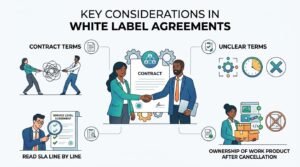
Contract terms define the scope, duration, and cancellation conditions of a white label agreement, and unclear terms cause the majority of partnership disputes. I read every SLA line by line before signing, and I recommend every agency owner do the same.
Ownership of Work Product After Cancellation
Ownership of work product determines whether an agency keeps the content, links, and technical fixes a partner produced after ending the relationship. Contracts silent on this point often leave agencies starting from zero with a new provider.
Realistic SEO Timelines a Reputable Partner Will Set
A realistic SEO timeline sets expectations of four to twelve months before meaningful ranking movement, depending on competition and site history. Partners promising rankings within weeks are describing a level of control search engines don’t actually give anyone.
Why 4–12 Month Timelines Are Standard
Search engines need time to crawl new content, evaluate authority signals, and compare a site against established competitors before adjusting rankings. This process cannot be compressed regardless of budget size.
Industry Certifications, Case Studies, and Proof of Results
Proof of results includes verifiable case studies, client references, and third-party audit data showing what a partner has actually achieved. Certifications matter less than documented, checkable outcomes.
How to Verify Case Study Claims
Verifying a case study means asking for the client’s actual domain, checking historical rankings through a tool like Ahrefs or Semrush, and confirming timelines match what the partner claims. A provider unwilling to name a single verifiable client is hiding something.
The White Label SEO Vetting Checklist
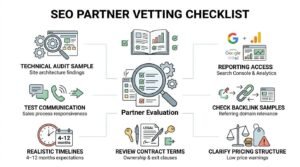
A vetting checklist consolidates every criterion covered in this guide into a single evaluation framework an agency can apply consistently across every prospective partner.
A Step-by-Step Evaluation Framework
- Request a live technical audit sample and review site architecture findings.
- Review three verifiable case studies with named, checkable client domains.
- Confirm reporting includes direct Search Console and Analytics access.
- Ask for sample backlinks and check referring domain relevance.
- Clarify pricing structure and question anything unusually low.
- Review the contract for ownership terms and exit clauses.
- Confirm realistic timeline expectations of four to twelve months.
- Test communication responsiveness during the sales process itself.
Common Mistakes Agencies Make When Selecting a Partner
The most common mistake agencies make is choosing a partner based on price before verifying technical competency or reviewing real client results. I’ve watched this decision reversed within ninety days more times than I can count.
Skipping reference checks and assuming a polished sales deck reflects actual delivery quality causes the second most common failure pattern.
Signs It’s Time to Switch White Label SEO Providers
Declining rankings, vague monthly reports, and slow response times to legitimate concerns are the clearest signs a white label partnership has run its course. I recommend a formal quarterly review against the original contract terms to catch this early.
A partner unwilling to explain a ranking drop with specific data has already stopped being a true partner.
Conclusion
Choosing a white label SEO partner means evaluating technical skill, content quality, link practices, reporting transparency, and contract terms together, not any single factor alone.
The right partner strengthens your agency’s reputation and client retention over years, not just the next reporting cycle.
We built our process around the transparency this guide describes. Talk to White Label SEO Service about a partnership built on verifiable results.
Frequently Asked Questions
What does a white label SEO partner actually do?
A white label SEO partner performs technical audits, content creation, and link building under another agency’s brand name. The agency owns the client relationship while the partner delivers the work behind the scenes.
How much does white label SEO typically cost?
Most white label SEO retainers range from $750 to $5,000 monthly depending on scope and site complexity. Performance-based and hourly models also exist but are less common industry-wide.
How do I know if a white label SEO provider is legitimate?
A legitimate provider shares verifiable case studies, grants direct analytics access, and explains tactics without vague “proprietary method” language. Ask for a live technical audit sample before signing anything.
Can I white label SEO reporting under my own brand?
Yes, most white-label SEO providers offer branded reporting dashboards and PDF exports carrying the reselling agency’s logo and colors. Confirm this capability exists before signing, since not every provider supports full white-labeling.
What’s the difference between white label and reseller SEO?
White label SEO involves the partner doing the actual execution work invisibly, while pure reselling can sometimes mean simply marking up another company’s packaged service. The distinction matters for how much quality control the reselling agency actually has.
How long should a white label SEO contract be?
Most SEO partnerships require a minimum six- to twelve-month contract term to allow enough time for ranking improvements to materialize. Shorter contracts rarely give enough runway to judge real performance.
What red flags suggest I should avoid a provider?
Guaranteed rankings, refusal to share analytics access, unusually low pricing, and vague explanations of tactics are the clearest red flags. Any one of these alone justifies looking elsewhere.