White label SEO lets an agency sell search optimization services under its own brand while a specialized partner performs the actual technical, content, and link-building work behind the scenes. I’ve watched this model reshape how small and mid-sized agencies compete against larger shops without the overhead of building a full internal team.
Agencies that skip this model often turn away SEO clients or deliver inconsistent results due to thin internal expertise.
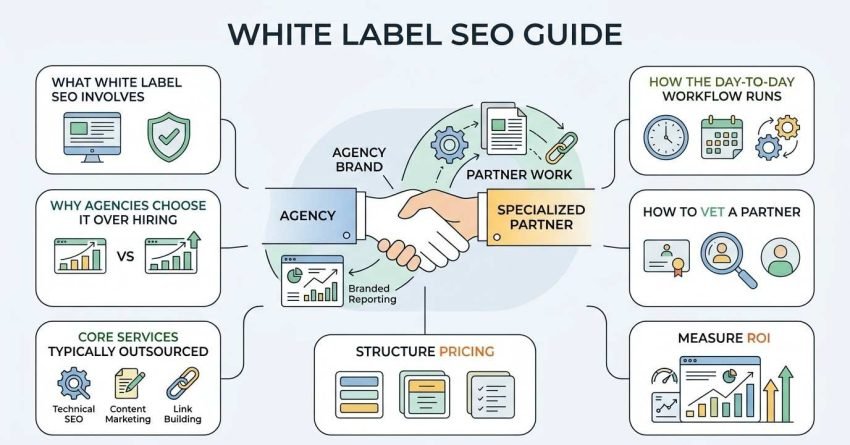
This guide covers what white label SEO actually involves, why agencies choose it over hiring, the core services typically outsourced, how the day-to-day workflow runs, and how to vet a partner, structure pricing, and measure ROI along the way.
What White Label SEO Actually Means for Agencies
White label SEO is an arrangement where one company performs SEO work that another company sells and presents to its own clients under its own name. I think of it as a manufacturing relationship applied to marketing services; the end client never sees who’s actually doing the work.
White label SEO is a service delivery model in which an agency outsources SEO execution to a specialized provider while retaining the client relationship and branding. We rely on this structure constantly because it separates sales and strategy from production.
Three parties sit inside every white label relationship: the agency (client-facing), the white label partner (execution), and the end client (usually unaware of the arrangement). Each has distinct responsibilities that keep the engagement running smoothly.
The agency owns communication, contracts, and account strategy. The partner owns technical audits, content production, and link acquisition. This division is what makes white label reseller programs attractive to agencies wanting to scale fast.
Why Agencies Turn to White Label Partners Instead of Hiring In-House
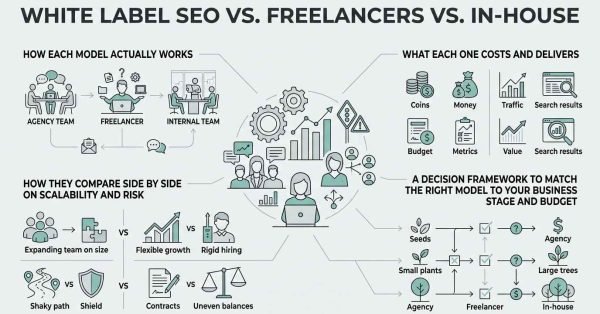
Agencies choose white label partners because building an equivalent in-house SEO team costs significantly more in salary, tools, and training time than outsourcing the same output. I’ve seen agencies spend six figures annually on a team that a white label partner replicates for a fraction of the cost.
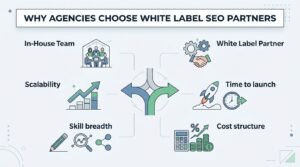
Hiring in-house means recruiting technical SEOs, content writers, and link builders separately, then managing their output internally. This takes months before the team even produces client-ready work.
In-House Team vs. White Label Partner
| Factor | In-House Team | White Label Partner |
| Time to launch | 3–6 months hiring/training | Days to weeks |
| Cost structure | Fixed salaries + benefits + tools | Variable, project-based |
| Skill breadth | Limited to hires made | Full team across specialties |
| Scalability | Slow, requires more hires | Immediate, scales with demand |
We find that agencies without deep SEO expertise get faster time-to-value this way. Instead of managing separate specialists, the agency now oversees one relationship covering technical SEO, content creation, and link building together.
The Core Services Agencies Typically White Label
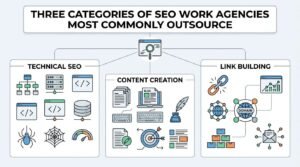
Agencies most commonly outsource three categories of SEO work: technical SEO, content creation, and link building. Each addresses a different ranking factor, and most agencies lack deep bench strength across all three simultaneously.
Technical SEO
Technical SEO covers site architecture, crawlability, indexation, page speed, and structured data the foundation search engines use to understand and rank a site. I always tell clients this is the layer that determines whether content and links even get credit.
Technical SEO audits require specialized tooling and expertise most agencies don’t maintain internally, which makes this one of the most frequently outsourced categories.
Content Creation
Content creation for SEO means producing pages and articles built around keyword research, search intent, and topical authority rather than general copywriting. This differs from typical marketing content because every piece maps back to a specific ranking objective.
Agencies without in-house SEO writers rely on white label partners to handle keyword mapping and on-page optimization at scale.
Link Building
Link building is the process of earning backlinks from other websites to build a domain’s authority and improve its ranking potential. It remains one of the hardest services to deliver consistently because it requires outreach relationships most agencies haven’t built.
Link building outreach demands ongoing relationship management that’s difficult to staff for occasional client needs, which pushes many agencies toward white label execution instead.
How the White Label Workflow Functions Day to Day
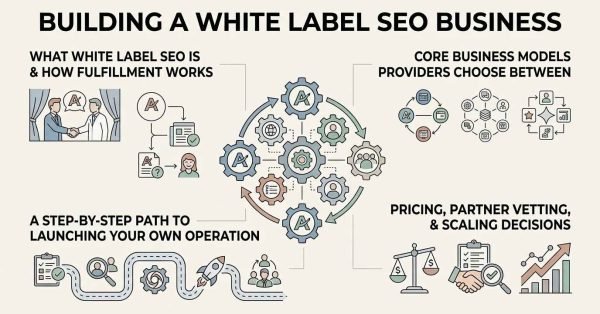
The white label workflow typically follows a five-step loop: onboarding, strategy handoff, execution, reporting, and communication back to the client. I’ve refined this loop across dozens of partner relationships, and the sequence rarely changes.
- The agency onboards the client and gathers goals, access, and background
- The agency shares client details with the white label partner under NDA
- The partner executes technical, content, or link building work
- The partner delivers white-labeled reports back to the agency
- The agency reviews, rebrands, and presents results to the client
This loop repeats monthly for most engagements, with strategy adjustments made based on performance tracking data from each cycle.
How Agencies Evaluate and Select a White Label SEO Partner
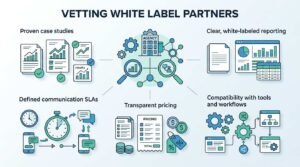
Agencies vet white label partners by examining their track record, reporting transparency, communication responsiveness, and pricing structure before signing any agreement. I’ve seen agencies skip this step and regret it within the first quarter.
Key Vetting Criteria
- Proven case studies with measurable ranking or traffic improvements
- Clear, white-labeled reporting templates ready for client presentation
- Defined communication SLAs (response time, escalation process)
- Transparent, itemized pricing with no hidden markup structures
- Compatibility with the agency’s existing tools and workflows
A partner failing on communication responsiveness alone tends to cause the most client friction, since delays cascade directly onto the agency’s own reputation.
Pricing Models and Cost Structures in White Label SEO
White label SEO pricing typically follows one of three models: flat monthly retainers, per-project fees, or hourly rates based on scope. Each model suits different types of agency engagements.
Pricing Model Types
| Model | Best For | Typical Structure |
| Monthly retainer | Ongoing SEO campaigns | Fixed fee for defined deliverables |
| Per-project | One-time audits or migrations | Flat fee per project scope |
| Hourly | Ad hoc or variable-scope work | Billed by hours logged |
We see retainers dominate for content and link building because both require sustained monthly output rather than one-off delivery.
Branding, Reporting, and Client-Facing Transparency
White-labeled reporting means the white label partner produces performance reports formatted with the agency’s own logo and branding rather than the partner’s identity. This lets the agency present all results as if the work happened entirely in-house.
White-labeled reports typically include rankings, traffic changes, and completed deliverables, formatted under the agency’s brand identity. I always confirm this capability exists before signing with any partner, since inconsistent branding breaks client trust fast.
Reporting cadence usually matches the retainer cycle, arriving monthly alongside a summary the agency can walk clients through directly.
Common Risks and Mistakes Agencies Make with White Label Partnerships
The most common mistake agencies make is failing to vet a partner’s actual output quality before committing client accounts to them. I’ve seen this destroy client trust within a single reporting cycle.
Agencies also underestimate communication gaps, since a partner working across multiple agencies may deprioritize slower-paying or smaller accounts. This creates inconsistent turnaround times that clients notice immediately.
Contract ambiguity around ownership of work, exclusivity, and termination terms causes disputes later. Agencies that skip a detailed SEO service agreement often discover gaps only after a conflict arises.
How White Label Partnerships Support Agency Scalability
White label partnerships let agencies take on more SEO clients without proportionally increasing internal headcount. This decouples revenue growth from hiring speed, which is normally the biggest constraint on service-based scaling.
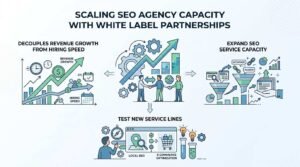
An agency using a white label model can expand SEO service capacity because production scales with the partner rather than with internal hiring cycles. We find this especially valuable for agencies experiencing seasonal or unpredictable demand spikes.
This scalability also lets agencies test new service lines, like local SEO or e-commerce optimization, without the risk of hiring specialists for unproven demand.
Measuring Performance and ROI in a White Label Arrangement
Agencies measure white label SEO performance through organic traffic growth, keyword ranking movement, and conversion metrics tied back to client revenue goals. These three signals together tell the full ROI story.
A 2024 analysis by Ahrefs found that only 5.7% of newly published pages reach the top 10 search results within a year, which sets realistic expectations for how quickly white label work should show measurable ranking movement.
Agencies typically pull this data through Google Search Console and Analytics, reviewing it monthly alongside the white label partner’s own performance summary.
How White Label SEO Fits Into a Broader Agency Growth Strategy
White label SEO functions as one lever inside a larger agency growth strategy that also includes sales positioning, service diversification, and client retention systems. It rarely works well as an isolated tactic disconnected from broader business goals.
Agencies that treat their white label partner as a strategic extension of their own team, rather than a vendor, tend to retain clients longer and expand account values faster.
Conclusion
We’ve covered how white label partnerships let agencies expand technical SEO, content, and link building capacity without the cost of building an in-house team.
This model connects directly to broader agency growth, letting firms scale service lines, retain clients, and compete against larger shops confidently.
We help agencies structure exactly this kind of partnership. Reach out to White Label SEO Service to start scaling your SEO delivery today.
Frequently Asked Questions
What is white label SEO in simple terms?
White label SEO means one company does the SEO work while another company sells it under its own brand name. The end client never knows a third party is involved.
How much does white label SEO typically cost?
Costs vary by model, ranging from hourly rates to flat monthly retainers. Most agencies pay based on scope, service type, and required deliverables each month.
Do clients know their SEO is outsourced?
Usually not, since white-labeled reporting hides the partner’s identity entirely. The agency presents all work and results under its own brand.
How long does it take to see results from a white label partner?
Most SEO campaigns take four to twelve months to show meaningful ranking movement. Technical fixes can show impact faster than content or link building efforts.
What’s the difference between white label and reseller SEO?
White label partners perform the actual work under the agency’s brand, while resellers simply resell another company’s services with less involvement. The distinction affects control and quality oversight significantly.
Can small agencies use white label SEO partners?
Yes, small agencies often benefit most since white label partners let them offer full SEO services without hiring specialists. This keeps overhead low while expanding service capacity.
What should be in a white label SEO contract?
Contracts should define ownership, confidentiality, service scope, and termination terms clearly. Pricing structure and reporting expectations should also be spelled out explicitly.