SEO is the practice of improving a website’s visibility in organic search results, and it remains one of the highest-ROI marketing channels available to businesses in 2026. I’ve sat across the table from enough CFOs and CMOs to know the real question isn’t “does SEO work”; it’s “when does it pay off, and how much should we spend to get there?”
Most executives approve budgets for channels they can measure in 30 days. SEO doesn’t work that way, and treating it like paid media wastes both.
This primer covers how search ranking actually works, realistic timelines and cost structures, how to calculate ROI before you commit budget, the technical and content foundations that make growth possible, and the KPIs your leadership team should actually track.
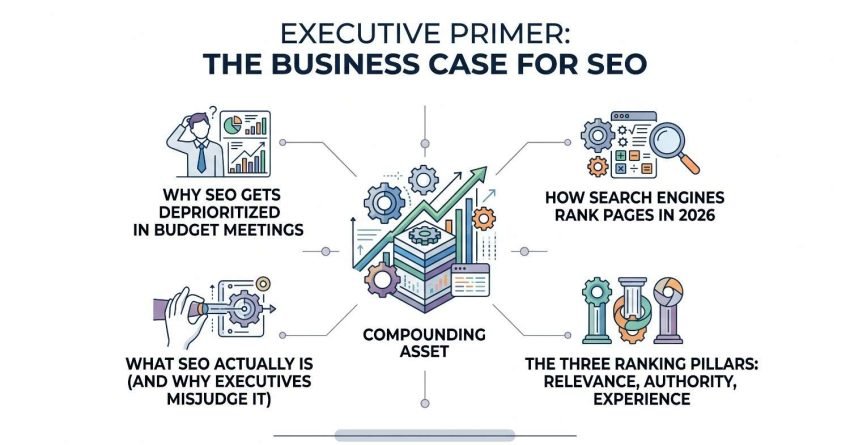
What SEO Actually Is (And Why Executives Misjudge It)
SEO is the process of earning organic (unpaid) visibility in search engines by aligning a website’s technical structure, content, and authority signals with what search engines reward. I’ve watched this definition get flattened into “getting to page one of Google,” which misses the mechanism entirely.
Search engines aren’t ranking websites. They’re ranking answers. A page ranks when it demonstrates, more convincingly than competing pages, that it satisfies a specific searcher’s intent.
That distinction matters for budget conversations. SEO isn’t a line item you buy; it’s a compounding asset you build.
Why SEO Gets Deprioritized in Budget Meetings
Executives deprioritize SEO because its payoff curve looks nothing like paid media’s. Paid search shows results within days; SEO usually takes months to show comparable traction, which makes it a harder sell in a quarterly review.
I get why that’s uncomfortable. But the channels that compound slowly are usually the ones still paying off two years later, long after the ad budget stopped.
How Search Engines Rank Pages in 2026
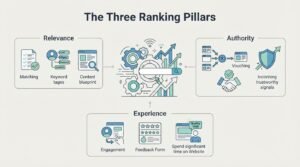
Search engines rank pages using three core signal categories: relevance, authority, and user experience, weighted through hundreds of algorithmic factors. Google’s ranking systems evaluate over 200 signals, according to Google’s own Search documentation, though only a handful carry meaningful weight for most queries.
Relevance measures how well content matches the semantic intent behind a query, not just keyword overlap. Authority measures whether other credible sites vouch for a page through links and citations. Experience measures whether real users engage with a result or bounce back to try another one.
The Three Ranking Pillars: Relevance, Authority, Experience
These three pillars rarely move independently. A technically fast site with no authority still won’t rank for competitive terms, and a well-linked site with poor content won’t hold rankings once it gets there.
I treat this as a diagnostic tool with clients. When rankings stall, the fix is almost always isolated to one of these three pillars, and identifying which one saves months of guessing.
The Real SEO Timeline: What Happens Month by Month
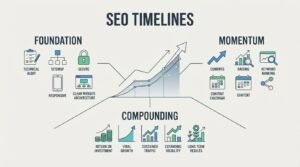
SEO timelines follow a predictable curve: most websites see initial ranking movement within 3 to 4 months, meaningful traffic growth by month 6 to 9, and compounding returns from month 12 onward. An Ahrefs study analyzing two million keywords found that even top-ranking pages took an average of two years to reach page-one positions for competitive terms.
That number surprises people. But it’s an average across all content a well-executed technical fix on an established domain can show ranking gains in weeks, while a brand-new site targeting competitive commercial keywords genuinely can take that long.
I break the timeline into three phases with clients: foundation (months 1–3, technical fixes and content architecture), momentum (months 4–9, content velocity and initial rankings), and compounding (month 10+, when organic traffic starts generating leads without proportional new investment).
Why “SEO Takes 6 Months” Is an Oversimplification
The six-month figure gets repeated because it’s a safe, defensible middle ground, not because it’s universally accurate. Timeline depends heavily on domain age, competitive density in the niche, and how much technical debt exists at the start.
A site with clean technical SEO and existing domain authority can see results faster than that. A site launching in a saturated niche with zero backlink profile typically takes longer.
SEO Cost Structures: What Drives Price and Value
SEO pricing is driven primarily by scope of work, competitive difficulty of target keywords, and delivery model: agency, freelancer, or in-house team. U.S. businesses typically spend between $2,500 and $10,000 per month on professional SEO services, according to Ahrefs’ 2024 SEO pricing survey, with enterprise engagements running considerably higher.
Cost isn’t the right first question, though. Value density is. A $3,000/month retainer that generates ten qualified leads is cheaper than a $1,000/month retainer generating zero.
In-House vs Agency vs Freelancer Cost Models
In-house SEO hires cost more in salary and benefits but offer tighter alignment with internal product and sales teams. Agencies spread specialized expertise (technical, content, link building) across a team for a fraction of what three in-house specialists would cost. Freelancers sit in between: lower cost, but limited bandwidth and narrower skill coverage.
I’ve seen all three models work. The failure pattern is almost never the model itself; it’s mismatched expectations about what that model can realistically deliver at its price point.
Calculating SEO ROI: The Framework Executives Need
SEO ROI is calculated by comparing the lifetime value of organic-driven customers against the total cost of SEO investment over the same period. The formula sounds simple. The inputs are where most companies get it wrong.
Start with three numbers: average customer value, current organic conversion rate, and projected organic traffic growth. Multiply projected traffic by conversion rate to estimate new customers, then multiply by customer value to estimate revenue attributable to organic growth.
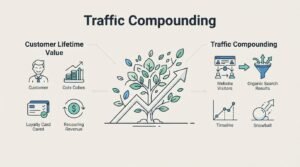
Customer lifetime value matters more in this calculation than first-purchase value, because organic traffic tends to convert repeat customers at a higher rate than paid channels. Organic search drives 53% of all trackable website traffic, according to BrightEdge’s channel research, making it the largest single acquisition channel for most B2B and B2C sites.
Traffic compounding is the part spreadsheets miss. A blog post ranking on page one keeps generating leads in month 24 without additional spend, while a paid ad stops the day the budget does.
Technical SEO Foundations: The Non-Negotiables
Technical SEO is the practice of optimizing a website’s infrastructure, so search engines can efficiently crawl, render, and index its content. Nothing else in this primer matters if a search engine can’t access the pages in the first place.
I treat technical SEO as the foundation, not a feature; content and links built on top of a broken technical base underperform no matter how good they are individually.
Site Speed, Crawlability, and Indexation Basics
Site speed affects both user experience and crawl efficiency, since slow-loading pages consume more of a search engine’s limited crawl budget per visit. Crawlability determines whether search engines can even discover a site’s pages, and indexation determines whether those discovered pages qualify to appear in results at all.
These three factors interact constantly. A fast site that blocks search engines through a misconfigured robots.txt file will never rank, regardless of speed.
Content Strategy as a Growth Lever
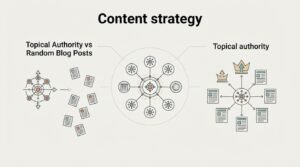
Content strategy is the deliberate planning of topics, formats, and publishing cadence designed to build comprehensive coverage of a business’s core subject areas. Random blog posts published without a strategic framework rarely move rankings, because they don’t build the topical depth search engines reward.
I structure content around pillar-and-cluster models, where one comprehensive hub page anchors a group of supporting articles covering related subtopics in depth.
Topical Authority vs Random Blog Posts
Topical authority is the degree to which a website comprehensively covers a subject area relative to competing sites, and it’s become one of the strongest predictors of ranking performance. A site publishing ten scattered posts across unrelated topics builds far less authority than one publishing ten posts covering a single subject in depth.
This is where most SMEs waste content budget. Volume without structure produces traffic that never compounds into rankings for the terms that actually convert.
Link Building and Authority Signals
Link building is the process of earning hyperlinks from other websites that signal credibility and relevance to search engines. Backlinks remain one of the top three ranking factors, according to Moz’s ranking factors survey, even as algorithms have grown more sophisticated at evaluating content quality directly.
Not every link carries equal weight, and chasing volume over relevance is one of the most common ways businesses waste link-building budget.
Why Not All Backlinks Are Created Equal
A single link from a recognized industry publication can outweigh dozens of links from low-quality directories, because search engines evaluate the linking site’s own authority and topical relevance. Link quality is assessed through domain authority, topical alignment, and the linking page’s own traffic and engagement.
I’ve seen sites damaged by aggressive link schemes that violated search engine guidelines. Sustainable link building always trades short-term volume for long-term credibility.
SEO vs Paid Search: Where Each Wins
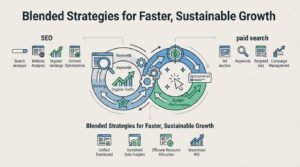
SEO and paid search serve different roles in a marketing mix: paid search delivers immediate, scalable traffic that stops the moment spend stops, while SEO builds compounding, durable visibility that continues generating traffic without ongoing incremental cost. Neither replaces the other completely for most businesses.
Paid search wins for time-sensitive campaigns, new product launches, and testing which keywords actually convert before investing organic effort there.
Blended Strategies for Faster, Sustainable Growth
Blended strategies use paid search to generate immediate revenue and keyword-level conversion data while SEO investments mature in the background. This approach lets businesses validate which keywords are worth the long-term organic investment before committing months of content and link-building effort to them.
I recommend this blend to nearly every new client. It removes the false choice between “wait for SEO” and “pay forever for ads.”
Measuring SEO Performance: KPIs That Matter to Leadership
SEO performance should be measured through metrics directly connected to revenue: organic conversion rate, cost per acquisition from organic channels, and organic revenue contribution, rather than traffic or ranking position alone. Leadership teams need numbers that translate directly into business impact.
Google Search Console and Google Analytics provide the raw data, but the translation into business terms is where most reporting falls short.
Vanity Metrics vs Revenue-Connected Metrics
Vanity metrics like total keywords ranked or raw traffic volume look impressive in a report but don’t tell you whether SEO is generating revenue. Revenue-connected metrics organic-assisted conversions, organic pipeline value, and customer acquisition cost by channel tell you whether the investment is working.
I’ve replaced traffic-only dashboards with revenue-mapped reporting for clients specifically because the traffic number alone kept generating the wrong internal conversations.
Common SEO Risks and Red Flags in Vendor Selection
SEO vendor risk comes primarily from providers using outdated or manipulative tactics that generate short-term ranking gains followed by penalty-driven traffic collapse. Guaranteed rankings, suspiciously low pricing, and vague reporting are the three most common warning signs.
I’ve inherited more recovery projects from penalized sites than I can count, and nearly all of them started with a vendor promise that sounded too good to be true.
Warning Signs of Short-Term or Black-Hat Tactics
Black-hat tactics include purchased link schemes, hidden text, and content generated purely to manipulate rankings without serving genuine search intent. These approaches can produce fast ranking gains, followed by algorithmic penalties that erase months or years of progress overnight.
A vendor unwilling to explain their methodology in plain language is the single clearest red flag I screen for in vendor evaluations.
Building an SEO Roadmap for Your Organization
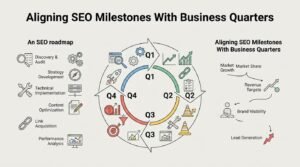
An SEO roadmap is a phased plan that sequences technical fixes, content production, and link acquisition against realistic timelines and available budget. Building one before starting execution prevents the common mistake of treating SEO as a single undifferentiated task.
I sequence roadmaps in quarters, because that matches how most leadership teams already plan and review budget internally.
Aligning SEO Milestones With Business Quarters
Quarterly milestones give leadership a natural checkpoint for evaluating whether early technical and content work is translating into the ranking and traffic gains the timeline predicted. The first quarter typically focuses on technical fixes and foundational content; the second on content velocity and initial link acquisition.
This alignment matters more than most roadmaps acknowledge. A plan that doesn’t map to how a business already reviews performance gets deprioritized regardless of its quality.
The Compounding Value of SEO Over 12-36 Months
SEO’s defining economic advantage is compounding: content and authority built in year one continues generating traffic and leads in year three without proportional additional investment. Sites with strong organic foundations report organic traffic growth of 20-30% year-over-year once past the initial building phase, based on aggregate performance patterns across established content programs.
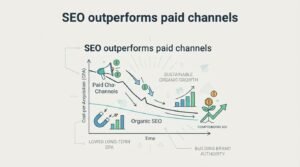
This compounding curve is the entire business case in one chart. Paid channels produce a flat line that drops to zero the day spend stops. SEO produces a curve that keeps climbing.
Why SEO Outperforms Paid Channels Long-Term
SEO outperforms paid channels over long time horizons because the marginal cost of an additional organic visitor approaches zero once content and authority are established, while every paid click carries its original cost indefinitely. This makes SEO’s true cost-per-acquisition decline over time, the opposite of most paid channels.
I show clients a three-year cost-per-lead projection alongside their SEO proposal specifically because this is the number that makes the long timeline worth defending internally.
Conclusion
SEO connects technical infrastructure, content authority, and measurable performance into one compounding growth engine. We’ve walked through the timelines, costs, and ROI frameworks that make this investment defensible at the leadership level.
Sustainable organic growth rewards businesses that commit past the six-month mark, when compounding effects genuinely start outperforming paid alternatives.
We build that long-term visibility for clients every day. Partner with White Label SEO Service to turn this framework into a working roadmap for your business.
Frequently Asked Questions
How long does SEO take to show results?
Most websites see initial ranking movement within 3 to 4 months and meaningful traffic growth by month 6 to 9. Full compounding returns typically start after month 12, depending on competition and starting domain authority.
How much should a business budget for SEO?
U.S. businesses typically spend between $2,500 and $10,000 per month on professional SEO services. The Budget should scale with competitive difficulty and the scope of technical, content, and link-building work required.
Is SEO worth it compared to paid ads?
SEO delivers compounding, long-term traffic at a declining cost per acquisition, while paid ads stop generating traffic the moment spend stops. Most businesses benefit from running both channels in a blended strategy.
What’s the difference between technical SEO and content SEO?
Technical SEO ensures search engines can crawl, render, and index a website properly. Content SEO focuses on creating topically comprehensive material that satisfies search intent and earns rankings.
How do I know if my SEO vendor is using risky tactics?
Warning signs include guaranteed rankings, suspiciously low pricing, and vague or unexplained reporting methodologies. Legitimate vendors can clearly explain their technical, content, and link-building approach in plain language.
What KPIs should I track for SEO performance?
Track organic conversion rate, cost per acquisition from organic channels, and organic revenue contribution rather than traffic or keyword rankings alone. These metrics connect SEO activity directly to business outcomes.
Can SEO results be guaranteed?
No legitimate SEO provider can guarantee specific rankings, since search engines control their own algorithms and results. Reputable providers instead commit to transparent methodology, measurable milestones, and consistent reporting.