SEO results are the measurable changes in organic traffic, keyword rankings, and search visibility that follow from search engine optimization work, and they typically take four to twelve months to become meaningful. Business owners who expect page-one rankings in a few weeks are working from a false premise, and that mismatch causes more SEO relationships to fail than any technical mistake does.
I’ve watched too many businesses judge SEO on a 30-day window. That’s not how search engines work, and setting the wrong timeline wastes budget and trust in thirty days flat.
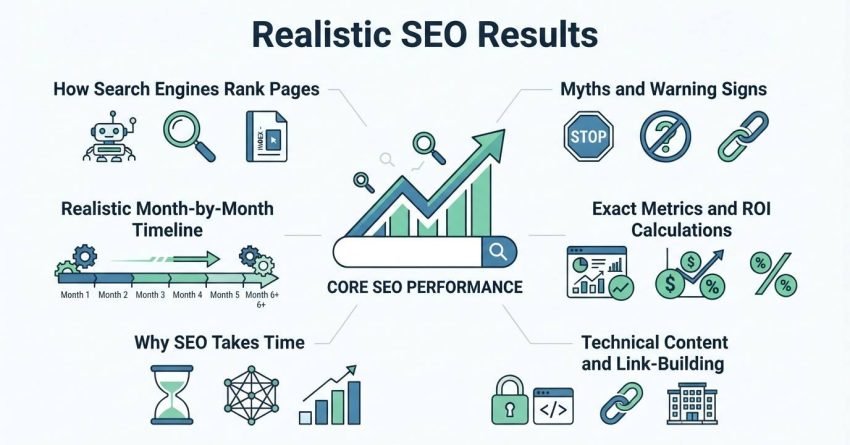
This guide covers how search engines actually rank pages, the realistic month-by-month timeline you should expect, why SEO takes the time it does, and the technical, content, and link-building work behind it. I’ll also walk through the exact metrics and ROI calculations that prove progress, plus the myths and warning signs that derail expectations.
How Search Engines Actually Decide Rankings
Search engines rank pages through three distinct stages: crawling, indexing, and ranking, and a page can fail at any one of them regardless of how good the content is. I treat these as separate diagnostic checkpoints, not one blended process, because a page stuck at “not indexed” will never rank no matter how well it’s written.
Crawling, Indexing, and Ranking as Three Separate Stages
Crawling is a search engine bot discovering a URL exists. Indexing is that page being stored in the engine’s database as eligible to appear in results. Ranking is the algorithm deciding where that indexed page sits relative to every other page competing for the same query.
I see sites treat these as one step, and it costs them months. A page can be crawled and indexed and still rank nowhere near page one because ranking depends on relevance and authority signals the first two stages don’t touch.
The Ranking Factors That Carry the Most Weight
Google’s own documentation confirms that relevance, content quality, and usability signals like page experience all factor into ranking, without a single fixed formula. Content relevance to search intent, backlink authority, and technical health form the three pillars I weigh most heavily when diagnosing why a site underperforms.
The Realistic SEO Timeline: Month-by-Month Expectations
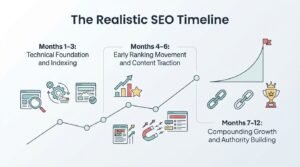
Most websites see their first meaningful ranking movement between month four and month six, with compounding growth continuing through month twelve and beyond. I break this into three phases because each one has a different job, and skipping ahead mentally to “where are my rankings” during phase one just creates frustration.
Months 1–3: Technical Foundation and Indexing
The first quarter is foundation work: fixing crawl errors, improving site speed, and getting new or updated pages indexed. Rankings barely move here, and that’s expected, not a warning sign.
Ahrefs’ study of two million keywords found that only 5.7% of pages reach the top 10 within a year, and most of those started climbing after month three, not before it. I use this phase to build the technical base everything else depends on.
Months 4–6: Early Ranking Movement and Content Traction
By month four, indexed content starts competing in search results, and impressions in Google Search Console typically rise before clicks do. Keyword positions in the 20–50 range are common here, which signals the content is relevant but hasn’t earned enough authority yet.
This is where content velocity and quality start separating winners from stalled campaigns. Sites publishing consistent, intent-matched content usually see position improvements stacking month over month.
Months 7–12: Compounding Growth and Authority Building
The second half of year one is where backlinks, content depth, and technical trust compound into visible traffic growth. Rankings that sat at position 30 in month five often move into the top 10 by month nine, assuming the underlying content and link profile kept improving.
I tell clients this phase rewards consistency more than any single tactic. Momentum from the first six months pays off here, not before.
Why SEO Takes Time (The Mechanics Behind the Timeline)
SEO takes months rather than days because search engines require sustained trust signals and repeated content evaluation cycles before granting a site higher rankings. A brand-new page has zero history for an algorithm to judge, and that history has to accumulate through real user behavior and third-party validation.
Domain Authority and Trust Accumulation
Domain authority builds gradually as a site earns backlinks, consistent traffic, and content depth over time, and no shortcut compresses that timeline safely. I’ve seen sites try to buy their way past this with low-quality links, and it almost always backfires within a year.
Content Indexing and Algorithm Evaluation Cycles
Search engines don’t just index a page once and rank it permanently. Google re-crawls and re-evaluates content on an ongoing cycle, comparing it against competing pages that are also being updated, which means rankings shift as the entire competitive landscape moves.
Technical SEO Foundations That Influence Results
Technical SEO is the foundational work of making a website crawlable, indexable, and fast enough for search engines to properly evaluate its content. Without this layer, even excellent content underperforms because search engines can’t fully access or trust the page.
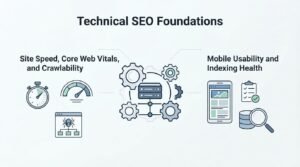
Site Speed, Core Web Vitals, and Crawlability
Core Web Vitals measure loading speed, interactivity, and visual stability, and Google has confirmed these signals factor into ranking as part of page experience. Slow-loading pages lose both rankings and user patience, often within the first few seconds of a visit.
Crawlability issues like broken internal links, orphaned pages, or blocked resources in robots.txt prevent search engines from even seeing content that could otherwise rank well.
Mobile Usability and Indexing Health
Google indexes the mobile version of a site first under mobile-first indexing, so a page that renders poorly on a phone gets evaluated on that broken experience. I check mobile rendering before anything else during a technical audit because it affects the baseline for every other signal.
Content Strategy’s Role in Driving Organic Growth
Content strategy drives organic growth by matching what a business publishes to the actual search intent behind the keywords it wants to rank for. Publishing content that answers a different question than the one users are asking wastes the effort entirely, regardless of writing quality.
Search Intent Matching and Topical Depth
Search intent falls into four types: informational, navigational, commercial, and transactional, and each requires a different content format to satisfy it. A page targeting “how does SEO work” needs an explainer, while “SEO agency pricing” needs a commercial page, and mismatching the two guarantees poor rankings no matter how well-written the content is.
Content Velocity vs. Content Quality
Publishing frequency matters less than topical completeness and depth. I’ve seen sites publish twice a week and stall, while a competitor publishing twice a month with genuinely comprehensive, intent-matched pages pulled ahead within two quarters.
Link Building and Authority Signals
Link building is the process of earning hyperlinks from other websites that signal trust and relevance to search engines, and it remains one of the strongest ranking factors available. Not all links carry equal weight, and quality outweighs raw quantity by a wide margin.
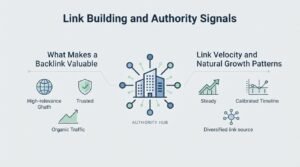
What Makes a Backlink Valuable
A valuable backlink comes from a topically relevant, established site with its own organic traffic and editorial standards. One link from a respected industry publication typically outweighs dozens of links from low-quality directories or unrelated blogs.
Link Velocity and Natural Growth Patterns
Search engines watch the rate at which a site acquires backlinks, and a sudden unnatural spike can trigger scrutiny rather than reward. Steady, gradual link growth that mirrors genuine content promotion reads as authentic and avoids the risk profile of manipulative link schemes.
Key SEO Metrics That Prove Progress
The core metrics that prove SEO progress are organic traffic, keyword ranking positions, impressions, and click-through rate, tracked consistently over months rather than days. Any one metric in isolation can mislead, so I always look at them together.
| Metric | What It Shows | Tool |
| Organic Traffic | Total visits from unpaid search | Google Analytics |
| Keyword Rankings | Position for target queries | Search Console, rank trackers |
| Impressions | How often a page appears in search results | Google Search Console |
| Click-Through Rate | Percentage of impressions that become clicks | Google Search Console |
Organic Traffic and Impressions
Organic traffic reflects actual visits, while impressions reflect visibility even without a click, and impressions typically rise weeks before traffic does. Watching impressions climb in Search Console is often the earliest legitimate sign that SEO work is taking effect.
Keyword Rankings and Ranking Distribution
Ranking distribution how many keywords sit in positions 1–3, 4–10, and 11–20 matters more than tracking one or two flagship terms. A healthy campaign shows keywords steadily migrating from position 20+ into the top 10 across a widening set of terms, not just movement on a single query.
Click-Through Rate and SERP Visibility
Click-through rate depends heavily on ranking position, with Backlinko’s analysis of 4 million search results finding that the first organic result earns an average CTR of 27.6%, dropping sharply by position 10. Improving title tags and meta descriptions can lift CTR even without a ranking change.
How to Measure ROI From SEO
SEO ROI is measured by comparing the revenue generated from organic search leads or sales against the total cost of the SEO investment over the same period. This calculation only becomes meaningful once enough traffic and conversion data has accumulated, usually after month six.
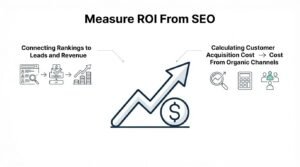
Connecting Rankings to Leads and Revenue
Attribution starts with tagging organic conversions in analytics, then tracing which landing pages and keywords produced them. A page ranking well for a high-intent commercial query but generating no leads points to a conversion problem, not an SEO problem.
Calculating Customer Acquisition Cost From Organic Channels
Customer acquisition cost from SEO is calculated by dividing total SEO spend over a period by the number of customers that channel produced in that same window. Comparing this figure against paid channels usually shows organic search producing a lower long-term cost per customer once the initial ramp-up period ends.
Industry and Competitive Factors That Affect Timelines
SEO timelines vary significantly by industry because competition level, average domain authority, and content saturation differ across niches. A local plumbing business and a national SaaS company are playing entirely different competitive games, even using the same core SEO tactics.
Low-Competition vs. High-Competition Niches
| Factor | Low-Competition Niche | High-Competition Niche |
| Typical time to top 10 | 3–6 months | 9–18 months |
| Content volume needed | Moderate | Extensive |
| Backlink authority required | Low to moderate | High |
Local SEO vs. National SEO Timeframes
Local SEO campaigns targeting city-specific or “near me” queries typically show results faster because the competitive pool is smaller and Google Business Profile signals carry significant local weight. National campaigns competing against established enterprise sites take longer simply because the authority gap is wider from day one.
Common SEO Myths That Set Unrealistic Expectations
The most damaging SEO myths involve unrealistic speed, volume, or guaranteed outcomes that don’t reflect how search algorithms actually evaluate websites. These myths usually come from misunderstanding paid advertising timelines and applying them to an organic channel that works completely differently.
“SEO Should Work in 30 Days”
Thirty days is barely enough time for a search engine to crawl and index new content, let alone evaluate and rank it against established competitors. Any provider promising page-one rankings in a month is either targeting zero-competition terms or setting up a disappointment.
“More Content Always Means Faster Rankings”
Publishing volume without topical relevance or quality dilutes a site’s authority rather than building it. I’ve seen sites with 50 thin pages get outranked by a competitor with 15 genuinely comprehensive ones covering the same topics.
Warning Signs of Underperforming or Risky SEO
Warning signs of risky or underperforming SEO include vague reporting, guaranteed ranking promises, and unexplained spikes in low-quality backlinks. Recognizing these early prevents wasted budget and protects a site from long-term ranking penalties.
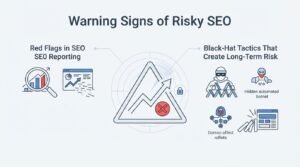
Red Flags in SEO Reporting
Reports that show only vanity metrics like “keywords tracked” without traffic or conversion data are hiding a lack of real progress. Transparent reporting always connects ranking movement to actual business outcomes like leads or revenue.
Black-Hat Tactics That Create Long-Term Risk
Black-hat tactics include buying links in bulk, cloaking content, and keyword stuffing, and all three risk manual penalties that can erase years of organic gains overnight. Google’s Search Essentials guidelines explicitly warn against manipulative link schemes as a violation that can result in removal from search results.
How to Set Realistic SEO Goals for Your Business
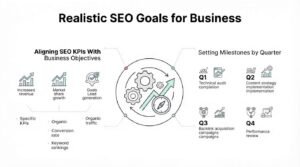
Realistic SEO goals connect specific ranking and traffic milestones to broader business objectives like lead volume or revenue targets, set on a quarterly timeline. Vague goals like “rank higher” give no way to measure whether the strategy is actually working.
Aligning SEO KPIs With Business Objectives
A KPI framework should trace a direct line from keyword rankings to traffic to leads to closed revenue, so every metric ties back to something the business actually cares about. I build this backward from revenue targets rather than forward from vanity ranking goals.
Setting Milestones by Quarter
Quarterly milestones might include indexing completion in quarter one, ranking distribution improvements in quarter two, and measurable lead growth by quarter three. Breaking a 12-month goal into quarterly checkpoints keeps expectations grounded and progress visible.
When to Expect a Return on SEO Investment
Most businesses see a measurable return on SEO investment between month six and month twelve, though smaller or less competitive markets can see returns sooner. I set this expectation upfront with every client because it prevents the premature “this isn’t working” conversation at month three.
Typical ROI Timelines by Business Size
Small local businesses in low-competition markets sometimes see ROI within four to six months, while enterprise companies competing nationally often need twelve to eighteen months before the investment clearly outperforms its cost. Budget and competitive intensity both shift this timeline more than any single tactic does.
Conclusion
SEO results come from technical health, content relevance, and earned authority working together over months, not days. Rankings, traffic, and ROI compound gradually as trust builds.
Understanding this timeline helps you evaluate strategies honestly and avoid tactics that promise shortcuts search engines don’t reward. Sustainable growth always outperforms quick fixes.
We build SEO strategies around realistic timelines and transparent measurement. Partner with White Label SEO Service to turn organic search into predictable, sustainable growth.
Frequently Asked Questions
How long does SEO take to show results?
Most websites see initial ranking movement within four to six months, with substantial traffic growth typically appearing between months seven and twelve. Competitive industries often take longer.
Why do SEO results vary so much between businesses?
Results vary because of differences in starting domain authority, competition level, content quality, and technical health. Two businesses in different industries rarely follow the same timeline.
Can SEO results be guaranteed?
No legitimate provider can guarantee specific rankings because search engines control their own algorithms. Anyone promising guaranteed rankings is making an unverifiable claim.
What is a good ROI for SEO?
A good SEO ROI shows organic revenue exceeding total SEO spend within twelve months, though this varies by industry and average customer value. Many businesses see 3–5x returns after the first year.
How do I know if my SEO strategy is working?
Rising impressions and improving keyword positions in Search Console are early indicators, followed by organic traffic and conversion growth. Consistent upward trends matter more than single-month snapshots.
Does changing SEO providers reset progress?
Switching providers doesn’t erase existing rankings or backlinks, but inconsistent strategy shifts can slow momentum. Technical and content continuity help preserve prior progress.
How often should SEO performance be reported?
Monthly reporting is standard for tracking trends, though meaningful strategic evaluation works best on a quarterly basis. Monthly reports should feed into quarterly strategy reviews.