SEO typically takes four to twelve months to produce meaningful traffic growth, though small, measurable improvements often appear within the first 60 to 90 days. I tell every client this on day one because it’s the single most important expectation to set correctly. The timeline depends on your site’s age, competition, and how consistently you execute.
Most businesses give up right around month three, which is usually the exact moment the groundwork starts paying off. I’ve watched this pattern repeat across dozens of accounts.
This guide covers what “working” actually looks like month by month, the factors that speed up or slow down your timeline, the core disciplines that make up a real SEO strategy, and how to measure ROI once results start showing. We’ll also cover cost, in-house versus agency decisions, and the warning signs that something’s off.
What “SEO Working” Actually Means
SEO is working when organic traffic, keyword rankings, and qualified leads show sustained upward movement over multiple months, not a single spike. I look at trend lines, never single-day snapshots, because search visibility is inherently volatile week to week.
A lot of business owners expect a straight line up. That’s not how it goes. Rankings fluctuate as Google tests your pages against competitors, and a temporary dip in week six doesn’t mean the strategy failed.
The real signal is direction over a 90-day window: more indexed pages, more impressions in Google Search Console, and a slow climb in average position. Organic traffic growth is the clearest long-term indicator, but it’s rarely the first one to move.
Rankings and impressions typically shift before raw traffic does. I treat early impression growth as the leading indicator and traffic as the lagging one.
The Realistic SEO Timeline, Month by Month
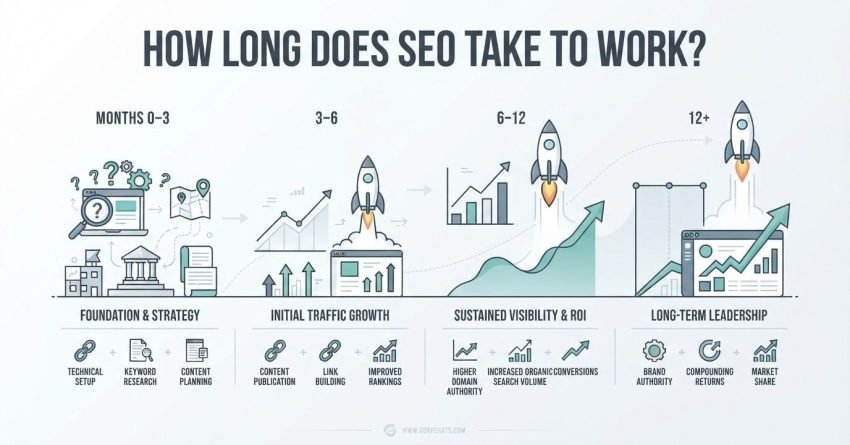
Most SEO campaigns follow a predictable four-stage arc: technical foundation in months 1-3, early momentum in months 4-6, measurable ranking growth in months 7-12, and compounding authority beyond month 12. I’ve mapped this pattern across small business sites and larger catalogs alike, and the shape holds remarkably consistent.
Months 1-3: Foundation and Technical Fixes
Nothing ranks yet in this window, and that’s expected. We’re fixing crawl errors, cleaning up site architecture, and publishing the first wave of optimized content.
Google needs to recrawl and reprocess the site before any of this shows up in rankings. Technical SEO issues left unresolved here will quietly cap every result that follows, no matter how good the content is later.
Months 4-6: Early Momentum and Indexing Gains
New pages start getting indexed, and long-tail keywords begin appearing in positions 20-50. Impressions in Search Console usually climb noticeably during this window, even if clicks haven’t caught up yet.
This is the stage where I start seeing the first real proof the strategy is working. It’s subtle, but it’s there if you know where to look.
Months 7-12: Ranking Growth and Traffic Compounding
Rankings for target keywords start moving into the top 20, then the top 10, for a growing share of pages. Traffic growth compounds because each newly ranking page adds to the total, rather than replacing what came before.
An Ahrefs study of two million keywords found only 5.7% of pages reach the top 10 within a year of publishing, which is exactly why patience during this stretch matters more than most people expect.
Beyond 12 Months: Authority and Compounding ROI
Established pages continue climbing, older content compounds in value, and new content ranks faster because the domain has built trust. Domain authority acts like compound interest for content published after the first year.
Sites that stay consistent past month 12 typically see their cost-per-lead from organic search drop significantly, since the traffic keeps arriving without new ad spend. This is where the ROI case for SEO becomes obvious.
Why SEO Takes Time to Work
SEO takes time because search engines must crawl, index, evaluate, and build trust in a page before ranking it competitively, and each of those steps happens on Google’s schedule, not yours. I explain this to every new client because it reframes the entire conversation around patience versus tactics.
Crawling alone can take days to weeks depending on your site’s crawl budget and how often Google’s bots visit. Once crawled, a page still needs to be indexed, which means added to Google’s searchable database, before it can rank for anything.
Even after indexing, new pages sit in a kind of probationary period. Domain trust accumulates gradually through consistent signals like backlinks, content depth, and user engagement over months, not days.
Competitors who’ve been building trust for years have a head start that no amount of short-term effort erases overnight.
Key Factors That Affect Your SEO Timeline
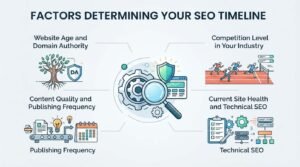
Website age, competition level, technical health, and content publishing frequency are the four biggest factors that determine whether your SEO timeline runs closer to four months or twelve. I evaluate all four before giving any client a timeline estimate, because skipping this step leads to guesswork.
Website Age and Domain Authority
Older domains with a clean history tend to rank faster because Google already trusts them. A brand-new domain starts from zero and has to earn that trust from scratch.
I’ve seen five-year-old sites outrank better-optimized new pages purely on accumulated domain trust.
Competition Level in Your Industry
Highly competitive niches like insurance, finance, and legal services take longer because established players have years of backlinks and content depth. Local service businesses in less saturated markets often see results faster.
Keyword difficulty is the clearest early signal of how competitive your specific niche will be, and it should shape timeline expectations before a single page goes live.
Current Site Health and Technical SEO
Sites with crawl errors, slow load speeds, or poor mobile experience start every campaign with a handicap. Fixing these issues first is non-negotiable, since content and links built on a broken technical foundation underperform.
Content Quality and Publishing Frequency
Sites publishing one thin post a month move noticeably slower than sites publishing consistent, comprehensive content weekly. Volume without quality doesn’t help, but quality without consistency doesn’t compound either.
SEO Timeline by Website Type
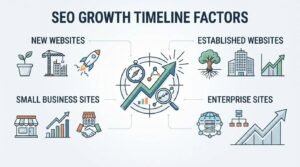
New websites typically need six to twelve months to see substantial organic traffic, while established sites with existing authority can see measurable gains in as little as sixty to ninety days. The gap comes down entirely to trust that’s already been built versus trust that has to be earned.
New Websites vs. Established Websites
A brand-new domain has no backlink history, no crawl history, and no established topical authority. Everything has to be built from the ground up, which is why patience matters most in these first campaigns.
Established websites, by contrast, are often just optimizing and expanding on authority that already exists.
Small Business Sites vs. Enterprise Sites
Small business sites with focused, local keyword targets often see results faster because the competition pool is smaller. Enterprise SEO campaigns typically take longer to show results simply due to the sheer number of pages, stakeholders, and approval layers involved.
The Core Components of an SEO Strategy
A complete SEO strategy is built on four pillars: technical SEO, on-page and content optimization, off-page link building, and local SEO where relevant. Each one affects the timeline differently, and skipping any one of them slows the whole system down.
Technical SEO
This covers crawlability, site speed, mobile usability, and structured data. Technical SEO is the foundation everything else sits on, and weaknesses here quietly undermine every other effort.
On-Page and Content SEO
This is where keyword targeting, search intent matching, and content depth live. On-page optimization determines whether a page can actually satisfy the query it’s trying to rank for, regardless of how many backlinks point to it.
Off-Page SEO and Link Building
Backlinks remain one of the strongest ranking signals Google uses to evaluate trust and authority. Link building is typically the slowest-moving component of SEO, since earning genuine, relevant backlinks takes sustained outreach and content worth linking to.
Local SEO (if applicable)
For businesses serving specific geographic areas, local pack rankings and Google Business Profile optimization often move faster than traditional organic rankings. This is frequently the quickest visible win for local service businesses.
How Search Engines Crawl, Index, and Rank New Content
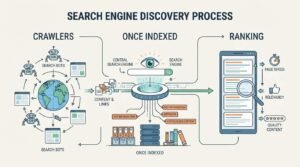
Search engines discover new content through crawling, store it through indexing, and then rank it by evaluating relevance and authority against every other indexed page competing for the same query. This three-step pipeline runs continuously and explains why nothing ranks instantly.
Crawlers follow links from page to page, which is why internal linking and sitemaps matter so much for discovery speed. Crawl budget determines how quickly a search engine revisits and reprocesses a site, and it becomes a real bottleneck once a site passes ten thousand pages.
Once indexed, ranking is a constant recalculation based on hundreds of signals, which is why positions shift daily even without any changes to the page itself.
Signs Your SEO Strategy Is Working (Even Before Page One)
Rising impressions in Google Search Console, increasing indexed pages, and improving average position are all signs SEO is working, even before any keyword hits page one. I tell clients to watch these three metrics closely during the first six months, since they move well before traffic does.
Impressions tell you Google is showing your pages for relevant queries more often. Google Search Console data is the single most reliable early indicator of SEO progress, months before rankings or traffic reflect the same trend.
A shrinking average position number, even while still on page two or three, means the algorithm is gaining confidence in your content.
Common Reasons SEO Takes Longer Than Expected
SEO takes longer than expected most often because of unresolved technical issues, inconsistent content publishing, weak backlink profiles, or targeting keywords that are too competitive for the site’s current authority level. I audit these four areas first whenever a campaign underperforms its projected timeline.
Algorithm updates can also reset progress temporarily, since Google periodically re-evaluates how it weighs different ranking signals. A Google algorithm update can shift rankings industry-wide overnight, regardless of how well a specific site was performing beforehand.
Inconsistent publishing is the most common self-inflicted delay I see. Sites that publish in bursts and then go quiet for months lose the compounding momentum that steady output builds.
How to Speed Up SEO Results Without Cutting Corners
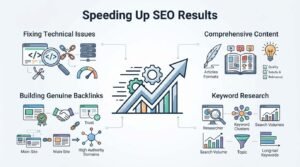
The fastest legitimate way to speed up SEO results is fixing technical issues first, then publishing comprehensive content targeting realistic keyword difficulty, while building genuine backlinks in parallel rather than sequentially. Running these three tracks simultaneously compresses the timeline more than any single tactic alone.
Targeting lower-competition, high-intent keywords early builds momentum and trust faster than chasing the most competitive terms first. Keyword research done properly upfront prevents months of wasted effort on terms the site has no realistic chance of ranking for yet.
Combining SEO with a short-term paid search campaign can also fill the visibility gap while organic rankings build in the background.
How Much Does SEO Cost Relative to Timeline?
SEO costs typically range from $1,500 to $10,000+ per month depending on competition and scope, with longer timelines generally requiring sustained investment rather than a one-time project fee. Budget and timeline are directly connected, since more resources applied consistently accelerate technical fixes, content output, and link acquisition.
Businesses that underfund SEO relative to their competition often see their timeline stretch well past twelve months, simply because output volume can’t keep pace. A Semrush survey of marketing budgets found that companies investing consistently for six or more months report significantly higher satisfaction with SEO ROI than those running short-term campaigns.
Measuring SEO ROI Over Time
SEO ROI is measured by comparing the value of organic traffic and conversions generated against total SEO investment over a defined period, typically six to twelve months for an accurate picture. I recommend clients avoid judging ROI before the six-month mark, since early months are foundation-building rather than conversion-generating.
Tracking organic leads, assisted conversions, and cost-per-acquisition against paid channels gives the clearest comparison. Google Analytics conversion tracking is essential for connecting organic traffic to actual revenue rather than vanity metrics like sessions.
In-House SEO vs. Hiring an SEO Agency
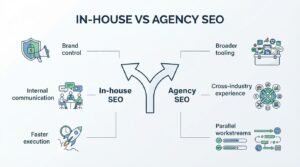
In-house SEO teams offer tighter brand control and faster internal communication, while agencies typically bring broader tooling, cross-industry experience, and faster execution across technical, content, and link-building workstreams simultaneously. The right choice depends on internal bandwidth and how quickly results are needed.
Agencies often compress timelines because they run multiple workstreams in parallel rather than sequentially, which matters most for businesses without dedicated internal SEO staff.
Conclusion
SEO timelines depend on domain trust, technical health, content consistency, and competition, compounding from foundational fixes into measurable traffic over months.
Every website’s cluster of pages, links, and authority signals builds toward long-term visibility that outlasts any single campaign or algorithm shift.
We help businesses build that foundation correctly from day one. Partner with White Label SEO Service to turn realistic timelines into sustainable growth.
Frequently Asked Questions
How long does SEO take to show results?
Most websites see initial ranking movement within 3 to 6 months, with substantial traffic growth by month 6 to 12. Timelines vary based on competition, site age, and execution consistency.
Can SEO work in 30 days?
SEO rarely produces significant results in 30 days because crawling, indexing, and trust-building take longer than a month. Minor technical fixes can show quick wins, but rankings need more time.
Why is my SEO not working after 6 months?
Common causes include unresolved technical issues, inconsistent content publishing, or targeting keywords too competitive for the site’s current authority. An audit typically identifies the specific bottleneck.
Does SEO take longer for new websites?
Yes, new websites generally take 6 to 12 months to see substantial results since they lack established domain trust and backlink history. Established sites often move faster.
How long should I invest in SEO before expecting ROI?
Most businesses should budget for at least six months before evaluating ROI, since early months focus on foundational work rather than conversions. Twelve months gives a clearer picture.
Is SEO faster than paid ads?
No, paid ads typically generate traffic immediately while SEO takes months to build momentum. However, SEO traffic compounds over time and doesn’t stop when spending stops.
What happens if I stop doing SEO after ranking?
Rankings typically decline gradually as competitors continue publishing and building links while your site stays static. Technical issues can also accumulate without ongoing maintenance.