Organic traffic is website traffic that arrives from unpaid search engine results, where a person types a query, sees your page listed, and clicks through without you paying for that placement. It is the single largest acquisition channel for most websites, and it behaves nothing like advertising.
I have watched businesses pour money into ads for years while ignoring the channel that compounds. That gap costs them margin every single month, and it widens quietly.
This guide covers what organic traffic actually means and how search engines generate it, how it compares to paid, where the clicks come from across modern search results, what determines the volume a site earns, the technical, content, and authority work behind it, how to measure and report it properly, realistic growth timelines, and what to do when it drops.
What Organic Traffic Actually Means
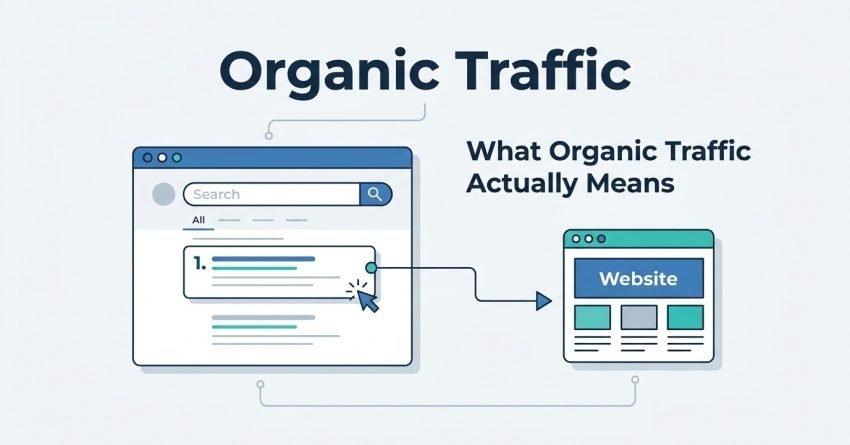
Organic traffic is the count of sessions on a website that originate from unpaid search engine results pages. The visitor searched, saw a listing, and clicked. No ad spend touched that click.
I want to be precise here because the term gets used loosely. Organic traffic is a channel classification inside analytics, not a vague synonym for “good traffic” or “free visitors.”
Organic Traffic vs. Direct, Referral, and Social Traffic
Analytics platforms split incoming visitors into channels based on where the session began. Each channel tells you something different about how the person found you.
Direct traffic means no referrer was passed, usually someone typing your URL or clicking a bookmark. Referral traffic comes from a link on another website. Social traffic comes from a social platform. Organic traffic comes from a search engine’s unpaid results.
The distinction matters because you optimise each one differently. I have seen teams celebrate a direct traffic spike that was really misattributed organic, then build the wrong strategy on top of it.
What Counts as an Organic Session in Analytics
A session counts as organic when the referring source is a recognised search engine and the URL carries no paid campaign parameters. Google, Bing, DuckDuckGo, Yahoo, and Yandex all register as organic sources by default.
Google Ads clicks carry a gclid parameter and are classified as paid search, not organic. Shopping ads, display ads, and YouTube ads are separate channels again.
One thing trips people up constantly. A click from Google Business Profile or Google Maps often lands in organic or direct depending on setup, and that misclassification distorts local reporting more than any other single issue I encounter.
How Organic Traffic Is Generated
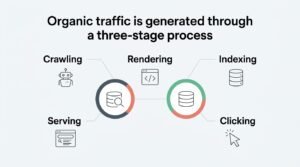
Organic traffic is generated through a three-stage process: a search engine crawls your page, indexes it, then serves it in response to a relevant query. A click on that served result becomes an organic session.
Here is the sequence in order:
- Crawling: a bot requests and downloads the page
- Rendering: the bot executes JavaScript and sees the finished page
- Indexing: the page is stored and understood in the search index
- Serving: the page is retrieved and ranked for a matching query
- Clicking: the user selects the result and lands on your site
Break any one of those stages and traffic stops. I diagnose far more traffic problems at stages one through three than at stage four, and clients almost always assume the opposite.
Crawling, Indexing, and Serving
Crawling is the discovery phase. Googlebot follows links and reads sitemaps to find URLs worth requesting.
Indexing is the storage and comprehension phase. Google decides whether the page is worth keeping, deduplicates it against near-identical pages, and assigns it meaning.
Serving is the retrieval phase. For a given query, Google pulls candidate pages from the index and ranks them. Only pages that survived indexing are eligible.
Why a Page Has to Be Indexed Before It Earns a Click
An unindexed page earns zero organic traffic regardless of how good the content is. That is not a ranking penalty; it is an eligibility problem, and it is invisible unless you check.
I check Search Console’s Pages report before touching anything else on a new account. Noindex tags left over from staging, canonical tags pointing at the wrong URL, and blocked directories in robots.txt account for a huge share of mystery traffic problems.
Organic Traffic vs. Paid Traffic
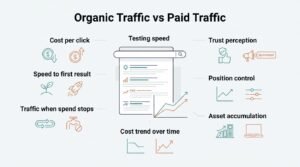
Organic traffic and paid traffic both come from search results, but organic clicks are earned through ranking while paid clicks are bought through an auction. The difference in economics is the whole argument.
This table shows how the two channels compare across the dimensions that affect budget decisions:
| Dimension | Organic Traffic | Paid Traffic |
| Cost per click | No direct cost | Pay per click, every click |
| Speed to first result | Weeks to months | Hours |
| Traffic when spend stops | Continues | Stops immediately |
| Cost trend over time | Falls per visit | Rises with competition |
| Asset accumulation | Compounds | None |
| Position control | Indirect | Direct via bid |
| Trust perception | Higher | Lower |
| Testing speed | Slow | Fast |
Cost Structure and Compounding Returns
Paid traffic has linear economics. Ten thousand clicks cost ten times what a thousand clicks cost, forever.
Organic traffic has a front-loaded cost curve. You invest heavily to earn a position, then the incremental cost of each additional visit approaches zero while the page keeps ranking.
That is why the channel compounds. A page I published for a client three years ago still delivers qualified leads every month at no marginal cost, and it has now paid for itself dozens of times over.
When Paid Makes More Sense Than Organic
Paid search wins in specific situations, and I will not pretend otherwise. New product launches, short-window promotions, and markets where you need data this week all justify ad spend.
Paid also wins for queries you cannot realistically rank for within a sensible timeframe. A brand-new domain competing against entrenched authority sites on a head term should buy that traffic while building toward it organically.
The mature answer is a mix. Paid covers the immediate gap, organic builds the long-term floor.
The Main Sources of Organic Traffic
Organic traffic arrives from several distinct result types on a search page, and each one has a different click behaviour. Treating them as one undifferentiated block is how forecasts go wrong.
The sources that matter most:
- Standard organic listings: the classic blue links, still the highest-volume source for most sites
- Featured snippets: the boxed answer above position one, which captures clicks but also satisfies some queries outright
- AI Overviews: the AI-generated summary block, which cites sources and can drive clicks or absorb them
- People Also Ask: the expandable question accordion, a meaningful click source for question-shaped content
- Image and video results: often overlooked, substantial for visual and instructional queries
- Local packs and Google Business Profile: dominant for anything with local intent
- Google Discover: feed-based, unpredictable, and capable of enormous spikes
Classic Blue Link Results
Standard organic listings remain the highest-volume organic traffic source across most industries. Position one on a commercial query typically captures a substantial share of all clicks, with a steep falloff below position three.
Anything below position ten receives negligible traffic. Page two is functionally invisible for commercial intent, and I have never seen a business case built on it that worked.
Featured Snippets and SERP Features
A featured snippet is a search result format that extracts and displays an answer directly on the results page, attributed to a source URL. Winning one puts you above the standard first position.
Snippets cut both ways. They capture visibility, but they also answer simple queries completely, which suppresses the click for definitional searches. I target them for queries where the snippet answer creates a follow-up question rather than closing the loop.
AI Overviews and AI Assistants
An AI Overview is a Google search feature that generates a synthesised answer from multiple sources and cites those sources with links. Being cited in one is a genuine organic traffic source, and increasingly a genuine referral source from assistants outside Google entirely.
The mechanics reward the same thing snippets do, only harder. Self-contained sentences, clear entity definitions, and statistics with the source named in the same sentence get lifted. Vague prose does not.
I now write every key claim so it survives being quoted alone, because that is the unit AI systems extract.
Google Business Profile and Local Packs
Local pack results appear for queries with geographic intent and pull from Google Business Profile rather than your website index. For service businesses with a physical presence, the local pack frequently outperforms standard organic listings.
Local organic behaves differently enough that it needs separate measurement. Proximity, review volume, and profile completeness carry weight that traditional ranking factors do not touch, which is why local SEO sits as its own discipline rather than a subset of general optimisation.
Why Organic Traffic Matters for Business Growth
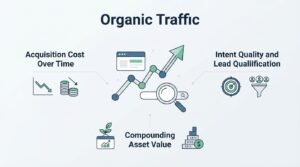
Organic traffic matters because it delivers high-intent visitors at a declining marginal cost while building an asset the business owns. Ads rent attention. Organic accumulates it.
Search drives the majority of measurable website traffic across the web, and organic listings carry substantially more trust than ads among users who can distinguish between them. That trust converts.
Acquisition Cost Over Time
Organic customer acquisition cost falls as the channel matures because fixed investment spreads across growing traffic volume. Paid acquisition cost rises as competitors bid up the same auctions.
I model this for clients as a crossover point. Early months favour paid on pure efficiency. Somewhere between month nine and month eighteen, depending on competitiveness, the organic cost per acquisition drops below paid and keeps falling.
Intent Quality and Lead Qualification
Organic visitors arrive mid-problem, having articulated their need as a query. That self-selection produces better-qualified leads than interruption-based channels.
Someone searching “how to reduce warehouse picking errors” has a problem they are actively trying to solve. They are a fundamentally different prospect from someone who saw a display ad.
Compounding Asset Value
A ranking page is an appreciating asset on the balance sheet, even though no accounting standard treats it that way. It produces traffic without ongoing spend, and its value increases as the domain’s authority grows around it.
Stop paying for ads and traffic ends that day. Stop investing in SEO and the existing rankings decay slowly, often over quarters rather than days, giving the business a genuine cushion.
What Determines How Much Organic Traffic a Site Earns
Organic traffic volume is determined by three multiplied variables: how many people search your topics, how highly you rank for them, and how many relevant pages you have indexed. Weakness in any one caps the other two.
The formula in practice: search volume × click-through rate at your position × number of ranking pages.
Search Demand and Keyword Volume
Search demand sets your absolute ceiling. Ranking first for a term nobody searches produces nothing, no matter how perfectly optimised the page is.
This is the most common strategic error I see. Teams optimise for terms that describe their product in internal language rather than terms buyers actually type, then wonder why first position delivered nothing. Proper keyword research exists precisely to prevent that mismatch before the content budget is spent.
Ranking Position and Click-Through Rate
Click-through rate falls sharply with position. The top result on a query captures a large multiple of the clicks that position five receives, and the curve steepens further down.
The practical implication is that moving from position eight to position four delivers a far larger traffic gain than moving from twenty to fifteen. Prioritise pages already ranking on page one before chasing new terms.
Indexed Page Count and Topical Coverage
Traffic scales with the number of distinct queries a site can answer. A site with forty indexed pages has forty entry points. A site with four hundred well-differentiated pages has ten times the surface area.
Volume alone does not work. Four hundred thin, overlapping pages perform worse than forty strong ones, because duplication and cannibalisation actively suppress the pages that would otherwise rank.
The Core Ranking Factors Behind Organic Traffic
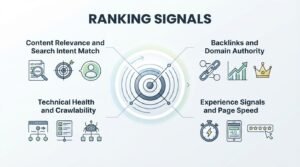
Organic rankings are determined by hundreds of signals, but they cluster into four groups: relevance, authority, technical accessibility, and user experience. Every tactic worth running maps to one of them.
This table shows what each factor group controls and where most sites lose ground:
| Factor Group | What It Signals | Common Weakness |
| Content relevance | Page matches query intent | Wrong format for the intent |
| Backlinks and authority | Other sites vouch for you | Low-quality or thin link profile |
| Technical health | Page is accessible and indexable | Crawl waste and index bloat |
| Experience signals | Page is usable and fast | Slow mobile load, layout shift |
Content Relevance and Search Intent Match
Relevance means the page delivers what the searcher wanted in the format they expected. Google infers expected format from the results already ranking.
If the top ten for a query are all comparison tables, a long narrative essay will not rank regardless of quality. Search intent dictates format before it dictates depth, and getting the format wrong caps a page permanently.
Backlinks and Domain Authority
A backlink is a link from an external website that passes authority and acts as a third-party endorsement. Links remain one of the strongest correlated ranking factors across every major industry study.
Authority operates at two levels: the domain’s overall strength and the individual page’s link profile. A strong domain lifts new pages faster, which is why established sites rank new content within days while new domains wait months.
Technical Health and Crawlability
Technical health determines whether your content is eligible to rank at all. Crawl errors, broken canonicals, slow server responses, and blocked resources all suppress performance before content quality is assessed.
I treat this as a gate, not a ranking lever. You do not get bonus points for a technically clean site. You get eliminated for a broken one.
Experience Signals and Page Speed
Page experience signals measure how usable a page is once loaded, covering load speed, visual stability, and interaction responsiveness. Core Web Vitals are Google’s specific framework for quantifying those measurements.
Experience signals act as a tiebreaker rather than a primary driver. They rarely lift a weak page into the top ten, but they regularly decide which of two comparable pages wins position three.
Technical SEO: The Foundation Organic Traffic Sits On
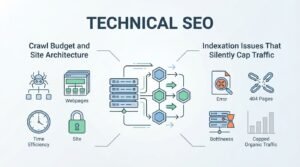
Technical SEO is the discipline of making a website accessible, crawlable, and indexable so that search engines can evaluate it properly. It is the foundation every other SEO investment sits on.
Nothing else compounds if this layer is broken. I have audited sites with excellent content earning almost nothing because a single directive blocked half the catalogue from the index.
Crawl Budget and Site Architecture
Crawl budget is the number of URLs a search engine will request from a site within a given period. It becomes a real constraint on sites above roughly ten thousand URLs.
Site architecture determines how efficiently that budget gets spent. Flat structures with strong internal linking get important pages crawled frequently. Deep, orphaned structures waste budget on pages nobody searches for, and the pages you care about get crawled monthly instead of daily.
Indexation Issues That Silently Cap Traffic
Indexation problems are the most underdiagnosed cause of flat organic traffic. The pages look fine to a human and are entirely absent from the index.
The usual culprits: noindex tags surviving a staging launch, canonical tags consolidating pages you wanted separate, parameter URLs creating thousands of duplicates, and soft 404s on thin pages. Search Console’s Pages report surfaces all of them, and almost nobody reads it monthly.
Content Strategy and Keyword Research
Content strategy is the process of deciding which topics to cover, in what depth, and in what order, so that a site accumulates authority in a defined subject area. Keyword research supplies the demand data that strategy needs.
Publishing without strategy produces a library of unrelated pages that never compound. Publishing with it produces a cluster where each page strengthens the others.
Mapping Keywords to Search Intent
Every keyword carries an intent: informational, navigational, commercial, or transactional. Mapping keyword to intent determines the page type before a word gets written.
I classify by reading the current results, not by guessing from the phrasing. The ranking pages tell you exactly what Google has decided that query means, and arguing with that decision is expensive.
Topical Authority and Content Clusters
Topical authority is the accumulated signal that a site covers a subject comprehensively rather than superficially. Search engines reward depth of coverage across a topic, not just quality of individual pages.
The structural expression of this is the content cluster: a broad pillar page linked to focused supporting pages, each covering one subtopic in real depth. Topical authority builds faster through complete clusters than through scattered high-quality one-offs, because the internal link structure makes the relationship explicit.
Link Acquisition and Authority Building
Link acquisition is the practice of earning links from external websites to increase a domain’s authority and improve ranking potential. It remains the hardest and most differentiating part of SEO.
Content and technical work can be executed by any competent team. Authority takes time and cannot be shortcut safely, which is exactly why it retains its value as a ranking signal.
Why Links Still Move Rankings
Links work because they are expensive to fake at scale and reflect genuine editorial judgement. A link from an established publication signals that a human with a reputation to protect decided your page was worth citing.
Google has spent two decades attacking manipulated link patterns, and the detection is now good. The links that move rankings are the ones that would have existed anyway.
Quality Signals vs. Volume
Link quality is determined by the linking site’s authority, its topical relevance to yours, the link’s placement in editorial content, and the anchor text used. A handful of strong, relevant links outperforms hundreds of weak ones.
Volume-focused link building creates measurable risk rather than measurable gain. I would rather have five contextual links from respected industry sites than five hundred directory placements, and the data across client accounts supports that consistently.
How to Measure Organic Traffic
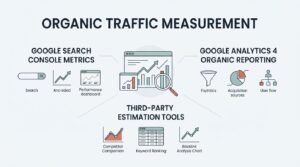
Organic traffic is measured using Google Search Console for search-side data and Google Analytics 4 for site-side behaviour, with third-party tools supplying competitive estimates. Each answers a different question.
Use them together. Search Console tells you what happened in the results. GA4 tells you what happened after the click.
Google Search Console Metrics
Google Search Console reports four core metrics for organic search: impressions, clicks, click-through rate, and average position. The data comes directly from Google with no sampling.
To pull your organic traffic data:
- Open the Performance report in Search Console
- Set the date range to a comparable period
- Filter to Search type: Web for standard results
- Add a comparison period to see change, not just totals
- Segment by Query, Page, and Country to find the movement
The limitations matter. Search Console retains sixteen months of data and anonymises low-volume queries, so the query-level clicks will never sum to your total clicks.
Google Analytics 4 Organic Reporting
GA4 classifies organic search as its own default channel group and tracks what those visitors do on the site. Sessions, engagement rate, conversions, and revenue all segment by channel.
The reliability depends entirely on setup. Misconfigured UTM parameters, missing cross-domain tracking, and untagged internal campaigns push organic sessions into direct or referral, which understates the channel and misdirects budget.
Third-Party Estimation Tools
Tools like Ahrefs, Semrush, and Similarweb estimate organic traffic by modelling keyword rankings against click-through rate curves. Those estimates are directional, not precise.
I use them for competitor analysis where I have no first-party access. For my own sites, I use Search Console every time, because an estimate is never better than the actual data.
The Metrics That Matter Beyond Session Count
Session count alone is a vanity metric because it says nothing about intent, qualification, or revenue. The metrics that actually predict business outcomes sit underneath it.
This table shows which organic metrics matter and what each one reveals:
| Metric | What It Tells You | Why It Matters |
| Impressions | Ranking surface area | Leading indicator of future clicks |
| Click-through rate | Listing appeal at position | Cheapest traffic gain available |
| Average position | Competitive standing | Shows momentum before clicks move |
| Non-brand share | Genuine acquisition | Strips out demand you already had |
| Conversion rate | Traffic quality | Separates useful traffic from noise |
| Assisted conversions | Multi-touch contribution | Captures organic’s real role |
Impressions, Clicks, and Average Position
Impressions move before clicks do. A page climbing from position twenty-eight to position fourteen gains impressions and almost no clicks, which reads as failure on a traffic chart and is actually progress.
I report impressions and average position in the first six months of any engagement, because those are the metrics that move first. Clicks follow once positions cross into the top ten.
Conversion Rate and Assisted Revenue
Organic conversion rate reveals whether the traffic matches the offer. High traffic with low conversion usually means the keyword intent was informational while the page was commercial.
Assisted conversions capture organic’s role in journeys that close elsewhere. A visitor who finds you through a guide, leaves, and returns via direct search two weeks later was acquired organically, and last-click reporting hides that entirely.
Non-Brand vs. Brand Traffic Split
Brand traffic comes from people searching your company name. Non-brand traffic comes from people who did not know you existed.
Only non-brand growth proves SEO is acquiring new demand. I have reviewed dozens of reports celebrating organic growth that was entirely brand traffic driven by a PR campaign, and the SEO investment had produced nothing.
How Long Organic Traffic Takes to Grow
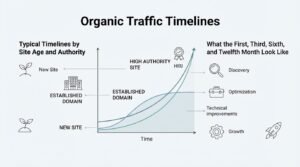
Organic traffic typically takes four to twelve months to produce meaningful, compounding results, with new domains sitting at the longer end and established sites moving faster. Anyone promising rankings in thirty days is selling something else.
An Ahrefs study of two million keywords found only 5.7% of pages reached the top ten within a year of publication.
Typical Timelines by Site Age and Authority
Domain age and existing authority are the largest variables in speed. This table shows realistic first-meaningful-results windows:
| Site profile | First meaningful movement | Compounding growth |
| New domain, no authority | 6–9 months | 12–18 months |
| Established site, weak SEO | 3–5 months | 8–12 months |
| Established site, strong authority | 4–8 weeks | 4–6 months |
| Large site with technical debt | 2–4 months post-fix | 6–12 months |
Competition changes these numbers substantially. A low-competition B2B niche moves faster than consumer finance by a wide margin.
What the First, Third, Sixth, and Twelfth Month Look Like
Month one is diagnosis and foundation: technical audit, keyword mapping, and fixing whatever is blocking indexation. Traffic does not move.
Month three shows impression growth and position improvements on existing pages. New content begins getting indexed and finding its initial position range.
Month six is where clicks usually become visible in reporting, as early content crosses into the top ten and technical fixes compound. Month twelve is where the channel starts behaving like an asset, with published pages ranking without further intervention and the SEO timeline curve turning genuinely exponential rather than linear.
What Causes Organic Traffic to Drop
Organic traffic drops for four main reasons: algorithm updates, technical regressions, competitive displacement, and demand changes. Diagnosing which one applies is the entire job.
The first move is always to establish whether the drop is site-wide or page-specific, and whether it coincides with a known update date.
- Algorithm updates: broad changes to how Google evaluates quality or relevance
- Technical regressions: a deployment breaking canonicals, noindex, or robots directives
- Site migrations: redirect maps with gaps, losing accumulated authority
- Competitive displacement: someone published something better for your terms
- Seasonality: demand genuinely fell, and nothing is wrong
- SERP layout changes: a new feature pushed your listing below the fold
- Manual actions: a human reviewer applied a penalty
Algorithm Updates
A Google algorithm update is a change to the ranking systems that re-evaluates which pages deserve visibility for existing queries. Core updates roll out several times a year and can shift traffic substantially within days.
Recovery from a core update is rarely a quick fix. The systems have re-assessed relative quality, and regaining position means genuinely improving relative to whoever replaced you. Understanding what a specific Google algorithm update targeted determines whether recovery is a content problem or a trust problem.
Technical Regressions and Migrations
Technical regressions cause the fastest and most severe drops, because they remove eligibility rather than reduce ranking. A robots.txt change or a stray noindex can delete a site from the index within a week.
Site migrations are the highest-risk event in SEO. Incomplete redirect maps, URL structure changes without mapping, and CMS moves that alter internal linking all destroy accumulated authority.
Seasonality and Demand Shifts
Not every decline is a problem. Search demand fluctuates seasonally in almost every industry, and a January drop in a summer-peaking category is expected behaviour.
I check Google Trends and year-over-year comparisons before diagnosing anything. Comparing December to November produces panic. Comparing December to last December produces truth.
Common Mistakes That Suppress Organic Traffic
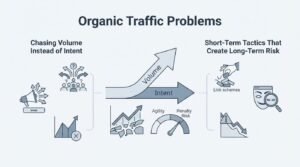
Most organic traffic problems come from a small set of recurring strategic mistakes rather than exotic technical failures. I see the same handful across most accounts I audit.
The costly ones:
- Targeting volume over intent: ranking for terms that never convert
- Publishing without a cluster strategy: pages that never reinforce each other
- Ignoring existing page-two rankings: chasing new terms while easy wins sit unclaimed
- Keyword cannibalisation: multiple pages competing for one query
- Neglecting internal linking: orphaned pages that never accumulate authority
- Treating SEO as a launch project: stopping investment once initial rankings appear
- Buying links: short-term gain against long-term penalty risk
Chasing Volume Instead of Intent
High-volume head terms attract attention because the numbers look impressive in a proposal. They frequently convert at a fraction of the rate that specific long-tail queries do.
A term with two hundred monthly searches and clear buying intent often outperforms one with twenty thousand informational searches. I would rather own fifty specific queries than fight for one broad one.
Short-Term Tactics That Create Long-Term Risk
Bought links, AI-generated content at scale with no editing, doorway pages, and expired domain redirects all work briefly. Every one of them carries eventual penalty risk.
The cost is asymmetric, and that is the part people underweight. A short-term gain of a few months against a recovery period measured in years is a bad trade at any discount rate.
Building a Sustainable Organic Traffic Strategy
A sustainable organic traffic strategy sequences technical foundations, content production, and authority building in that order, with continuous measurement feeding the next cycle. Running all three at once without sequencing wastes budget.
The order matters because each stage makes the next one more efficient. Content published on a broken technical foundation underperforms permanently.
Sequencing Technical, Content, and Authority Work
The sequence I run on every engagement:
- Technical audit and remediation: remove indexation and crawl blockers first
- Keyword research and content mapping: define the cluster before writing anything
- Foundation content production: build the pillar and core supporting pages
- Internal linking architecture: connect the cluster so authority flows
- Authority building: earn links to pages that are now worth linking to
- Measurement and iteration: double down on what moved, cut what did not
Step five before step three is the most common sequencing error. Building links to thin content produces nothing, and the links are wasted on pages that cannot convert the authority into rankings.
Budget, Resourcing, and Realistic ROI Modelling
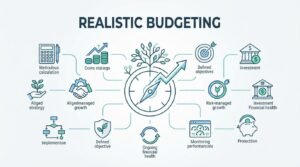
Realistic budgeting starts from the timeline, not the monthly fee. A twelve-month runway at a sustainable investment level beats six months of aggressive spend followed by abandonment, every time.
I model ROI using target keyword volume, realistic position assumptions, click-through rate curves, and current conversion rates. That produces a defensible forecast rather than a promise, and it lets a business decide honestly whether the channel is worth the runway it requires.
Conclusion
Organic traffic is unpaid search visitors, generated through crawling, indexing, and ranking, driven by relevance, authority, technical health, and experience signals working together.
Understanding these mechanics lets you set realistic timelines, measure the right metrics, and diagnose drops accurately rather than reacting to noise.
We build sustainable organic growth for businesses that want an asset, not a rental. Talk to White Label SEO Service about your search visibility today.
Frequently Asked Questions
Is organic traffic free?
Organic traffic has no cost per click, but it is not free. You invest in content, technical work, and authority building upfront, then earn clicks without paying for each one.
How much organic traffic is good for a small business website?
There is no universal benchmark. A local service business converting fifty organic visits into five leads monthly outperforms a site with five thousand unqualified visits and no conversions.
Does organic traffic include Google Ads clicks?
No. Google Ads clicks are classified as paid search because they carry campaign parameters. Organic traffic counts only unpaid search result clicks with no ad spend attached.
Why is my organic traffic going down but rankings staying the same?
Usually a SERP layout change. AI Overviews, featured snippets, or new ad slots push your listing lower on the page without changing your ranking position.
How long does it take to see organic traffic from a new website?
New domains typically need six to nine months for meaningful traffic. Impressions and early positions appear sooner, but clicks follow once pages reach the top ten.
Do AI Overviews reduce organic traffic?
AI Overviews reduce clicks on simple informational queries while preserving them on complex commercial ones. Being cited as a source within the overview still drives qualified traffic.
Can you buy organic traffic?
No. Any service selling organic traffic delivers bot visits or paid clicks mislabelled as organic. Genuine organic traffic only comes from earning search rankings.