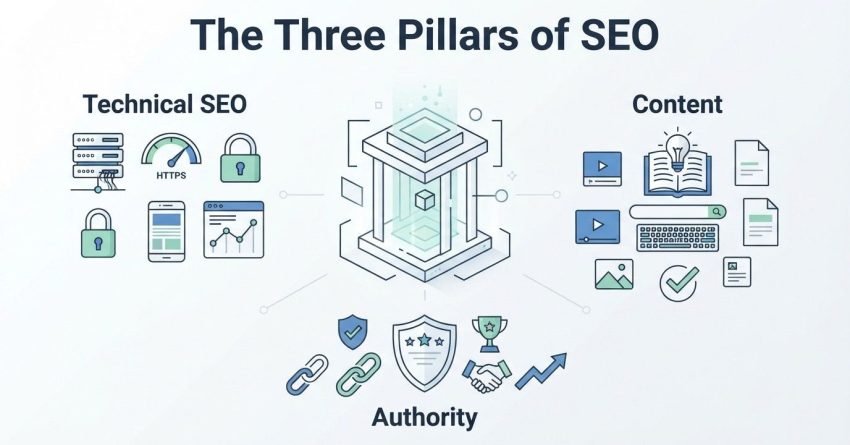
SEO rests on three pillars: technical SEO, which lets search engines crawl and index a site; content, which matches what people actually search for; and authority, which proves the site deserves to be trusted. All three must work together for rankings to hold.
I have watched businesses pour money into one pillar and wonder why nothing moved. A fast site with thin content stalls. Brilliant content on an unindexable site never gets seen.
This guide covers how search engines actually crawl and rank pages, what each of the three pillars involves in practice, how keyword research and content quality connect to real demand, what E-E-A-T and link acquisition genuinely require, how the pillars compound together, and what realistic timelines, budgets, measurement, and strategy sequencing look like once you start investing.
What the Three Pillars of SEO Actually Mean
The three pillars of SEO are technical SEO, content, and authority, and each one solves a different problem: access, relevance, and trust. A site needs all three to rank, because search engines evaluate them together rather than in isolation.
I think of it as a sequence of questions Google asks about every page. Can I reach this page and understand it? Does it answer what someone searched for? Do I have any reason to trust this source over the other nine results?
This table shows what each pillar answers and what fails when it is missing.
| Pillar | Question it answers | What happens without it |
| Technical SEO | Can search engines access and understand this? | Pages never get indexed or render incorrectly |
| Content | Does this satisfy the search intent? | Pages get indexed but never rank |
| Authority | Why should this source be trusted? | Pages rank on low-competition terms only |
The mistake I see most often is treating these as a checklist to complete in order and then walk away from. They are ongoing disciplines, and weakness in one caps the ceiling of the other two.
Technical SEO: The Access Layer
Technical SEO is the discipline that makes a website accessible, crawlable, and correctly interpretable by search engines. It covers site architecture, indexation, page speed, structured data, and how content renders for a bot rather than a browser.
This is the layer nobody notices until it breaks. A single misconfigured robots directive can remove an entire section of a site from search results overnight.
Content: The Relevance Layer
Content is the material that answers a searcher’s query, and its job is to match intent more completely than competing pages do. Relevance is not about repeating a keyword; it is about covering the subject a searcher actually needs covered.
I have seen 400-word pages outrank 4,000-word pages because the shorter one answered the question and the longer one circled it.
Authority: The Trust Layer
Authority is the accumulated signal of trust a site carries, built primarily through links from other credible sites, brand mentions, and demonstrated expertise. It is the hardest pillar to build and the slowest to move.
Authority also decides which keywords are realistically winnable. A new domain competing for high-value commercial terms is fighting a battle that content quality alone cannot win.
How Search Engines Crawl, Index, and Rank Pages
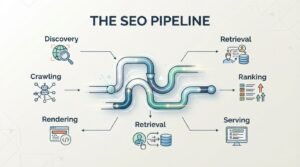
Search engines work in three stages: crawling to discover URLs, indexing to store and understand them, and ranking to order them for a given query. A page must survive every stage to appear in results, and most SEO problems trace back to a failure at one specific stage.
Understanding this sequence changes how you diagnose problems. “We are not ranking” is not one problem; it is at least three different problems with three different fixes.
Here is the pipeline every page passes through before it reaches a searcher.
- Discovery: Google finds a URL via links, sitemaps, or submitted requests
- Crawling: Googlebot requests the URL and downloads the raw response
- Rendering: JavaScript executes, and the final page state is constructed
- Indexing: Content is parsed, entities extracted, and the page stored
- Retrieval: A query triggers a candidate set from the index
- Ranking: Candidates are scored and ordered by relevance and quality
- Serving: Results display, sometimes with snippets or AI summaries
Crawling and Discovery
Crawling is the process where search engine bots request URLs to see what exists on a site. Discovery depends heavily on internal links and XML sitemaps, which is why orphaned pages often sit undiscovered for months.
Crawl budget is the number of URLs a search engine requests from a site within a given period. I only worry about it seriously on sites above roughly 10,000 URLs, where wasted crawls on filtered or duplicate URLs genuinely starve important pages.
Indexing and Rendering
Indexing is the stage where a crawled page is parsed, understood, and stored in the search engine’s database. Rendering happens first on JavaScript-heavy sites, and it is where a surprising number of pages quietly fail.
A page can be crawled and still never indexed. Google Search Console’s Page Indexing report tells you exactly which bucket each URL landed in, and I check it before touching anything else on a new client site.
Ranking and Retrieval
Ranking is the scoring process that orders indexed pages for a specific query based on relevance, quality, and context signals. Retrieval narrows the index to candidates first, then ranking sorts them.
Google has publicly confirmed it uses hundreds of ranking signals, weighted differently by query type. That variation matters more than most people realise, because the signals that win a local query differ from those that win an informational one.
Technical SEO: Making a Site Machine-Readable
Technical SEO ensures search engines can reach, render, and correctly interpret every page that should rank. It is foundational work, meaning it does not generate rankings on its own but removes the barriers preventing content and authority from paying off.
I run technical work first on every engagement. Fixing content on an unindexable site is spending money to publish into a void.
The scope is narrower than people assume. Most technical SEO reduces to three concerns: can bots get there, should they index it, and do they understand what it is.
Crawlability and Site Architecture
Site architecture is the structural arrangement of pages and internal links that determines how easily bots and users navigate a site. Flat architecture, where important pages sit within three clicks of the homepage, consistently outperforms deep nesting.
Internal linking does double duty here. It distributes authority between pages, and it signals which pages matter most.
Indexation Control
Indexation control is the practice of directing which URLs search engines store and which they ignore, using robots.txt, meta robots tags, and canonical tags. Getting this wrong causes two opposite failures: important pages blocked, or thousands of junk URLs diluting the site.
Faceted navigation on ecommerce sites is the usual culprit. One filter system can generate tens of thousands of near-duplicate URLs if nobody constrains it.
Structured Data and Markup
Structured data is standardised code that explicitly tells search engines what a page’s content represents, using vocabulary from schema.org. It does not directly boost rankings, but it enables rich results and helps machines classify entities correctly.
I prioritise it on product, local business, article, and FAQ pages, where the display benefit is measurable.
Site Speed, Core Web Vitals, and Mobile Performance

Core Web Vitals are three performance metrics Google uses to measure real-world loading, interactivity, and visual stability. They function as a tiebreaker rather than a primary ranking factor, meaning speed rarely lifts weak content, but slow pages lose ground against equally relevant competitors.
The business case is stronger than the ranking case. Slow pages lose conversions regardless of where they rank.
What Core Web Vitals Measure
This table shows the current thresholds Google considers good for each metric.
| Metric | What it measures | Good threshold |
| Largest Contentful Paint | Loading speed of main content | Under 2.5 seconds |
| Interaction to Next Paint | Responsiveness to user input | Under 200 milliseconds |
| Cumulative Layout Shift | Visual stability during load | Under 0.1 |
Field data from real users matters more than lab scores. I trust the Chrome User Experience Report over a synthetic PageSpeed run every time.
Where Performance Actually Affects Rankings
Page speed affects rankings most in competitive verticals where multiple pages satisfy intent equally well. In those cases, performance becomes a genuine differentiator.
Mobile-first indexing means Google predominantly uses the mobile version of a page for indexing and ranking. A desktop site that degrades badly on mobile is being judged on its weaker version.
Keyword Research and Search Intent Matching
Keyword research is the process of identifying the queries a target audience actually types and mapping each one to a page that satisfies its intent. Volume matters far less than intent match, because a page that ranks for the wrong intent converts nobody.
I have killed more keyword targets than I have kept. Most high-volume head terms are unwinnable for a site without established authority, and chasing them wastes months.
Mapping Keywords to Intent Types
This table shows the four intent categories and what each demands from a page.
| Intent type | What the searcher wants | Page type that wins |
| Informational | To learn or understand | Guide, explainer, definition |
| Navigational | To reach a specific site | Brand or product page |
| Commercial | To compare options | Comparison, review, best-of |
| Transactional | To buy or convert | Product, pricing, booking |
Mismatched intent is the single most common reason a well-written page fails. If the SERP shows comparison pages and you published a definition page, you are not in the race.
Choosing Winnable Keywords
Keyword difficulty scores estimate how hard it is to rank for a term based on the authority of pages already ranking. I treat them as directional, not absolute, because they ignore intent match and content quality gaps.
Long-tail keywords carry lower volume but higher conversion rates and dramatically lower competition. For most businesses under a year into SEO, that is where the entire opportunity sits.
Content Quality, Depth, and Topical Authority
Content quality in SEO means satisfying a searcher’s intent completely enough that they do not return to the results page. Depth matters only insofar as it serves that goal, and topical authority accumulates when a site covers a subject comprehensively rather than sporadically.
Google’s stated position is that it rewards content created for people rather than search engines. In practice, that translates into a measurable preference for pages that demonstrate genuine subject knowledge.
What Google Means by Helpful Content
Google’s helpful content guidance asks whether a page provides original insight, demonstrates first-hand expertise, and leaves the reader feeling their question was answered. Pages that summarise other pages without adding anything tend to lose ground over time.
I use one test. Could someone who has actually done this work have written this page, or could anyone with a search bar have written it?
Topic Clusters and Internal Linking
A topic cluster is a group of related pages, organised around a central pillar page, that collectively cover a subject in depth. The architecture signals expertise to search engines and gives readers a coherent path through a subject.
The internal links between cluster pages do real work. They distribute authority from the pillar down to specific pages and back up again.
Content Refresh and Decay
Content decay is the gradual traffic decline that older pages experience as information ages and competitors publish fresher material. It affects nearly every site with a content library beyond a year old.
Refreshing existing pages usually delivers faster returns than publishing new ones. I audit for decay quarterly and prioritise pages that once ranked well and slipped.
On-Page Optimization Fundamentals
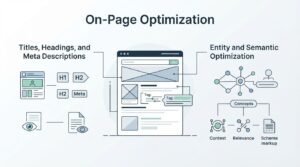
On-page optimization is the practice of structuring a page’s visible and semantic elements so both readers and search engines understand its subject immediately. It covers titles, headings, meta descriptions, internal links, and the entities a page names.
This is the cheapest SEO work available. It requires no development time and no outreach.
Titles, Headings, and Meta Descriptions
Title tags remain one of the strongest on-page signals, and they directly affect click-through rate from the results page. I front-load the primary term and keep titles under roughly 60 characters so they display fully.
Headings should describe the section beneath them accurately rather than creatively. A heading that hides its subject helps nobody.
Meta descriptions do not influence rankings directly, but heavily influence clicks. Google rewrites them often, which is an argument for writing them well rather than skipping them.
Entity and Semantic Optimization
Entity optimization is the practice of naming the specific people, places, organisations, and concepts a page discusses so search engines can classify it accurately. Modern search understands relationships between entities, not just keyword strings.
Naming related concepts explicitly helps. A page about email marketing that never mentions deliverability, segmentation, or open rates reads as shallow to a machine and to a reader.
E-E-A-T and Why Trust Signals Matter
E-E-A-T is Google’s framework for evaluating Experience, Expertise, Authoritativeness, and Trustworthiness, used by human quality raters to assess content reliability. It is not a direct ranking factor, but the signals raters look for correlate strongly with what ranks.
E-E-A-T matters most in what Google calls Your Money or Your Life topics: finance, health, legal, and safety, where poor information causes real harm. In those verticals, an anonymous page competing against a credentialed author rarely wins.
The practical signals are unglamorous. Named authors with genuine credentials, visible contact information, cited sources, clear editorial standards, and evidence that the writer has actually done the thing they are describing.
I have seen trust signals move rankings on pages where nothing else changed. Adding author bios and source citations to a thin medical content library lifted it measurably within a quarter.
Authority Building and Link Acquisition
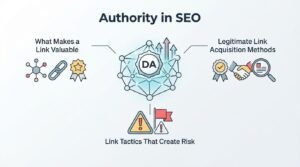
Authority in SEO is the accumulated trust a domain earns, signalled primarily through links from other credible websites. Links function as votes, and their value depends on the linking site’s own authority and topical relevance rather than raw count.
This is the slowest pillar and the one most people get wrong. The temptation to buy volume is constant, and the penalty risk is real.
What Makes a Link Valuable
A valuable link comes from a site with genuine authority, topical relevance to yours, and editorial intent behind the placement. A single relevant link from a respected industry publication outweighs hundreds from unrelated directories.
I evaluate four things: the linking domain’s own backlink profile, its topical relevance, whether the link sits in editorial content or a footer, and whether a real human chose to place it.
Legitimate Link Acquisition Methods
These are the acquisition methods that survive algorithm updates, each with the condition that makes it work.
- Original research and data: when you publish something others need to cite
- Digital PR: when you have a genuinely newsworthy angle journalists want
- Expert commentary: when you can respond fast to reporter requests
- Resource and tool creation: when the tool solves a real recurring problem
- Strategic guest contribution: when the publication has a real audience, not just link inventory
- Broken link replacement: when your content genuinely replaces the dead resource
Link Tactics That Create Risk
Link schemes are any arrangement where links are exchanged for money, goods, or reciprocal placement with the intent to manipulate rankings. Google’s link spam policies treat these as violations regardless of how they are packaged.
Paid link networks, private blog networks, and mass directory submissions carry genuine risk. I have inherited sites where cleaning up a previous provider’s link profile took longer than the original campaign did.
Local SEO and Geographic Relevance
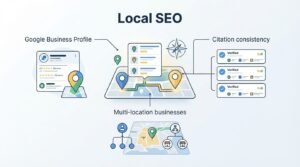
Local SEO is the discipline of optimising a business to appear in geographically targeted search results and map listings. It runs on a partly separate set of signals from traditional organic SEO, which is why a strong national site can still lose local queries.
The dominant asset is the Google Business Profile. Its category selection, review volume and velocity, photo activity, and proximity to the searcher drive most local pack placement.
Citation consistency matters more here than anywhere else. A business name, address, and phone number that differ across directories creates ambiguity that suppresses local visibility.
For multi-location businesses, dedicated location pages with genuinely distinct content outperform a single contact page with a list of cities. Duplicating a template across forty pages achieves nothing.
How the Three Pillars Interact and Compound
The three pillars multiply rather than add, meaning a site’s SEO performance is closer to the product of technical health, content quality, and authority than the sum of them. A near-zero score in any one pillar suppresses the returns from the other two.
This explains a pattern I see constantly. A client invests heavily in content, sees modest returns, and concludes content does not work when the actual constraint was an unindexable template or a domain with no authority to rank competitive terms.
The compounding runs in both directions. Better content earns more links, more links raise the authority ceiling, and a higher ceiling makes more ambitious content targets winnable.
Technical health determines how much of that compounding Google actually observes. A site where 30% of pages are excluded from the index is compounding on 70% of its effort.
Sequencing matters because of this. Fixing the constraint that caps everything else returns more than improving a pillar that is already functioning.
How long does SEO take, and what should it cost?
Realistic SEO Timelines: What Happens Month by Month
SEO typically takes four to twelve months to produce meaningful organic traffic growth, with competitive verticals and new domains sitting at the longer end of that range. The variation depends on existing authority, technical condition, competition level, and publishing velocity.
An Ahrefs study of two million keywords found only 5.7% of pages reached a top-10 ranking within one year of publication. That figure sets a realistic baseline for expectations.
Months 1–3: Foundation
The first quarter is diagnostic and corrective work: technical audit, indexation fixes, keyword mapping, and initial content production. Traffic movement in this window is usually minimal and often negative if you are removing low-quality pages.
I set expectations explicitly here. Clients who expect ranking movement in month two are measuring the wrong thing.
Months 4–6: Early Traction
Months four through six typically show the first genuine signals: long-tail keyword rankings, impression growth in Search Console, and early conversions from lower-competition terms. Head terms usually remain out of reach.
Impressions moving before clicks is normal and healthy. It means Google is testing pages at lower positions.
Months 7–12+: Compounding Returns
From month seven onward, accumulated content and links begin to compound, and previously unwinnable keywords become reachable. This is where SEO shifts from cost to asset.
This table shows what each phase typically produces.
| Phase | Primary activity | Expected signal |
| Months 1–3 | Technical fixes, keyword mapping | Indexation improvements |
| Months 4–6 | Content publishing, early links | Long-tail rankings, impressions |
| Months 7–12 | Scale content, authority building | Head term movement, traffic growth |
| Months 12+ | Refresh, expand, defend | Compounding traffic and leads |
SEO Budgets and What Investment Levels Buy
SEO budgets in the US typically range from $1,500 to $10,000+ per month for agency retainers, with the figure driven by competition level, site size, and content volume rather than by any fixed formula. The relationship between budget and outcome is real but not linear.
Underfunding is the most expensive mistake. A budget that covers technical fixes but not content or links funds one pillar and stalls.
This table shows what different investment levels realistically deliver.
| Monthly investment | Typical scope | Realistic outcome |
| Under $1,500 | Technical fixes or minimal content | Foundation only, slow growth |
| $1,500–$4,000 | Content plus light technical | Long-tail traction within 6 months |
| $4,000–$10,000 | Full-stack SEO with link acquisition | Competitive terms within 9–12 months |
| $10,000+ | Aggressive content and digital PR | Category-level visibility |
I would rather see a client spend $3,000 monthly for eighteen months than $9,000 for six. SEO rewards duration over intensity.
Measuring SEO Performance and Proving ROI
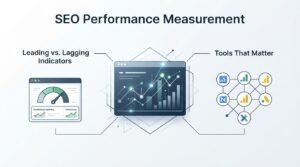
SEO performance is measured through a combination of leading indicators that predict future traffic and lagging indicators that confirm business impact. Tracking only rankings produces a distorted picture, because rankings move before revenue does and sometimes without it.
The reporting mistake I see most often is presenting ranking screenshots with no connection to pipeline. Executives do not fund keyword positions.
Leading vs. Lagging Indicators
This table separates the metrics that predict outcomes from those that confirm them.
| Indicator type | Metrics | What it tells you |
| Leading | Impressions, indexed pages, referring domains, average position | Whether the work is registering |
| Lagging | Organic sessions, qualified leads, pipeline, revenue | Whether the work is paying |
Leading indicators move first, typically within eight to sixteen weeks. Lagging indicators follow by a quarter or more.
Tools That Matter
Google Search Console is the only source of truth for how Google actually sees a site, covering impressions, clicks, indexation status, and query data. Everything else estimates.
I pair it with Google Analytics 4 for behaviour and conversion attribution, plus one third-party platform for competitive and backlink visibility. Adding more tools past that point adds noise rather than insight.
Common SEO Mistakes That Waste Budget
These are the failures I encounter most often in audits, each with the specific cost it creates.
- Publishing without keyword research: content that targets terms nobody searches
- Ignoring search intent: well-written pages competing in the wrong format
- Buying links at volume: short-term gains followed by manual action risk
- Rebuilding a site without migration planning: losing years of accumulated rankings
- Measuring rankings only: no line connecting SEO spend to revenue
- Abandoning at month four: stopping precisely before compounding begins
- Duplicating location pages: thin content across dozens of URLs
- Blocking staging environments incorrectly: either indexing test sites or blocking production
The most expensive of these is abandonment. Every month of SEO investment that stops before compounding starts is a month written off entirely.
Building an SEO Strategy That Sequences Correctly
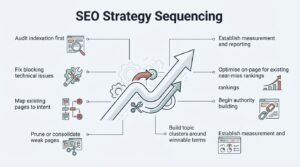
An effective SEO strategy sequences work by constraint, addressing whichever pillar currently caps performance before investing further in the others. Sequencing by constraint consistently outperforms working all three pillars evenly from day one.
Here is the sequence I use on new engagements.
- Audit indexation first: confirm Google can actually see the site
- Fix blocking technical issues: crawl errors, broken canonicals, render failures
- Map existing pages to intent: find mismatches before writing anything new
- Prune or consolidate weak pages: remove what dilutes the site
- Build topic clusters around winnable terms: depth over scattered coverage
- Optimise on-page for existing near-miss rankings: fastest available wins
- Begin authority building: only once there is content worth linking to
- Establish measurement and reporting: before results arrive, not after
Step seven is deliberately late. Acquiring links to thin content wastes the links and the effort that earned them.
Reassess quarterly rather than monthly. The constraint moves as the site improves, and strategy should move with it.
Conclusion
Technical SEO, content, and authority form an interlocking system where each pillar determines how much the others can deliver.
Sustainable organic growth comes from sequencing work by constraint, funding it consistently, and measuring against business outcomes rather than rankings alone.
We help businesses build exactly that foundation. Talk to White Label SEO Service about a strategy built for compounding returns.
Frequently Asked Questions
How long does SEO take to show results?
SEO typically takes four to twelve months to produce meaningful traffic. New domains and competitive industries sit at the longer end of that range.
Which SEO pillar should I fix first?
Fix technical SEO first, because unindexable pages cannot rank regardless of content quality. Content and authority investment only pays once access is confirmed.
Can I do SEO without technical knowledge?
Yes, for content and on-page work. Technical fixes like indexation control, rendering issues, and structured data usually require developer support.
How many backlinks do I need to rank?
There is no fixed number. Relevance and authority of linking domains matter far more than count, and requirements vary entirely by keyword competition.
Does content quality matter more than backlinks?
Neither outweighs the other universally. Content determines whether you can rank for a term, and authority determines how competitive that term can be.
How much should a business spend on SEO monthly?
Most US businesses invest $1,500 to $10,000 monthly. Consistent spending over eighteen months outperforms larger budgets sustained for only six.
What is the difference between SEO and paid search?
SEO earns organic placement through relevance and authority, compounding over time. Paid search buys placement instantly and stops the moment spending stops.