E-E-A-T is Google’s framework for evaluating Experience, Expertise, Authoritativeness, and Trustworthiness in content, and it shapes how search systems assess whether a page deserves to rank for queries where accuracy and credibility matter. I’ve watched this concept move from a niche SEO term into one of the most misunderstood parts of search strategy. Most site owners have heard the acronym but couldn’t tell you what each letter actually requires from their content.
Google’s algorithm doesn’t score pages with an “E-E-A-T number.” Instead, it looks for the same signals human quality raters are trained to spot, then rewards pages that carry them.
This guide covers what each E-E-A-T component means on its own, why YMYL topics face stricter scrutiny, how to build and strengthen each signal on your site, and how E-E-A-T connects to AI Overviews and long-term ranking stability. We’ll walk through the practical side, too: audits, common mistakes, and realistic timelines.
What Does E-E-A-T Stand For?
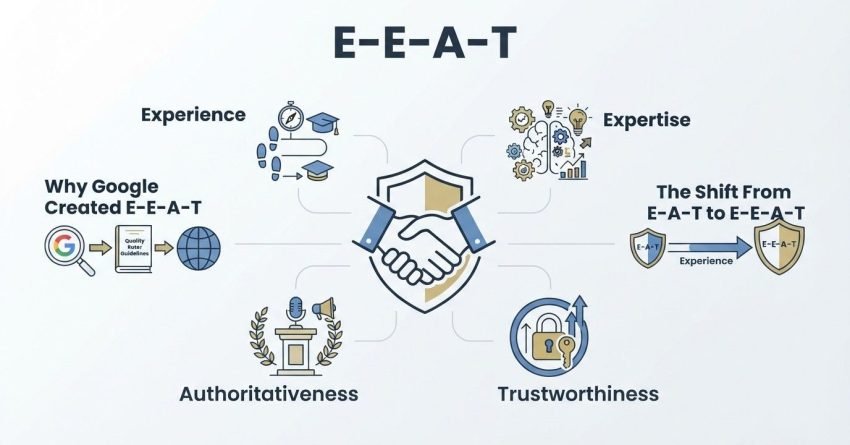
E-E-A-T stands for Experience, Expertise, Authoritativeness, and Trustworthiness, the four qualities Google’s Search Quality Rater Guidelines use to judge whether content and its creator are credible. I think of it less as a checklist and more as a lens the same lens a skeptical reader would use to size up whether they trust what they’re reading.
Each of the four components measures something distinct, but they reinforce each other constantly.
Experience
Experience refers to whether the content creator has first-hand or life experience with the topic they’re writing about. A product review written by someone who actually used the product carries more weight than one assembled from spec sheets alone.
Expertise
Expertise measures the knowledge or skill level of the content creator relative to the topic. This can come from formal credentials, but it doesn’t have to demonstrated, accurate knowledge counts too.
Authoritativeness
Authoritativeness reflects whether the creator or website is recognized as a go-to source on the topic by others in the field. Its reputation is measured externally, not self-declared.
Trustworthiness
Trustworthiness is the most heavily weighted of the four and reflects whether the content, the creator, and the website itself can be relied upon as accurate and safe. Google’s own guidelines treat trust as the foundation the other three sit on.
Why Google Created E-E-A-T
Google introduced the extra “E” for Experience in December 2022, expanding the original E-A-T framework that quality raters had used since 2014. I remember the immediate confusion in the SEO community; people assumed a new ranking signal had dropped overnight, when really Google had formalized something raters were already evaluating.
The Shift From E-A-T to E-E-A-T
The addition of Experience responded directly to a gap: expertise alone doesn’t guarantee a creator has actually done the thing they’re describing. A travel writer with a journalism degree but no first-hand visits lacks the experience layer entirely, even with strong expertise.
E-E-A-T’s Role in the Search Quality Rater Guidelines
The Search Quality Rater Guidelines run over 170 pages and instruct thousands of human raters on how to score search result quality using E-E-A-T as the central framework. Rater scores don’t directly change rankings, but they train and validate the systems that do.
Is E-E-A-T a Direct Ranking Factor?
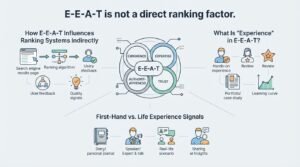
E-E-A-T is not a direct ranking factor in the way page speed or mobile-friendliness are, because Google has confirmed there’s no single algorithmic signal that scores a page’s E-E-A-T. I get asked about this constantly by clients who want a number to track, and the honest answer disappoints them at first.
How E-E-A-T Influences Ranking Systems Indirectly
Google’s ranking systems use proxy signals like backlink quality, content depth, author information, and site reputation that approximate what E-E-A-T represents. These proxies feed into hundreds of individual signals that combine to influence visibility.
What Is “Experience” in E-E-A-T?
Experience in E-E-A-T means the content creator has genuine, first-hand involvement with the subject rather than secondhand or purely researched knowledge. A recipe from someone who’s cooked the dish repeatedly reads differently than one scraped together from other sites.
First-Hand vs. Life Experience Signals
First-hand experience applies to using a product, visiting a place, or performing a task, while life experience can apply more broadly, such as someone managing a chronic illness writing about that condition, for example. Both count, but they show up differently in the content itself, usually through specific, concrete detail that’s hard to fake.
What Is “Expertise” in E-E-A-T?
Expertise in E-E-A-T describes the depth of knowledge or skill a content creator brings to their subject, whether earned through formal training or years of hands-on practice. Google’s guidelines explicitly allow for “everyday expertise” on topics that don’t require professional credentials.
Formal Credentials vs. Demonstrated Knowledge
Medical and financial content typically demands formal expertise from a licensed doctor or certified financial planner because the stakes of bad advice are high. Lower-stakes topics, like hobby content or personal essays, can establish expertise through accuracy, depth, and consistency instead.
What Is “Authoritativeness” in E-E-A-T?
Authoritativeness in E-E-A-T reflects how well-known and recognized a creator or site is as a reliable source within its specific field. It’s judged externally by other sites, by mentions, and by reputation rather than by anything a site claims about itself.
How Authority Is Earned Online
Authority builds slowly through consistent, accurate publishing, citations from other reputable sites, and recognition within an industry or community. A Moz study on ranking correlations found that link-based authority metrics still track closely with search visibility across competitive niches.
What Is “Trustworthiness” in E-E-A-T?
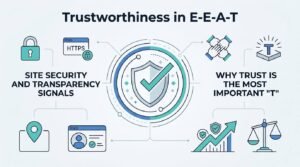
Trustworthiness in E-E-A-T measures whether a page, its creator, and the underlying website can be relied upon for accurate, safe, and honest information. Google’s guidelines state that trust is the most important member of the E-E-A-T family because an untrustworthy page undermines any experience, expertise, or authority behind it.
Site Security and Transparency Signals
Basic trust signals include HTTPS encryption, clear contact information, accurate business details, and transparent sourcing for claims. Sites that hide who’s behind them or obscure their business identity struggle to earn trust regardless of content quality.
Why Trust Is the Most Important “T”
A page can demonstrate strong experience and expertise yet still fail on trust if it spreads inaccurate information or hides commercial intent. That’s why trust sits at the center of the model rather than as an equal fourth component.
Why YMYL (Your Money or Your Life) Topics Face Stricter E-E-A-T Scrutiny
YMYL stands for “Your Money or Your Life” and refers to topics where inaccurate information could cause real harm to a person’s health, finances, safety, or well-being. I always tell clients in finance, health, or legal niches to expect a higher bar here, because Google’s raters are trained to apply extra scrutiny to these categories specifically.
Examples of YMYL Content Categories
Medical advice, financial planning guidance, legal information, and news covering civic or safety issues all fall under YMYL. Content in these categories without visible author credentials or credible sourcing tends to underperform, even when the writing quality is otherwise strong.
How to Improve Experience Signals on Your Site
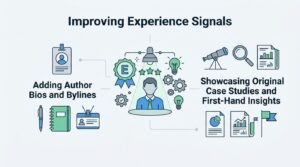
Improving experience signals starts with showing, not just telling, that the people behind your content have actually done what they’re writing about. This is one of the more overlooked areas of on-page SEO, and it’s often the cheapest to fix.
Adding Author Bios and Bylines
A visible author bio with relevant background, credentials, and a link to more of their work gives both readers and Google a clear signal of who created the content. Anonymous or generic “admin” bylines do the opposite, especially on YMYL content.
Showcasing Original Case Studies and First-Hand Insights
Original photos, screenshots, data, or documented processes demonstrate direct experience in a way generic stock content can’t replicate. I’ve seen conversion and dwell-time metrics improve simply from swapping stock imagery for real, first-party screenshots.
How to Improve Expertise Signals on Your Site
Improving expertise signals means demonstrating consistent, accurate depth on a subject rather than surface-level coverage. This typically requires structural changes to how content gets planned and produced, not just individual page edits.
Building Topical Depth Through Content Clusters
Content clusters organize a broad topic into a pillar page supported by multiple in-depth articles covering specific subtopics in detail. This structure signals comprehensive subject coverage rather than a single isolated post trying to cover everything shallowly.
Citing Credentials and Subject-Matter Contributors
Bringing in a subject-matter expert to review or co-author content, and stating their credentials clearly, adds a layer of expertise that general staff writers often can’t provide alone. This matters most in specialized or YMYL niches where credentials carry real weight.
How to Build Authoritativeness Through Off-Site Signals
Building authoritativeness happens largely outside your own website, through recognition and validation from other credible sources in your industry. It’s the slowest E-E-A-T component to build because it depends on other parties, not just your own output.
The Role of Backlinks and Digital PR
Earning backlinks from respected industry publications, being quoted in press coverage, and getting cited by other experts all reinforce authoritativeness signals externally. Digital PR campaigns built around original research or data tend to earn this kind of coverage more reliably than generic outreach.
How to Strengthen Trust Signals Technically and Editorially

Strengthening trust signals combines technical site hygiene with editorial transparency about who’s publishing and why. Both layers need attention, because a technically secure site with vague or misleading content still fails the trust test.
HTTPS, Privacy Policies, and Accurate Contact Information
Basic technical trust markers include HTTPS across the entire site, a clear privacy policy, visible contact details, and accurate business registration information where applicable. These are table stakes rather than differentiators, but their absence actively damages trust.
How Google’s Quality Raters Evaluate E-E-A-T
Google’s quality raters evaluate E-E-A-T by reviewing pages against detailed guidelines and assigning quality ratings that help validate and train Google’s automated ranking systems. These raters don’t directly control any individual page’s ranking, but their aggregated feedback shapes how the algorithm gets tuned over time.
What the Search Quality Rater Guidelines Actually Measure
Raters assess the purpose of a page, the expertise of its creator, the reputation of the website, and the overall quality of the main content itself. Pages created primarily to manipulate rankings rather than serve users receive the lowest quality ratings in this framework.
How to Audit Your Website’s Current E-E-A-T Level
Auditing your site’s E-E-A-T level means systematically reviewing content, authorship, and trust signals against the same criteria Google’s raters use. I run this as a standing exercise every quarter for ongoing clients rather than a one-time project.
Key Questions to Ask During an E-E-A-T Content Audit
Does each piece of content have a named, credentialed author? Is there evidence of first-hand experience or original research? Are sources cited accurately, and is the site’s ownership and contact information transparent? Answering these honestly across a site usually reveals the biggest gaps fast.
Common E-E-A-T Mistakes That Hurt Rankings
Common E-E-A-T mistakes include publishing anonymous content, relying on thin AI-generated pages with no human review, and leaving outdated information live on high-traffic pages. I see these mistakes most often on sites that scaled content production faster than their editorial oversight.
Thin Content, Anonymous Authorship, and Outdated Pages
Thin content lacks the depth needed to demonstrate real expertise, anonymous authorship removes the human accountability raters look for, and outdated pages signal neglect on topics that change over time. Fixing all three usually requires an editorial calendar built around regular content reviews, not just new publishing.
How E-E-A-T Connects to AI Overviews and AI Search
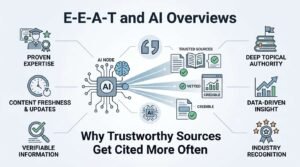
E-E-A-T connects to AI Overviews because generative search systems favor citing sources that demonstrate clear credibility, accurate sourcing, and established authority on a topic. A Princeton and Georgia Tech study on generative engine optimization found that citing credible sources and adding statistics measurably increased a source’s visibility in AI-generated answers.
Why Trustworthy Sources Get Cited More Often
AI systems pull from sources that already rank well and carry strong trust signals, which means the same E-E-A-T fundamentals that help traditional rankings also help AI citation rates. Sites with vague authorship or weak sourcing rarely get selected as citations, regardless of how well-written the content reads.
How Long Does It Take to See E-E-A-T Improvements Reflect in Rankings?
E-E-A-T improvements typically take three to six months to show measurable ranking movement, since authority-building signals like backlinks and reputation accumulate gradually rather than updating instantly. I set this expectation with every client upfront because impatience here leads to abandoning strategies right before they start working.
Realistic Timelines for Authority Building
Technical trust fixes like HTTPS or author bios can show impact within weeks, while authoritativeness gains from backlinks and industry recognition often take two quarters or more to compound. Content depth and expertise signals tend to land somewhere in between, improving steadily as topical clusters mature.
Conclusion
E-E-A-T ties together experience, expertise, authority, and trust into one framework search systems use to judge credibility. Understanding each component separately makes it far easier to fix specific gaps.
This isn’t a one-time fix; it’s an ongoing practice that compounds alongside your broader content and authority-building strategy. Stronger E-E-A-T signals support more resilient rankings over time.
We help businesses build these signals systematically through content, technical fixes, and authority building. Reach out to White Label SEO Service to strengthen your site’s E-E-A-T today.
Frequently Asked Questions
Is E-E-A-T an official Google ranking factor?
E-E-A-T is not an official, direct ranking factor. Google uses it as a conceptual framework that informs the proxy signals its algorithms actually measure.
What is the most important letter in E-E-A-T?
Trustworthiness is the most important component, according to Google’s own quality rater guidelines. The other three qualities support trust but can’t compensate for its absence.
Can a small business realistically build strong E-E-A-T?
Yes, small businesses can build strong E-E-A-T through transparent authorship, accurate niche content, and genuine customer proof. Scale matters less than consistency and honesty in execution.
Does E-E-A-T apply to every type of website?
E-E-A-T applies to every website, but scrutiny varies by topic sensitivity. YMYL sites face far stricter evaluation than low-stakes hobby or entertainment content.
How often should E-E-A-T signals be updated?
E-E-A-T signals should be reviewed quarterly, especially author bios, statistics, and outdated claims. Regular updates prevent content from signaling neglect over time.
Do author bios really impact SEO performance?
Author bios do impact SEO performance, particularly on YMYL content where credentials matter most. They provide concrete experience and expertise signals that raters and algorithms both look for.
What’s the fastest way to start improving E-E-A-T?
The fastest starting point is adding real author bios and fixing basic trust signals like HTTPS and contact information. These changes require no new content production and can be completed within days.