Topical authority is the degree to which a website is recognized by search engines as a comprehensive, trustworthy source on a specific subject. I think of it as the difference between a site that ranks for one lucky keyword and a site Google trusts to answer an entire category of questions. It matters because search engines increasingly reward depth over isolated keyword wins.
Businesses that ignore this concept end up chasing individual rankings instead of building lasting visibility. We’ve watched clients plateau for years chasing single keywords. Understanding topical authority changes that trajectory entirely.
This guide covers what topical authority actually means and how search engines evaluate it; the core components and architecture that build it, including pillar-cluster models and internal linking; the research and content strategies that support it; and the technical foundations, link building, timelines, and measurement systems that keep it growing.
What Is Topical Authority in SEO?
Topical authority is a ranking signal that reflects how thoroughly a website covers a given subject area compared to other sites competing for the same topic. I look at it as earned trust, not something you can claim in an about page. Google infers it from patterns across dozens or hundreds of pages, not a single declaration.
This differs from generic authority scores that vendors sell as one-size-fits-all metrics. A site can have a low overall authority score and still dominate a narrow topic if its coverage is deep and internally consistent.
Topical Authority vs. Domain Authority
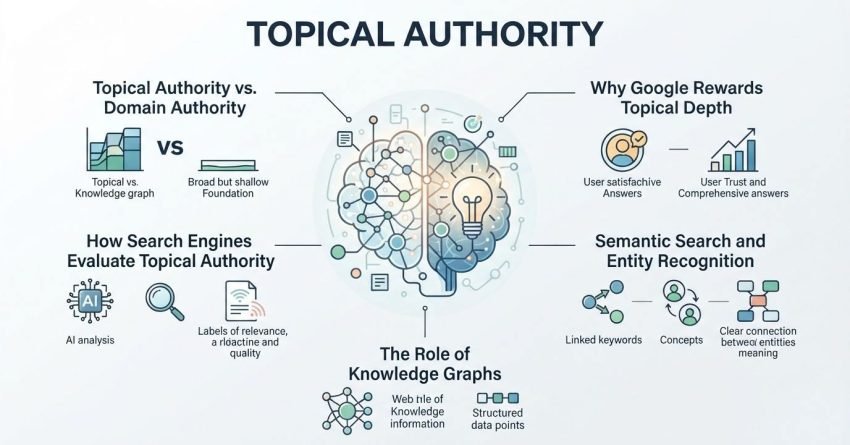
Domain authority is a third-party metric estimating a site’s overall link strength, while topical authority is Google’s own internal read on subject-matter depth. I’ve seen sites with modest domain authority scores outrank far bigger competitors simply because they went deeper on one topic. The two measures answer completely different questions.
Why Google Rewards Topical Depth
Search engines reward depth because it correlates with user satisfaction across an entire query space, not just one search. A Google Search Central helpful content update explicitly reinforced this by favoring sites that demonstrate consistent expertise across a topic. I read that update as a formal confirmation of something practitioners had already noticed for years.
How Search Engines Evaluate Topical Authority
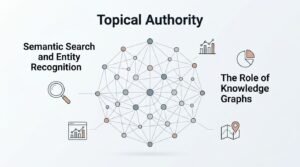
Search engines evaluate topical authority by analyzing entity relationships, semantic coverage, and content consistency across a site’s full set of pages on a subject. This isn’t a single algorithm factor. It’s an emergent pattern built from many smaller signals working together.
Semantic Search and Entity Recognition
Semantic search identifies the entities and concepts inside content rather than just matching exact keyword strings. Search engines connect “SEO,” “search visibility,” and “organic traffic” as related entities within the same topic space. I write with this in mind constantly, because keyword-only thinking misses how modern retrieval actually works.
The Role of Knowledge Graphs
A knowledge graph is a structured database that maps entities and the relationships between them, which search engines reference to understand how concepts connect. Google’s own knowledge graph draws on structured data, Wikipedia-style sourcing, and crawled content patterns. I make sure our clients’ sites use schema markup so their entities get parsed correctly into that structure.
The Core Components of Topical Authority
The core components of topical authority are content depth and coverage, site architecture, and demonstrated E-E-A-T signals working together across a domain. Miss any one of these three, and the others can’t compensate fully.
Content Depth and Coverage
Content depth means addressing a subject from multiple angles: definitions, comparisons, processes, and edge cases a reader might hit. We map every subtopic a real searcher would need before green-lighting a content calendar. Coverage gaps are usually where competitors sneak past us in rankings.
Site Architecture and Internal Linking
Site architecture is the structural organization of pages that tells search engines how topics relate to one another. A flat structure with no hierarchy signals scattered coverage even when the content itself is strong. I always audit architecture before touching a single piece of copy.
E-E-A-T Signals
E-E-A-T stands for Experience, Expertise, Authoritativeness, and Trustworthiness, a framework Google’s Search Quality Rater Guidelines use to assess content quality. Author bios, cited sources, and factual accuracy all feed into this. I treat E-E-A-T as a checklist item on every published page, not an afterthought.
Topic Clusters and Pillar-Cluster Architecture
Pillar-cluster architecture is a content structure where one comprehensive hub page links to multiple in-depth articles covering related subtopics. This is the single most practical framework I’ve used to organize topical authority work for clients.
Pillar Pages vs. Cluster Content
A pillar page introduces a broad topic at orientation depth and directs readers toward deeper resources, while cluster content fully exhausts one narrow subtopic. This guide you’re reading right now is functioning as a pillar page. Every H2 here could become its own dedicated cluster article given enough search demand.
Mapping a Content Silo
A content silo is a grouped set of pages: one pillar plus its clusters that all reinforce the same core topic through internal links. Mapping a silo before writing anything prevents the scattered, disconnected content structure that undermines most SEO efforts. I sketch this map on a whiteboard before a single article gets drafted.
How to Conduct a Topical Gap Analysis
A topical gap analysis identifies the subtopics, questions, and entities your competitors cover that your own site is missing. I run this exercise quarterly for active clients because competitor content shifts constantly.
Tools for Identifying Content Gaps
Content gap tools compare your indexed pages against top-ranking competitors and surface the topics you haven’t addressed. Platforms like Ahrefs’ Content Gap tool pull this comparison directly from ranking data. I pair automated tools with manual SERP reading, since automated gap reports miss nuance in search intent.
Keyword Research for Topical Authority
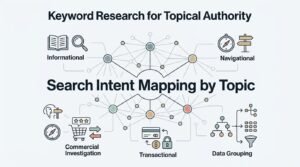
Keyword research for topical authority means grouping keywords by shared search intent and entity relationships rather than treating each term as an isolated target. This is a fundamentally different exercise than traditional single-keyword research.
Search Intent Mapping by Topic
Search intent mapping groups every keyword variation under the specific question or need it represents, then assigns each group to one page. Getting this wrong causes keyword cannibalization, where two pages compete against each other in the same search results. I map intent before I map keywords, because intent decides page structure.
Content Creation Strategy for Building Authority
A content creation strategy built for topical authority prioritizes comprehensive coverage of a subject area over publishing volume alone. Businesses often ask us how many articles they need. The honest answer depends entirely on how competitive and broad the topic is.
Content Depth vs. Content Volume
Depth refers to how thoroughly one page answers its specific query, while volume refers to the raw number of pages published. A site with 30 deep, well-researched pages regularly outranks one with 300 thin pages. I’d rather ship fewer pieces that fully answer a question than flood a site with filler.
Updating and Consolidating Existing Content
Content consolidation merges multiple thin or overlapping pages into one stronger, more comprehensive resource. Old blog posts scattered across years often duplicate intent without either page ranking well. We run consolidation audits on every existing client site before adding anything new.
Internal Linking Strategy for Topical Authority
An internal linking strategy for topical authority connects pillar pages to cluster content in a deliberate hub-and-spoke pattern that signals topic relationships to search engines. Random internal linking based on whatever feels convenient wastes this signal entirely.
Hub-and-Spoke Linking Models
A hub-and-spoke model links a central pillar page out to every related cluster page, and each cluster page links back to the pillar. This creates a closed loop that search engines can crawl and interpret as a defined topic boundary. I check this loop specifically during every technical audit.
On-Page and Technical SEO Foundations
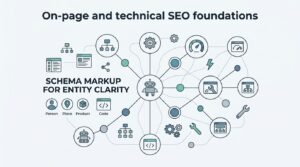
On-page and technical SEO foundations ensure that content demonstrating topical depth is actually crawlable, indexable, and correctly understood by search engines. None of the content strategy above matters if the technical layer is broken underneath it.
Schema Markup for Entity Clarity
Schema markup is structured code added to a page that explicitly tells search engines what entities and relationships the content describes. Article and FAQ schema types documented by Schema.org help search engines parse entity data more precisely than plain text alone. I add schema to every pillar and cluster page we publish.
Building Authority Through Backlinks and Digital PR
Backlinks and digital PR build topical authority when the linking sites are themselves relevant to the same subject area, not simply high in raw authority. A link from an unrelated high-authority site carries far less topical weight than one from a smaller, subject-relevant publication.
Relevance-Based Link Building
Relevance-based link building targets sites already publishing content on the same or adjacent topics rather than chasing generic high-metric domains. I prioritize outreach lists by topical overlap first and domain metrics second. This approach consistently produces links that move rankings, not just vanity numbers.
How Long Does It Take to Build Topical Authority?
Building measurable topical authority typically takes four to twelve months, depending on competition level, site history, and publishing consistency. Newer domains sit at the longer end of that range regardless of content quality.
Timeline Benchmarks by Industry
Competitive industries like finance and legal often take nine to eighteen months to show topical authority gains, while niche B2B topics can show movement in three to six months. An Ahrefs study of over 2 million keywords found that only 5.7% of pages reach the top 10 within a year of publishing. I set client expectations against benchmarks like this from day one.
Measuring and Tracking Topical Authority
Measuring topical authority means tracking rankings, organic traffic, and visibility across an entire topic cluster rather than watching individual keyword positions. Single-keyword tracking gives an incomplete and often misleading picture.
Key Metrics and Tools
Key metrics include share of voice across a keyword cluster, total organic pages ranking on page one, and branded search volume growth over time. Tools like Google Search Console’s performance reports let you filter by page groups to see cluster-level trends. I build a custom dashboard for every client tracking exactly this.
Common Mistakes That Undermine Topical Authority
The most common mistake that undermines topical authority is publishing isolated content without connecting it to a broader topic structure through internal links. Businesses often produce genuinely good content that never accumulates authority because nothing ties it together.
Thin, duplicate, or outdated pages left unaddressed also dilute a site’s overall topic signal. I regularly find clients sitting on strong content assets that are simply disconnected from any larger structure.
Topical Authority and AI Search (SGE/AI Overviews)
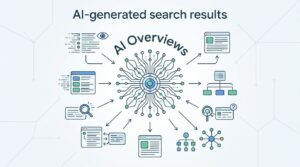
AI-generated search results pull from sites that demonstrate the clearest, most structured topical coverage, making topical authority more valuable than ever for AI visibility. AI Overviews tend to cite pages with clean definitions and well-organized subtopic coverage.
I’ve noticed AI Overviews frequently lift sentences from pillar-style pages that answer a question in the first sentence. Structuring content this way isn’t optional anymore if AI citation matters to a business.
Conclusion
Topical authority connects content depth, site architecture, and technical execution into one system search engines trust. It extends beyond any single page into an entire cluster of interlinked, evolving resources.
We build that system for clients daily, from research through measurement. Partner with White Label SEO Service to build topical authority that compounds instead of plateaus.
Frequently Asked Questions
What is topical authority in SEO?
Topical authority is how thoroughly search engines trust a site to be a comprehensive source on a subject. It’s built through depth, structure, and consistent coverage, not a single ranking factor.
How long does it take to build topical authority?
Most sites see measurable topical authority gains within four to twelve months. The Timeline depends on competition, domain history, and how consistently new content gets published.
What is the difference between topical authority and domain authority?
Domain authority is a third-party link-strength metric, while topical authority reflects Google’s internal assessment of subject-matter depth. A site can rank strongly on one topic without a high domain authority score.
How many articles do I need to build topical authority?
There’s no fixed number since it depends on topic breadth and competition level. Coverage completeness matters more than hitting any specific article count.
Do I need a content silo to rank well?
A content silo isn’t strictly required, but it significantly speeds up topical authority gains. Organized pillar-cluster structures make it easier for search engines to interpret topic relationships.
Can small websites build topical authority?
Small websites can build strong topical authority by focusing on a narrow niche rather than competing broadly. Deep coverage of a specific subject often beats shallow coverage of many topics.
How do I measure topical authority?
Topical authority is measured by tracking rankings and traffic across an entire keyword cluster, not individual terms. Tools like Google Search Console reveal these cluster-level patterns clearly.