Domain Authority is a third-party metric developed by Moz that predicts how well an entire website will rank on search engines, scored from 1 to 100 based on linking root domains and overall link profile strength. Page Authority measures that same ranking potential but for a single page rather than a whole domain. I get asked which one matters more almost every week, and the honest answer depends entirely on what you’re trying to rank.
Business owners waste budget chasing the wrong metric constantly. Misreading DA versus PA leads to misallocated link building spend and unrealistic timeline expectations for clients.
This guide covers what each metric actually measures and how they’re calculated, the real differences between domain-level and page-level authority, when each one matters more for your strategy, and practical steps for checking and improving both scores.
What Is Domain Authority (DA)?
Domain Authority is a search engine ranking score developed by Moz that predicts how likely an entire website is to rank in search results, based on the strength and quantity of its backlink profile. I think of DA as a comparative benchmark rather than a ranking factor Google actually uses.
Moz built this metric to give SEOs a way to compare websites against each other on a consistent 1–100 logarithmic scale. A jump from 20 to 30 is much easier to achieve than a jump from 70 to 80, and that’s by design.
Who Created Domain Authority and Why
Moz introduced Domain Authority in 2010 to fill a gap left by Google’s own deprecated PageRank toolbar. Marketers needed some way to compare the relative link strength of competing domains, and DA became the industry shorthand for that comparison.
I still use it as a quick gut-check on a domain’s overall backlink health. It’s never a substitute for actual ranking data pulled from Google Search Console.
How Domain Authority Is Calculated
Domain Authority draws on dozens of factors, but linking root domains and total link profile strength carry the most weight. Moz’s own documentation confirms the score is generated through a machine-learning model trained against actual Google SERPs.
The exact formula changes as Moz retrains the model, which is why DA scores can shift even when a site’s backlink profile hasn’t changed. That volatility surprises a lot of clients I work with.
What Is Page Authority (PA)?
Page Authority is a Moz metric that predicts how well a specific page will rank in search results, scored on the same 1–100 scale as Domain Authority but calculated using page-level signals instead of domain-wide ones. I lean on PA when I want to know if one specific page can compete for a specific keyword, independent of how strong the rest of the site is.
A page on a low-DA site can still carry a respectable PA if it has earned strong, relevant backlinks directly to that URL. This is exactly why niche blogs sometimes outrank massive corporate domains for a single query.
How Page Authority Differs From DA in Calculation
Page Authority calculation factors in the number and quality of backlinks pointing directly at that one URL, along with on-page link equity distributed through internal linking. Domain-wide signals still contribute some weight, but the page’s own link profile dominates the score.
I’ve seen individual blog posts hit a PA of 40+ on a domain sitting at DA 25. That gap tells me the page earned its own authority independent of the site around it.
Domain Authority vs Page Authority: Core Differences
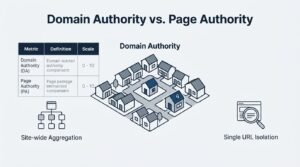
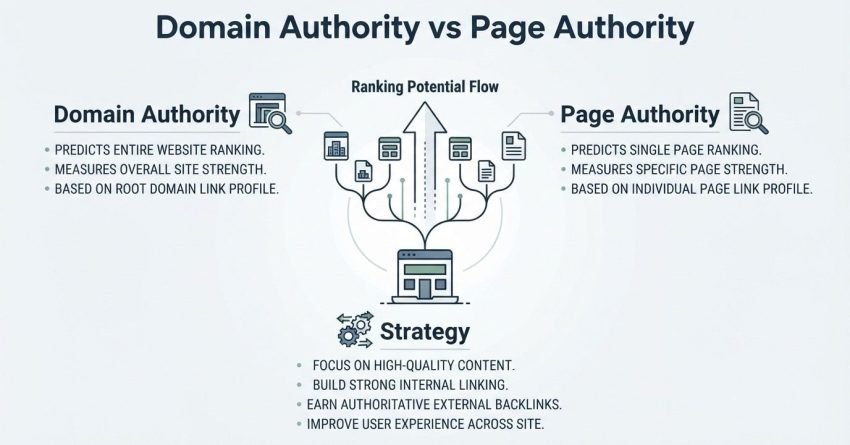
Domain Authority measures the ranking strength of an entire website, while Page Authority measures the ranking strength of one individual page on that website. The distinction matters because a site can have excellent domain-wide authority while individual pages still underperform, and vice versa.
I explain this to clients using a neighborhood analogy. DA is the reputation of the whole neighborhood; PA is the condition of one specific house within it.
Scope of Measurement (Site-Wide vs Page-Level)
Domain Authority aggregates link signals across every page, subdomain, and piece of content a website has ever published. Page Authority isolates just one URL and asks how competitive that single page is on its own merits.
This is why a homepage often carries a different PA than a deep blog post, even though both share the same DA. Scope, not quality, drives the divide.
Comparison Table: DA vs PA at a Glance
The table below shows how Domain Authority and Page Authority differ across the metrics that matter most for SEO strategy.
| Factor | Domain Authority | Page Authority |
| Scope | Entire website | Single page |
| Created by | Moz | Moz |
| Scale | 1–100 (logarithmic) | 1–100 (logarithmic) |
| Primary input | Linking root domains | Page-level backlinks |
| Best use case | Comparing overall site strength | Comparing single-page ranking potential |
| Google ranking factor | No | No |
How Domain Authority Is Calculated
Domain Authority is generated through a machine-learning algorithm that weighs dozens of link-based signals, with the total number of linking root domains acting as the single strongest predictor. The model gets retrained periodically against live Google search results to keep its predictions accurate.
Linking Root Domains
Linking root domains counts the number of unique websites linking to a domain, rather than the raw number of individual backlinks. Ten links from ten different domains carry far more weight than fifty links from one single referring site.
MozRank and Link Profile Signals
MozRank scores the quality of a site’s link profile on a logarithmic scale, feeding directly into the broader Domain Authority calculation. Sites earning links from already-authoritative domains see their MozRank, and by extension their DA, climb faster than sites earning the same volume of links from weak domains.
How Page Authority Is Calculated
Page Authority calculation weighs the quantity and quality of backlinks pointing at a specific URL, combined with internal link equity flowing to that page from the rest of the site. A single high-authority external link to a page can move its PA more than dozens of internal links alone.
On-Page Signals That Influence PA
Internal linking structure distributes authority from stronger pages to weaker ones across a site, directly influencing individual Page Authority scores. A page linked prominently from the homepage typically carries higher PA than an orphaned page buried deep in a site’s architecture.
Is Domain Authority a Google Ranking Factor?
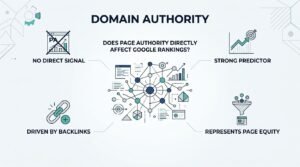
Domain Authority is not a ranking factor Google uses in its algorithm, and Google has confirmed this directly on multiple occasions. Moz built DA as a third-party predictive tool, not as a metric that search engines themselves reference when ranking pages.
Google’s own search advocates have repeatedly stated that third-party authority scores play no role in actual ranking decisions. I treat DA purely as a competitive benchmarking tool, never as a direct lever I’m pulling to affect rankings.
Does Page Authority Directly Affect Google Rankings?
Page Authority also has no direct role in Google’s ranking algorithm, since it’s a Moz-created predictive metric rather than a Google-native signal. What actually drives rankings are the underlying factors PA attempts to approximate, like backlink quality and relevance.
I still find PA useful as a proxy signal when auditing which pages on a site are undervalued relative to their actual backlink strength.
Domain Authority vs Domain Rating vs Trust Flow (Third-Party Metrics Compared)
Domain Rating is Ahrefs’ equivalent metric to Moz’s Domain Authority, while Trust Flow is Majestic’s link-quality metric weighted toward trustworthy sources rather than raw link volume. All three metrics attempt to solve the same problem using different underlying data sets and formulas, which is why the same website can show a DA of 35, a DR of 52, and a Trust Flow of 20 simultaneously.
I never compare these scores across tools directly. Each platform crawls a different slice of the web, so the numbers simply aren’t calibrated the same way.
When Domain Authority Matters More

Domain Authority carries more weight for new websites and businesses entering highly competitive niches where overall site credibility needs to be established first. A brand-new site publishing its first few pages benefits more from building domain-wide trust than optimizing any single page in isolation.
New Websites and Competitive Niches
New websites in competitive verticals like finance or health typically need broad domain authority before any individual page has a realistic shot at ranking. I prioritize earning diverse, high-quality root domain links early in these situations rather than chasing page-specific wins.
When Page Authority Matters More
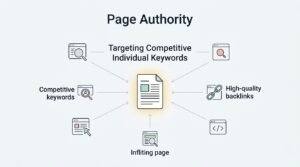
Page Authority becomes the more important metric when a specific page is competing for a specific, well-defined keyword against pages from other established domains. In this scenario, the page’s own link equity and relevance often outweigh whatever the site’s overall domain authority happens to be.
Targeting Competitive Individual Keywords
Targeting a competitive individual keyword usually means the winning page earned direct, topically relevant backlinks rather than relying purely on domain-wide strength. I’ve watched a single well-linked article from a mid-authority site outrank pages from much bigger domains because that one page’s authority was simply stronger.
How to Check Your Domain Authority and Page Authority
Checking Domain Authority and Page Authority requires a Moz account or a third-party SEO tool that pulls directly from Moz’s Link Explorer index. Both scores update on a rolling basis as Moz recrawls the web and retrains its predictive model.
Free and Paid Tools for Checking DA/PA
Moz’s free Link Explorer tool provides basic DA and PA lookups, while paid platforms like Moz Pro, Ahrefs, and SEMrush offer deeper backlink breakdowns alongside the score itself. I recommend checking these scores monthly rather than obsessing over daily fluctuations, since the underlying model doesn’t recalculate that frequently.
How to Improve Domain Authority
Improving Domain Authority requires earning backlinks from a growing number of unique, relevant root domains while maintaining strong technical site health across the board. This is a long-term effort measured in months, not days, since DA reflects accumulated link equity across an entire site.
Site-Wide Link Building and Technical Health
Site-wide link building focused on earning coverage from diverse, authoritative domains does more for DA than any single high-volume outreach campaign. Technical issues like broken links, orphaned pages, and slow site speed can quietly suppress DA growth even when link building is going well.
How to Improve Page Authority
Improving Page Authority means earning direct backlinks to a specific URL while strengthening the internal linking pointing toward that same page from elsewhere on the site. A page’s own content quality and relevance also influence how effectively it converts earned links into authority.
Internal Linking and On-Page Optimization
Internal linking from high-authority pages toward a target page passes measurable link equity that can lift that page’s individual PA over time. Pairing this with solid on-page optimization, like clear headings and relevant content depth, gives earned backlinks more to work with.
Common Misconceptions About DA and PA
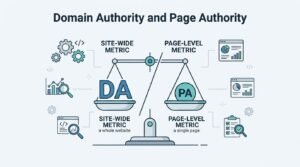
The most common misconception about Domain Authority and Page Authority is that Google uses them directly in its ranking algorithm, which Google has explicitly denied. Another widespread myth is that a higher DA guarantees better rankings across every page on a site, when in reality individual page-level factors still decide most ranking outcomes.
I also hear that DA and PA scores are interchangeable across different SEO tools, which isn’t accurate since Ahrefs, SEMrush, and Moz each calculate their own versions differently.
Domain Authority and Page Authority in a Modern SEO Strategy
Domain Authority and Page Authority work best as diagnostic tools within a broader SEO strategy rather than as standalone goals to optimize directly. I use both metrics to benchmark competitive positioning and identify which pages are underperforming relative to their link profile, then build strategy around the actual ranking factors those scores approximate.
A modern approach treats DA and PA as compass points, not destinations. Real strategy still centers on technical health, content relevance, and earning links that a genuine audience would click on its own.
Neither score should dictate content or link building decisions in isolation. I pair DA and PA readings with actual keyword rankings and organic traffic data before making any strategic call, since a rising authority score with flat traffic usually signals a deeper technical or relevance problem elsewhere on the site.
Conclusion
Domain Authority and Page Authority measure different things: one reflects site-wide strength, the other reflects a single page’s ranking potential. Neither is a Google ranking factor directly.
We see both metrics as diagnostic tools, not strategy goals. Real growth comes from technical health, relevant content, and earned links working together.
Ready to build authority the right way? White Label SEO Service helps you translate these metrics into a strategy that actually drives rankings and revenue.
Frequently Asked Questions
Is a higher Domain Authority always better for rankings?
A higher Domain Authority does not guarantee better rankings, since DA is not a factor Google’s algorithm actually uses. Page-level relevance and backlink quality often matter more for any single ranking.
Can a page rank well with low Page Authority?
Yes, a page can rank well with low Page Authority if it satisfies search intent better than competing pages. PA is only a predictive estimate, not a ranking requirement Google checks directly.
How often does Domain Authority update?
Domain Authority updates on a rolling basis as Moz recrawls the web and retrains its predictive model. Scores can shift even without any changes to a site’s own backlink profile.
What is a good Domain Authority score?
A good Domain Authority score is relative to a site’s specific competitors rather than a fixed universal number. Comparing DA only makes sense against similar sites in the same niche and age range.
Does Domain Authority mean the same thing across all SEO tools?
No, Domain Authority is specific to Moz and isn’t directly comparable to Ahrefs’ Domain Rating or Majestic’s Trust Flow. Each tool uses its own data set and calculation method.
Can I increase Domain Authority quickly?
Domain Authority typically takes months to shift meaningfully, since it reflects accumulated link equity across an entire site. Sudden increases are rare and usually signal a major, sustained link building effort.
Should I prioritize DA or PA when building links?
Prioritize whichever metric matches your goal: DA for overall site credibility, PA for ranking a specific page against specific competitors. Most strategies benefit from working on both simultaneously.