A guaranteed SEO ranking is a promise that a website will reach a specific position in Google’s organic results by a specific date, and no agency can honestly make it, because search rankings are decided by Google’s algorithm rather than by any vendor’s work. Every agency controls its own inputs. None controls the outcome.
That gap between input and outcome is where most SEO disputes, wasted budgets, and penalised websites begin. Understanding it protects your money and your domain.
This guide covers what the guarantee claim actually means, which ranking factors an agency can and cannot influence, why volatility and competitor behaviour break fixed promises, the contractual tricks that make guarantees look real, what legitimate commitments and timelines look like instead, and how to hold an agency accountable using metrics that reflect revenue rather than vanity positions.
What a Guaranteed SEO Ranking Actually Means
A guaranteed SEO ranking is a contractual promise that a named page will occupy a named position for a named keyword within a named timeframe. That is the full claim, and every word in it matters, because agencies routinely weaken one word while keeping the rest intact.
I’ve read a lot of these agreements. The promise almost never survives contact with the definitions section.
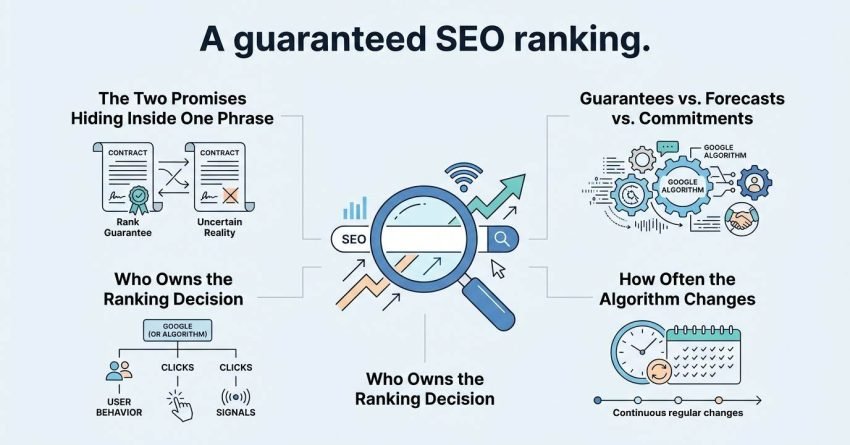
The Two Promises Hiding Inside One Phrase
Most guarantee offers bundle two separate claims together. The first is a performance claim about where you will rank. The second is a financial claim about what happens if you don’t, usually a refund or extended service.
Buyers hear the performance claim. Lawyers write the financial one. When I compare what a client believed they bought against what the contract obligates, the two rarely match.
Guarantees vs. Forecasts vs. Commitments
A guarantee promises an outcome the vendor does not control. A forecast projects a probable outcome based on data and states its assumptions. A commitment binds the vendor to work they do control, such as audits delivered, pages published, or issues fixed.
Only the second and third are defensible. We build every agreement on forecasts and commitments, and I explain why in the sections on SEO forecasting models and the process commitments a legitimate agency signs up for.
Why No Agency Controls Google’s Algorithm
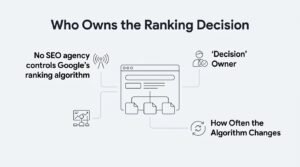
No SEO agency controls Google’s ranking algorithm, because the ranking decision is made inside Google’s systems using signals, weightings, and machine learning models that no external party can access or override. An agency supplies inputs. Google decides what those inputs are worth.
Who Owns the Ranking Decision
Google’s algorithm is a ranking system that evaluates pages against a query using hundreds of signals and then orders results for each individual search. The system runs on Google’s infrastructure, and its weightings are proprietary and undisclosed.
That single fact ends the guarantee argument. You cannot promise a decision made by someone else’s software.
How Often the Algorithm Changes
Google confirms it makes thousands of ranking changes per year, including several broad core updates that measurably reshuffle results across entire industries. A ranking that holds in March is not the same ranking in September.
Anyone guaranteeing a twelve-month position is guaranteeing something that will be re-decided dozens of times before the deadline arrives.
Google’s Own Position on Ranking Guarantees
Google states plainly that no one can guarantee a number one ranking. Google’s official SEO starter documentation warns businesses to be wary of any SEO that claims to guarantee rankings or claims a special relationship with Google.
There is no partner tier, reseller status, or ad spend level that buys placement in organic results. Google Ads is a separate auction and does not influence organic position.
So when an agency implies privileged access, they are either misinformed or misrepresenting. Both are reasons to walk.
The Ranking Factors an Agency Can Influence
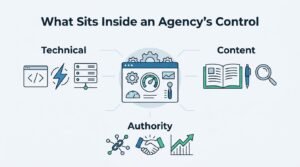
An SEO agency can influence the factors it can physically change on or around your website, which fall into three groups: technical health, content relevance, and external authority. These are inputs, not outcomes, and a good agency will commit to all three in writing.
This table shows what sits inside an agency’s control and how directly each lever works.
| Factor group | Examples | Degree of control |
| Technical | Crawlability, indexation, site speed, structured data, internal linking | Direct |
| Content | Topical coverage, search intent match, on-page optimisation, freshness | Direct |
| Authority | Digital PR, editorial links, brand mentions, citations | Indirect – requires third-party agreement |
Technical Foundations
Technical SEO is the practice of making a site crawlable, indexable, and fast enough that search engines can access and understand every page you want ranked. Broken canonicals, blocked resources, and orphaned pages suppress rankings regardless of content quality.
I start here on every account, because fixing technical debt is the only work with a predictable cause-and-effect relationship.
Content and Relevance
Content quality determines whether a page can satisfy the query behind a keyword. Search intent matching decides whether Google considers the page eligible at all, and no amount of optimisation rescues a page that answers the wrong question.
This is where a genuine keyword research process earns its budget, because the targets you choose set the ceiling on everything downstream.
Authority and Links
Authority signals come from other websites choosing to reference yours. An agency can create the asset, run the outreach, and earn the coverage, but the publisher makes the final call.
That third-party dependency is exactly why link building timelines resist precise promises.
The Ranking Factors No Agency Can Control
Several ranking factors sit permanently outside any agency’s control, including competitor investment, searcher personalisation, and Google’s own interface decisions. Each one can move your position without a single change to your website.
- Competitor budgets, hiring, and publishing velocity
- The searcher’s location, device, language, and search history
- Google’s SERP layout, feature rollouts, and AI Overview placement
- Algorithm updates and their timing
- Brand-level factors such as reviews, news coverage, and public sentiment
Competitor Behaviour
Search results are a fixed number of slots contested by everyone targeting the same query. A competitor doubling their content budget pushes someone down, and that someone may be you.
Competitive analysis tells you what you’re up against, but it cannot stop a rival from outspending you next quarter.
Personalisation and Location
Google personalises results by location, device, and prior behaviour, which means two people searching the same term at the same moment see different pages. A single verified screenshot of “position one” proves almost nothing.
SERP Layout Changes
Google reorganises the results page constantly. Featured snippets, local packs, shopping units, and AI Overviews all push traditional organic listings further down without changing your ranking number at all.
That distinction between position and visibility is why click-through rate modelling belongs in every reporting conversation.
How SERP Volatility Breaks Any Fixed Promise
Search results fluctuate daily, and that volatility alone makes a fixed-position guarantee unenforceable in practice. Semrush’s Sensor tracking records measurable daily movement across every major category, with spikes during core updates that reorder top-ten results wholesale.
Rankings also differ by data centre and by the tool measuring them. Two rank trackers checking the same keyword on the same day routinely disagree.
So a contract promising position three has to define whose measurement counts, from which location, on which device, at which hour. Most don’t, and that ambiguity always favours the vendor.
The Keyword Trick Behind Most “Guaranteed” Offers
Most ranking guarantees are made honest by choosing keywords nobody searches for. The agency promises position one on terms with effectively zero search volume, hits the target, and keeps the fee.
Here’s how the substitution typically works.
| What you asked for | What gets guaranteed | Monthly searches |
| “accounting software” | “cloud accounting software for nonprofit dentists in Akron” | 0–10 |
| “personal injury lawyer” | “affordable personal injury lawyer near me reviews 2024” | 0–20 |
| “project management tool” | “[your brand name] project management tool” | Branded only |
Branded keyword guarantees are the most common version. You already rank first for your own company name, so the guarantee costs the agency nothing.
Check the guaranteed keyword list against real search volume data before you sign anything. If the terms carry no demand, the guarantee delivers no revenue.
Why Guarantees Push Agencies Toward Risky Tactics
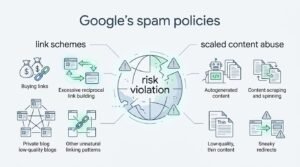
A guarantee transfers outcome risk onto the agency, and agencies under outcome pressure reach for shortcuts that produce fast movement. The shortcuts work briefly, then trigger penalties.
The escalation usually runs in this order:
- Aggressive exact-match anchor text on purchased links
- Private blog networks and paid guest post schemes
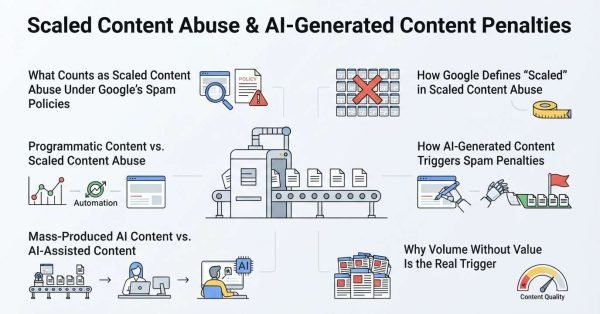
- Mass-produced or spun content published at volume
- Doorway pages targeting slight keyword variations
- Cloaking or sneaky redirects when nothing else moves
Google’s spam policies explicitly name link schemes and scaled content abuse as violations. The agency collects its fee on the short-term spike. You inherit the manual action.
Understanding which link building practices stay inside Google’s guidelines is the difference between an asset and a liability.
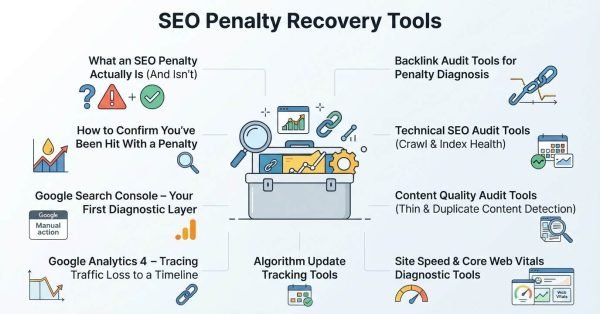
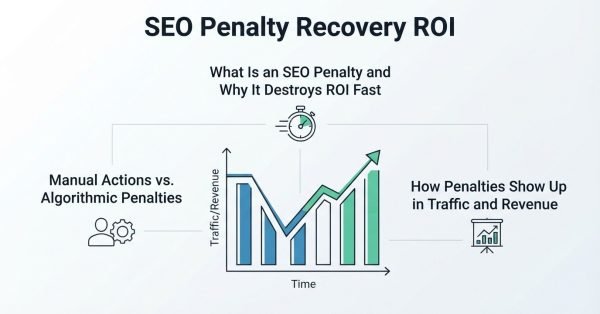
The Real Cost of a Google Penalty
A Google penalty can remove a site from search results for months, and recovery is neither guaranteed nor fast. Manual actions require a reconsideration request, and Google notes the review is carried out by a human reviewer with no committed turnaround.
Algorithmic suppression is worse, because there is no notification and no appeal. You diagnose it from traffic loss and fix it by removing whatever triggered it.
Then you wait for the next update to recognise the cleanup. I’ve watched recoveries take three quarters, and I’ve watched brands rebuild on a fresh domain because the old one never came back. That risk profile is why penalty recovery deserves its own serious planning.
How to Read an SEO Contract That Mentions Guarantees
Read the definitions and remedies sections before the headline promise, because that is where the guarantee is quietly dismantled. The marketing page says “guaranteed rankings.” The contract says something considerably narrower.
Look specifically for:
- The keyword schedule, and whether you approved it or the agency selected it
- The measurement method, location, device, and tracking tool named
- The definition of “ranking” – top ten, top three, position one, or “first page”
- Whether local pack, image, or video results count toward the promise
- The remedy: refund, partial refund, or free months of the same service
- Exclusion clauses covering algorithm updates, penalties, or client delays
An algorithm-update exclusion clause voids the guarantee in the exact scenario the guarantee exists to cover. If that clause is present, the promise is decorative.
What a Legitimate SEO Agency Commits To Instead
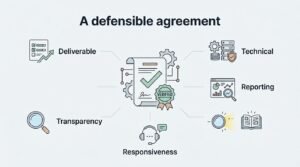
A legitimate SEO agency guarantees its process and deliverables, never its rankings. The commitment covers work the agency fully controls, measured against dates and volumes you can verify independently.
This table shows the shape of a defensible agreement.
| Commitment type | Example | How you verify it |
| Deliverable | 8 optimised pages per month | Published URLs |
| Technical | Core Web Vitals passing on templates | PageSpeed Insights |
| Reporting | Monthly performance review with raw data access | Search Console and Analytics |
| Responsiveness | Critical issues addressed within 48 hours | Ticket log |
| Transparency | Full link and content inventory | Shared documentation |
Process Commitments
Process commitments define how the work happens: research methodology, approval workflows, quality review, and communication cadence. They protect you from an agency that goes quiet for a quarter.
Deliverable Commitments
Deliverable commitments define what arrives and when. Volume, format, and acceptance criteria all get stated, so “we published content” becomes a number you can audit.
We structure every engagement this way, and a clear SEO scope of work document is what makes it enforceable.
Realistic SEO Timelines and What Drives Them
Most SEO campaigns produce meaningful traffic movement between four and twelve months, with competitive niches taking longer. Google’s own guidance states that SEO changes typically take four months to a year to show effect.
The range is wide because four variables drive it. Domain history matters, since an established site with existing authority moves faster than a domain registered last month. Competition level matters, because outranking entrenched incumbents takes more assets than filling an underserved niche.
Technical starting condition matters, as a site with indexation problems spends its first months recovering ground rather than gaining it. And publishing velocity matters, because output compounds.
Anyone quoting a fixed timeline without asking about all four is guessing. A proper SEO timeline expectation is built from your specific inputs, not a template.
The Metrics That Matter More Than Rankings
Rankings are a leading indicator, not a business outcome, and the metrics that predict revenue sit further down the funnel. Position one on a keyword nobody converts on is a screenshot, not a result.
Track these instead.
| Metric | What it tells you | Where to find it |
| Organic sessions by landing page | Which content earns traffic | Google Analytics |
| Impressions and clicks by query | Demand captured vs. demand available | Search Console |
| Non-brand organic traffic | Growth beyond people who already knew you | Search Console filtering |
| Assisted conversions | SEO’s contribution to closed revenue | Analytics attribution |
| Share of voice | Visibility across your full keyword set | Rank tracking platform |
Non-brand organic traffic is the number I care about most, because it isolates the growth SEO actually created. Branded traffic follows your marketing, not your search work.
Building the right SEO reporting dashboard makes these visible monthly instead of annually.
How to Forecast SEO Results Without Guaranteeing Them
A credible SEO forecast models expected traffic from search volume, projected position, and click-through rate, then states its confidence range and assumptions openly. It predicts. It does not promise.
The method runs in five steps:
- Build the target keyword set and pull accurate search volume
- Assess current position and realistic position gain per term
- Apply CTR curves to convert projected position into projected clicks
- Apply your existing conversion rate to estimate leads or revenue
- Present a low, expected, and high scenario with the assumptions listed
Forecasts should be revisited quarterly, because the inputs change. A forecast that never updates is a guarantee wearing a disguise.
So how do you tell an honest forecast from a sales pitch?
Warning Signs of an SEO Scam
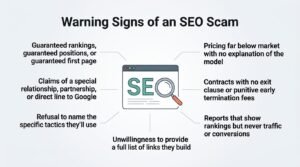
Certain claims reliably indicate an SEO provider is selling something they cannot deliver. Any one of these justifies ending the conversation.
- Guaranteed rankings, guaranteed positions, or guaranteed first page
- Claims of a special relationship, partnership, or direct line to Google
- Refusal to name the specific tactics they’ll use
- Unwillingness to provide a full list of links they build
- Pricing far below market with no explanation of the model
- Contracts with no exit clause or punitive early termination fees
- Reports that show rankings but never traffic or conversions
Opaque link building is the single most common vector for damage, which is why evaluating an SEO agency properly starts with asking for their link inventory.
Questions to Ask Before Signing an SEO Agreement
Ask questions that force the agency to describe controllable work rather than promised outcomes. The answers tell you more than any case study.
- Which specific deliverables are contractually committed each month?
- How do you select target keywords, and do I approve the list?
- Will you provide every link you build, including those that don’t work?
- What does your reporting show beyond ranking positions?
- Who owns the content, accounts, and assets if we part ways?
- What is your process when an algorithm update hits our site?
- Can I speak to a client whose campaign underperformed?
That last question separates transparent agencies from the rest. Every campaign has a difficult quarter, and how a provider handled theirs predicts how they’ll handle yours.
When a Ranking Guarantee Is Technically Honest
A ranking guarantee is technically honest only when the target is trivially achievable, such as a branded term or an ultra-long-tail phrase with negligible competition. In those narrow cases, the promise is real, and also commercially meaningless.
There is one other legitimate version: a money-back guarantee on the service fee itself, with no ranking claim attached. That shifts financial risk without pretending to control Google.
If a provider offers that, read what triggers the refund. A guarantee with a twelve-month qualification period and a narrow window to claim is a retention mechanism, not a protection.
How to Hold an SEO Agency Accountable Without a Guarantee
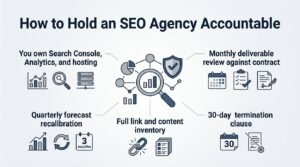
You hold an SEO agency accountable by owning the data, contracting on deliverables, and reviewing leading indicators monthly. Accountability comes from visibility, not from a promise.
| Control mechanism | What it prevents |
| You own Search Console, Analytics, and hosting | Being locked out of your own data |
| Monthly deliverable review against contract | Silent under-delivery |
| Quarterly forecast recalibration | Drifting expectations |
| Full link and content inventory | Hidden risky tactics |
| 30-day termination clause | Being trapped in a failing engagement |
Owning your own analytics access is non-negotiable. An agency that resists handing over admin rights to your own properties is protecting information you are entitled to, and setting up a proper SEO audit process depends on having it.
Conclusion
Ranking guarantees promise an outcome Google decides, while real SEO accountability lives in deliverables, process transparency, forecasting, and metrics tied to revenue.
Every factor covered here connects: algorithm ownership, volatility, contract language, and timelines all explain the same underlying reality about search.
We build campaigns on commitments we can keep. Talk to White Label SEO Service about an SEO agreement you can actually hold us to.
Frequently Asked Questions
Can any SEO company guarantee a number one ranking?
No SEO company can guarantee a number one ranking. Google controls the algorithm that decides positions, and no external agency can access or override that system.
Is a guaranteed SEO service always a scam?
Not always, but almost. The honest versions guarantee branded or zero-volume keywords, or refund the fee without claiming any ranking outcome at all.
Why do some agencies still offer ranking guarantees?
Guarantees convert prospects who fear wasting budget. Agencies then protect themselves through narrow keyword schedules, vague measurement terms, and exclusion clauses covering algorithm updates.
How long does SEO take to show results?
SEO typically takes four to twelve months to show meaningful traffic gains. Domain authority, competition level, technical condition, and publishing velocity determine where you land in that range.
What should an SEO contract guarantee instead of rankings?
Contracts should guarantee deliverables and process: page volumes, technical fixes, reporting cadence, response times, and full transparency on every link built.
Can Google penalise my site for my agency’s work?
Yes. Google penalises the website, not the vendor. Manual actions and algorithmic suppression follow your domain regardless of who performed the violating work.
What is a reasonable way to measure SEO performance?
Measure non-brand organic traffic, impressions and clicks by query, assisted conversions, and share of voice. These reflect business impact rather than isolated ranking positions.