AI search optimization sits at the intersection of traditional SEO and generative answer engines, and hiring the wrong agency wastes months of budget chasing outdated tactics. I’ve watched businesses sign year-long contracts with agencies that never once mentioned AI Overviews or how large language models pull information from the web. That gap costs real visibility.
Getting this hire wrong delays your growth by six months or more, and every month spent with the wrong partner is a month your competitors spend building AI citation authority instead. We built this guide to close that gap.
This guide walks through what these agencies actually do, the credentials and questions that separate real expertise from recycled SEO playbooks, what pricing and timelines look like in the real world, and how to decide between an in-house team and an outside partner.
What Is an AI Search Optimization Agency?
An AI search optimization agency is a specialized marketing partner that helps brands earn visibility inside AI-generated answers, chat assistants, and traditional search results simultaneously. I think of it as SEO’s natural evolution the fundamentals of crawlability and content quality still matter, but the destination has multiplied beyond ten blue links.
Search behavior shifted hard once Google’s AI Overviews rolled out to over a billion users in 2024, and that single change rewired how visibility gets measured. An agency in this space tracks citations inside AI Overviews, ChatGPT, and Perplexity, not just rank positions on a results page.
How AI Search Optimization Differs from Traditional SEO
Traditional SEO chases rankings on a results page; AI search optimization chases citations inside a generated answer. I still care about technical health and content depth, but the scoring criteria for a machine writing a summary sentence differ sharply from the criteria for a ranking algorithm sorting ten links.
Search engines used to reward the page. Answer engines reward the sentence, and that distinction reshapes almost every recommendation an agency makes.
Why AI Search Optimization Matters for Your Business Now
Businesses that ignore AI search optimization risk losing visibility as more searches resolve directly inside AI-generated answers rather than traditional listings. I’ve seen click-through rates on informational queries drop noticeably once an AI Overview answers the question directly on the results page.
That shift isn’t slowing down. Gartner projects traditional search engine volume will drop 25% by 2026 as users shift to AI chatbots and virtual agents. A business relying only on classic ranking tactics is optimizing for a shrinking slice of the pie.
Core Services an AI Search Optimization Agency Should Offer
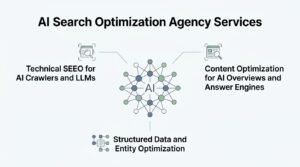
A qualified AI search optimization agency should offer technical AI-crawler optimization, answer-focused content structuring, and entity-level structured data as its three core services. I look for agencies that treat these as one integrated system rather than three separate upsells.
Anything less than full coverage across these three areas leaves gaps competitors will exploit.
Technical SEO for AI Crawlers and LLMs
AI crawlers like GPTBot and Google-Extended read a site differently than a standard search crawler, and technical SEO now has to account for both. I check whether an agency understands robots.txt directives for AI-specific user agents, because blocking the wrong crawler quietly removes a site from an entire answer engine’s training and retrieval pipeline.
Site architecture, page speed, and structured markup still matter here; they’re just serving a second audience of machine readers now.
Content Optimization for AI Overviews and Answer Engines
Content optimization for answer engines means writing sentences that can be lifted out of a page and quoted alone without losing meaning. Answer-first paragraphs, clear entity definitions, and self-contained claims are the building blocks a strong agency writes into every page.
I’ve found that content written this way tends to perform better in featured snippets too, since the extraction logic overlaps heavily between the two systems.
Structured Data and Entity Optimization
Structured data and entity optimization is the practice of marking up content with schema so search engines and AI systems can identify exactly what an entity is and how it relates to other entities on the page. This work directly feeds knowledge graph inclusion, which is one of the strongest trust signals a brand can build.
An agency skipping schema markup entirely in 2026 is missing a foundational piece of the AI visibility puzzle.
Key Credentials and Experience to Verify
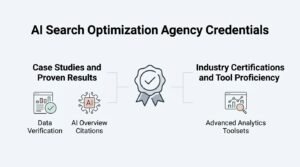
The most reliable credentials for an AI search optimization agency are documented case studies showing AI Overview citations, verifiable client results, and demonstrated proficiency with modern SEO and AI-tracking tools. Credentials on a homepage mean nothing without proof behind them.
I always ask for specifics, not “we improved traffic” but “we went from zero to twelve AI Overview citations across a client’s core topic cluster in four months.”
Case Studies and Proven Results
Case studies should show before-and-after AI citation data, not just traffic graphs, since traffic alone doesn’t confirm AI search optimization work actually happened. I want to see screenshots of an AI Overview citing the client’s page, dated and sourced.
Vague percentage improvements without context are a soft warning sign, not a disqualifier by themselves.
Industry Certifications and Tool Proficiency
Look for fluency with tools that specifically track AI visibility, since traditional rank trackers can’t see inside a chat interface. Proficiency in platforms tracking share of voice inside AI answers separates agencies that have adapted from ones still selling last decade’s SEO.
Certifications from Google, Semrush, or HubSpot show baseline competence but don’t confirm AI-specific expertise on their own.
Essential Questions to Ask Before Hiring
Before hiring, ask how the agency measures AI Overview citations, how they’ve adapted their content process for answer engines, and what their reporting cadence looks like. These three questions expose more about actual capability than any pitch deck.
I’d also ask what percentage of their current client base has active AI-search-specific deliverables versus legacy SEO packages rebranded with new terminology.
Reporting, Metrics, and KPIs That Matter
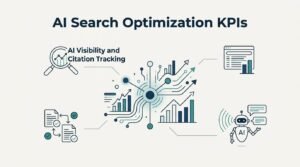
The KPIs that matter most for AI search optimization are AI Overview citation frequency, share of voice inside generative answers, and traditional organic metrics like organic sessions and keyword rankings. A good report shows both sides of that ledger, not just one.
Reports that only show ranking positions are reporting on half the picture in 2026.
AI Visibility and Citation Tracking
AI visibility tracking measures how often and how prominently a brand’s content gets cited inside AI-generated answers across platforms like Google AI Overviews, ChatGPT, and Perplexity. This is a genuinely new metric category, and agencies without dedicated tooling for it are working blind.
Ahrefs’ Brand Radar data shows a strong correlation between existing organic ranking strength and AI Overview citation frequency, which means the two disciplines reinforce each other rather than compete.
Traditional SEO Metrics Still Worth Watching
Organic sessions, keyword rankings, and conversion rate from organic traffic remain valid KPIs because AI search optimization builds on top of solid SEO fundamentals rather than replacing them. Dropping these metrics entirely in favor of AI-only tracking would leave a real blind spot.
The strongest reporting dashboards blend both metric families into one view.
Red Flags and Warning Signs of a Bad Agency
The clearest red flags are guaranteed rankings, vague reporting, no mention of AI search or generative engines, and reluctance to share past client results. Any agency promising a guaranteed page-one position is either inexperienced or dishonest, since no agency controls the algorithm.
I also watch for agencies that rebrand old link-building packages as “AI SEO” without changing the actual deliverables. That’s a rename, not a strategy shift.
Pricing Models and What to Expect to Pay
AI search optimization services typically run between $2,500 and $10,000 per month for small to mid-sized businesses, depending on scope, competitiveness, and whether technical work is included. Enterprise engagements with heavy technical and content demands run considerably higher.
Project-based pricing exists too, usually for a defined technical audit or content overhaul rather than ongoing management.
Monthly Retainer vs. Project-Based Pricing
Monthly retainers suit businesses wanting continuous optimization, reporting, and adaptation as AI algorithms shift, while project-based pricing suits a one-time technical fix or content refresh. I generally recommend a retainer once a business is serious about long-term AI visibility, since this space changes fast enough that a “set it and forget it” project rarely holds up for more than a quarter.
Realistic Timelines for AI Search Optimization Results
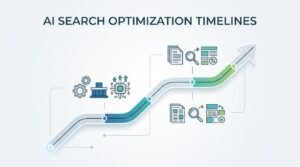
Most businesses start seeing measurable AI search optimization results within four to nine months, depending on site authority, competitiveness, and how much technical work was needed at the outset. I’ve seen well-established sites with strong technical foundations see AI Overview citations in as little as eight weeks after content restructuring.
Newer sites or highly competitive industries stretch that timeline out, sometimes past the nine-month mark before citations become consistent.
Matching Agency Expertise to Your Business Type and Industry
The right agency fit depends on whether they’ve worked in your industry’s regulatory and competitive environment before, since YMYL industries like healthcare and finance carry stricter content and trust requirements. An agency skilled at local service business SEO won’t automatically transfer that skill to a SaaS company’s technical documentation needs.
I always ask for industry-specific examples rather than accepting general capability claims at face value.
Contract Terms, Onboarding, and Communication Expectations
A solid contract should specify deliverables, reporting frequency, contract length, and an exit clause, with onboarding typically taking two to four weeks to complete audits and strategy alignment. Month-to-month terms after an initial commitment period signal a confident agency willing to earn continued business.
Communication cadence matters just as much as contract terms. I look for agencies committing to a specific monthly call or written report, not vague “we’ll keep you updated” language.
In-House Team vs. Hiring an Agency: Making the Right Choice
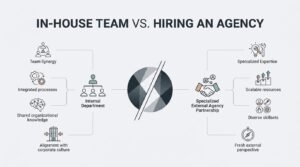
An in-house team makes sense for large organizations with steady content output needs, while an agency makes sense for businesses wanting specialized AI search expertise without the overhead of a full department. I’ve watched mid-sized businesses struggle to hire and retain in-house talent that understands both technical SEO and AI-answer content structuring, since that combined skill set is still rare.
The hybrid model of a lean in-house marketer paired with an outside agency for technical and AI-specific work tends to work best for growing businesses.
Conclusion
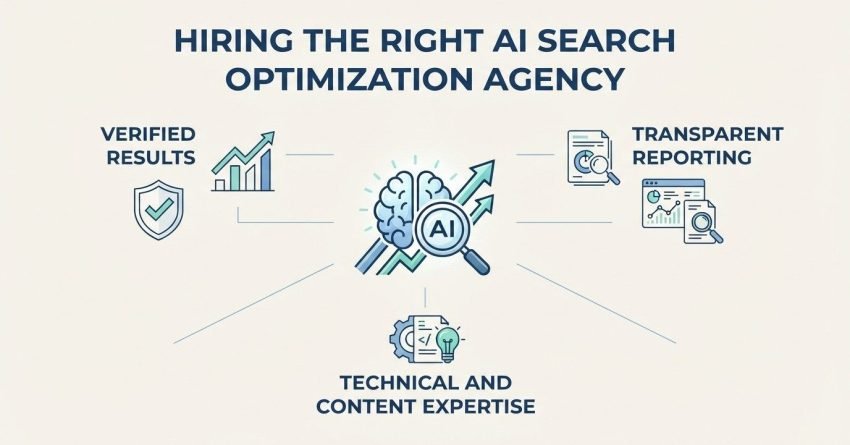
Hiring the right AI search optimization agency comes down to verified results, transparent reporting, and genuine technical and content expertise across both traditional SEO and generative answer engines.
The landscape keeps shifting, and the agencies staying ahead of it now will define search visibility standards for years to come.
We built White Label SEO Service to help businesses navigate exactly this shift. Reach out and let’s map your growth strategy together.
Frequently Asked Questions
What does an AI search optimization agency actually do?
An AI search optimization agency optimizes a brand’s technical foundation, content, and structured data to earn visibility in both traditional search results and AI-generated answers. This combines classic SEO with newer citation-tracking work.
How much does AI search optimization cost per month?
Most small to mid-sized businesses pay between $2,500 and $10,000 per month for AI search optimization. Enterprise pricing runs higher depending on technical scope and competitiveness.
How long does it take to see results from AI search optimization?
Most businesses see measurable results within four to nine months. Sites with stronger existing authority sometimes see AI Overview citations within eight weeks.
What’s the difference between SEO and AI search optimization?
Traditional SEO targets rankings on a results page, while AI search optimization targets citations inside generative answers. Both rely on similar technical and content fundamentals underneath.
Should I hire an agency or build an in-house team?
Agencies suit businesses wanting specialized expertise without added headcount, while in-house teams suit larger organizations with steady content demands. Many growing businesses use a hybrid of both.
What certifications should an AI search optimization agency have?
Look for baseline certifications from Google, Semrush, or HubSpot alongside demonstrated proficiency with AI-visibility tracking tools. Certifications alone don’t confirm AI-specific expertise without proof of results.
How do I measure if an AI search optimization agency is working?
Measure success through AI Overview citation frequency, share of voice in generative answers, and traditional metrics like organic sessions and rankings. A reliable agency reports on both metric families regularly.