AI search optimization is the practice of structuring content, technical infrastructure, and authority signals so that AI-driven platforms like Google AI Overviews, ChatGPT, and Perplexity can find, understand, and cite a brand’s content in generated answers. It matters because these platforms now answer millions of queries directly, often without a single click to a website, which means visibility inside the answer itself has become as important as ranking on a results page. I’ve watched this shift accelerate over the past two years, and it’s changed how I think about content structure entirely.
Businesses that ignore this shift risk losing visibility precisely where their buyers are now searching. Traditional rankings alone no longer guarantee discovery or traffic.
This guide covers how AI platforms differ from traditional search engines, the core technical and content components that drive AI citations, how to build the authority signals these systems trust, and what realistic timelines and measurement look like in practice. We’ll also cover common mistakes and how this strategy fits into a broader SEO plan.
What Is AI Search Optimization?
AI search optimization is a set of technical, content, and authority practices designed to help generative AI platforms retrieve, understand, and cite a website’s content in their generated answers. I think of it as the natural evolution of SEO, built for a search landscape where answers get synthesized rather than just listed.
Traditional SEO focuses on ranking a page in a list of blue links. AI search optimization focuses on becoming the source an AI model chooses to quote, paraphrase, or link to when constructing its answer. Both disciplines depend on relevance and authority, but the delivery mechanism is fundamentally different.
Marketers sometimes call this practice AEO (answer engine optimization) or GEO (generative engine optimization), and the terms are largely interchangeable in current industry usage. I use them depending on the platform being discussed, but the underlying goal never changes: earn the citation.
How AI Search Platforms Differ From Traditional Search Engines
AI search platforms differ from traditional search engines because they synthesize a single generated answer from multiple sources instead of returning a ranked list of links for the user to evaluate. That difference changes almost everything about how content needs to be built.
A traditional search engine sends users to pages. An AI platform often keeps users inside its own interface, presenting a synthesized answer and citing sources as supporting evidence rather than as the primary destination.
Google AI Overviews vs. Traditional SERPs
Google AI Overviews pull excerpts from multiple ranking pages and compress them into a single generated summary that appears above traditional organic results. I’ve noticed that pages earning these citations tend to have tightly extractable sentences near the top of each section, rather than long, meandering explanations.
Traditional SERPs still exist below the AI Overview, but click-through rates on those lower results have dropped noticeably. That’s the practical reason this strategy can no longer be treated as optional.
Conversational Answer Engines
Conversational answer engines like ChatGPT, Perplexity, and Copilot work differently again, since many pull from live web retrieval combined with pre-trained knowledge rather than a fixed index. Perplexity, for example, shows inline citations directly in its chat responses, which makes source selection highly visible to the end user.
These platforms tend to favor content with clear structure, dated information, and named entities, because that structure makes retrieval and verification easier for the underlying model.
Why Businesses Need an AI Search Visibility Strategy
Businesses need an AI search visibility strategy because a growing share of informational queries are answered directly inside AI interfaces, often without the user ever clicking through to a website. I’ve seen internal client data where AI Overview appearances correlate directly with a dip in organic click-through, even when rankings stayed stable.
The absence from an AI-generated answer is now equivalent to being invisible for that query. A business that ranks #1 organically but never appears in the AI Overview citation still loses that impression entirely.
This isn’t a future risk. It’s already reshaping how buyers discover vendors, compare options, and form early opinions before they ever land on a website.
Core Components of an AI Search Optimization Strategy
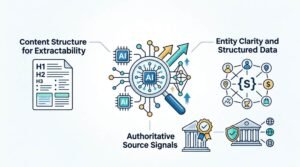
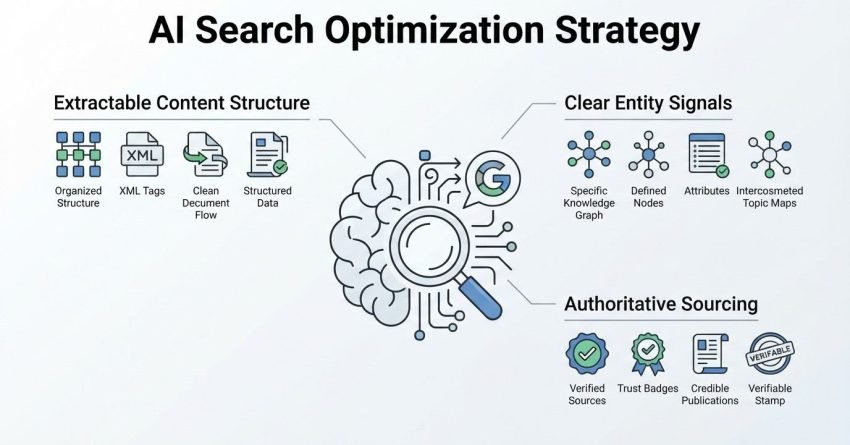
An AI search optimization strategy is built on three core components: extractable content structure, clear entity signals, and authoritative sourcing that AI models can verify and trust. Each one plays a distinct role in whether a platform selects your content for citation.
I treat these three as inseparable. Strong content structure without authority signals rarely earns a citation, and strong authority without extractable formatting gets passed over just as often.
Content Structure for Extractability
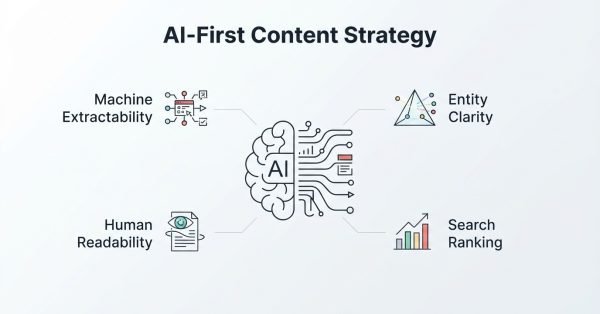
Content structured for extractability answers each heading directly in its opening sentence, before adding supporting context or nuance. This mirrors exactly how AI models pull sentence-level answers out of a page.
Short paragraphs, direct definitions, and clearly labeled sections all increase the odds that a model can lift a clean, standalone answer from your page.
Entity Clarity and Structured Data
Entity clarity means naming people, organizations, products, and concepts explicitly and consistently, rather than relying on pronouns or vague references. AI models build much of their understanding around entities and the relationships between them.
Structured data reinforces this by explicitly labeling entities and relationships in a machine-readable format, which reduces ambiguity for any system parsing the page.
Authoritative Source Signals
Authoritative source signals include backlinks, brand mentions across the web, and credentials that establish a domain as a trustworthy reference point. A Semrush analysis of AI Overview citations found that cited domains had 3.2 times more referring domains on average than non-cited competitors in the same result set.
That gap tells me authority signals matter just as much in AI search as they always did in traditional rankings, if not more.
How AI Platforms Choose What to Cite
AI platforms choose what to cite based on a combination of source credibility, content clarity, topical relevance, and how well-structured the information is for extraction. No single factor decides it alone.
Freshness plays a role too, particularly for topics tied to changing data, pricing, or industry trends. A page updated within the last several months tends to outperform a stale one covering the identical topic.
Consensus across multiple sources also matters. When several credible domains state the same fact in similar terms, AI models treat that repetition as a trust signal worth citing.
Technical Foundations That Support AI Visibility
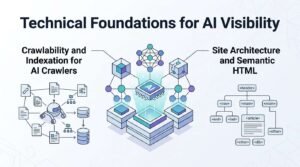
Technical foundations for AI visibility start with ensuring AI crawlers can actually access and parse a website’s content without being blocked or obstructed. This sounds basic, but I still find sites failing at this exact step.
Without proper crawl access, none of the content or authority work downstream matters, because the AI system never sees the page in the first place.
Crawlability and Indexation for AI Crawlers
Crawlability for AI crawlers depends on allowing bots like GPTBot, PerplexityBot, and Google-Extended appropriate access through robots.txt rather than blocking them by default. Many sites unintentionally block these crawlers while trying to manage server load or protect content.
An emerging file called llms.txt is being adopted by some sites specifically to guide AI crawlers toward priority content, though adoption is still uneven across the web.
Site Architecture and Semantic HTML
Site architecture that supports AI visibility uses semantic HTML elements, like proper heading tags and list structures, so machines can parse the page’s hierarchy accurately. A flat, div-heavy page with no semantic structure is much harder for any parser, human or machine, to interpret correctly.
Clean internal linking and logical URL structures reinforce this by making the relationships between pages explicit rather than implied.
Content Strategy for AI Search Optimization
A content strategy for AI search optimization prioritizes answer-first writing and topical depth across a connected cluster of pages rather than isolated, keyword-targeted articles. This structural approach gives AI models more surface area to find, verify, and cite.
I build this the same way I’d build a hub-and-spoke SEO architecture, just with an added layer of attention to extractable sentence structure.
Answer-First Content Structure
Answer-first content structure places the direct answer to a heading’s implied question in the very first sentence beneath it, with supporting detail following afterward. This is the single most consistent trait I’ve found across pages that get cited repeatedly.
Burying the answer under three paragraphs of preamble is one of the fastest ways to get skipped over entirely.
Topical Authority and Content Clusters
Topical authority through content clusters means building a pillar page supported by multiple dedicated subtopic pages, each covering one dimension of the broader topic in depth. This structure signals comprehensive coverage to both traditional search engines and AI retrieval systems.
Keyword research and content planning work as the foundation for identifying exactly which subtopics deserve their own dedicated page within that cluster.
Structured Data and Schema Markup for AI Understanding
Structured data and schema markup give AI platforms an explicit, machine-readable description of a page’s content, entities, and relationships, removing the guesswork from interpretation. This is one of the more technical but highest-leverage steps in the whole strategy.
FAQ schema, Article schema, and Organization schema each serve a distinct purpose in helping a platform understand exactly what type of content it’s looking at and who published it.
Schema markup implementation tends to be one of the most overlooked technical steps, even among sites that have otherwise strong content.
Building Authority Signals AI Platforms Trust
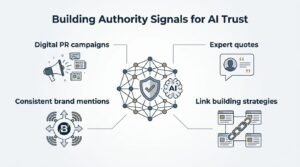
Building authority signals that AI platforms trust means earning backlinks, brand mentions, and third-party citations from sources that are themselves considered credible. This works almost identically to how authority has always functioned in traditional SEO.
Digital PR campaigns, expert quotes, and consistent brand mentions across industry publications all contribute to this trust layer over time.
Link building strategies remain one of the most direct ways to build the off-site authority signals that both traditional rankings and AI citation models rely on.
Measuring AI Search Visibility and Performance
Measuring AI search visibility requires tracking a different set of metrics than traditional rankings, since AI citations rarely show up cleanly inside standard rank-tracking tools. This is genuinely one of the harder parts of this discipline right now.
I rely on a mix of manual query testing, referral traffic analysis, and emerging third-party tools built specifically for tracking AI citation frequency.
Tracking AI Citations and Brand Mentions
Tracking AI citations involves manually querying target platforms with representative questions and logging whether and how a brand’s content gets referenced. Several emerging tools now automate parts of this process, but manual spot-checking still catches things automated tools miss.
Referral traffic segments from ChatGPT, Perplexity, and Copilot are now visible in most analytics platforms, giving a rough proxy for AI-driven visibility even without direct citation data.
KPIs Beyond Traditional Rankings
KPIs beyond traditional rankings include AI referral traffic, citation frequency across target queries, and share of voice relative to named competitors. These metrics tell a different story than keyword position alone.
Google Search Console reporting still plays a role here too, particularly for identifying which existing pages are already earning impressions tied to AI Overview appearances.
Realistic Timelines for AI Search Optimization Results
Realistic timelines for AI search optimization typically run three to six months for initial citation appearances, with compounding visibility building over six to twelve months as authority signals accumulate. This tracks closely with traditional organic SEO timelines, though the specific milestones differ.
An Ahrefs study of AI Overview citation patterns found that over 60% of cited URLs also ranked in the top 10 traditional organic results for the same query, suggesting the two systems remain closely linked rather than fully separate.
I tell clients not to expect overnight citation appearances. The domains earning consistent AI visibility today were almost always investing in strong technical and content foundations well before AI Overviews existed.
SEO timeline expectations provide useful context here, since the underlying patience required mirrors what’s always been true of organic search growth.
Common Mistakes That Limit AI Search Visibility
Common mistakes that limit AI search visibility include thin content that never answers questions directly, missing or broken structured data, and weak off-site authority signals. I see these three mistakes repeated across almost every audit I run.
Blocking AI crawlers unintentionally through an overly restrictive robots.txt file is another mistake that quietly erases a site’s chances before content quality even becomes a factor.
Vague, pronoun-heavy writing that never names its subject clearly also hurts extractability, since AI models struggle to isolate a clean, quotable answer from ambiguous sentences.
How AI Search Optimization Fits Into a Broader SEO Strategy
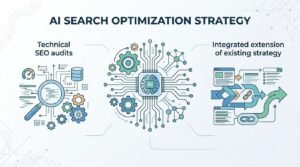
AI search optimization fits into a broader SEO strategy as one additional visibility layer built on the same technical, content, and authority foundations that traditional organic search has always required. It doesn’t replace existing SEO work; it extends it.
Technical SEO audits remain the starting point for most engagements, since crawlability and indexation issues affect both traditional rankings and AI retrieval equally.
The businesses seeing the strongest results treat AI search optimization as an integrated extension of their existing strategy, not a separate initiative competing for the same resources.
Conclusion
AI search optimization brings together technical infrastructure, extractable content, and authority signals into one coordinated approach. Together, these elements determine whether AI platforms find, trust, and cite a brand’s content.
This strategy sits alongside traditional SEO rather than replacing it, and the deeper cluster resources referenced throughout this guide build on that foundation.
We built White Label SEO Service to help businesses plan and execute exactly this kind of integrated strategy. Reach out and let’s map your path to AI search visibility.
Frequently Asked Questions
What is AI search optimization?
AI search optimization is the practice of structuring content and technical signals so AI platforms can find and cite a website. It covers technical access, content clarity, and authority building.
How is AI search optimization different from SEO?
AI search optimization targets citation inside generated answers rather than a ranked list of links. It shares the same technical and authority foundations as traditional SEO.
How long does it take to see results from AI search optimization?
Initial citations typically appear within three to six months of consistent optimization work. Compounding visibility usually builds further over six to twelve months.
Can small businesses compete for AI search visibility?
Yes, small businesses can compete by focusing on narrow topical authority and strong extractable content. AI platforms cite credible, well-structured sources regardless of company size.
Does structured data really help with AI citations?
Yes, structured data helps by giving AI platforms an explicit, machine-readable description of page content. It reduces ambiguity and speeds up accurate interpretation.
How do I know if my content is being cited by AI platforms?
Manually querying target platforms with relevant questions is the most reliable check right now. Referral traffic segments from AI platforms in analytics tools offer a secondary signal.
Is traditional SEO still necessary with AI search optimization?
Yes, traditional SEO remains necessary since AI platforms rely heavily on the same authority and technical signals. Strong organic rankings often correlate with AI citation eligibility.