Link building services are professional programs that acquire backlinks from other websites to a client’s site in order to improve its search engine rankings, authority, and organic visibility. I’ve watched businesses waste budget on link building that never moved a ranking, and I’ve watched a handful of well-placed links do more than months of content ever could.
The difference always comes down to strategy, not volume. Search engines still treat backlinks as one of the strongest trust signals a site can earn, and that hasn’t changed as algorithms have gotten smarter.
This guide covers what link building services actually do day to day, the strategies that separate quality programs from spam, what a link is really worth, realistic costs and timelines, and how to tell a trustworthy provider from a risky one. I’ll also cover how link building fits into the rest of an SEO program and what red flags should send you running.
What Are Link Building Services?
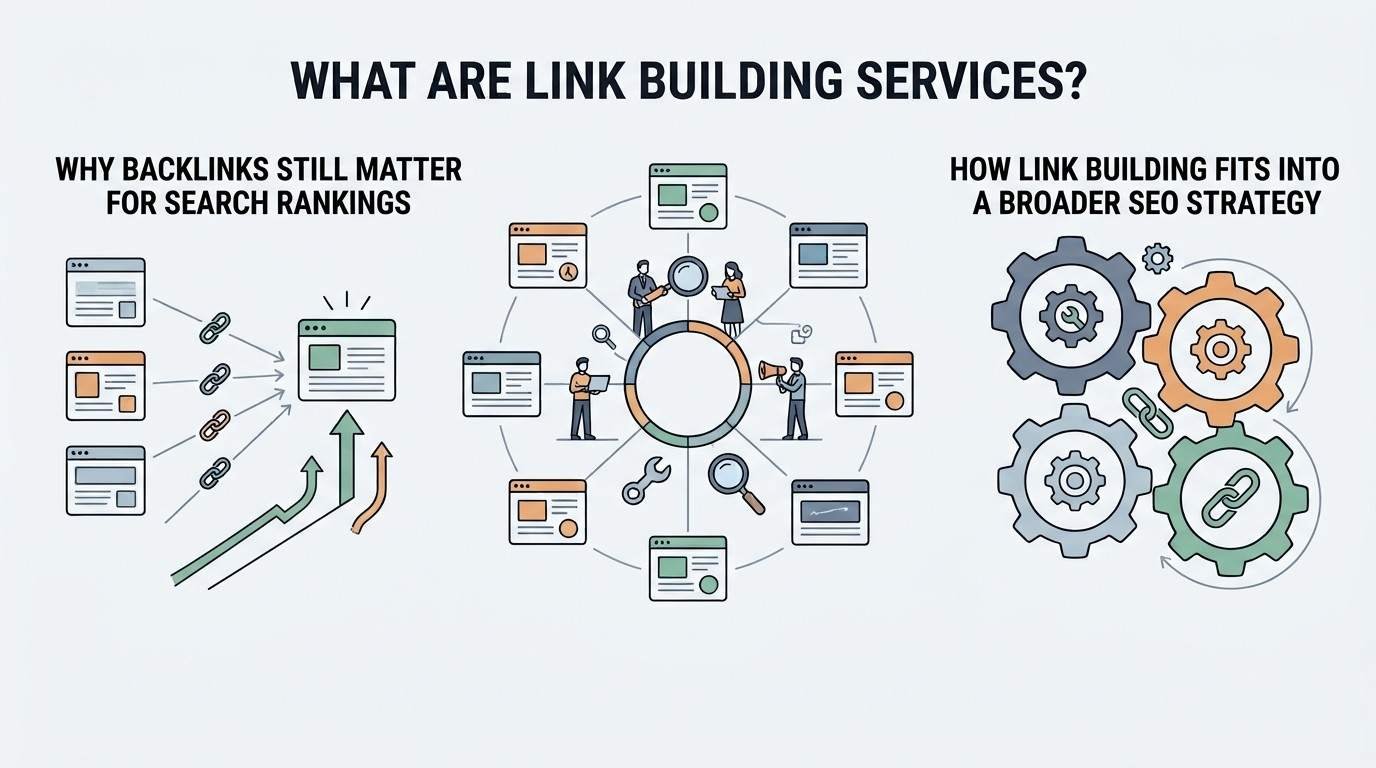
Link building services are managed programs where an agency or specialist earns backlinks on a client’s behalf through outreach, content creation, and relationship-based placements. I think of it as reputation-building at scale every link is essentially another website vouching for yours.
Backlinks work because Google’s own documentation on how search works confirms that links remain one of the signals used to understand a page’s relevance and authority. A site with strong, relevant backlinks tends to earn more trust from search engines than one with none.
Why Backlinks Still Matter for Search Rankings
Backlinks matter because they act as third-party votes of confidence that search engines use to gauge a page’s trustworthiness and relevance. I still see backlinks cited as a top-three ranking factor in nearly every major SEO study published in the last few years.
An Ahrefs study of two million search results found a strong correlation between the number of referring domains and higher rankings across nearly every niche tested. That correlation doesn’t mean links are the only factor, but it does mean they’re rarely optional for competitive keywords.
How Link Building Fits Into a Broader SEO Strategy
Link building is one of four core disciplines in a complete SEO program, working alongside technical SEO, on-page optimization, and content strategy. On-page SEO tells search engines what a page is about, and link building tells them why that page deserves to be trusted.
I never recommend link building in isolation. A page with excellent backlinks but poor on-page optimization or weak technical health rarely ranks as well as it should.
How Link Building Services Actually Work
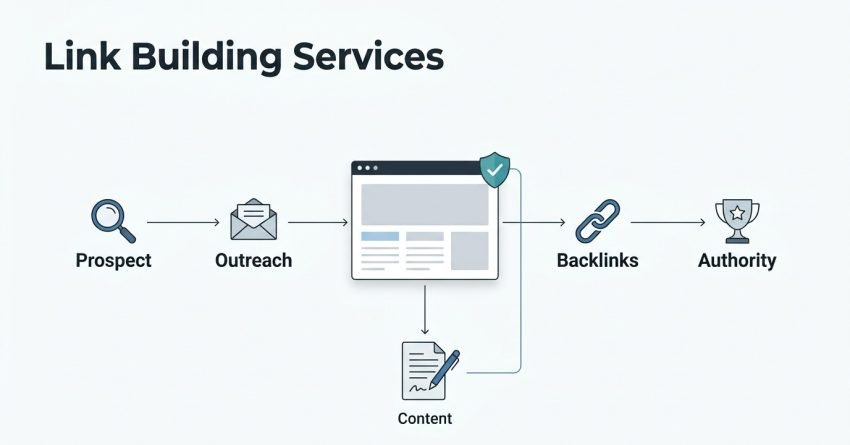
Link building services work by identifying relevant, authoritative websites, reaching out to build a genuine editorial connection, and earning a placement that links back to the client’s site. The process is far more manual and relationship-driven than most business owners expect.
Prospecting and Site Vetting
Prospecting is the process of identifying websites that are relevant, authoritative, and realistically willing to link out to a client’s content. I look at domain rating, organic traffic, topical relevance, and spam signals before a single outreach email goes out.
A site with high domain authority but no real traffic or topical relevance is usually a weak prospect. Quality vetting protects both the client’s site and its future rankings from being tied to bad neighborhoods.
Outreach and Relationship Building
Outreach is the stage where a link builder contacts website owners, editors, or bloggers to propose a piece of content, a resource mention, or a collaborative placement. This is the most time-intensive part of the entire process and the biggest reason link building services take weeks, not days.
Most outreach campaigns see reply rates in the single digits, and placement rates lower still. That’s normal, and any provider promising a 100% success rate on cold outreach is not being fully transparent.
Content Creation for Link Acquisition
Content creation for link building means producing the specific asset a guest post, a data study, an infographic, or a resource page that gives a target website a genuine reason to publish and link back. Digital PR campaigns, in particular, rely on original research or data-driven stories that journalists and bloggers want to cite naturally.
I’ve seen a single well-designed data study earn more links in a month than six months of generic guest post pitching. The content has to be genuinely link-worthy, not just link-bait.
Types of Link Building Strategies
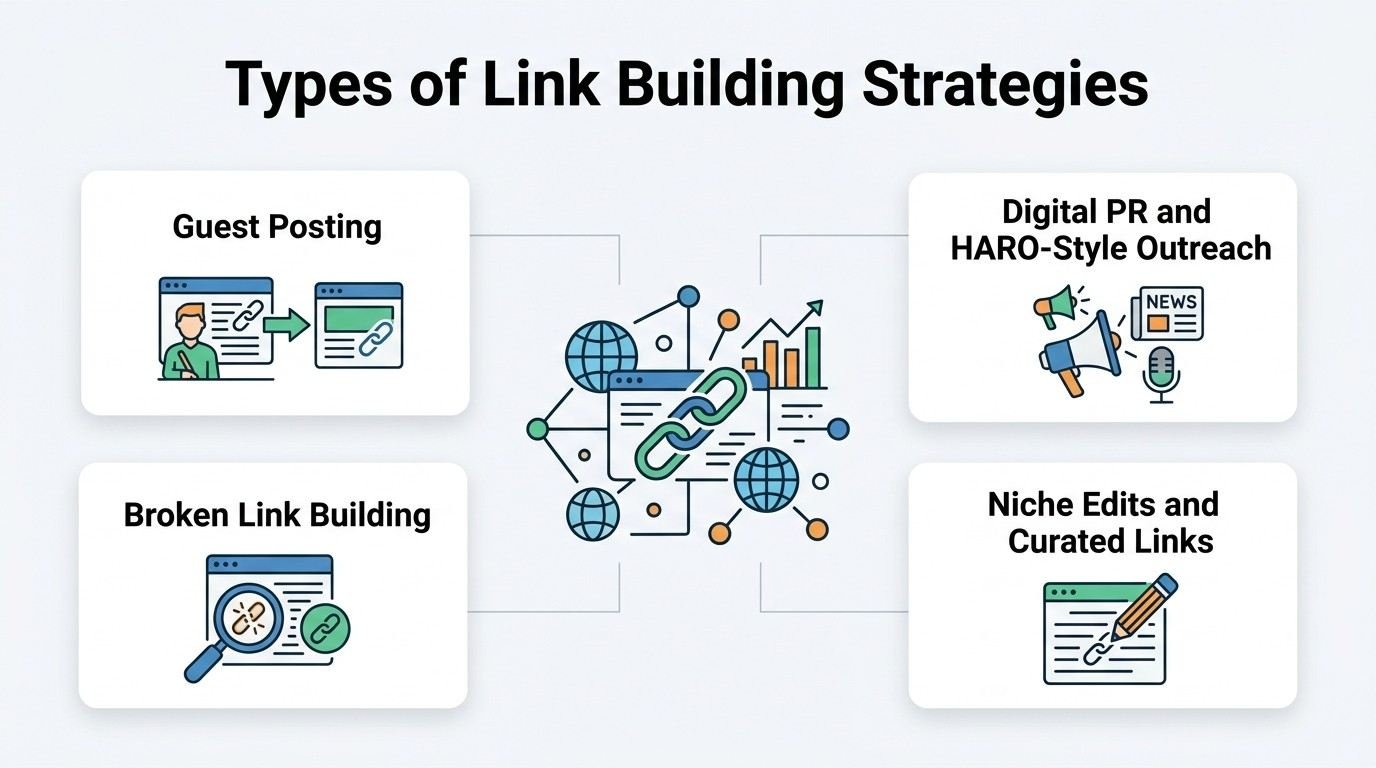
There are several core link building strategies, and the right mix depends on the client’s industry, budget, and existing authority. The table below shows what a reader wants to know here: not just what each strategy is called, but how it differs in effort, risk, and cost.
| Strategy | How It Works | Typical Cost Level | Risk Level |
| Guest Posting | Publishing content on relevant third-party sites with a link back | Medium | Low |
| Digital PR | Data stories and campaigns pitched to journalists and bloggers | High | Low |
| Broken Link Building | Finding dead links on relevant pages and offering a replacement | Low–Medium | Low |
| Niche Edits | Adding a link into existing, already-ranking content | Medium–High | Medium |
Guest Posting
Guest posting is the practice of writing and publishing an article on another website in exchange for a contextual backlink within the content. It remains one of the most consistent link-building channels because it scales predictably once a provider has established outreach relationships.
Digital PR and HARO-Style Outreach
Digital PR involves pitching data-driven stories, original research, or expert commentary to journalists and publishers in exchange for coverage and a link. This strategy tends to produce the highest-authority links because news and media sites typically carry strong domain trust.
Broken Link Building
Broken link building means finding dead or broken links on relevant websites and pitching the site owner a working replacement ideally, the client’s own content. It works because website owners generally want to fix broken links; it’s good for their own user experience too.
Niche Edits and Curated Links
Niche edits are links inserted into existing, previously published content rather than a brand-new article. These links can pass authority faster since they’re added to a page that’s already earned trust and rankings, though they require more careful vetting to avoid manipulative placements.
What Makes a Link Valuable?
A link’s value comes down to the authority of the linking domain, its topical relevance to the client’s site, and whether it sits on a page that gets genuine organic traffic. Not all backlinks carry equal weight, even from sites with similar-looking metrics.
Domain Authority and Domain Rating
Domain Authority and Domain Rating are third-party metrics, from Moz and Ahrefs respectively, that estimate how likely a website is to rank well based on its backlink profile. Neither metric is used directly by Google, but both act as useful shorthand for judging a prospective link source.
Relevance and Topical Alignment
Relevance refers to how closely a linking site’s subject matter matches the client’s industry or niche. A backlink from a directly relevant site in the same industry typically carries more ranking value than a high-authority but topically unrelated site.
Traffic and Editorial Placement
A link’s placement and surrounding traffic matter because search engines can factor in whether real users are actually clicking and engaging with the linking page. A link buried in a footer or a low-traffic directory page contributes far less than one placed naturally within a well-read article.
Link Building Metrics That Actually Matter
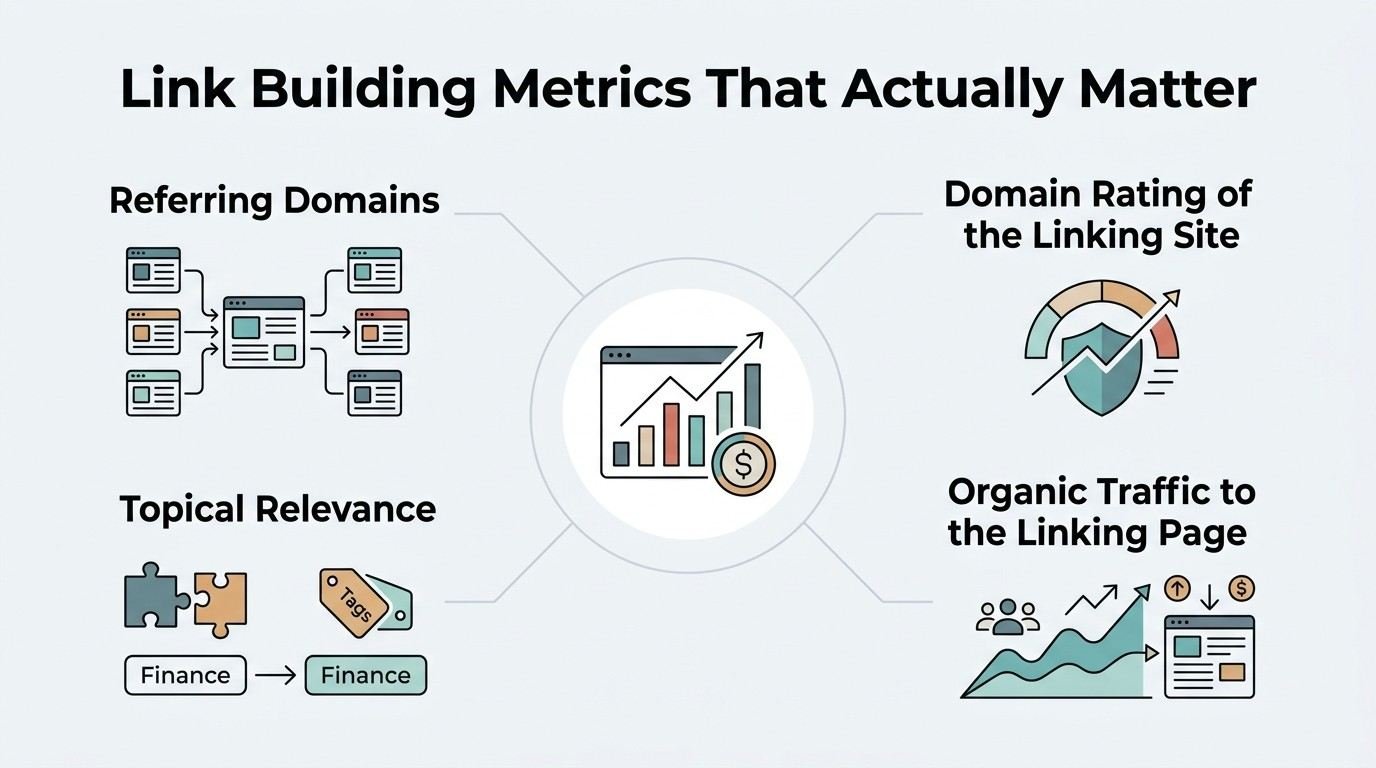
The metrics that matter most in link building are referring domains, domain rating of the linking site, topical relevance, and organic traffic to the linking page. I pay far less attention to raw link count than most reports suggest clients should.
Referring domains The count of unique websites linking to a page tends to correlate more strongly with rankings than total backlinks, since ten links from one site carry less weight than ten links from ten different sites. A Backlinko analysis of 11.8 million search results found that the number of unique referring domains was one of the strongest ranking correlations across the entire dataset studied.
How Much Do Link Building Services Cost?
Link building services in the US typically cost between $500 and $20,000 per month, depending on the volume, quality tier, and strategy mix involved. Per-link pricing for a single high-quality placement generally ranges from $150 to $1,500, with digital PR campaigns often costing more due to the content production involved.
Pricing this widely varies because a $150 link and a $1,500 link are not interchangeable products. The cheaper end usually reflects lower-authority sites, faster turnarounds, and less rigorous vetting, while higher pricing reflects genuine editorial relationships and stronger domains.
Link Building Timelines: What to Expect Month by Month
Link building typically takes three to six months to show measurable ranking movement, though initial placements can begin appearing within the first four to six weeks. The table below breaks down what’s realistic at each stage.
| Timeframe | What Typically Happens |
| Weeks 1–4 | Prospecting, vetting, and initial outreach begin |
| Weeks 4–8 | First links start going live |
| Months 2–4 | Link velocity increases; early ranking shifts may appear |
| Months 4–6+ | Compounding authority gains; measurable traffic and ranking improvements |
I always tell clients that link building is closer to compound interest than a light switch. The value builds gradually as the domain’s overall authority strengthens.
White Hat vs Gray Hat vs Black Hat Link Building
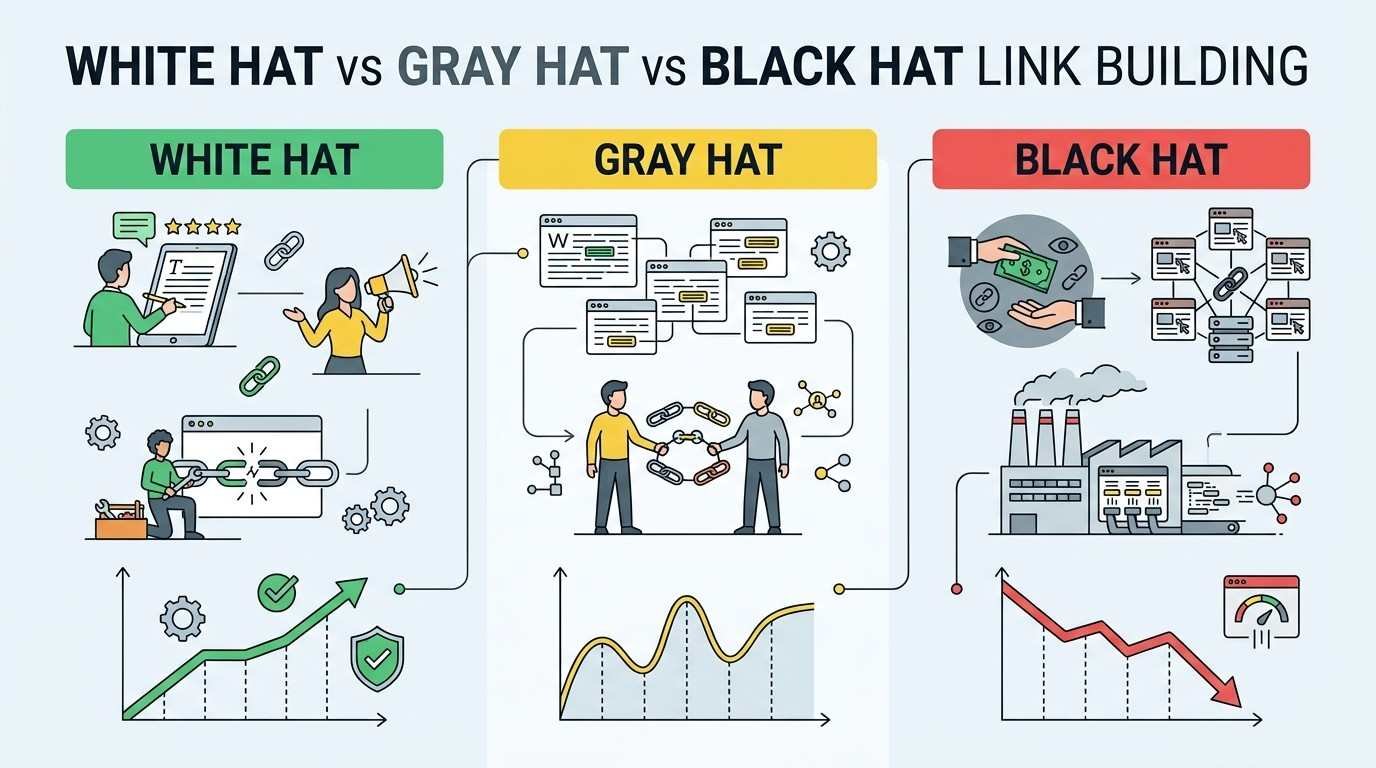
White hat, gray hat, and black hat describe three risk tiers of link building tactics, ranging from fully compliant with search engine guidelines to explicitly manipulative. Understanding where a tactic falls matters because the wrong choice can trigger a manual action or algorithmic penalty.
| Category | Examples | Risk Profile |
| White Hat | Guest posting, digital PR, broken link building | Low, compliant with guidelines |
| Gray Hat | Aggressive niche edits, heavy reciprocal linking | Medium, some guideline ambiguity |
| Black Hat | Paid links with no disclosure, private blog networks (PBNs), link farms | High, direct guideline violation |
Google’s Search Central spam policies explicitly name link schemes as a violation that can lead to ranking demotions or removal from search results entirely.
How to Vet a Link Building Provider
Vetting a link building provider means reviewing their outreach methods, sample placements, and reporting transparency before signing a contract. I always ask providers to show real, live examples of past client placements rather than screenshots or anonymized case studies.
A trustworthy provider should be able to explain exactly how a link was earned, on what kind of site, and why it fits the client’s niche. Vague answers about “high DA sites” without specifics is usually the first sign of a weak program.
Red Flags: Link Building Tactics to Avoid
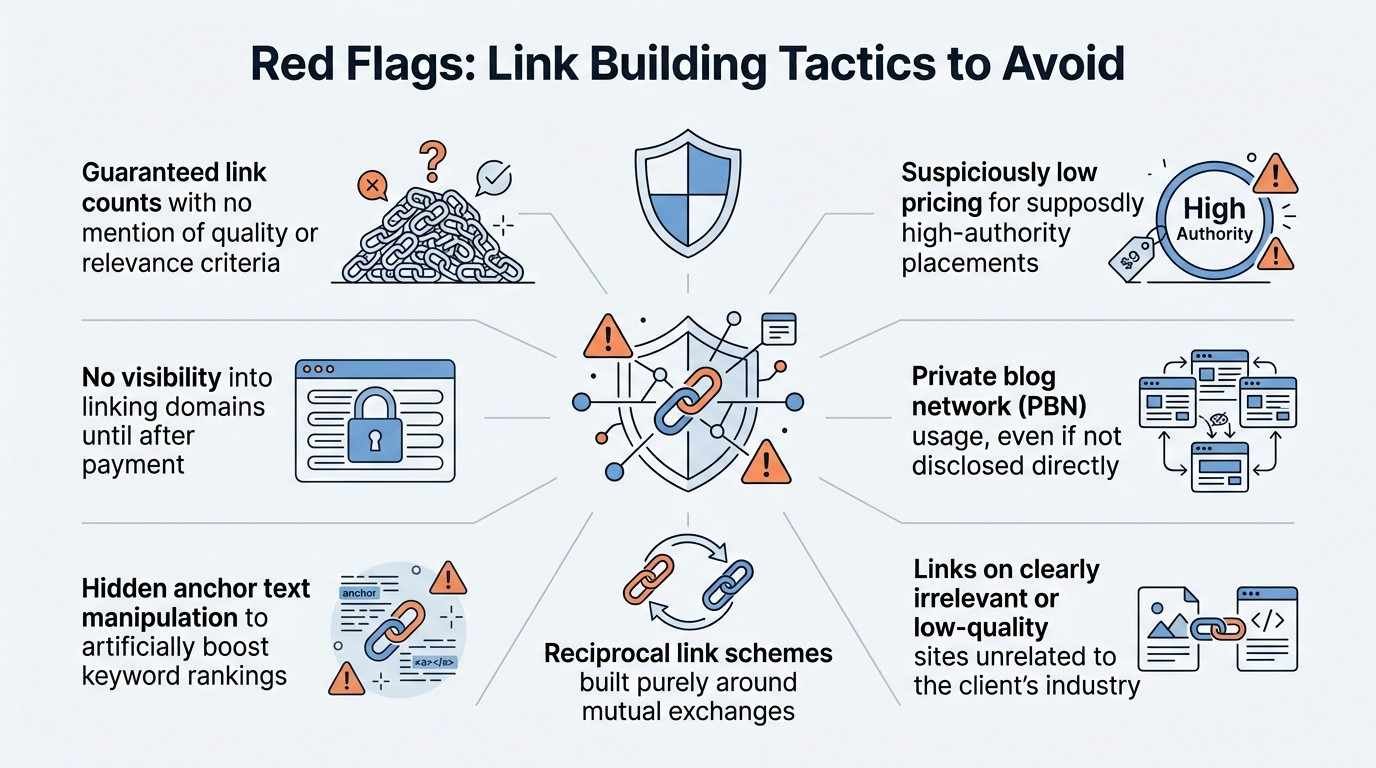
Certain link building tactics signal a high risk of penalty or wasted spend, and spotting them early protects both rankings and budget. Watch for these signs before committing to any provider.
- Guaranteed link counts with no mention of quality or relevance criteria
- Suspiciously low pricing for supposedly high-authority placements
- Private blog network (PBN) usage, even if not disclosed directly
- No visibility into linking domains until after payment
- Reciprocal link schemes built purely around mutual exchanges
- Links on clearly irrelevant or low-quality sites unrelated to the client’s industry
Link Building vs Other SEO Services
Link building is one component of SEO, distinct from technical SEO, on-page optimization, and content strategy, each of which addresses a different ranking dimension. Technical SEO ensures a site can be crawled and indexed properly, on-page optimization aligns content with search intent, and link building builds third-party trust signals.
None of these disciplines fully substitutes for another. A technically flawless site with zero backlinks competes at a disadvantage against a well-linked competitor with similar content quality.
How Link Building Impacts Rankings, Traffic, and ROI
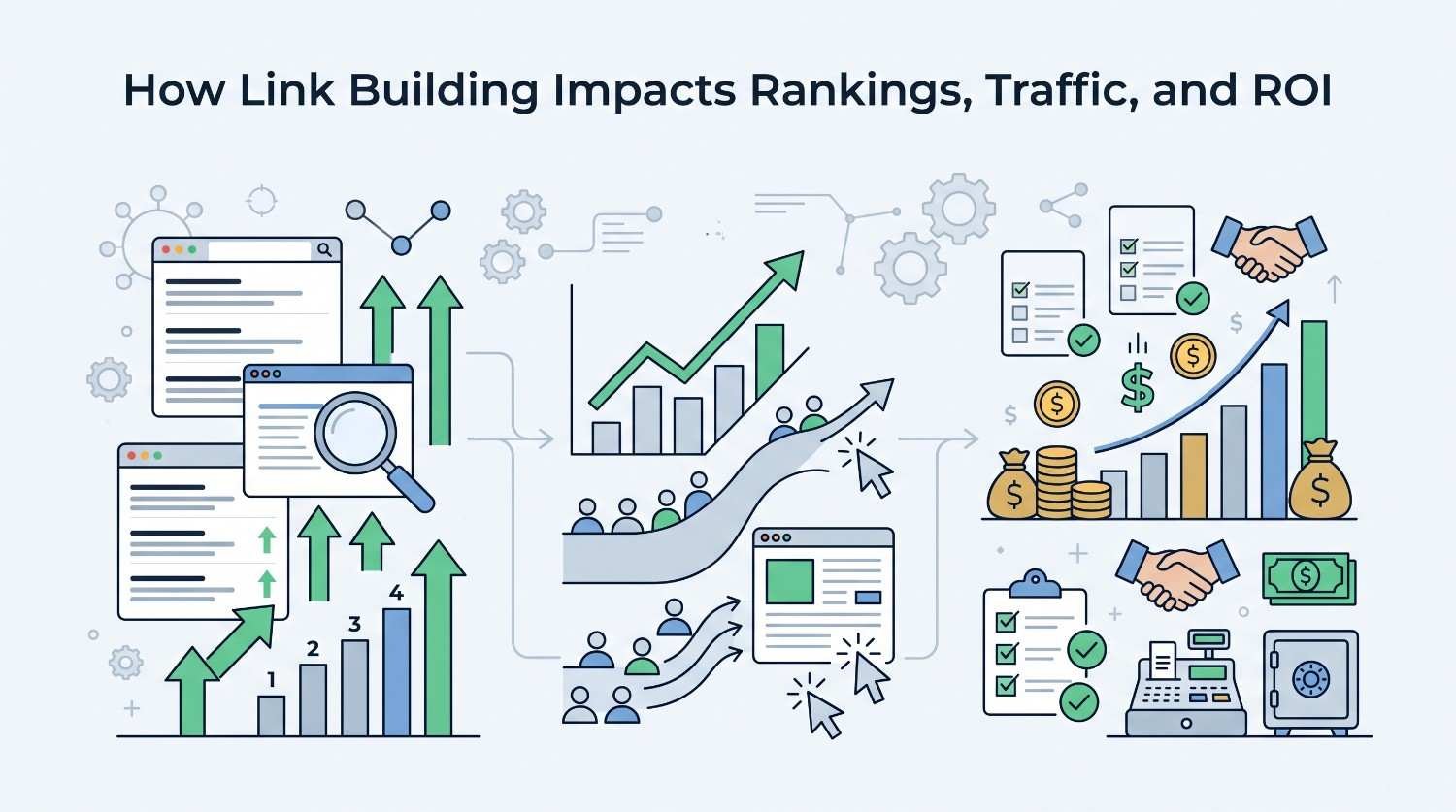
Link building’s impact shows up as improved keyword rankings first, followed by increased organic traffic and, eventually, more leads or revenue from that traffic. I track this impact across three stages rather than expecting it to hit all at once.
Rankings typically move first, usually within two to four months of consistent link acquisition. Traffic growth follows a few weeks behind ranking gains, and revenue impact trails traffic by another reporting cycle or two, since new visitors still need to convert.
A Sistrix study on click-through rates found that the top three organic positions capture roughly 54.4% of all clicks on a typical search results page, which is a large part of why ranking improvements from link building translate so directly into traffic gains.
Reporting and Transparency: What Deliverables Look Like
Transparent link building reporting includes the live URL of each placement, the linking domain’s authority metrics, anchor text used, and the publication date. I expect a monthly report that I could hand directly to a skeptical client without needing to explain anything.
Providers who withhold specific URLs until a contract ends, or who report only in aggregate numbers like “12 links this month,” are usually hiding something about link quality. A transparent link building report should read like an audit trail, not a summary slide.
Is Link Building Right for My Business Right Now?
Not every business needs an aggressive link building program on day one. A newer site with thin content or unresolved technical issues usually gets more value from fixing those foundations first, since links pointing to a weak site produce diminished returns.
In-House vs Outsourced Link Building
In-house link building means hiring or training internal staff to run outreach and relationship building, while outsourced link building means hiring an agency or specialist team to manage the process. The right choice usually comes down to available time, existing relationships, and outreach expertise.
Building an internal outreach function from scratch typically takes six months or more before it produces consistent results, since relationships and domain contacts take time to develop. Outsourcing tends to shortcut that ramp-up period because an established provider already has existing publisher relationships.
How Link Building Fits Into a Full SEO Program
Link building works best as one part of a coordinated SEO program that also includes technical health, keyword-aligned content, and ongoing performance tracking. I rarely see link building alone move the needle if the rest of the site’s SEO foundation is neglected.
A full program treats link building as the authority layer sitting on top of solid technical SEO and content that already satisfies search intent. Skipping straight to links without those foundations tends to waste budget on placements that a fragile site can’t fully capitalize on.
Conclusion
Link building services combine prospecting, outreach, and content creation to earn the backlinks search engines still weigh heavily. Understanding cost, timelines, and provider vetting protects your budget from risky, low-value tactics.
We build link building programs around relevance, transparency, and measurable authority growth, not inflated link counts. Reach out to White Label SEO Service to build a link strategy backed by real reporting and sustainable results.
Frequently Asked Questions
How long does link building take to show results?
Link building typically takes three to six months to produce measurable ranking movement. Early placements often appear within four to six weeks, with compounding gains building afterward.
How much should I budget for link building services?
Most US businesses budget between $500 and $20,000 per month for link building. Per-link pricing generally ranges from $150 to $1,500 depending on quality and strategy.
Is link building still important for SEO in 2025?
Yes, backlinks remain one of the top-weighted ranking signals search engines use. Studies consistently show referring domains correlating strongly with higher search rankings.
What’s the difference between white hat and black hat link building?
White hat link building follows search engine guidelines, using tactics like guest posting and digital PR. Black hat tactics, like paid link schemes or PBNs, violate guidelines and risk penalties.
Can link building hurt my website?
Yes, low-quality or manipulative link building can trigger penalties or ranking demotions. Choosing a transparent provider that avoids spammy tactics protects your site’s long-term rankings.
Do I need link building if my content is already strong?
Strong content helps, but it rarely ranks competitively without backlinks supporting it. Link building adds the third-party trust signal that content alone can’t generate.
How do I know if a link building provider is trustworthy?
A trustworthy provider shows real, live examples of past placements and reports specific linking URLs. Vague claims about “high authority sites” without evidence are a warning sign.