International link building is the practice of acquiring backlinks from websites in different countries or language markets to strengthen a site’s authority and relevance in those specific regions. I think of it as domestic link building’s more complicated sibling: the fundamentals hold, but geography, language, and local search behavior change almost everything else. Business owners expanding into new markets run into this fast.
Getting this wrong wastes budget on links that carry no local weight. Getting it right builds authority exactly where a business needs it, market by market.
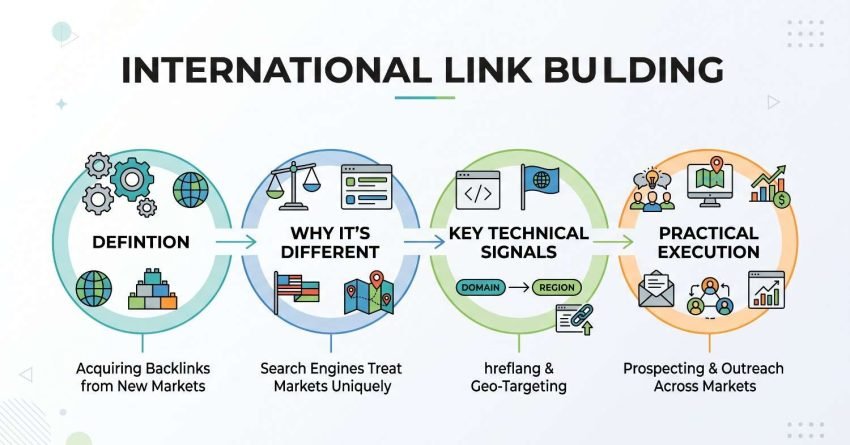
This guide covers what cross-border link building actually is and why search engines treat it differently, the technical signals like hreflang and geo-targeting that connect to link equity, practical tactics for prospecting and outreach across markets, and how to measure results and budget realistically. We’ll walk through the full picture from definition to execution.
What Is International Link Building?
International link building is the process of earning backlinks from region-specific or language-specific websites to build authority and trust with search engines in a target foreign market. It’s not just link building that happens to cross a border. We treat it as a distinct discipline because the destination market’s search engine behavior, competitive landscape, and content expectations differ from the home market.
A US-based company targeting the UK market, for example, needs links from UK-relevant domains, not just high-authority US ones. Geographic relevance and topical relevance often carry equal weight in cross-border campaigns.
I’ve seen teams import a domestic strategy wholesale into a new country and wonder why rankings stall. The gap is almost always link relevance, not link volume.
Why Cross-Border Links Matter for Global SEO
Cross-border links matter because search engines use geographic and linguistic signals from backlinks to determine which regional audience a page should serve. A page with dozens of high-authority home-market links but zero local links in the target country often struggles to rank there at all.
Search engines infer relevance partly from who is linking to a page and from where. Google’s own documentation on international targeting confirms that locale-specific signals, including links, help clarify which market a page is meant to serve.
Trust signals compound over time too. A cluster of relevant local links tells search engines a brand has real standing in that market, not just a presence.
How Search Engines Evaluate International Backlinks
Search engines evaluate international backlinks using a combination of geo-targeting signals and language relevance signals to determine which market a link’s authority should count toward. Two backlinks with identical domain authority can carry very different weight depending on where they originate and what language surrounds them.
Geo-Targeting Signals (hreflang, ccTLD, IP/host location)
Geo-targeting signals include the linking domain’s country-code top-level domain, its hosting location, and any hreflang annotations present on the site. A .de domain linking to a German-language page reinforces the geographic match search engines are already inferring from content.
I pay close attention to ccTLD distribution across a link profile when auditing international campaigns. A profile skewed entirely toward .com domains, even reputable ones, sends a weaker regional signal than a mix that includes local extensions.
Language & Relevance Signals in Cross-Border Links
Language relevance signals come from the linking page’s on-page content, not just its domain extension. A link from a French-language article about a related topic passes stronger contextual relevance than a link from an English page hosted on a French server.
Context around the anchor text matters here too. Search engines read the surrounding paragraph to judge topical fit, and that judgment doesn’t change just because the link crossed a border.
Domestic vs. International Link Building: Key Differences
Domestic and international link building differ primarily in prospecting criteria, outreach language, and the relevance signals search engines weigh most heavily. The table below shows what shifts between the two.
| Factor | Domestic Link Building | International Link Building |
| Prospecting pool | Single-market sites | Multiple region-specific site sets |
| Outreach language | Single language | Multiple languages, often localized |
| Relevance signal weight | Topical relevance dominant | Topical + geographic relevance both weighted |
| Content requirement | Existing content often reusable | Localized or translated content usually required |
| Competitive landscape | One competitor set | Distinct competitor set per market |
Running a domestic playbook against every target country tends to underperform for exactly these reasons. The prospecting pool and outreach approach have to shift per market.
Core Components of a Cross-Border Link Strategy
A cross-border link strategy rests on market-specific prospecting and localized outreach, both built around the target region’s own web ecosystem rather than the home market’s. Skipping either component tends to produce links that look fine on paper but do nothing for regional rankings.
Market-Specific Link Prospecting
Market-specific prospecting means building a separate list of link targets for each country or language market rather than reusing one global list. A prospecting list built for Germany looks structurally different from one built for Brazil, even for the same brand and industry.
I always start this by mapping who already ranks locally for the target keywords, then reverse-engineering their backlink sources. That local competitor set reveals which sites carry real weight in that specific market.
Localized Outreach Approaches
Localized outreach approaches involve contacting site owners and journalists in their own language, using region-appropriate pitch angles and publication norms. A pitch that works with US tech bloggers can fall flat with Japanese trade publications, purely because the expectations around tone and structure differ.
Native-language outreach converts at meaningfully higher rates in my experience than translated templates. Site owners can tell the difference almost immediately.
Link Building Tactics for Multi-Country SEO Campaigns
The main tactics for multi-country link building are localized digital PR, region-specific guest posting, local directory and citation building, and partnerships with in-market publishers. These four approaches cover most successful cross-border campaigns I’ve seen executed well.
- Localized digital PR pitching region-specific angles to local media outlets and journalists.
- Region-specific guest posting contributing to blogs and publications with an established local audience.
- Local directory and citation building: listing on country-specific business directories and industry associations
- In-market publisher partnerships: ongoing content or sponsorship relationships with regional sites
- Localized resource creation: building region-specific tools, data, or guides that naturally attract local links
- Translated content syndication: republishing localized content on regional platforms with backlink attribution
Each tactic pulls different weight depending on the market’s media landscape and how competitive the target keywords already are there.
Evaluating International Link Prospects
International link prospects should be evaluated on local relevance and market authority first, with domain authority treated as a secondary filter rather than the primary one. A moderate-authority site with strong standing in the target country regularly outperforms a high-authority site with no connection to that market.
Domain Authority vs. Local Relevance Trade-Offs
Domain authority measures a site’s general link-earning strength, while local relevance measures how connected that site is to the specific target market. A DA 70 US site and a DA 40 site based in the target country don’t compete on equal footing for a regional campaign; the DA 40 site often wins on relevance alone.
I’ve had to talk clients out of chasing big-name global sites purely for the authority number more than once. The regional impact just wasn’t there.
hreflang, ccTLD, and Technical Foundations for Link Equity
hreflang tags and ccTLD structure don’t directly pass link equity, but they clarify to search engines which market a linked page is meant to serve, which affects how that link’s value gets applied. Getting the technical foundation wrong can mute the benefit of an otherwise strong link.
| Technical Element | Function | Link Equity Impact |
| hreflang tags | Signals language/region targeting per URL | Helps search engines route link relevance to the correct locale version |
| ccTLD | Country-specific domain extension | Reinforces geographic signal search engines already read from links |
| Subdirectory structure (/uk/, /de/) | Organizes content by market under one domain | Consolidates authority while preserving regional signals |
| IP/hosting location | Server location tied to domain | Minor signal, weighted less than hreflang and content language |
A backlink pointing to the wrong locale version of a page, even a technically sound one, ends up reinforcing the wrong market. I check this alignment early in any international audit.
Content Localization’s Role in Earning Cross-Border Links
Content localization increases the likelihood of earning cross-border links because local site owners and journalists overwhelmingly prefer linking to content written natively for their market. Direct translation gets you understood; localization gets you cited.
A currency example, a regional statistic, or a locally relevant case study gives a foreign publisher a genuine reason to reference the page. Generic translated content rarely earns that same reaction.
I’ve watched identical campaigns get dramatically different link pickup purely based on whether the content felt native or translated. The difference shows up fast in outreach reply rates.
Digital PR Strategies for International Markets
Digital PR for international markets works by pitching locally relevant angles, data, or stories to journalists and publications within each specific target country. A single global press release rarely performs as well as country-specific versions built around local news hooks.
- Localize the data angle using country-specific statistics wherever possible.
- Build a media list of journalists who cover the topic in that market specifically.
- Adjust pitch tone and length to match local journalistic norms
- Time pitches around regionally relevant news cycles or events
- Follow up in the local language, not a translated template
This adds real operational overhead compared to single-market PR. The link and mention quality it produces tends to justify the extra work.
Common Risks in Cross-Border Link Building
The most common risk in cross-border link building is acquiring links from low-quality regional link networks that mimic legitimate local sites but carry little real authority or traffic. These networks specifically target companies trying to expand internationally, betting that unfamiliarity with the local web landscape will slip past scrutiny.
Avoiding Low-Quality Regional Link Networks
Low-quality regional link networks typically show inflated domain metrics paired with thin or duplicated content and no real organic traffic. Checking a prospect’s actual organic search visibility in that country, not just its domain authority score, usually exposes the pattern quickly.
I run every unfamiliar regional prospect through a local search visibility check before committing budget. It’s saved more than one campaign from a bad batch of links.
Measuring the Impact of International Link Campaigns
International link campaigns are measured by tracking referring domains by country, geo-specific organic traffic lift, and keyword rank movement within each target locale. Global aggregate metrics tend to hide what’s actually happening market by market.
| KPI | What It Shows | Tracking Method |
| Referring domains by country | Growth in region-specific link authority | Backlink tools filtered by country/TLD |
| Geo-traffic lift | Organic traffic change within the target locale | Google Analytics segmented by country |
| Keyword rank by locale | Ranking movement in the specific market’s search results | Rank tracker set to local search engine/location |
| Referral traffic from new links | Direct visits driven by the acquired links | Referral traffic reports by source domain |
Reviewing these by market rather than in aggregate is the only way I’ve found to know whether a specific country campaign is actually working.
Timeline and Budget Expectations for Cross-Border Link Building
Most cross-border link building campaigns take four to nine months to show measurable ranking movement in the target market, depending on competition and how underdeveloped the existing link profile is. Budgets scale with the number of markets and the localization work each one requires.
| Campaign Scope | Typical Timeline | Relative Budget Range |
| Single new market, low competition | 3–5 months | Lower |
| Single new market, high competition | 6–9 months | Moderate to high |
| Multi-market rollout (3+ countries) | 9–14 months, staggered | High, scales per market |
Rushing a multi-market rollout by cutting localization corners tends to backfire. I’d rather sequence markets properly than launch all of them thin.
Building a Scalable Cross-Border Link Strategy
A scalable cross-border link strategy sequences markets by opportunity size, builds repeatable localization workflows, and reviews performance by country before expanding further. Trying to launch every target market simultaneously with the same team almost always dilutes quality across all of them.
I usually recommend proving the model in one or two markets first. Once the workflow for prospecting, localization, and outreach is repeatable, scaling to additional countries gets significantly more efficient.
We built White Label SEO Service around exactly this kind of market-by-market execution. Our team handles the full cross-border link strategy so your brand can expand into new search markets with confidence.
Frequently Asked Questions
What is international link building?
International link building is earning backlinks from region- or language-specific websites to build authority in a target foreign market. It differs from domestic link building in prospecting, outreach, and relevance signals.
Why do cross-border links matter for SEO?
Cross-border links matter because search engines use geographic and language signals from backlinks to determine which regional audience a page serves. Without local links, rankings in that market often stall.
How is international link building different from domestic link building?
International link building requires market-specific prospecting, localized outreach, and geographic relevance signals that domestic campaigns don’t need. The competitive landscape also differs by country.
Does hreflang affect link building results?
hreflang doesn’t pass link equity directly, but it clarifies which locale a linked page targets. This helps search engines apply a link’s value to the correct regional version.
How long does international link building take to show results?
Most campaigns take four to nine months to show measurable ranking movement in a target market. Timelines depend on competition level and the existing link profile’s strength.
What’s the biggest risk in cross-border link building?
The biggest risk is acquiring links from low-quality regional link networks that mimic legitimate local sites. Checking actual local search visibility, not just domain metrics, helps avoid this.
How do you measure success in international link campaigns?
Success is measured by tracking referring domains by country, geo-specific traffic lift, and keyword rank movement within each locale. Aggregate global metrics tend to obscure market-level performance.