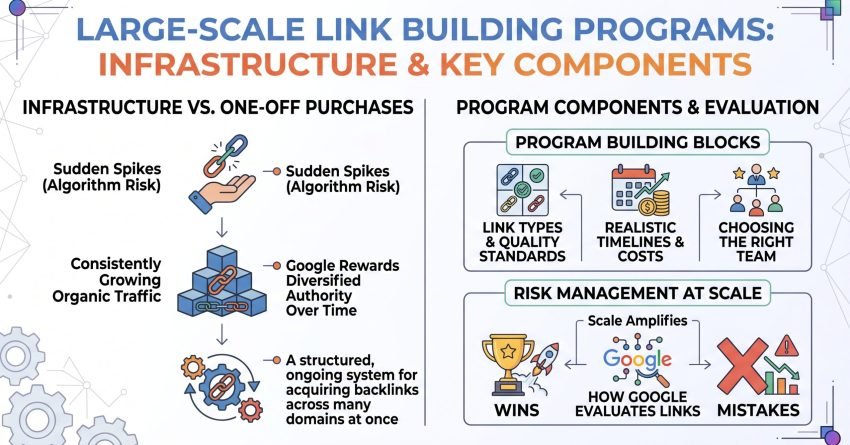
A large-scale link building program is a structured, ongoing system for acquiring backlinks across many domains at once, rather than picking up links one at a time. I’ve watched businesses waste six-figure budgets chasing link volume with no system behind it, and the ones that actually grow organic traffic are the ones treating link building as infrastructure, not a series of one-off purchases. This matters because Google’s algorithms reward consistent, diversified authority signals over time, not sudden spikes.
Most SEO campaigns stall the moment link acquisition slows down. We built this guide because business owners deserve a clear picture of what a real program looks like.
This guide covers what a large-scale program actually is, the link types and quality standards that hold it together, how Google evaluates links at scale, realistic timelines and costs, and how to choose the right team to run it. I’ll walk through the risks too, because scale amplifies mistakes just as fast as it amplifies wins.
What Is a Large-Scale Link Building Program?
A large-scale link building program is a repeatable system for acquiring backlinks across dozens or hundreds of relevant domains on a continuous schedule. I think of it less as a campaign and more as a pipeline of prospecting, outreach, content, and placement running in parallel every month.
One-off link building buys a handful of links and stops. A program keeps running, which is exactly why it needs its own infrastructure behind it. We see this distinction trip up a lot of first-time clients who expect a single push to move rankings permanently.
Larger sites, competitive niches, and businesses chasing national visibility are the ones who actually need this. A local service business with ten competitors rarely needs the same machine as a SaaS company competing in a crowded vertical.
Core Components of a Large-Scale Link Building Program
A large-scale link building program is built from four core components: prospecting, outreach infrastructure, linkable content assets, and quality control. Miss any one of these and the whole system slows down or starts producing weak links.
Prospecting at volume means researching hundreds of potential linking domains every month, not dozens. I lean on tools like Ahrefs’ Link Intersect and Content Explorer to find sites already linking to competitors, since that’s the fastest signal of genuine relevance.
Outreach infrastructure covers the people and systems sending personalized pitches at scale; this includes dedicated outreach specialists, CRM-style tracking, and templated-but-personalized email sequences. Without this layer, prospecting lists just sit there unused.
Content assets built for linkability are the actual reason someone says yes. A boring product page rarely earns links; original research, data studies, and genuinely useful tools do. I’ll get into what makes an asset “linkable” a little further down.
Quality control closes the loop, screening every prospective link against relevance and spam signals before it goes live. Programs that skip this step tend to accumulate weak links that quietly erode trust over time.
Types of Links Used in Large-Scale Campaigns
Large-scale campaigns typically draw from four link types: guest posts, digital PR placements, niche edits, and journalist-sourced links through platforms like HARO. Each type carries a different cost, timeline, and authority profile.
Guest post and contributor links come from writing full articles for other publishers in exchange for a byline link. These are the most controllable link type because you write the content and largely choose the anchor context.
Digital PR and editorial links come from journalists and publishers linking to your site because your data, story, or research earned genuine editorial interest. A study from Backlinko analyzing 11.8 million Google search results found that pages earning links from a wide variety of unique referring domains consistently outranked pages with links from fewer, repeated sources.
Niche edits and curated placements insert a link into an already-published, relevant article rather than creating new content. They’re faster to execute than guest posts but require more scrutiny, since the existing page’s history and link profile matter as much as its current content.
HARO and journalist-sourced links come from responding to reporter queries with expert quotes, in exchange for a citation link. This channel produces some of the strongest editorial links in a program, though response rates are unpredictable.
How Link Quality Is Measured and Protected at Scale
Link quality at scale is measured through domain authority metrics, topical relevance, and traffic signals, then protected through ongoing spam screening before and after placement. A program moving fast without this layer accumulates risk quietly.
Domain rating, authority scores, and relevance to your niche form the baseline filter for any prospective link. Ahrefs reports that domains with a Domain Rating above 30 combined with topical relevance produce measurably stronger ranking impact than high-DR but irrelevant domains.
Spam signals include thin content, link farms, excessive outbound links, and domains with unnatural anchor text distributions. I flag any site showing more than a handful of these traits and pull it from the prospect list entirely, no matter how attractive the metrics look on the surface.
Building the Outreach and Prospecting Infrastructure
Outreach and prospecting infrastructure is the operational engine that finds, qualifies, and contacts link opportunities on a repeatable schedule. Without this system, even the best content assets never reach the people who’d actually link to them.
Prospecting tools and data sources pull from backlink databases, content gap analysis, and competitor link profiles to build fresh opportunity lists every cycle. Teams running this well treat prospecting as a continuous research function, not a one-time list-building exercise.
Personalization at volume is the hardest part to solve, since generic mass outreach gets ignored and fully custom outreach doesn’t scale. The programs that work best build templates with genuine personalization variables pulled from real research on each target site.
Content Strategy Behind Large-Scale Link Acquisition
Content strategy behind link acquisition means producing assets specifically designed to earn citations, not just rank for keywords. This is a different content brief than a typical blog post, and treating it the same way is a common reason programs underperform.
Linkable asset types that perform tend to be original frameworks, free tools, comprehensive guides, and industry benchmarks that other writers can cite as a source. A generic “top 10 tips” post almost never earns organic links, regardless of how well it’s written.
Data studies and original research consistently outperform every other asset type for earning links, because journalists and bloggers need a number to cite. Running a small proprietary survey or analyzing a public dataset in a novel way tends to generate outsized link return relative to production cost.
How Google Views Large-Scale Link Building Programs
Google evaluates large-scale link building programs by looking for natural link velocity, topical diversity, and organic-looking acquisition patterns rather than the sheer number of links gained. A program that looks manufactured draws more scrutiny than one that looks like the natural result of good content.
Natural link velocity means links accumulate at a pace and pattern that resembles organic growth some months higher, some lower- from a mix of source types. Sudden, uniform spikes in links with identical anchor text are exactly the pattern Google’s Search Central documentation flags as a manipulative link scheme.
Google’s guidelines explicitly prohibit paid links that pass PageRank without proper disclosure, large-scale guest posting campaigns run purely for links, and automated link exchange schemes. Any program built at scale needs a clear line between “content marketing that happens to earn links” and “link buying dressed up as content.”
Realistic Timelines for Large-Scale Link Building Results
Realistic timelines for large-scale link building results run in three phases: minimal visible movement in the first three months, measurable ranking gains between three and nine months, and compounding authority gains after nine months. Programs sold on faster timelines are usually cutting corners somewhere.
Short-term movement in the first zero to three months is mostly foundational: prospecting pipelines get built, initial outreach goes out, and the first handful of links start landing. Rankings rarely move meaningfully in this window, no matter how well the program is run.
Mid-term momentum between three and nine months is where most clients start seeing keyword position improvements and traffic growth, as accumulated links begin passing meaningful authority. This is typically when link building starts showing up clearly inside Google Search Console’s performance reports.
Long-term compounding after nine months is where the real return shows up, as authority signals stack and older links continue passing value while new links keep landing. Businesses that stop the program early routinely lose the compounding effect they spent months building toward.
Costs and Budgeting for Large-Scale Link Building Programs
Costs for large-scale link building programs typically run from a few thousand to well over fifty thousand dollars per month, depending on link volume, content production, and outreach team size. Per-link pricing, monthly retainers, and hybrid models each shift where that budget actually goes.
Pricing models vary between per-link fees (paying for each secured placement), flat monthly retainers (covering the full team and process regardless of exact output), and hybrid models blending both. I generally see retainers produce more consistent quality, since the incentive isn’t tied to link count alone.
What drives cost variance comes down to domain authority requirements, content production complexity, and how competitive the target niche is for outreach. A program targeting DR 50+ sites in a competitive B2B niche costs meaningfully more than one targeting general-interest blogs.
Measuring ROI and Performance of a Link Building Program
Measuring ROI on a link building program means tracking keyword rankings, organic traffic growth, and referring domain growth against the program’s monthly investment. Without this tracking, it’s impossible to know if the spend is actually working.
Key metrics to track include net new referring domains per month, keyword position changes for target pages, and organic traffic lift measured through Google Analytics segmented by landing page. I check referring domain growth specifically, since raw link count can be inflated by multiple links from the same low-value domain.
Attributing rankings and traffic to links specifically (versus other SEO work happening simultaneously) requires isolating pages that received links from pages that didn’t, then comparing their trajectories. This kind of controlled comparison is the only reliable way to separate link impact from content or technical changes happening at the same time.
Risks, Penalties, and Common Pitfalls at Scale
The biggest risks in large-scale link building are unnatural link velocity, over-optimized anchor text, and low-quality placements that trigger manual actions rather than rankings. Scale multiplies every mistake, which is exactly why quality control matters more here than in smaller campaigns.
Link velocity red flags show up when a site gains links far faster than its content or brand growth would naturally justify, especially with repetitive anchor text patterns. Programs that vary link sources, timing, and anchor phrasing avoid tripping this signal.
Recovering from a manual action typically means auditing the entire backlink profile, disavowing toxic links through Google Search Console, and waiting through a slow reconsideration process. This recovery process routinely takes months and can erase a year or more of ranking progress in the meantime.
In-House vs. Agency vs. White Label Link Building
Choosing between in-house, agency, and white label link building comes down to budget, existing team capacity, and how much specialized outreach expertise the business already has. Each model fits a different stage of growth.
In-house teams make sense for businesses with enough budget to hire dedicated outreach and content staff, and enough volume to keep them busy year-round. Below a certain scale, this option often sits idle or gets pulled into other marketing tasks.
Outsourcing makes sense when a business needs outreach expertise and existing industry relationships faster than it could build them internally. This is where many agencies turn to a white label SEO service to deliver link building without building the entire outreach function from scratch.
How to Choose a Link Building Partner for Scale
Choosing a link building partner for scale means vetting their prospecting standards, reporting transparency, and actual placement quality, not just their promised link count. A partner focused purely on volume is the fastest way to end up with a toxic backlink profile.
Vetting questions worth asking include how they source prospects, what disqualifies a site from their list, and whether they can show live examples of recent placements. A partner unwilling to show real, recent work is a signal worth taking seriously.
Transparency and reporting standards should include monthly reports listing every link placed, its domain metrics, and the anchor text used. Programs without this level of reporting make it nearly impossible to audit quality after the fact.
Integrating Link Building Into a Broader SEO Strategy
Integrating link building into a broader SEO strategy means aligning it with technical SEO health and content strategy, rather than running it as an isolated activity. Links pointing to a technically broken or thin page rarely convert into ranking gains.
Aligning links with technical SEO means confirming the target pages are crawlable, fast, and free of indexing issues before investing heavily in acquiring links to them. Sending authority to a page Google can barely crawl wastes most of that authority.
Aligning links with content strategy means prioritizing link acquisition toward pages already built to rank comprehensive, well-structured content that deserves the authority boost. Links tend to compound fastest on pages that were already strong before the links arrived.
Conclusion
Large-scale link building programs succeed through consistent prospecting, quality content assets, and disciplined quality control across every domain acquired. Rankings compound over nine-plus months as referring domains and authority signals accumulate together.
We see the businesses that treat this as ongoing infrastructure, not a one-time push, pull ahead of competitors still chasing quick wins. Sustainable link acquisition remains one of the strongest long-term levers in organic search.
We built White Label SEO Service to run exactly this kind of program for agencies and brands. Reach out and let’s map out what a real program looks like for your growth goals.
Frequently Asked Questions
How long does a large-scale link building program take to show results?
Most programs show measurable ranking movement between three and nine months, with compounding gains after nine months. Earlier promises usually mean shortcuts somewhere in the process.
How much does large-scale link building typically cost?
Programs typically range from a few thousand to over fifty thousand dollars monthly, depending on link volume and target domain quality. Pricing models vary between per-link, retainer, and hybrid structures.
Is large-scale link building against Google’s guidelines?
It isn’t inherently against guidelines, but paid links passing PageRank without disclosure and manipulative schemes are prohibited. Programs built around genuine content and outreach stay compliant.
What’s the difference between guest posts and niche edits?
Guest posts involve writing new content for a publisher in exchange for a link, while niche edits insert a link into already-published content. Guest posts offer more control; niche edits are typically faster.
How many links per month is considered large-scale?
Large-scale programs typically acquire anywhere from 20 to over 100 links monthly, depending on the niche and budget. Volume matters less than the consistency and relevance of each placement.
Can large-scale link building get a website penalized?
Yes, if links show unnatural velocity, repetitive anchor text, or come from low-quality domains, a manual action becomes a real risk. Diversified, quality-screened placements minimize this exposure.
Should I build links in-house or outsource to an agency?
It depends on budget and existing team capacity: in-house suits high-volume ongoing need, while outsourcing suits businesses needing expertise and relationships faster. Many agencies use white label partners to scale delivery without hiring internally.