Google rolls out thousands of algorithm changes every year, and most site owners only notice when traffic drops. An algorithm-resilient website is one built on fundamentals strong enough to withstand those changes rather than chase them individually. I’ve watched businesses lose 40% of their organic traffic overnight because they optimized for a loophole instead of a foundation. That volatility is avoidable.
Ranking on shaky ground costs real money in lost leads and wasted ad spend as a backup. We see this every quarter with new clients who arrive mid-crisis.
This guide covers what actually makes a site resilient, how Google’s update system works, the penalty types you need to watch for, and the technical, content, and link-based defenses that hold up over time. We’ll also walk through auditing, recovery, and realistic timelines for the whole process.
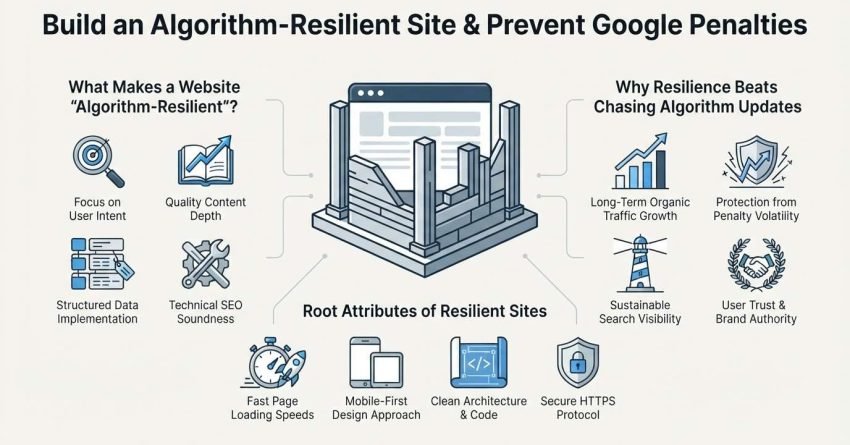
What Makes a Website “Algorithm-Resilient”?
An algorithm-resilient website is a site built on fundamentals strong enough that individual Google algorithm updates cause little to no ranking volatility. It doesn’t rely on tactics tied to a specific loophole or a temporary ranking quirk. I think of resilience as insurance against Google’s own unpredictability.
Root attributes that most resilient sites share include genuine topical depth, clean technical architecture, and a natural backlink profile. Unique attributes vary by niche, but they tend to reinforce the same root qualities rather than replace them.
Root Attributes of Resilient Sites
Resilient sites consistently show strong crawlability, fast page experience, original content, and a link profile built from earned mentions rather than manufactured placements. These attributes overlap heavily with what Google’s own Search Central documentation describes as the foundation of sustainable ranking.
I look for these same signals during every technical audit I run for a new client.
Why Resilience Beats Chasing Algorithm Updates
Chasing individual updates means rebuilding strategy every few months, and that cycle never ends. Resilience-focused SEO fixes root causes instead of symptoms, so a single update rarely causes a major swing.
Sites built this way recover faster on the rare occasion volatility does hit.
How Google Algorithm Updates Actually Work
Google’s algorithm updates are systematic changes to how search results are ranked, released either as broad core updates or narrower, targeted updates addressing specific quality issues. Google runs thousands of minor tweaks every year alongside a handful of major named updates. Most sites never notice the minor ones.
Core updates reassess overall content and site quality at a broad level. Spam updates target manipulative tactics like link schemes or auto-generated content. Product review updates focus specifically on affiliate and review content quality.
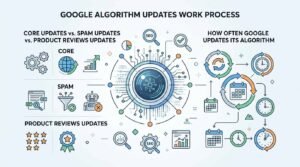
Core Updates vs. Spam Updates vs. Product Reviews Updates
A core update re-evaluates how Google’s systems assess quality overall, and it can lift or lower sites with no algorithmic penalty involved at all. Spam updates specifically target manipulative techniques such as scaled content abuse or link spam. Product review updates apply narrowly to affiliate and review-style content.
Each type demands a different diagnostic approach when traffic shifts.
How Often Google Updates Its Algorithm
Google confirms several thousand algorithm changes per year, though only a handful of major core updates are officially announced. Most changes are small enough that no single site owner would notice them individually.
The announced core updates are the ones worth tracking closely.
The Most Common Types of Google Penalties
A Google penalty is a ranking or visibility reduction applied either manually by Google’s review team or automatically by an algorithm detecting a quality violation. Manual actions come with a notice inside Google Search Console. Algorithmic penalties never do, which makes them harder to diagnose.
Common categories include unnatural links, thin or auto-generated content, cloaking, and structured data abuse. Each has its own detection pattern and recovery path.
Manual Actions vs. Algorithmic Penalties
A manual action is a human reviewer’s decision, delivered with an explicit message and category inside Search Console. An algorithmic penalty happens silently, often as a side effect of a broader quality update, and requires the site owner to diagnose it from traffic patterns alone.
Both can devastate visibility, but they demand entirely different fixes.
Signs Your Site Has Been Hit
A sudden traffic drop that coincides with a known Google update date is the clearest signal. Rankings disappearing for branded terms specifically often indicates something more severe, like a manual action.
Checking the Manual Actions report in Search Console should always be the first diagnostic step.
E-E-A-T and Why It’s Central to Algorithm Resilience
E-E-A-T stands for Experience, Expertise, Authoritativeness, and Trustworthiness, and it’s the framework Google’s quality raters use to judge whether content deserves to rank. It isn’t a direct ranking factor in the technical sense, but it shapes the signals that do rank.
Sites lacking demonstrable experience or clear authorship tend to be the first hit during quality-focused core updates.
Experience, Expertise, Authoritativeness, Trust Explained
Experience means the content creator has actually done the thing they’re writing about. Expertise reflects formal knowledge or credentials in the subject. Authoritativeness measures how the wider web and industry regard that source, and trustworthiness covers accuracy, transparency, and site security.
I treat weak E-E-A-T signals as an early warning during every content audit.
Technical SEO Foundations That Protect Against Penalties
Technical SEO foundations are the crawlability, indexing, and performance elements that let Google access and understand a site without friction. Weak technical health doesn’t usually trigger a penalty directly, but it amplifies the damage when a quality update hits.
Clean architecture, fast Core Web Vitals scores, and mobile-first compliance form the baseline every resilient site needs.
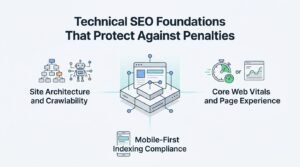
Site Architecture and Crawlability
A logical, shallow site architecture lets Googlebot reach every important page within a few clicks from the homepage. Orphaned pages and broken internal linking waste crawl budget and slow discovery of new content.
I map site architecture before touching anything else on a technical audit.
Core Web Vitals and Page Experience
Google’s Core Web Vitals research shows that pages passing all three thresholds see measurably better retention and conversion rates than pages that fail them. Loading speed, interactivity, and visual stability all factor into the page experience signal.
Slow, unstable pages compound ranking losses whenever a core update reassesses quality.
Mobile-First Indexing Compliance
Google indexes the mobile version of a page as the primary version for nearly all sites now. A site with content, links, or structured data missing from its mobile version effectively loses that content in Google’s eyes.
Testing mobile parity should be routine, not a one-time check.
Content Quality Standards That Survive Algorithm Updates
Content quality standards that survive algorithm updates require original insight, accurate information, and a clear match to what the searcher actually needs. Google’s helpful content systems specifically target material that exists only to attract clicks rather than serve a genuine need.
Depth, originality, and demonstrable first-hand knowledge separate resilient content from content that gets swept out with the next update.
Helpful Content System Signals
The helpful content system looks for signals like whether a page answers the query completely, whether it was written for people first, and whether the site has topical depth in that subject area. Pages produced primarily to rank rather than inform tend to underperform even when technically optimized well.
I audit for this signal set on every legacy content library I inherit.
Thin Content, Duplicate Content, and Content Decay
Thin content lacks the depth to fully satisfy the query it targets. Duplicate content confuses which version should rank and dilutes authority signals across near-identical pages. Content decay happens when previously ranking pages lose relevance as information ages or competitor content improves.
All three erode resilience gradually rather than causing a sudden drop.
Link Profile Health and Off-Page Risk Factors
Link profile health measures whether a site’s backlinks look natural and editorially earned rather than manufactured for ranking manipulation. A single toxic link rarely causes damage on its own, but a pattern of manipulative link building is one of the most common triggers for both manual actions and algorithmic link-spam penalties.
Natural link growth tends to be irregular, diverse in anchor text, and sourced from genuinely relevant sites.
Toxic Backlinks vs. Natural Link Growth
Toxic backlinks typically come from low-quality directories, link farms, or clearly paid placements with manipulative anchor text. Natural link growth accumulates unevenly over time from editorial mentions, citations, and genuine reader shares.
Distinguishing the two requires actually reviewing referring domains, not just counting them.
Link Schemes Google Explicitly Penalizes
Google’s link spam documentation explicitly names link exchanges, paid links passing PageRank, and large-scale guest posting purely for links as violations subject to penalty. These schemes were common practice a decade ago and still linger in many older link profiles today.
Cleaning up a legacy link profile is often the single highest-leverage recovery step.
On-Page Optimization Without Over-Optimization
On-page optimization without over-optimization means using target keywords naturally within content, titles, and headers without triggering spam-pattern detection. Keyword density obsession from the early 2010s is now a liability rather than an advantage.
Modern on-page work focuses on topical coverage and semantic relevance rather than exact-match repetition.
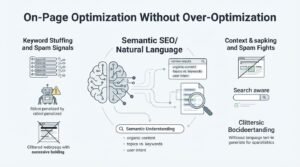
Keyword Stuffing and Spam Signals
Keyword stuffing involves repeating a target phrase unnaturally throughout a page in a way that reads awkwardly to an actual reader. Google’s spam systems flag this pattern algorithmically, often without any human review involved at all.
Writing for the reader first consistently avoids this trap without any extra effort.
Structured Data and Schema Markup Best Practices
Structured data is code added to a page that explicitly tells search engines what the content represents, using a shared vocabulary like schema.org. Misused or fabricated structured data, such as fake review star ratings, is specifically called out as a spam violation and carries manual action risk.
Accurate schema markup for articles, products, and FAQs earns rich results without any penalty exposure when implemented honestly.
How to Audit Your Site for Penalty Risk
Auditing a site for penalty risk means systematically reviewing Search Console data, traffic patterns, and content quality signals to catch problems before they escalate. A quarterly audit rhythm catches most issues while they’re still minor and easy to fix.
The process combines automated monitoring with manual pattern review across technical, content, and link dimensions.
Google Search Console Signals to Monitor
The Manual Actions report, Core Web Vitals report, and Coverage report together surface most early warning signs. A spike in “Discovered – currently not indexed” pages often signals a quality issue Google is quietly flagging.
I check these three reports before anything else during a new client onboarding.
Traffic Drop Diagnosis Checklist
Cross-referencing a traffic drop date against Google’s confirmed update timeline is the fastest first step. Segmenting the drop by page type, query type, and device reveals whether it’s algorithmic, technical, or seasonal.
A drop isolated to one content cluster points to a very different fix than a sitewide decline.
Recovering From a Google Penalty
Recovering from a Google penalty requires identifying the specific violation, fixing the underlying cause completely, and in the case of manual actions, submitting a reconsideration request. Algorithmic penalties resolve on their own once the underlying issue is fixed and Google recrawls and reassesses the site.
Recovery speed depends heavily on penalty type, site size, and how thoroughly the root cause gets addressed.
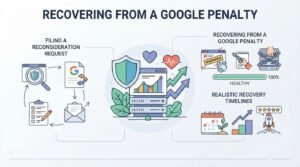
Filing a Reconsideration Request
A reconsideration request is submitted directly through Search Console once every violation has been fixed and documented. The request should explain exactly what was wrong, what was changed, and provide evidence like a disavow file or removed content list.
Vague or incomplete requests get rejected and cost another full review cycle.
Realistic Recovery Timelines
Manual action recovery typically takes two to six weeks after a successful reconsideration request. Algorithmic recovery tied to a core update can take until the next core update rolls out, sometimes several months later.
Setting this expectation early prevents panic-driven decisions mid-recovery.
Building a Long-Term Algorithm-Resilience Strategy
A long-term algorithm-resilience strategy combines ongoing technical monitoring, consistent content quality standards, and disciplined link acquisition into a repeatable governance process. Treating resilience as a one-time project rather than an ongoing practice is the most common reason sites relapse into volatility.
Quarterly audits, documented content standards, and a clear escalation plan for traffic anomalies keep the strategy functioning without constant firefighting.
Governance, Monitoring, and Update Response Planning
Governance means assigning clear ownership over technical health, content standards, and link monitoring so nothing falls through organizational cracks. A documented update response plan tells the team exactly what to check within 48 hours of any confirmed core update.
This structure turns algorithm updates from emergencies into routine check-ins.
SEO Timelines and Realistic Growth Expectations
Most SEO strategies take four to twelve months to produce meaningful organic traffic growth, depending on competition, site age, and starting technical health. Businesses expecting month-one results are usually working from misleading agency promises rather than how search algorithms actually behave.
Competitive industries and newer domains sit at the longer end of that range consistently.
Measuring SEO Performance and ROI
Measuring SEO ROI means tracking organic traffic growth, keyword ranking movement, and conversion data against the cost of the SEO investment over a defined period. Vanity metrics like raw traffic mean little without tying them to leads or revenue.
Tools like Google Analytics and Search Console, paired with CRM conversion data, give the clearest picture of actual return.
Common Algorithm Resilience Mistakes Businesses Make
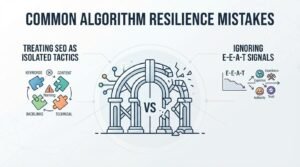
The most common algorithm resilience mistake is treating SEO as a series of isolated tactics instead of an integrated technical, content, and link strategy. Businesses that chase individual ranking factors in isolation tend to build fragile sites that swing wildly with every update.
Ignoring E-E-A-T signals and neglecting a documented content standard are close behind on the list of recurring failures I see during audits.
Conclusion
Algorithm resilience comes from technical health, genuine content quality, and a clean link profile working together, not from chasing any single ranking factor. Google’s updates will keep coming regardless of strategy.
We treat resilience as an ongoing practice, not a project with an end date. Businesses that build this way avoid the volatility everyone else scrambles to fix.
Ready to build a site that holds steady through every update? Partner with White Label SEO Service for a resilience audit today.
Frequently Asked Questions
What is an algorithm-resilient website?
An algorithm-resilient website is one built on strong technical, content, and link fundamentals that hold steady through Google algorithm updates. It doesn’t rely on tactics tied to temporary ranking loopholes.
How long does it take to recover from a Google penalty?
Manual action recovery typically takes two to six weeks after a successful reconsideration request. Algorithmic penalty recovery can take until the next relevant core update, sometimes several months.
What is the difference between a manual action and an algorithmic penalty?
A manual action is a human reviewer’s explicit decision, flagged inside Search Console with a clear category. An algorithmic penalty happens silently through automated systems with no direct notification.
How often does Google update its ranking algorithm?
Google makes several thousand algorithm changes per year, though only a handful of major core updates are officially announced. Most changes are too minor for any single site to notice.
Can toxic backlinks hurt my site without me building them?
Yes, negative SEO attacks using toxic backlinks built by competitors can affect a site’s link profile. Monitoring referring domains regularly and disavowing suspicious links limits this risk.
What is E-E-A-T and why does it matter for penalties?
E-E-A-T stands for Experience, Expertise, Authoritativeness, and Trustworthiness, the framework Google’s quality raters use to judge content. Weak E-E-A-T signals often correlate with sites hit hardest during quality-focused updates.
How much does SEO cost and how soon will I see results?
SEO costs vary widely by scope, but most strategies need four to twelve months before producing meaningful traffic growth. Competitive industries and newer domains typically sit at the longer end of that range.