Local link building is the process of earning hyperlinks from geographically or contextually relevant websites to strengthen a business’s visibility in local search results. I’ve watched this discipline get flattened into “get on more directories” advice for years, and that’s not what actually moves rankings anymore.
Local search has gotten more competitive, and businesses that skip this step keep losing map pack visibility to competitors with fewer resources but stronger local link profiles. We built this guide because most explanations either oversimplify link building or ignore its local dimension entirely.
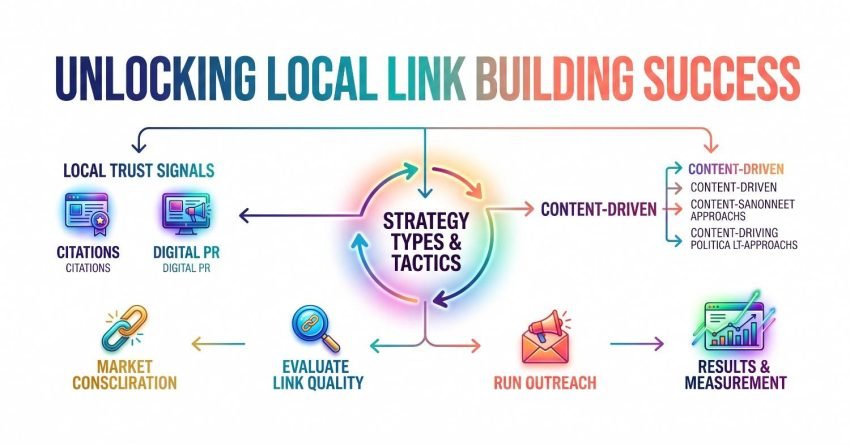
This guide covers what local link building actually is and why it matters, the main strategy types and content-driven tactics for earning links, how digital PR and citations factor into local trust signals, how to evaluate link quality and run outreach, and what realistic costs, timelines, and measurement look like in practice.
What Is Local Link Building?
Local link building is the practice of acquiring backlinks from websites tied to a specific geographic area or local community to improve a business’s local search visibility. It differs from general link building mainly in the source of the link, not the mechanics of earning it.
A link from a city newspaper, a regional chamber of commerce, or a neighborhood blog carries local relevance that a generic high-authority link from an unrelated industry site doesn’t provide. Local relevance signals to Google that a business is genuinely embedded in the community it claims to serve.
How Local Link Building Differs From General Link Building
General link building typically chases domain authority regardless of topical or geographic fit. Local link building prioritizes proximity and relevance; a link from a local radio station’s event page often outperforms a national blog mention for local ranking purposes.
The audience overlap matters too. A local link usually sits on a page that real local customers browse, which means it can drive direct referral traffic in addition to any ranking benefit.
Why Local Relevance Matters More Than Domain Authority Alone
Google’s local algorithm weighs geographic and topical relevance heavily, sometimes more than a link source’s raw authority score. A moderate-authority local news site frequently outperforms a high-authority national directory for local ranking impact.
This happens because Google’s local search systems cross-reference a business’s location signals against the sources linking to it. Relevance closes that loop in a way authority alone cannot.
Why Local Link Building Matters for Local SEO Rankings
Local link building matters because backlinks remain one of the strongest ranking factors search engines use to determine which local businesses deserve map pack and localized organic placement. A Whitespark local ranking factors survey consistently places link signals among the top five ranking factors for map pack visibility.
Businesses with a thin local link profile struggle to outrank competitors even when their on-page optimization and citations are technically flawless.
The Role of Links in Google’s Local Algorithm (Localized Organic + Map Pack)
Google’s local ranking system blends three inputs: relevance, distance, and prominence. Prominence draws heavily on link signals, review volume, and general online visibility.
A business that earns links from credible local sources sends a prominence signal that’s difficult to fake through on-page tactics alone. This is why two businesses with identical citations and reviews can still rank differently in the map pack.
Links vs. Citations vs. Reviews: Different Local Ranking Signals
Links, citations, and reviews are three distinct local ranking signals that serve different functions rather than interchangeable versions of the same tactic. A citation confirms a business’s name, address, and phone number across the web, a review signals customer trust and engagement, and a link passes authority and relevance from one site to another.
Businesses that treat these as one bucket often over-invest in citations while neglecting the link signal that actually moves competitive rankings.
Types of Local Link Building Strategies
Local link building strategies fall into several core categories, each targeting a different type of local relationship or community connection. Choosing the right mix depends on the business type, budget, and competitive landscape.
| Strategy Type | Best For | Typical Effort |
| Local directories/niche listings | New businesses building foundational presence | Low |
| Sponsorships and community involvement | Established businesses with local budget | Medium |
| Local news and digital PR | Businesses with a newsworthy angle | High |
| Chamber of Commerce/associations | Any local business seeking trust signals | Low |
| Local partnerships/cross-promotion | Businesses with complementary local vendors | Medium |
Local Business Directories and Niche Listings
Local directories and niche listings are websites that catalog businesses by category or geography, and they remain a foundational, though no longer sufficient, local link source. Industry-specific directories carry more weight than generic ones because they combine relevance with local proximity.
I still recommend claiming and optimizing the major niche directories relevant to a business’s industry before moving to higher-effort tactics.
Local Sponsorships and Community Involvement
Local sponsorships involve funding or supporting community events, sports teams, or nonprofit initiatives in exchange for recognition that often includes a website link. This tactic works because it’s a mutually beneficial relationship rather than a cold outreach request.
Sponsoring a local 5k run or youth sports league typically earns a link from the event page or the organization’s sponsor list.
Local News and Digital PR
Local news and digital PR involve pitching stories, data, or expert commentary to regional journalists and publications to earn coverage and a link. This tactic produces some of the highest-value local links because news sites carry strong domain trust combined with genuine geographic relevance.
Chamber of Commerce and Local Association Links
Chamber of Commerce and trade association memberships typically come with a directory listing on the organization’s website, which counts as a locally relevant, low-effort link. These links won’t single-handedly move rankings, but they contribute to a well-rounded local link profile that looks natural to search engines.
Local Partnerships and Cross-Promotion
Local partnerships involve two or more complementary local businesses linking to each other through partner pages, joint content, or co-hosted events. A landscaping company and a local nursery, for example, can cross-link naturally because their audiences and services genuinely overlap.
Content-Driven Local Link Building Tactics
Content-driven local link building uses original, locally-focused content assets as the reason other sites choose to link, rather than relying on relationship-based outreach alone. This approach scales better because the content itself does the persuading.
Local Resource Pages and Guides
Local resource pages are comprehensive guides covering a locally relevant topic like “best hiking trails near [city]” designed to attract links from other local sites, bloggers, and community organizations. These pages work because they solve a genuine information need that local publishers want to reference.
Local Data and Original Research
Original local research, such as neighborhood housing trend reports or regional consumer surveys, gives journalists and bloggers a citable data source tied to a specific geography. Data-driven content earns links because publications need sources, not just opinions, to support their local coverage.
Scholarships and Community-Focused Campaigns
Scholarship programs and community-focused campaigns are content and outreach initiatives that offer real value to a local audience, often students or nonprofits, in exchange for a link from schools or community organizations. This tactic has become heavily scrutinized by Google in recent years, so execution and genuine value matter more than the link acquisition angle itself.
Digital PR and Local Media Outreach
Digital PR for local SEO means building relationships with regional media and pitching newsworthy angles that naturally earn coverage and links. This differs from national digital PR because the target list is smaller and the relationships tend to be more durable over time.
Building Relationships With Local Journalists
Local journalists cover a narrower beat than national reporters, which means a business that becomes a reliable local source can earn repeat coverage over months or years. I’ve found that offering expert commentary on local trends works better as an opener than a direct pitch about the business itself.
Newsworthy Local Angles That Earn Coverage
A newsworthy local angle connects a business’s expertise to a timely community event, trend, or issue that a local journalist would cover regardless of the business’s involvement. Angles tied to local economic impact, seasonal trends, or community milestones tend to perform best.
Local Business Citations and Their Link Value
Local citations are online mentions of a business’s name, address, and phone number that reinforce local relevance even when they don’t include a followed link. Citations and links serve different purposes, but a strong citation profile makes earned links more effective by confirming consistency.
NAP Consistency and Its Impact on Local Trust Signals
NAP consistency refers to keeping a business’s name, address, and phone number identical across every online listing and mention. Inconsistent NAP data confuses search engines about which business entity a link or citation actually refers to, which weakens the trust signal even when the link itself is high quality.
Evaluating Local Link Quality
Evaluating local link quality means judging a potential link source by its relevance, trustworthiness, and audience overlap rather than by domain authority score alone. A link from a small but genuinely local blog often outweighs a link from an unrelated high-authority site with no geographic connection.
Relevance vs. Authority in Local Link Prospecting
Relevance in local link prospecting means the linking site shares genuine geographic or topical overlap with the target business, while authority measures the site’s general search engine trust. Prioritizing relevance over raw authority produces a link profile that looks natural and performs better for local queries specifically.
Red Flags of Low-Quality or Spammy Local Links
Low-quality local links typically come from link farms, irrelevant directories, or paid link networks disguised as local business listings. Signs include unrelated site content, excessive outbound links per page, and directories with no editorial review process.
Local Link Building Outreach Process
The local link building outreach process involves identifying relevant local prospects, researching each one individually, and sending a personalized pitch that explains a clear mutual benefit. Outreach that skips personalization consistently underperforms regardless of how strong the underlying content or offer is.
Finding Local Link Prospects
Finding local link prospects means researching community organizations, local media outlets, complementary businesses, and niche directories that serve the same geographic area as the target business. Tools like local search operators, competitor backlink analysis, and community event calendars all surface viable prospects.
Personalizing Outreach for Local Relevance
Personalizing local outreach means referencing specific, verifiable local details about the prospect’s site, audience, or recent content rather than sending a generic templated pitch. A pitch that mentions a journalist’s recent local story earns dramatically higher response rates than a mass email blast.
Common Local Link Building Mistakes to Avoid
The most common local link building mistake is treating every link opportunity as equally valuable regardless of relevance, which dilutes the local signal search engines are trying to detect. Businesses also frequently over-invest in low-value directory submissions while ignoring higher-impact digital PR and content opportunities.
Buying links from local-sounding but irrelevant sites is another frequent error, since Google’s spam detection systems have gotten considerably better at spotting manufactured local link patterns.
How to Measure Local Link Building Success
Measuring local link building success means tracking map pack rankings, localized organic visibility, and referral traffic alongside raw link counts. Link volume alone tells you very little without connecting it to actual ranking or traffic movement.
Key Metrics: Local Rankings, Map Pack Visibility, Referral Traffic
The core metrics for local link building success are keyword rank tracking for geo-modified terms, map pack position tracking, and direct referral traffic from the linking domains themselves. A rise in map pack visibility that coincides with new local links is a strong indicator the strategy is working.
Tools for Tracking Local Link Performance
Tools for tracking local link performance include Google Search Console for referral and impression data, along with local rank tracking platforms that monitor map pack position by geography. Backlink analysis tools also help confirm which links are indexed and passing value.
Local Link Building Costs and Realistic Timelines
Local link building costs vary widely depending on tactic, ranging from free directory submissions to several thousand dollars per month for sustained digital PR campaigns. Businesses should budget based on competitive intensity in their specific local market rather than a flat industry average.
Timelines for visible ranking movement from local link building typically run three to six months, since Google needs time to crawl, index, and factor new links into its trust calculations. A Backlinko study analyzing over 11 million search results found that pages recently earning new backlinks saw ranking improvements averaging several weeks to a few months after acquisition, depending on competition.
Businesses expecting overnight results from a single round of outreach usually abandon the strategy before it has time to compound.
Local Link Building for Multi-Location Businesses
Multi-location businesses face a distinct local link building challenge because each location needs its own geographically relevant link profile rather than a single generalized one. A single national link building campaign rarely serves a business with ten different city-level locations equally well.
Each location page benefits from its own local citations, local sponsorships, and community ties specific to that city or neighborhood, which means the link building workload scales with location count rather than staying fixed.
How Local Link Building Fits Into a Broader SEO Strategy
Local link building works best as one component within a broader SEO strategy that also includes technical optimization, on-page content, and citation management. Treating link building as an isolated tactic disconnected from overall search strategy tends to produce inconsistent results.
We see the strongest outcomes when local link acquisition runs alongside consistent content publishing and ongoing technical health monitoring, since each component reinforces the others’ effectiveness.
Conclusion
Local link building connects relevance, trust, and prominence into the ranking signals that decide map pack and local organic visibility. It works alongside citations, reviews, and technical SEO, not as a replacement for any of them.
We help businesses build these link profiles strategically instead of chasing quick, risky shortcuts. Talk to White Label SEO Service about building a local link strategy that compounds over time.
Frequently Asked Questions
What is local link building?
Local link building is the process of earning backlinks from geographically or topically relevant local websites to strengthen local search visibility. It differs from general link building by prioritizing local relevance over raw domain authority.
How many local links do I need to rank in the map pack?
There’s no fixed number, since map pack rankings depend on relevance, distance, and prominence relative to competitors. A smaller, highly relevant link profile often outperforms a larger, less relevant one.
Are local directory listings still worth it for SEO?
Local directory listings still provide foundational value, especially niche and industry-specific ones. They work best as a base layer alongside higher-impact tactics like digital PR and content-driven links.
How long does local link building take to show results?
Most businesses see measurable ranking movement within three to six months of consistent link acquisition. Google needs time to crawl, index, and factor new links into its trust calculations.
What’s the difference between local citations and local links?
Citations confirm business name, address, and phone number consistency without always including a link. Links pass authority and relevance signals and often (though not always) include referral traffic potential.
Can local sponsorships really improve SEO rankings?
Local sponsorships can improve rankings when they result in a genuine link from the sponsored organization’s website. The ranking value comes from the link itself, not the sponsorship spend.
How much does local link building cost?
Costs range from free directory submissions to several thousand dollars monthly for sustained digital PR campaigns. Budget should scale with the competitive intensity of the specific local market.