An ecommerce SEO penalty is a ranking or visibility loss triggered either by a manual review from Google or by an algorithmic filter reacting to low-quality patterns across a site. Online stores are especially vulnerable because thin product descriptions, duplicate category pages, and aggressive link tactics scale fast across thousands of URLs. A single templated product page issue can multiply into a sitewide credibility problem within weeks.
Ignoring a traffic drop for even a few weeks compounds lost revenue, wastes ad spend compensating for organic losses, and delays the recovery timeline further.
This guide covers how to tell a penalty apart from a normal ranking dip, the algorithm updates and manual actions most likely to hit online stores, the root causes behind catalog-wide penalties, and the diagnostic and recovery steps that get visibility back safely.
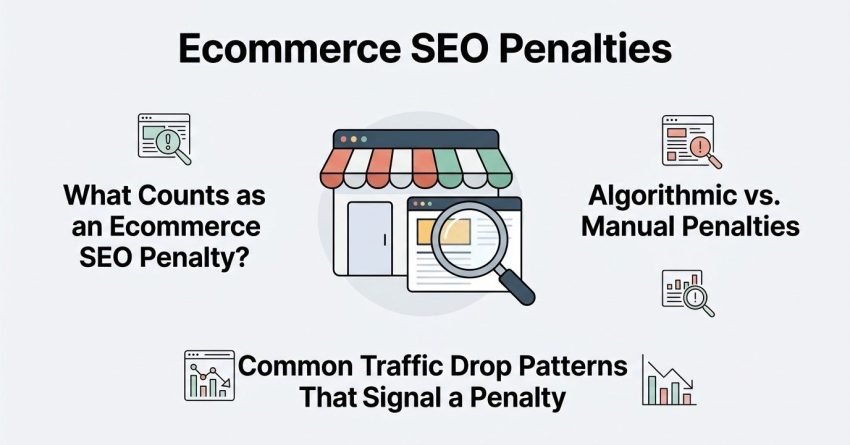
What Counts as an Ecommerce SEO Penalty?
An ecommerce SEO penalty is any deliberate or automated action by a search engine that reduces a store’s visibility because of policy violations or low-quality signals. Penalties fall into two broad categories: manual actions applied by a human reviewer, and algorithmic filters that adjust automatically during a core update or ongoing quality evaluation.
Store owners often confuse a penalty with a seasonal dip or a competitor outranking them. The distinguishing signal is timing: a penalty-driven drop is sudden, often 20% or more within days, and typically lines up with a known update rollout or a Search Console notification.
Algorithmic vs. Manual Penalties
Manual actions come with an explicit notice inside Google Search Console naming the violation and the affected URLs. Algorithmic filters never send a notice; a store simply stops ranking as well after an update rolls out, which makes correlating the drop with a known update timeline essential to diagnosis.
Common Traffic Drop Patterns That Signal a Penalty
A sitewide drop across most category and product pages simultaneously points to an algorithmic cause, while a drop isolated to a specific set of pages or backlinks often signals a manual action. Rankings that vanish for branded terms too, not just competitive ones, usually indicate a manual action rather than a filter.
Manual Actions vs. Algorithmic Filters
A manual action is a penalty applied directly by a Google reviewer after identifying a violation of search quality guidelines, while an algorithmic filter is an automated adjustment with no human review involved. The practical difference matters because each requires a completely different recovery path.
How Google Communicates Manual Actions
Manual actions appear under the Security & Manual Actions report inside Google Search Console, listing the violation type and the affected section of the site. No such notice exists for algorithmic changes, which is why correlating drop dates against known update rollouts becomes the primary diagnostic method for filter-based penalties.
Core Google Algorithm Updates That Hit Ecommerce Sites
Core updates, helpful content systems, and spam-focused updates are the three algorithm families most responsible for ecommerce ranking losses. Each targets a different quality signal, and knowing which one lines up with a traffic drop shapes the entire recovery strategy.

Core Updates
Broad core updates reassess overall page and site quality every few months, and thin or templated product pages are frequently reassessed downward during these rollouts. An Ahrefs study of ranking volatility found ecommerce and affiliate sites experience some of the highest volatility of any site category during core updates.
Helpful Content/Product Review Updates
These updates specifically target content that appears written for search engines rather than shoppers, including auto-generated product descriptions and review pages lacking first-hand testing detail. Stores relying on manufacturer-supplied descriptions across hundreds of near-identical SKUs are frequent casualties.
Spam Updates
Spam updates target manipulative patterns like scaled content abuse, cloaked redirects, and site reputation abuse through low-quality guest content, and ecommerce sites running aggressive PBN-style link campaigns are common targets.
Common Causes of Ecommerce SEO Penalties
Thin content, URL parameter bloat, manipulative link building, and cloaking are the four most frequent root causes behind ecommerce SEO penalties. Most stores are hit by a combination of two or more rather than a single isolated issue.
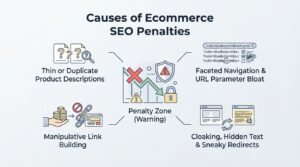
Thin or Duplicate Product Descriptions
Product pages using unedited manufacturer copy across dozens of competing retailers create sitewide duplicate content that algorithmic filters increasingly discount rather than rank. A Search Engine Journal analysis found duplicate product descriptions remain one of the most common technical issues flagged in large-catalog audits.
Faceted Navigation & URL Parameter Bloat
Filter and sort parameters on category pages can generate thousands of near-duplicate indexable URLs, diluting crawl budget and confusing canonical signals across an entire catalog.
Manipulative Link Building
Paid link schemes, excessive guest post exchanges, and PBN placements built purely to inflate rankings violate Google’s link spam policies and frequently trigger manual actions once detected.
Cloaking, Hidden Text & Sneaky Redirects
Showing search engines different content than shoppers see, or redirecting crawlers to unrelated pages, is treated as a direct violation and typically results in a manual action rather than a gradual algorithmic decline.
How to Diagnose an Ecommerce SEO Penalty
Diagnosing an ecommerce SEO penalty starts with checking the Manual Actions report in Google Search Console, then correlating any unexplained traffic drop against known algorithm update dates. These two steps separate a true penalty from normal ranking volatility before any recovery work begins.
Reading Google Search Console Manual Action Reports
The Manual Actions report lists the specific violation category, such as “unnatural links to your site” or “thin content with little or no added value,” alongside the exact URLs or site sections affected. This report is the only authoritative source confirming a manual action exists.
Correlating Traffic Drops With Update Timelines
Overlaying an organic traffic graph against a documented list of confirmed Google update rollout dates reveals whether a drop aligns with a known event. A drop with no alignment to any update or manual action notice is more likely a technical issue, such as an accidental noindex tag or broken redirect.
Auditing Indexation and Crawl Anomalies
A sudden spike in “Crawled currently not indexed” or “Duplicate without user-selected canonical” statuses inside Search Console’s Page Indexing report often accompanies algorithmic quality penalties, since these statuses reflect Google’s own quality assessment of the affected URLs.
Duplicate & Thin Content Penalties in Product Catalogs
A duplicate content penalty in an ecommerce catalog occurs when large sections of product or category pages share substantially identical text, causing search engines to suppress most of the duplicates from rankings. Large catalogs with thousands of SKUs are structurally prone to this because variant and filter pages generate near-identical content at scale.
Variant and Parameter-Based Duplication
Color, size, and sort-order variants of the same base product frequently share nearly all on-page text, and without proper canonical tagging, search engines may index and then suppress dozens of competing near-duplicate URLs simultaneously.
Toxic Backlink & Unnatural Link Penalties
A toxic backlink penalty happens when a site accumulates a pattern of low-quality, paid, or manipulative links that violate Google’s link spam policies, triggering either an algorithmic link-based filter or a manual action. Ecommerce sites are frequent targets of negative SEO attacks specifically because competitors know a link penalty can be difficult to trace back to its source.
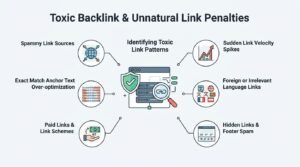
Identifying Toxic Link Patterns
Sudden spikes in referring domains from unrelated foreign-language sites, exact-match anchor text repeated across hundreds of links, or links from clearly automated directory networks are the clearest signals of a toxic link pattern requiring a backlink disavow strategy before recovery can begin.
Structured Data & Schema Markup Penalties
A structured data penalty occurs when a site implements schema markup that misrepresents page content, such as fake review star ratings or inflated pricing data not visible to users. Google has manually and algorithmically cracked down on spammy review schema specifically within ecommerce and affiliate niches in recent years.
Site Migration & Technical SEO Penalties
A site migration penalty is a ranking loss caused by technical errors introduced during a domain change, platform switch, or URL restructuring rather than by a content or link quality issue. These losses are frequently mistaken for algorithmic penalties because the timing coincidentally overlaps with unrelated update rollouts.
Redirect Chain and Canonical Errors
Multi-hop redirect chains, redirects pointing to irrelevant pages, and canonical tags left pointing to a staging environment after launch are the most common migration-related technical failures causing sustained ranking loss.
How to Recover From a Manual Action Penalty
Recovering from a manual action requires fixing every violation named in the Search Console report, documenting the remediation, and submitting a reconsideration request for human review. Skipping documentation is the most common reason reconsideration requests get rejected on the first attempt.
Submitting a Reconsideration Request
The request must explain what caused the violation, exactly what was changed to fix it, and what process now prevents recurrence, since reviewers specifically look for evidence the underlying pattern was addressed rather than just the flagged URLs.
How to Recover From an Algorithmic Penalty
Recovering from an algorithmic penalty means systematically improving the quality signal the update targeted, then waiting for the next algorithm refresh or core update to reflect the improvement. Unlike manual actions, there is no request to submit; recovery is entirely dependent on demonstrated quality improvement over time.
Content Quality Remediation Timelines
Rewriting thin product descriptions, consolidating duplicate variant pages, and adding genuine first-hand product testing content are the highest-impact fixes following a helpful content-related decline.
Ecommerce SEO Penalty Recovery Timelines
Manual action recovery typically takes two to four weeks after reconsideration submission, while algorithmic penalty recovery can take anywhere from one core update cycle to six months or more. These timelines differ because manual actions resolve through direct human review, while algorithmic recovery depends on Google’s next broad reassessment of the site.
How to Prevent Future Ecommerce SEO Penalties

Preventing future ecommerce SEO penalties comes down to maintaining unique product content, monitoring backlink quality continuously, and auditing technical health before and after any site change. A recurring quarterly technical audit catches parameter bloat and duplicate content issues before they scale across an entire catalog.
Ongoing Technical SEO Monitoring
Setting up automated alerts for sudden indexation drops, crawl error spikes, and unusual referring domain growth allows a team to catch early warning signs weeks before a full penalty materializes.
Conclusion
Ecommerce SEO penalties stem from manual actions, algorithmic filters, or technical failures tied to content quality and link integrity. Recovery depends on accurate diagnosis, targeted fixes, and realistic timelines.
Ongoing monitoring and clean technical foundations prevent most future penalties before they start. Search algorithms keep evolving.
We help stores diagnose, recover from, and prevent SEO penalties long-term. Talk to White Label SEO Service today.
Frequently Asked Questions
How long does an ecommerce SEO penalty last?
A manual action typically lasts until a successful reconsideration request is approved, usually two to four weeks. Algorithmic penalties can persist for months until the next relevant update.
Can a product page recover from a duplicate content penalty?
Yes, once the description is rewritten to be unique and canonical tags are corrected. Recovery usually appears within the next crawl and reassessment cycle.
Does changing ecommerce platforms cause an SEO penalty?
A platform migration itself is not a penalty, but technical errors like broken redirects during the switch often cause similar ranking losses. Proper redirect mapping prevents this.
How do I know if my site has a manual action?
Check the Manual Actions report inside Google Search Console. It lists the exact violation and affected URLs if one exists.
Will disavowing backlinks fix a link penalty?
Disavowing toxic links helps only when combined with removing what can be manually removed first. It’s a supporting step, not a standalone fix.
Do algorithm updates target ecommerce sites specifically?
Core updates and helpful content systems affect all site types, but ecommerce sites see higher volatility due to templated and duplicate content at scale.
How often should I audit my site for penalty risk?
A quarterly technical and content audit catches most emerging issues before they compound into a full penalty. High-growth catalogs benefit from monthly checks.