Brand mentions and unlinked citations are references to a business’s name across the web that shape how AI search tools like ChatGPT, Perplexity, and Google’s AI Overviews understand and recommend that brand, even without a clickable link. Traditional SEO trained us to chase backlinks. AI search runs on a different currency: recognition. A name that shows up consistently across forums, news sites, and review platforms builds a footprint that large language models learn to trust and repeat.
Getting this wrong costs visibility in the fastest-growing search channel right now. Businesses that only chase backlinks miss half the picture AI models actually use.
This guide covers what brand mentions and citations mean in an AI context, why AI models weigh them differently than Google’s link-based algorithm, where these mentions come from, and how to build a mention strategy that earns citations in AI-generated answers.
What Brand Mentions and Unlinked Citations Actually Mean
A brand mention is any reference to a business’s name, product, or service on the web, whether or not that reference includes a hyperlink. An unlinked citation happens when a site references a brand by name, in text, without linking to its website something that was largely invisible to traditional ranking systems but is now a meaningful signal to AI search tools.
I think about this distinction constantly when auditing a client’s visibility gaps. A brand can have hundreds of mentions across Reddit threads, comparison articles, and press coverage that never once pointed a hyperlink back home, and those mentions still shape how an AI model describes that brand when a user asks about it.
Brand Mention vs. Backlink – The Core Difference
A backlink is a hyperlink from one website to another, while a brand mention is simply the appearance of a brand’s name in text, with or without a link attached. Google’s classic algorithm was built to weigh links as votes of confidence. AI models, by contrast, are built to recognize entities and patterns of association, which means a mention carries weight even when there’s no href attribute anywhere near it.
What “Unlinked Citation” Means in AI Search Context
An unlinked citation is a textual reference to a brand, product, or entity that appears without a hyperlink but still contributes to how a search system understands that entity’s relevance and reputation. I’ve watched brands with strong unlinked citation footprints outperform competitors with more backlinks in AI Overview results, purely because the citations were consistent and contextually relevant.
Why AI Search Engines Treat Mentions Differently Than Google Search
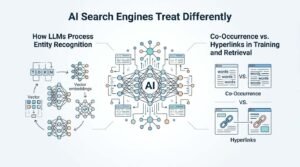
AI search engines process brand mentions primarily through entity recognition and co-occurrence patterns rather than hyperlink structure, which means a name mentioned frequently near relevant topics can influence AI outputs even without any links pointing to the brand’s site. Google’s PageRank-style algorithm never worked this way. It needed the link graph to function.
How LLMs Process Entity Recognition
Large language models identify entities- people, places, brands, and organizations- by recognizing patterns in how those names appear alongside related concepts across massive amounts of training text. We see this play out when a niche software brand gets mentioned repeatedly in “best tools for X” roundups. The model starts associating that brand name with the category, regardless of whether any of those roundups linked out.
Co-Occurrence vs. Hyperlinks in Training and Retrieval
Co-occurrence measures how often two terms or entities appear near each other across text, and this pattern matters more to generative AI models than the presence of a clickable hyperlink. Retrieval-augmented generation systems pull from indexed content at query time, and a brand name surrounded by trustworthy context wins that retrieval moment over a brand that only has scattered, unlinked mentions in low-authority spaces.
The Role of Entity SEO in AI Visibility
Entity SEO is the practice of establishing a brand, product, or person as a recognized entity within a search engine’s knowledge graph, and it functions as the foundation for how AI systems decide which brands deserve mention in generated answers. I approach this differently than keyword-based SEO because the target isn’t ranking for a phrase; it’s being known as a distinct thing worth citing.
Entities vs. Keywords – Why AI Models Think in Entities
An entity is a distinct, identifiable concept, such as a specific company or product, while a keyword is simply a string of words users type into a search box. AI models are trained on relationships between entities, not keyword density, so a brand that’s clearly and consistently identified as an entity across the web gets pulled into AI answers more reliably than one optimized purely around keyword phrases.
Building Entity Associations Across the Web
Strong entity associations form when a brand name consistently appears alongside the same core topics, attributes, and related entities across many independent sources. According to Google’s own documentation on the Knowledge Graph, entities gain confidence scores based on corroborating mentions across the web, which is functionally similar to how generative AI systems build confidence in which brands to surface.
How AI Overviews, ChatGPT, and Perplexity Source Brand Information
AI Overviews, ChatGPT, and Perplexity source brand information primarily through retrieval systems that pull from indexed web content, training data patterns, and, in the case of Perplexity, live web searches performed at the moment of the query. Each platform weighs these sources a little differently, but all three lean on some version of “what does the web say about this brand” rather than “what links point to this brand.”
Retrieval-Augmented Generation (RAG) and Citation Behavior
Retrieval-augmented generation is a method where an AI model pulls relevant documents from an external source at query time and uses them to ground its generated response. A Stanford study on RAG systems found that grounding responses in retrieved documents significantly reduces factual errors, which explains why AI search tools favor brands with clear, consistent, and well-corroborated mentions across multiple independent sources.
Which Platforms Weight Mentions Most Heavily
Perplexity leans most heavily on real-time web retrieval, which means fresh mentions on forums and news sites can influence its answers within days. ChatGPT’s web-browsing mode behaves similarly, while its base training data reflects a longer historical snapshot. Google’s AI Overviews blend its traditional index with generative summarization, so mentions on well-indexed, authoritative pages tend to carry the most weight there.
Where Brand Mentions Come From (Sources That Matter)
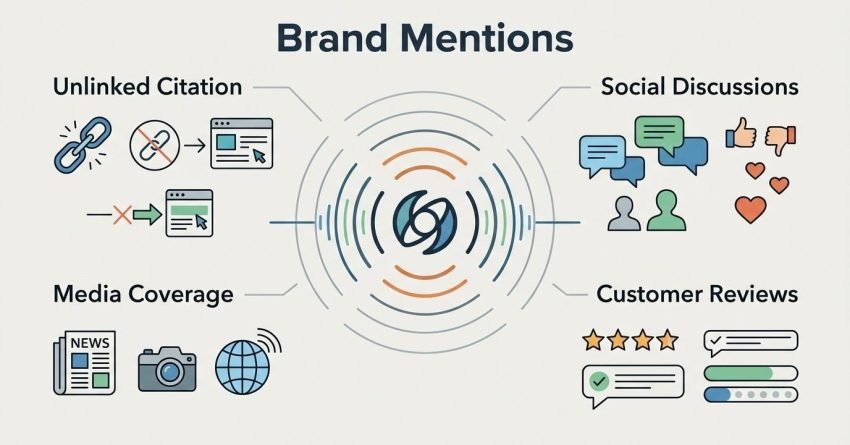
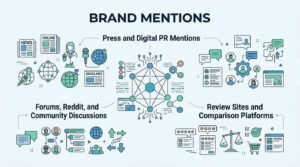
Brand mentions accumulate from press coverage, community discussions, review platforms, comparison articles, and any other content where a business’s name appears in context, and each source type carries different weight depending on the AI platform doing the retrieval. I tell clients to think of this as a distributed reputation system rather than a single link-building campaign.
Press and Digital PR Mentions
Press mentions come from journalists, industry publications, and news outlets covering a business, and they tend to carry outsized weight because AI models are trained to trust editorially vetted sources more than user-generated content. A single feature in a recognized trade publication can do more for entity recognition than dozens of low-authority blog mentions combined.
Forums, Reddit, and Community Discussions
Reddit threads and niche forum discussions have become surprisingly influential sources for AI search tools, since research from BrightEdge found that Reddit content appears in a significant share of Google’s AI Overview citations across multiple industries. Real conversations where users organically discuss a brand carry a kind of authenticity signal that polished marketing copy doesn’t replicate.
Review Sites and Comparison Platforms
Review platforms like G2, Capterra, and Trustpilot generate structured, comparison-heavy content that AI models frequently pull from when answering “best X for Y” style queries. Comparison platforms serve a similar function, and their standardized format, feature lists, pricing tables, and star ratings make it easy for a retrieval system to extract clean, citable facts about a brand.
Do Unlinked Mentions Actually Help Traditional SEO Rankings?
Unlinked mentions can provide indirect SEO value, but they do not pass direct ranking authority the way a hyperlink does within Google’s traditional algorithm. John Mueller and other Google representatives have addressed this question multiple times over the years, generally confirming that mentions can support brand signals without functioning as a substitute for actual links.
What Google Has Said About Implied Links
Google has referred to the concept of “implied links” in patent filings, describing a mechanism where an unlinked brand mention near relevant context could theoretically be treated similarly to a link. A Search Engine Land analysis of Google’s patents noted that while the patent exists, Google representatives have been cautious about confirming its live use, so unlinked mentions remain more valuable for brand and entity signals than for direct ranking boosts in classic search.
Brand Mentions and E-E-A-T Signals
E-E-A-T stands for Experience, Expertise, Authoritativeness, and Trustworthiness, and it’s the framework Google’s quality raters use to evaluate content credibility, with brand mentions serving as external validation of a business’s authority within its niche. A brand that gets referenced organically across independent, credible sources builds a trust footprint that self-published content alone can’t create.
How Consistent Mentions Build Topical Authority
Topical authority develops when a brand is consistently associated with a specific subject area across many different sources, rather than appearing once and disappearing. I’ve seen this compound over time. A brand mentioned in a dozen well-regarded industry publications over a year builds a reputation trail that both traditional algorithms and AI retrieval systems recognize as a durable authority signal, not a one-off spike.
How to Measure and Track Brand Mentions
Brand mention tracking involves monitoring the web for instances where a business’s name, products, or key personnel are referenced, whether linked or not, using a combination of manual search techniques and dedicated monitoring tools. Getting a full picture requires looking past your own backlink profile entirely.
Manual Tracking Methods
Manual tracking starts with running branded searches in Google using quotation marks around the exact brand name, then reviewing results across the web, news, and forum-specific searches. Setting up Google Alerts for brand name variations catches new mentions as they get indexed, though this method misses mentions on platforms that aren’t fully crawled by Google.
Tools for Monitoring Unlinked Citations
Dedicated mention tracking tools scan a much broader set of sources than manual searching allows, including social platforms, forums, and news aggregators that don’t always surface in standard search results. Ahrefs, Semrush, and specialized tools like Mention or Brand24 all offer some form of unlinked mention detection, typically flagging citations that don’t yet include a hyperlink so a team can prioritize outreach.
Turning Unlinked Mentions Into Linked Citations
Link reclamation is the process of finding unlinked brand mentions across the web and reaching out to request that the site add a hyperlink to the brand’s official page. This remains one of the highest-ROI SEO tactics precisely because the hardest part, earning the mention itself, has already happened.
Outreach Strategies for Link Reclamation
Effective outreach starts by identifying the highest-authority unlinked mentions first, since converting those into links delivers the most SEO value per email sent. A short, direct message thanking the site for the mention and politely requesting a link addition tends to convert far better than a generic templated pitch, especially when it’s sent to the actual author rather than a general contact address.
Building a Brand Mention Strategy for AI Search Visibility
A brand mention strategy for AI search visibility combines digital PR, community engagement, and structured data consistency to maximize the number of credible, contextually relevant references to a brand across the web. This isn’t a one-time project. It’s closer to an ongoing reputation-building function that sits alongside traditional SEO and content marketing.
Digital PR and Earned Media Tactics
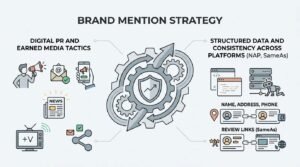
Digital PR campaigns that earn coverage in trade publications, industry roundups, and expert commentary pieces generate exactly the kind of high-authority, editorially vetted mentions that AI retrieval systems weight most heavily. Building relationships with journalists covering a specific industry pays dividends far beyond a single article, since those same reporters tend to return for quotes on future stories.
Structured Data and Consistency Across Platforms (NAP, SameAs)
Consistent Name, Address, and Phone number information, commonly abbreviated as NAP, across every platform where a business appears helps search engines and AI systems confirm that scattered mentions all refer to the same entity. Adding sameAs schema markup linking a brand’s official site to its verified social profiles and business listings gives AI crawlers a direct, structured way to confirm entity identity across the fragmented web.
Common Mistakes That Undermine Brand Mention Value
The most damaging mistake businesses make is treating brand mentions as an afterthought rather than a deliberate strategy, which leaves inconsistent naming, fragmented profiles, and missed reclamation opportunities scattered across the web. I audit this constantly, and the pattern repeats: strong products with a messy, inconsistent digital footprint.
Inconsistent Naming and Fragmented Entity Signals
Inconsistent naming happens when a business appears under slightly different names, abbreviations, or formatting across different platforms, which fragments the entity signals that AI models and search engines rely on to build a unified profile. A company that appears as “Acme Co,” “Acme Company,” and “Acme Corporation” across different directories forces search systems to work harder to connect those mentions to a single entity, weakening the cumulative authority each one could have contributed.
The Future of Citations in an AI-Driven Search Landscape
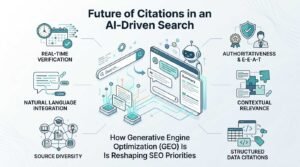
Citations are becoming the primary currency of AI-driven search, replacing some of the weight that backlinks held in traditional SEO, as more user queries get answered directly within AI-generated summaries rather than through a list of ranked links. This shift rewards brands that build genuine reputation and recognition rather than those that only optimize for crawlability.
How Generative Engine Optimization (GEO) Is Reshaping SEO Priorities
Generative Engine Optimization is the practice of optimizing content and brand presence specifically to be cited, quoted, or recommended within AI-generated search responses, and it’s forcing SEO teams to prioritize entity clarity and citation-worthy content alongside traditional keyword targeting. I expect this to keep accelerating as more search volume shifts toward conversational, AI-mediated answers instead of the traditional ten blue links.
Conclusion
Brand mentions, unlinked citations, and entity recognition now shape AI search results as much as backlinks once shaped Google rankings. Building genuine, consistent recognition across the web matters more than ever.
The shift toward AI-mediated search rewards brands with strong reputational footprints across press, forums, and review platforms. This trend will only accelerate.
We help brands build the citation footprint AI search rewards. Talk to White Label SEO Service about strengthening your entity visibility today.
Frequently Asked Questions
Do unlinked brand mentions help SEO rankings?
Unlinked brand mentions can provide indirect SEO value through brand signals, though they don’t pass direct ranking authority as hyperlinks do. They matter more for AI search visibility than for classic Google rankings.
How does ChatGPT decide which brands to mention?
ChatGPT relies on training data patterns and, in browsing mode, real-time retrieval to identify brands associated with a topic. Brands mentioned frequently and consistently across credible sources get surfaced more often.
What is the difference between a citation and a backlink in AI search?
A citation is any textual reference to a brand, linked or not, while a backlink specifically includes a hyperlink. AI search tools weigh both, but citations without links still carry meaningful entity signal.
How many brand mentions do you need to influence AI Overviews?
There’s no fixed number, since relevance and source authority matter more than raw volume. A handful of mentions on trusted, topically relevant sites can outperform dozens on low-authority pages.
Can negative brand mentions hurt AI search visibility?
Negative mentions can influence how an AI model characterizes a brand if they’re widespread and consistent across sources. Isolated negative mentions typically carry less weight than a broad pattern of criticism.
How long does it take for brand mentions to impact AI search results?
Impact timelines vary by platform, with real-time retrieval tools like Perplexity reflecting new mentions within days. Models relying on static training data can take months to reflect fresh mentions.
What tools track brand mentions across the web?
Tools like Ahrefs, Semrush, Mention, and Brand24 track both linked and unlinked brand mentions across the web. Google Alerts offers a free, basic starting point for manual monitoring.