Llms.txt is a plain-text file placed in a website’s root directory that gives AI crawlers and large language models a structured summary of a site’s most important content. I’ve watched this file go from a niche experiment to a genuine talking point in SEO circles within about a year. It matters because AI-driven answer engines now decide what gets cited, and a confusing or absent llms.txt file makes that job harder for them.
This guide covers what llms.txt actually is, how AI crawlers read and use it, the exact syntax and technical requirements for building one, how it compares to robots.txt and sitemap.xml, and where it fits into a broader SEO strategy. I’ll also flag where adoption still falls short of the hype.
What Is llms.txt?
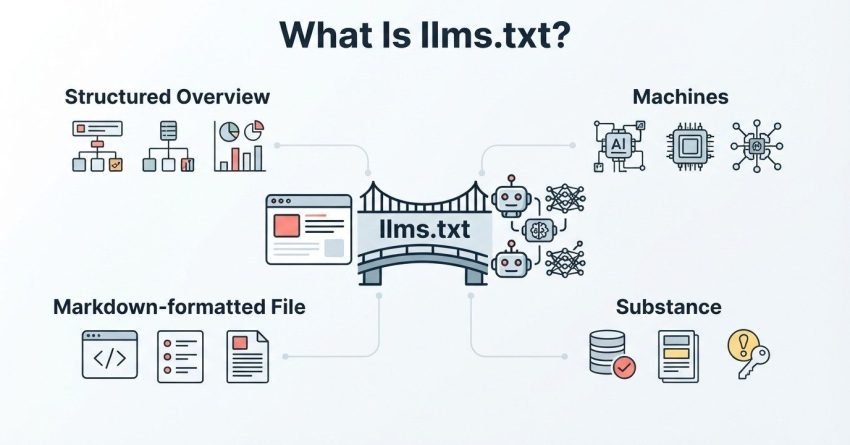
Llms.txt is a markdown-formatted file hosted at a website’s root domain that provides AI models with a condensed, structured overview of a site’s key pages and purpose. I think of it as a curated table of contents written specifically for machines that can’t easily parse a full site the way a human or traditional crawler does. It typically lives at /llms.txt, sitting alongside robots.txt and sitemap.xml.
The file was proposed by Jeremy Howard in September 2024 as a response to a real problem: large language models have limited context windows and struggle to extract clean information from JavaScript-heavy pages, navigation clutter, and ads. Llms.txt strips that away and hands over just the substance.
Origin and Purpose of the llms.txt Standard
The standard emerged directly from the limitations of feeding raw HTML into language models during inference. I’ve seen plenty of well-structured sites still produce messy, token-wasteful output when an LLM tries to summarize them on the fly. Llms.txt exists to fix that at the source rather than leaving it to the model’s guesswork.
How llms.txt Differs From robots.txt
Robots.txt tells crawlers what they’re allowed to access; llms.txt tells them what matters once they’re already in. One is a permission gate, and the other is a curated summary. They solve completely different problems, even though both sit in the root directory and use plain text.
Why llms.txt Matters for AI Search Visibility
Llms.txt matters for AI search visibility because it directly shapes how accurately and efficiently a language model represents a business when generating an AI-driven answer. I’ve noticed that as more search behavior shifts toward conversational AI tools, being cited accurately inside an AI Overview or chatbot response carries real traffic and credibility value. A site that’s easy for a model to parse has a structural edge.
This shift ties closely into how AI crawlers behave differently from traditional search bots, which changes what “visibility” even means going forward.
AI Crawlers vs. Traditional Search Bots
Traditional search bots like Googlebot crawl, render, and index full pages for ranking algorithms. AI crawlers, by contrast, often fetch content to feed directly into a model’s response generation, sometimes without traditional indexing at all. That distinction is why a file built purely for search engines doesn’t automatically serve AI systems well.
The Rise of LLM-Based Answer Engines
Tools like ChatGPT browsing, Perplexity, and Google’s AI Overviews increasingly answer queries without sending a click to the source site. A 2024 Similarweb analysis found AI-referred traffic, while still small in absolute volume, was growing faster than traditional organic referral traffic across several verticals. That trend alone justifies paying attention to how these tools consume your content.
How AI Crawlers Access and Use llms.txt
AI crawlers access llms.txt by requesting the file at the root domain during a crawl pass, then parsing its markdown structure to prioritize which linked pages to fetch and summarize. The file itself doesn’t guarantee inclusion in any AI answer. It simply makes the crawler’s job faster and reduces the odds of misrepresentation.
| AI System | Confirmed llms.txt Support (as of 2025) | Behavior |
| ChatGPT (OpenAI) | Not officially confirmed | Uses general web crawling (GPTBot) |
| Anthropic Claude | Not officially confirmed | Uses ClaudeBot for general crawling |
| Perplexity | Partial, unconfirmed | Crawls broadly via PerplexityBot |
| Google Gemini/AI Overviews | Not adopted | Uses standard Googlebot signals |
This table shows that despite the standard’s popularity in SEO discussions, no major AI platform has publicly confirmed full llms.txt adoption yet.
Which AI Crawlers Currently Support It
No major LLM provider has issued an official statement guaranteeing llms.txt parsing as of this writing. That gap between community enthusiasm and confirmed platform support is worth understanding before treating this file as a guaranteed visibility lever.
How Crawlers Interpret the File
A crawler that does support the format reads the Markdown headers as a hierarchy, follows the linked URLs, and uses the surrounding descriptive text as context for what each link contains. This mirrors how a human skimming a table of contents decides what’s worth opening.
llms.txt File Structure and Syntax
An llms.txt file follows a specific Markdown structure: an H1 with the site or project name, a blockquote summary, and H2-grouped sections of links with short descriptions. The format was intentionally kept close to standard Markdown, so it renders cleanly whether a human or machine opens it.
A minimal valid file shows the pattern clearly:
- Start with a single H1 line naming the site.
- Follow with a one-line blockquote summarizing the site’s purpose.
- Add optional free-text context paragraphs.
- Group key resource links under H2 headers like “Docs” or “Guides.”
- List each link as markdown with a short trailing description.
This numbered structure shows the minimum steps required to produce a spec-compliant file from scratch.
Required Sections and Markdown Format
Only the H1 title and a short summary are strictly required by the original specification. Everything past that, including linked sections, is technically optional but strongly recommended for the file to be useful to a crawler.
Optional Sections and Extended Directives
Some implementations add an “Optional” H2 section specifically for lower-priority links, signaling to a context-constrained model which resources to skip first if it needs to save space. This detail matters more on large sites with hundreds of pages competing for a model’s limited attention.
Technical Requirements for Implementation
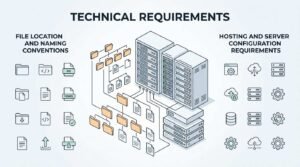
Implementing llms.txt technically requires hosting a plain UTF-8 text file at the domain root, named exactly “llms.txt,” accessible without authentication over HTTPS. Getting this wrong is the single most common reason the file fails to do anything useful.
File Location and Naming Conventions
The file must sit at https://example.com/llms.txt, not in a subfolder, and the filename is case-sensitive on most servers. A file placed at /pages/llms.txt or named LLMs.txt on a Linux server simply won’t be found by anything looking for the standard path.
Hosting and Server Configuration Requirements
The file needs a text/plain or text/markdown content-type header, no login wall, and no redirect chains longer than necessary. Static site generators and most CMS platforms can serve this without additional server configuration, though some page builders require a plugin or manual upload to the root.
llms.txt vs. robots.txt vs. sitemap.xml
llms.txt, robots.txt, and sitemap.xml serve three distinct functions: content summarization for AI models, crawler permission rules, and full URL indexing for search engines, respectively. Confusing these three files leads to duplicated effort or gaps in coverage.
| File | Primary Audience | Purpose | Format |
| llms.txt | AI/LLM crawlers | Curated content summary | Markdown |
| robots.txt | All crawlers | Access permissions | Plain text rules |
| sitemap.xml | Search engine crawlers | Complete URL index | XML |
This table lays out why a site typically needs all three rather than treating them as substitutes for one another.
What to Include in an llms.txt File
An effective llms.txt file includes the site name, a one-sentence summary, and links to the highest-value pages a model would need to understand or represent the business accurately. I’d rather see ten well-chosen links than eighty generic ones, since the whole point is reducing noise for a context-limited system.
Core Content Links
Prioritize documentation, product or service overviews, pricing, and any canonical explainer content over blog posts or promotional pages. These are the pages most likely to get quoted or summarized if a model draws on the file at all.
Context and Business Description
A short paragraph describing what the business does, who it serves, and any relevant specialization helps a model avoid generic or inaccurate framing when it references the brand. This is one of the few places where plain, unambiguous language pays off more than clever copy.
Common llms.txt Implementation Mistakes
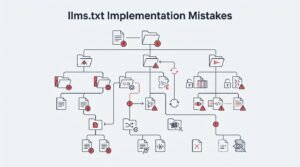
The most common llms.txt implementation mistakes are placing the file in the wrong directory, listing broken or outdated links, and treating the file as an SEO ranking factor rather than an AI context aid. I’ve seen teams spend hours perfecting a file that no crawler has confirmed it even reads yet, while ignoring far more established priorities like site speed or structured data markup.
Overloading the file with every page on the site defeats its purpose, since it’s meant to be a curated summary and not a second sitemap.
How to Create and Validate an llms.txt File
Creating an llms.txt file starts with drafting the markdown manually or through a generator tool, then validating the syntax and link accuracy before uploading it to the root directory. The process is closer to writing a README file than doing traditional technical SEO work.
- Draft the file using the required H1 and summary format.
- List priority pages grouped under clear H2 categories.
- Check every linked URL for accuracy and live status.
- Upload the file to the domain root as llms.txt.
- Confirm public access with no login wall or redirect.
- Re-check the file after major site restructures or URL changes.
This sequence covers the full path from a blank draft to a live, accessible file.
Tools for Testing and Validation
A handful of community-built validators and generator tools have emerged to check Markdown compliance and flag broken links before publishing. None of these tools confirm whether any specific AI platform will actually crawl or use the file, since that’s outside what a validator can test.
llms.txt Adoption Across AI Platforms
Adoption of llms.txt across AI platforms remains limited, with no major LLM provider having issued an official commitment to prioritize or guarantee parsing of the file as of 2026. That’s the most important caveat in this entire guide, and I don’t think it gets repeated enough in the broader conversation about this standard.
Current Limitations and Uncertainty
The format is community-driven rather than backed by a formal standards body like the W3C, which means adoption depends entirely on voluntary buy-in from AI companies. I’d treat it as a low-cost, low-risk addition rather than a guaranteed visibility strategy right now.
llms.txt and Its Role in Broader SEO Strategy
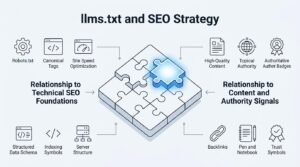
Llms.txt plays a supporting role in a broader SEO strategy by complementing, not replacing, established technical and content signals that search engines and AI systems already rely on. We see it as one small piece of a much larger visibility puzzle rather than a shortcut around the fundamentals.
Relationship to Technical SEO Foundations
Crawlability, site speed, mobile usability, and clean internal linking structure still carry far more weight for both traditional search and AI-driven discovery than a single markdown file ever will. Llms.txt doesn’t fix a technically broken site.
Relationship to Content and Authority Signals
Content depth, expertise and authority signals, and earned citations remain what actually gets a brand mentioned favorably by an AI model, since these systems are trained on and reference patterns across the wider web, not just one file. Llms.txt can guide a crawler, but it can’t manufacture authority that isn’t already there.
Should Every Website Implement llms.txt?
Not every website needs to implement llms.txt right now, though the low effort and negligible downside make it a reasonable addition for sites already investing in AI search visibility. I’d prioritize it after the core technical and content fundamentals are solid, not before.
Sites with large product catalogs, documentation hubs, or SaaS platforms stand to gain the most, simply because those are the use cases the format was originally designed to solve.
Conclusion
Llms.txt gives AI crawlers a structured summary of a site’s key content, sitting alongside robots.txt and sitemap.xml as a distinct, purpose-built file.
Adoption is still early, and no major LLM provider guarantees support, but the broader shift toward AI-driven search makes this worth monitoring closely.
We help businesses build technical foundations that work across both traditional and AI search. Reach out to White Label SEO Service to get started.
Frequently Asked Questions
Is llms.txt an official web standard?
No, llms.txt is a community-proposed convention, not an officially ratified web standard. It was introduced in September 2024 and has gained informal adoption without backing from a formal standards body.
Does llms.txt improve Google rankings?
No, llms.txt has no confirmed impact on Google search rankings. Google’s ranking systems rely on established signals like content quality and technical SEO, not this file.
Do ChatGPT and other AI tools currently read llms.txt?
No major AI provider has officially confirmed that it reads or prioritizes llms.txt as of 2025. Most AI crawlers still rely on standard web crawling methods instead.
Is llms.txt required for AI search visibility?
No, llms.txt is not required for AI search visibility. Strong content, technical SEO, and authority signals matter far more than this single file.
Can llms.txt block AI crawlers instead of allowing them?
No, llms.txt is not designed for blocking crawlers; that function belongs to robots.txt. Llms.txt only provides a content summary for crawlers that already have access.
How is llms.txt different from meta robots tags?
Meta robots tags control indexing behavior at the page level, while llms.txt provides site-wide content context for AI models. They operate at completely different levels of the site.
How often should an llms.txt file be updated?
An llms.txt file should be updated whenever key pages change, get removed, or new priority content is published. Outdated links inside the file reduce its usefulness to any crawler that reads it.