I’ve watched dozens of brands lose organic traffic over the past year while their Google rankings stayed exactly the same. AI search visibility is the measurable degree to which a brand, product, or piece of content appears, gets cited, or gets recommended inside AI-generated answers across platforms like ChatGPT, Google AI Overviews, Perplexity, and Gemini. It matters because a growing share of research and buying decisions now happen entirely inside an AI answer, with no click to any website at all.
I’m seeing this shift accelerate every quarter, and it changes what “visibility” even means for a business. Teams that only track rankings are flying blind on a whole new channel. This is the gap I want to close for you.
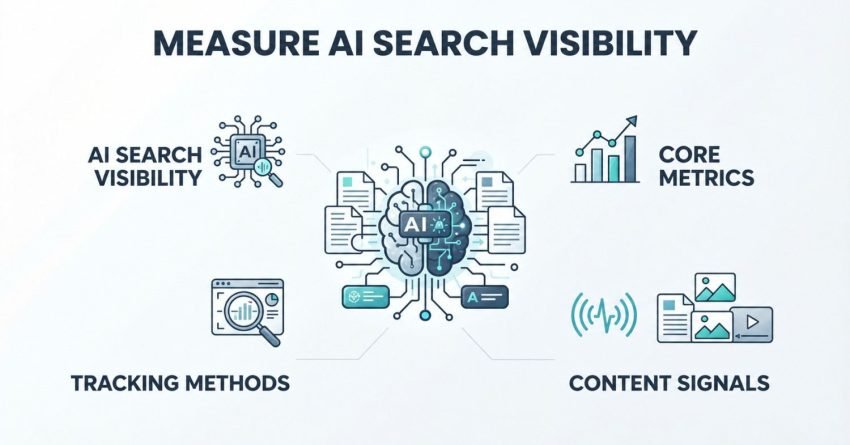
This guide covers what AI search visibility actually means and why it differs from ranking, which AI models matter right now and how they source answers, the core metrics worth tracking, manual and tool-based tracking methods, how to read AI referral traffic in analytics, and the content signals that improve your odds of being cited.
What AI Search Visibility Means
AI search visibility measures whether your brand gets surfaced, quoted, or recommended when someone asks an AI model a question related to your industry, product, or expertise. It’s a fundamentally different signal than a search engine ranking position.
I think of it this way: ranking tells you where you sit on a results page a human might scroll past. AI visibility tells you whether the model trusted your content enough to lift a sentence out of it and hand it directly to the user. Those are not the same outcome, and they don’t move together.
How It Differs From Traditional SEO Visibility
Traditional SEO visibility is measured by rank position, click-through rate, and organic sessions tied to a specific keyword. AI visibility is measured by citation frequency, whether your brand name appears in the generated answer, and whether the model links back to your page at all.
A page can sit at position one in Google and never get cited by an AI Overview for the same query, because the model is pulling from a different sentence on a different competing page. I’ve seen this exact mismatch happen on client accounts where rankings held steady, but AI Overview citations went entirely to a competitor with weaker rankings but better-structured answers.
Why Brands Are Losing Traffic Without Losing Rankings
Search engines increasingly answer the query directly on the results page, so the user never needs to click through at all. Organic sessions can decline even while ranking position holds firm, because the click was never the point of that particular search anymore.
This is the traffic pattern I now flag first when a client says “rankings look fine, but traffic dropped.” Zero-click AI answers are usually the explanation, and they require a different kind of measurement entirely.
Which AI Models and Platforms Matter Right Now
The AI platforms worth tracking today are ChatGPT, Google AI Overviews, Perplexity, and Gemini, because together they cover the overwhelming majority of AI-driven search and research behavior. Each one sources and displays brand mentions in a distinct way, so a single tracking method won’t cover all four.
I treat these four as the baseline monitoring set for any brand serious about AI visibility. Newer entrants get added as their usage grows, but these four dominate real query volume right now.
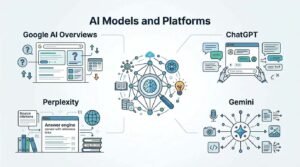
ChatGPT, Google AI Overviews, Perplexity, and Gemini
| Platform | Primary Source Behavior | Typical Citation Style |
| Google AI Overviews | Pulls from top-ranking organic pages | Inline citation with link |
| ChatGPT (browsing) | Blends training data with live retrieval | Brand mention, inconsistent linking |
| Perplexity | Built on live web retrieval | Numbered citations, direct source links |
| Gemini | Integrates Google Search index | Similar to AI Overviews, tied to SERP data |
This table shows why a brand can be strong in Perplexity citations and nearly invisible in ChatGPT for the exact same query.
How Each Model Sources Its Answers Differently
Google AI Overviews and Gemini draw heavily from the existing organic index, so strong technical SEO tends to correlate with stronger visibility on those two. ChatGPT and Perplexity weigh differently, favoring clearly structured, directly quotable content regardless of current rank position.
I’ve found that ranking well helps with Google’s AI surfaces but barely moves the needle on ChatGPT visibility. The two require overlapping but distinct strategies, not one blanket approach.
How AI Models Choose What to Cite
AI models select citations primarily based on content extractability, meaning how easily a single sentence can be lifted out of a page and stand alone as a complete, accurate answer. A model rarely cites an entire page. It cites one sentence or one short passage that answers the exact question cleanly.
I look at every client page now and ask the same question a model effectively asks: can this sentence be pulled out and still make complete sense with no missing context? Pages that fail this test get skipped in favor of a competitor’s cleaner passage.
The Role of Structured, Extractable Content
Content structured with a direct answer in the first sentence of a section, followed by supporting detail, gets cited more often than content that builds up to a conclusion gradually. Models are optimizing for speed and clarity, not narrative flow.
This is why I now insist on answer-first formatting for every client page targeting AI visibility, regardless of how that page reads for a human skimming it top to bottom.
Why Some Brands Get Cited, and Others Don’t
Brands with clear entity definitions, in-sentence data attribution, and consistent terminology get cited more often, because the model can verify and lift their claims with less risk of misrepresentation. Vague, hedged, or conditionally worded content gets passed over.
I’ve rewritten entire sections for clients purely to remove hedging language, and citation rates on those reworked pages improved within a few tracking cycles.
Core Metrics for Measuring AI Search Visibility
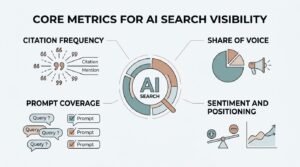
The core metrics for AI search visibility are citation frequency, share of voice against named competitors, prompt coverage, and sentiment or positioning within the generated answer. These four together give a full picture instead of a single vanity number.
I track these across a rotating set of prompts every month, because a single snapshot tells you almost nothing about a fast-moving surface like this.
Citation Frequency and Share of Voice
Citation frequency is the percentage of tracked prompts in which your brand, page, or content appears anywhere in the AI-generated answer. Share of voice compares that frequency against a defined set of named competitors across the same prompt list.
A brand cited in 30% of tracked prompts while its closest competitor sits at 65% has a clear, quantified visibility gap worth closing.
Prompt Coverage and Query Volume
Prompt coverage measures how many distinct question variations within your topic area actually surface your brand at all, rather than just tracking one flagship query. A single high-performing prompt can hide a much weaker picture across the surrounding query set.
I build prompt lists of 25 to 50 variations per core topic, because AI models respond very differently to rephrased versions of what looks like the same underlying question.
Sentiment and Positioning Within AI Answers
Sentiment tracks whether your brand is mentioned favorably, neutrally, or critically, and positioning tracks whether you’re the primary cited source or a secondary mention buried below a competitor. Both matter more than raw appearance count.
Being mentioned once, negatively, near the bottom of an answer isn’t a win, even though it counts as a technical citation in a raw frequency count.
Manual Methods to Track Brand Presence in AI Answers
Manual tracking means running a consistent, repeatable set of prompts across each AI platform on a fixed schedule and logging exactly what comes back. It’s slower than automated tooling, but it gives direct visibility into the actual answer text, not just a summarized score.
I still run manual checks even on accounts with paid tracking tools active, because seeing the raw answer text catches nuance a dashboard score can miss entirely.
Prompt Testing Across Multiple Models
Running the same prompt across ChatGPT, Gemini, Perplexity, and an AI Overview search in sequence takes only a few minutes and reveals platform-specific gaps immediately. I run this weekly for priority topics and monthly for the broader long-tail list.
- Write the exact prompt a real customer would type, not a keyword phrase
- Run it in each of the four priority platforms without altering wording
- Screenshot or copy the full generated answer text
- Note whether your brand appears, and where in the answer it sits
- Log competitor names that appear instead
- Repeat monthly on a fixed prompt list to track trend direction
Building a Tracking Spreadsheet for Recurring Prompts
A recurring tracking spreadsheet logs the prompt, the platform, the date, whether your brand was cited, the exact citation text, and the competitors also mentioned. This structure turns scattered manual checks into a trend line over time.
I keep this spreadsheet running for every client account now, because a single month of data tells you almost nothing about direction or momentum.
Tools and Platforms for AI Search Monitoring
Dedicated AI visibility monitoring tools automate prompt testing across multiple models and report citation frequency, sentiment, and competitor comparisons without manual entry. They save enormous time once prompt volume exceeds what a spreadsheet can reasonably handle.
I bring in dedicated tooling once a client’s prompt list grows past roughly 40 to 50 tracked variations, since manual testing at that volume becomes unsustainable weekly.
Dedicated AI Visibility Trackers
Purpose-built AI visibility platforms run scheduled prompts across multiple models simultaneously and surface citation trends in a dashboard format. These tools are built specifically for this surface, rather than adapted from older SEO tooling.
I treat this category the way I once treated rank tracking software, as infrastructure rather than an optional extra, once a brand takes AI visibility seriously.
Repurposing Existing SEO Tools for AI Monitoring
Some existing SEO platforms have added AI Overview tracking modules that monitor whether a tracked keyword triggers an AI Overview and whether your domain gets cited within it. This gives partial coverage, limited mostly to Google’s AI surfaces.
This repurposed tracking is useful as a starting point, but it misses ChatGPT and Perplexity entirely, so it can’t be your only monitoring layer.
Measuring Referral Traffic From AI Platforms
AI referral traffic is measured in analytics by isolating sessions where the referral source domain matches known AI platforms, since most AI tools now pass at least partial referrer data when a user clicks through. Volume is typically low, but the intent behind it tends to run high.
I set this segmentation up as one of the first steps on any new client account now, because without it, AI-driven sessions get buried inside generic “referral” or “direct” traffic buckets.
Setting Up Analytics to Isolate AI Traffic Sources
Creating a custom channel grouping or segment in your analytics platform that filters for referrer domains like chat.openai.com, perplexity.ai, and gemini.google.com isolates this traffic from the rest of your referral data. Without this step, AI-driven visits blend invisibly into the “direct” or “other” bucket.
I check this segment every week now on active accounts, because it’s often the earliest clean signal that AI visibility work is translating into real sessions.
Interpreting Low-Volume, High-Intent AI Referral Data
AI referral sessions tend to convert at a noticeably higher rate than average organic traffic, because the user arrived already having received a partial answer and clicked through specifically for depth or confirmation. Small volume doesn’t mean small value here.
A brand with only 40 monthly AI referral sessions but a 12% conversion rate on that segment is often outperforming much larger, lower-intent traffic sources.
Content Signals That Improve AI Visibility
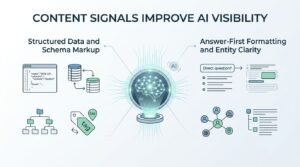
Structured data, schema markup, and answer-first content formatting are the primary signals that improve a page’s odds of being extracted and cited by an AI model. These signals make a page’s content easier for a model to parse, verify, and lift with confidence.
I now audit every priority page against these signals specifically, separate from the standard on-page SEO checklist that already existed before AI search became relevant.
Structured Data and Schema Markup
Schema markup, particularly FAQ, HowTo, and Article schema, gives AI crawlers a machine-readable map of a page’s key claims and structure. This doesn’t guarantee citation, but it removes ambiguity that could otherwise cause a model to misread or skip the content.
I treat schema as a baseline requirement now, not an optional enhancement, for any page targeting AI visibility as a goal.
Answer-First Formatting and Entity Clarity
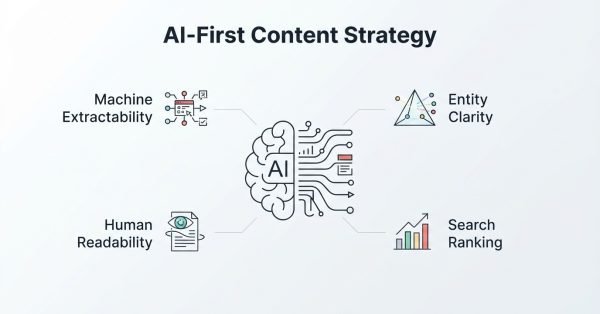
Opening every section with a direct, complete answer before adding supporting context gives a model a clean sentence to extract without needing to synthesize meaning across multiple sentences. Entity clarity, meaning naming the exact subject rather than relying on pronouns, reinforces this further.
This single formatting change has produced the most consistent citation improvement I’ve seen across client content reworked for AI visibility.
Benchmarking Your AI Visibility Against Competitors
Benchmarking AI visibility against competitors means running the identical prompt set against named competitor brands and comparing citation frequency, sentiment, and positioning side by side. Without this comparison, a raw citation number has no real context.
I build this benchmark before recommending any specific content change, because it reveals exactly which competitor is winning which type of query, not just that a gap exists somewhere.
Building a Competitive Citation Map
A competitive citation map logs, for each tracked prompt, which brand got cited first, which got mentioned secondarily, and which were absent entirely. Patterns emerge quickly, often showing one competitor dominating a specific question category.
This map has repeatedly shown me that visibility gaps are usually concentrated in a handful of question types, not spread evenly across an entire topic.
Common Measurement Mistakes to Avoid
The most common measurement mistake is treating a strong Google ranking as a proxy for AI visibility, when the two are measured independently and often move in opposite directions. Relying on rank tracking alone leaves an entire visibility channel unmonitored.
I see this mistake constantly with teams new to AI visibility tracking, and it’s usually the first misconception I have to correct before any real progress happens.
Confusing Ranking Position With Being Cited
A page can rank first for a query and still be completely absent from that query’s AI Overview or ChatGPT answer, because citation selection depends on extractability and structure, not rank position alone. These are two separate outcomes requiring two separate tracking systems.
I now report these as two distinct metrics on every client dashboard, specifically to prevent this exact confusion from creeping back in.
Building an AI Visibility Tracking Cadence
An effective AI visibility tracking cadence runs quick manual spot-checks weekly, a fuller prompt-set review monthly, and a complete competitive benchmark quarterly. This layered rhythm catches fast-moving changes without demanding daily monitoring effort.
I set this cadence up as a standing calendar item for every account, because AI answer behavior shifts frequently enough that quarterly-only checks miss real movement.
Weekly, Monthly, and Quarterly Checkpoints
Weekly checks cover your top five to ten priority prompts across all four platforms. Monthly checks expand to the full tracked prompt list with trend comparison against the prior month. Quarterly checks add the full competitive benchmark and a content signal audit.
This three-tier rhythm has become the standard operating cadence I run across every active client account now.
How AI Visibility Connects to Broader SEO Strategy
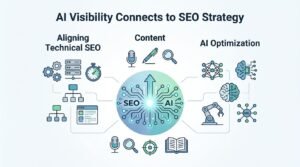
AI search visibility isn’t a separate discipline from SEO; it’s an extension of the same technical, content, and authority foundations that already drive organic rankings. A site with weak technical SEO or thin content will struggle in AI visibility for the same underlying reasons it struggles in traditional search.
I’ve stopped treating these as two separate workstreams internally, because the overlap in what actually works is too significant to manage them apart.
Aligning Technical SEO, Content, and AI Optimization
Strong technical SEO ensures a model can crawl and parse a page at all. Strong content strategy ensures the page contains clear, extractable answers. Authority-building ensures the brand is trusted enough to be cited with confidence rather than passed over.
These three pillars reinforce each other, and none of them functions well as an isolated fix when the other two are neglected.
Conclusion
AI search visibility now sits alongside rankings as a measurable, trackable outcome tied to citations, prompt coverage, and referral data across four dominant platforms. Understanding this shift changes how growth gets measured entirely.
We see this becoming a core layer of every search strategy, not a passing trend. It builds directly on the technical and content foundations already in place.
We help you build the tracking systems and content structure needed to earn real AI citations. Talk to White Label SEO Service to start measuring where you actually stand.
Frequently Asked Questions
What is AI search visibility?
AI search visibility is the measurable presence of a brand within AI-generated answers across platforms like ChatGPT, Gemini, and Google AI Overviews. It’s tracked through citation frequency, sentiment, and positioning rather than rank position.
How is AI visibility different from SEO rankings?
AI visibility measures whether content gets cited inside a generated answer, while SEO rankings measure position on a traditional results page. A page can rank highly and still never appear in an AI answer for the same query.
Which AI platforms should businesses track first?
ChatGPT, Google AI Overviews, Perplexity, and Gemini cover the majority of current AI search behavior. Each sources and displays citations differently, so all four need separate monitoring.
Can I track AI visibility without paid tools?
Yes, manual prompt testing across platforms logged in a spreadsheet works well at lower prompt volumes. Dedicated tools become more efficient once tracked prompt lists exceed roughly 40 to 50 variations.
Why does my site rank well but get little AI traffic?
Ranking position and AI citation are measured independently, and models often favor extractable, clearly structured content over rank position alone. A well-ranked page with hedged or poorly structured content can be skipped entirely.
How often should AI visibility be measured?
A layered cadence works best: weekly spot-checks on top prompts, monthly reviews of the full prompt list, and quarterly competitive benchmarking. This catches shifts without requiring constant daily monitoring.
Does schema markup help with AI citations?
Schema markup gives AI crawlers a clearer, machine-readable structure of a page’s key claims, which reduces misreading risk. It doesn’t guarantee citation but removes a common barrier to being selected.