Local search intent is the specific type of query intent Google identifies when a searcher wants results tied to a physical location, whether that location is stated outright or inferred from context. I look at this constantly when auditing why one business shows up in the map pack and another doesn’t. It affects every local business trying to win visibility in their market.
Getting this wrong costs businesses real customers every single day. Google’s local algorithm runs continuously, whether a business understands it or not, and ignoring it means losing ground to competitors who don’t.
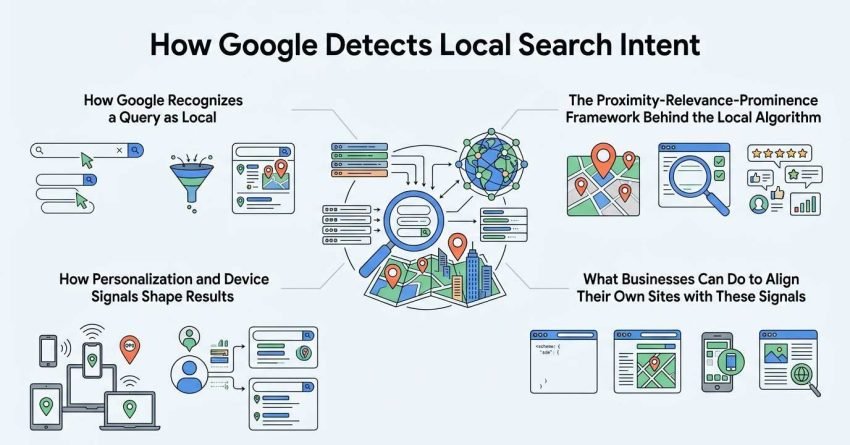
This guide covers how Google recognizes a query as local, the proximity-relevance-prominence framework behind the local algorithm, how personalization and device signals shape results, and what businesses can do to align their own sites with these signals.
What Local Search Intent Actually Means
Local search intent is a signal Google assigns to a query when it determines the searcher wants results connected to a specific geographic area. I see this play out constantly in the data: a query like “plumber” behaves completely differently than “plumbing supply history.”
Google separates local intent into two categories: explicit and implicit. An explicit query names the location directly, like “dentist in Austin.” An implicit query, like “dentist near me” or even just “dentist” typed from a phone in Austin, carries no location text at all but still triggers local results because Google fills in the location from other signals.
Explicit vs. Implicit Local Intent
Explicit local intent is a query that states the location in the search terms themselves, such as “coffee shop in Denver.” Implicit local intent relies on device signals, search history, or query patterns to infer the same geographic need without it being typed out.
I’ve watched businesses obsess over ranking for explicit “city name” keywords while ignoring the much larger volume of implicit searches happening around them. Both matter, but implicit local intent is where most day-to-day local traffic actually comes from.
Local Intent vs. General Informational Intent
General informational intent seeks knowledge or an answer, not a place to visit or a business to contact. A query carries local intent instead of informational intent when the underlying need points to a physical destination, action, or transaction tied to a location.
The line between the two isn’t always obvious from the keyword alone. Google increasingly relies on behavioral data, not just keyword pattern-matching, to decide which bucket a query belongs to.
How Google Identifies a Query as “Local”
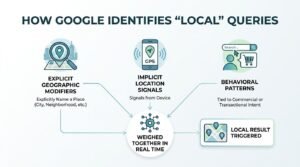
Google identifies a query as local by combining explicit geographic modifiers, implicit location signals from the device, and behavioral patterns tied to commercial or transactional intent. No single signal decides it alone; the algorithm weighs all three together in real time.
This is where most keyword research goes wrong. A term can look purely informational on paper and still trigger a local pack because Google has learned, over millions of similar queries, that most searchers typing it actually want a nearby business.
Geographic Modifiers and Location Keywords
Geographic modifiers are words or phrases within a query that explicitly name a place, such as a city, neighborhood, zip code, or landmark. These are the easiest local signals for Google to parse because they require no inference at all.
| Modifier Type | Example Query | Signal Strength |
| City name | “roofer in Phoenix” | Strong |
| Neighborhood | “cafe in SoHo” | Strong |
| Zip code | “dentist 90210” | Strong |
| Landmark | “hotel near Central Park” | Moderate |
| Regional term | “HVAC repair Bay Area” | Moderate |
Implicit Local Triggers Without a Location Keyword
A query triggers local intent implicitly when Google’s algorithm recognizes commercial or service-based language patterns commonly associated with location-based searches, even without a location keyword present. Terms like “open now,” “delivery,” or simple service names (“electrician,” “nail salon”) fall into this category constantly.
I treat these implicit triggers as the real battleground for local SEO. Most searchers never type their city name because their phone already knows where they are.
The Role of Device Location and IP Signals
Device location and IP signals give Google a real-time geographic anchor for a query, even when no location text appears in the search itself. This is the layer that makes “near me” searches functional at all; without it, Google would have nothing to measure proximity against.
GPS and Mobile Location Data
GPS data from a mobile device gives Google a precise, real-time coordinate that anchors local results to within a few meters of the searcher. This is the strongest and most accurate location signal available to the algorithm, and it’s a major reason mobile local search behaves differently than desktop.
Location permissions matter here too. A user who denies location access forces Google to fall back on weaker signals like IP address or account settings.
IP Address and Wi-Fi Positioning
IP address positioning estimates a searcher’s general location based on the network they’re connected to, typically accurate to a city or metro region rather than a precise address. Wi-Fi positioning adds another layer, cross-referencing known Wi-Fi network locations to refine that estimate further.
Neither is as precise as GPS, but both are more than enough for Google to confidently populate a local pack for a broad metro query.
Google’s Local Algorithm: Proximity, Relevance, and Prominence
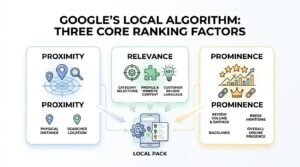
Google ranks local results using three core factors: proximity to the searcher, relevance of the business to the query, and prominence based on the business’s overall reputation and authority. These three factors, confirmed directly by Google’s own local ranking documentation, form the backbone of every local pack decision made today.
Proximity as a Ranking Factor
Proximity measures the physical distance between the searcher’s detected location and each candidate business location. It carries more weight in local rankings than it does in traditional organic search, which is why two businesses offering identical services can rank completely differently depending on who’s searching from where.
I’ve seen well-optimized businesses lose local pack visibility purely because a closer competitor existed, with weaker content and fewer reviews. Proximity can override almost everything else at close range.
Relevance Signals in the Local Algorithm
Relevance measures how well a business’s profile and website content match the intent and specific terms of the search query. Google pulls this from category selections, business descriptions, website copy, and even customer review language.
A business categorized incorrectly on its Google Business Profile can miss out on local pack visibility no matter how strong its website content is elsewhere. Category selection alone shapes a huge share of relevance scoring.
Prominence and Off-Site Authority
Prominence reflects how well-known and well-regarded a business is, based on signals like review volume, review ratings, backlinks, press mentions, and overall online presence. A well-known landmark business can rank in the local pack from farther away than an identical, unknown competitor closer to the searcher, purely on prominence strength.
This is where link authority and citation strength, similar to the prominence weighting Google confirmed in its local ranking guidelines, start to matter as much as anything happening on-site.
How the Local Pack (Map Pack) Gets Populated
The local pack, also called the map pack, is the group of typically three business listings Google displays at the top of search results for a local query, ranked using the proximity, relevance, and prominence model. Every business shown there has passed through the same three-factor filter before appearing.
Google Business Profile’s Role in Local Pack Inclusion
A Google Business Profile is the free listing businesses create and verify with Google that supplies the core data name, category, hours, location, and reviews used to determine local pack eligibility. Without a verified, accurately categorized profile, a business functionally doesn’t exist in Google’s local algorithm at all.
I treat profile accuracy as the single highest-leverage local SEO task available, ahead of almost anything done on the website itself.
Why Only Three Results Appear
Google limits the local pack to three results primarily to preserve a clean, fast mobile user experience, since most local searches now happen on phones with limited screen space. This scarcity is exactly why local pack competition has intensified across nearly every service category over the past several years.
Search History and Personalization in Local Results
Google personalizes local search results using a searcher’s past behavior, including previously visited businesses, saved locations, and frequently searched categories. This layer sits on top of the core proximity-relevance-prominence model rather than replacing it.
Past Search Behavior and Location History
Location history and past search behavior let Google infer preferences a searcher hasn’t explicitly stated, such as a tendency to choose highly rated independent businesses over chains. This data comes from a signed-in Google account with location history enabled.
Personalized vs. Non-Personalized Local Results
Non-personalized local results rely purely on proximity, relevance, and prominence signals available at query time, while personalized results adjust that baseline using individual account history. Two people standing on the same street corner searching the identical term can see meaningfully different local packs because of this layer alone.
On-Page and Website Signals That Confirm Local Relevance
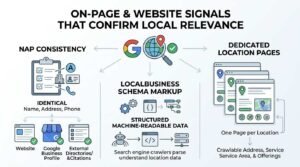
On-page signals confirm local relevance to Google by matching the business’s website content, structured data, and contact information against the data already established in its Google Business Profile. Mismatches between the two erode trust in the algorithm’s confidence about the business’s actual location.
NAP Consistency (Name, Address, Phone)
NAP consistency refers to keeping a business’s name, address, and phone number identical across its website, Google Business Profile, and all external directories or citations. Inconsistent NAP data is one of the most common reasons an otherwise strong business underperforms in local rankings.
Location Pages and Local Schema Markup
A dedicated location page gives Google clear, crawlable content confirming a business’s service area, address, and locally relevant offerings, while LocalBusiness schema markup provides that same information in a structured, machine-readable format search engines can parse directly. Businesses running multiple locations typically need one dedicated page per location to avoid diluting relevance signals across a single generic page.
Google’s Use of Natural Language Processing for Local Queries
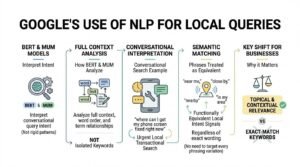
Google uses natural language processing models, including BERT and MUM, to interpret the intent behind conversational local queries that don’t match a rigid keyword pattern. This shift matters enormously for local businesses because it means exact-match keyword optimization now matters far less than genuine topical and contextual relevance.
How BERT and MUM Interpret Conversational Local Searches
BERT and MUM analyze the full context of a search phrase, including word order and relationships between terms, rather than matching isolated keywords in isolation. A query like “where can I get my phone screen fixed right now” gets correctly interpreted as an urgent, local, transactional search without a single traditional local keyword present.
Semantic Matching for “Near Me” Variations
Semantic matching allows Google to treat phrases like “near me,” “close by,” “in my area,” and “nearby” as functionally equivalent local intent signals, regardless of exact wording. This means businesses no longer need to target every possible phrasing variation individually; the underlying intent match handles that work.
Voice Search and Its Impact on Local Intent Detection
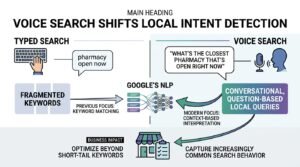
Voice search increases the share of conversational, question-based local queries Google needs to interpret, since spoken searches tend to be longer and more naturally phrased than typed ones. This shift has pushed Google’s NLP models even harder toward context-based interpretation rather than keyword matching.
Conversational Query Patterns in Voice Assistants
Voice queries typically take the form of full questions, such as “what’s the closest pharmacy that’s open right now,” rather than the fragmented keyword phrases common in typed search. Businesses optimizing purely for short-tail local keywords often miss this entire category of increasingly common search behavior.
Local Pack vs. Organic Local Results: How Google Decides Placement
Google separates the local pack from organic local results because each serves a distinct purpose: the pack surfaces specific businesses for transactional local intent, while organic results surface informational or comparative local content. A “best plumbers in Chicago” search might trigger both a local pack for direct business options and an organic listicle answering the “best” comparison question.
A business can rank strongly in organic local results through a well-optimized blog or guide page while still missing the local pack entirely due to weak Google Business Profile prominence. These are genuinely two separate rankings, competing under two different rule sets.
Common Signals That Weaken Local Intent Matching
Google weakens a business’s local intent matching when it detects inconsistent, thin, or conflicting location data across the business’s online presence. These signals don’t just fail to help; they actively erode the confidence score the algorithm assigns to the business’s location claims.
Inconsistent Business Information
Inconsistent business information, such as a phone number on the website that differs from the one listed on a major directory, creates doubt in Google’s confidence about which data point is accurate. Even small formatting differences, like “St.” versus “Street,” can register as inconsistencies at scale across citation sources.
Thin or Duplicate Location Content
Thin location content refers to location pages containing only a name, address, and phone number with no unique, locally relevant detail beyond boilerplate text copied across every page. Google treats duplicate location pages as low-value and frequently fails to index them competitively at all.
How Businesses Can Align With Google’s Local Intent Signals
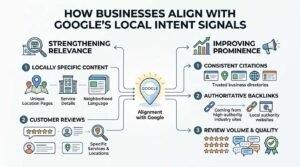
Businesses align with Google’s local intent signals by strengthening relevance through accurate, locally specific content and improving prominence through legitimate citations, reviews, and authoritative backlinks. These two levers account for the majority of controllable local ranking factors available to any business.
Strengthening Relevance Through Content and Reviews
Locally specific content unique location pages, service-area detail, and neighborhood-relevant language signals relevance far more effectively than generic template copy repeated across every page. Customer reviews mentioning specific services and locations by name reinforce this same relevance signal from an independent source.
Improving Prominence Through Citations and Links
Consistent citations across trusted directories and backlinks from locally relevant or industry-authoritative websites build the prominence signal Google weighs heavily in competitive local pack placements. A BrightLocal industry study found that 98% of consumers read online reviews for local businesses, underscoring how much prominence now hinges on review volume and quality alone.
The Future of Local Search Intent Detection
Google’s local intent detection is moving toward deeper AI-driven interpretation, using models capable of understanding multi-step, conversational, and multimodal queries rather than static keyword-based matching. This trajectory has been building steadily since the rollout of BERT and continues accelerating with each new model generation.
AI Overviews and Local Search Behavior
AI Overviews are increasingly surfacing synthesized answers to local queries directly in search results, pulling from multiple business listings, reviews, and web content simultaneously rather than sending searchers straight to a single ranked list. Businesses with clear, well-structured, and consistent online information are far more likely to be cited correctly inside these AI-generated summaries.
Conclusion
Google’s local algorithm blends proximity, relevance, and prominence with device signals, personalization, and NLP interpretation. Together, these systems decide exactly which businesses appear for any local search.
Local intent detection keeps evolving alongside AI Overviews and voice search, making consistent signals across your entire online presence more important than ever before.
We help businesses align every one of these signals correctly. Talk to White Label SEO Service about building a local visibility strategy that lasts.
Frequently Asked Questions
What is local search intent?
Local search intent is a query classification Google assigns when a searcher wants results tied to a specific geographic location. It can be stated explicitly or inferred from device and behavioral signals.
How does Google know a search is local?
Google combines geographic keywords, device location data, and behavioral patterns associated with commercial intent. No single signal decides it alone; the algorithm weighs all of them together.
Does Google use my location even without a location in the query?
Yes, Google uses GPS, IP address, and account-level location history when no location appears in the query text. This is how “near me” style searches function without the phrase ever needing to be typed.
What is the difference between the local pack and organic results?
The local pack shows business listings ranked by proximity, relevance, and prominence for transactional queries. Organic local results rank web pages and content for informational or comparative local searches.
How important is Google Business Profile for local intent?
It is one of the most important factors, since it supplies the core data Google uses to determine local pack eligibility. An unverified or poorly categorized profile severely limits local visibility.
Can voice search change how local intent is detected?
Yes, voice search increases longer, conversational, question-based queries that require deeper natural language interpretation. This pushes Google’s algorithm to rely more on context than exact keyword matching.
How long does it take to improve local search rankings?
Most businesses see meaningful local ranking improvement within three to six months of consistent optimization. Timelines vary based on competition, existing citation consistency, and review volume.