I’ve watched “near me” searches reshape local SEO more than almost any other query type in the past decade. These searches signal explicit or implicit local intent, and businesses that fail to optimize for them lose visibility to competitors who show up first on a map or in a local pack.
Local intent now drives a massive share of daily search volume. I’ve seen client accounts where “near me” style queries account for over a third of all local organic traffic, and ignoring this shift means losing customers who are ready to visit or buy right now.
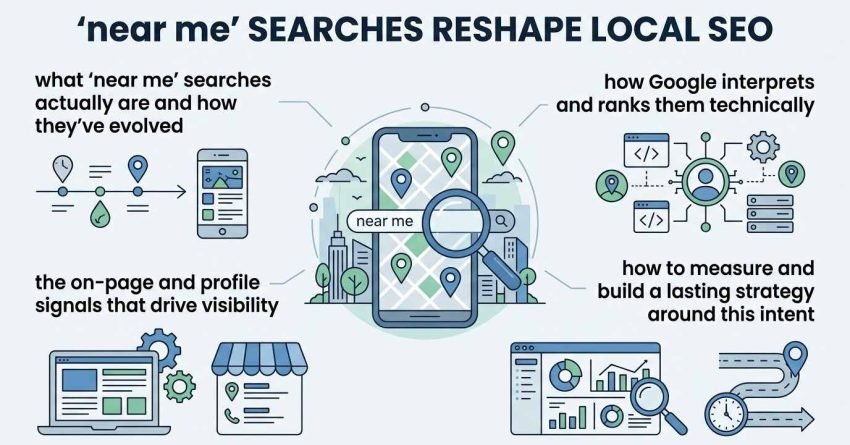
This guide covers what “near me” searches actually are and how they’ve evolved, how Google interprets and ranks them technically, the on-page and profile signals that drive visibility, and how to measure and build a lasting strategy around this intent. I’ll walk through each piece so you understand the full picture.
What Are “Near Me” Searches?
“Near me” searches are queries where a user is explicitly or implicitly asking for businesses, services, or locations close to their current physical position. The phrase itself might appear literally, like “coffee shop near me,” or it might be entirely absent while still carrying the same locational intent.
I think of these queries as a signal flare. The searcher isn’t researching a topic. They’re standing somewhere, right now, and they want an answer that respects their exact location.
Search engines treat this intent category differently than general informational queries. Google’s Search Central documentation confirms that local business signals directly influence how these results are ranked and displayed. That’s a fundamentally different ranking mechanism than a standard organic query.
The Anatomy of a “Near Me” Query
A typical “near me” query has three parts working together: an entity (what the user wants), an implied or explicit location modifier, and an urgency signal that Google reads through device context. I break these down constantly when auditing a client’s local presence.
The entity might be “plumber,” the location modifier might be GPS coordinates rather than typed words, and the urgency signal often comes from time of day or movement patterns detected by the device.
The Evolution of “Near Me” Search Behavior
“Near me” search behavior has shifted from typed exact-match phrases to implicit locational intent that Google infers without the words ever appearing. Early search engines needed the literal phrase to trigger local results, but that dependency disappeared years ago.
I remember when ranking for “near me” meant stuffing that exact phrase into title tags. That tactic stopped working once Google’s algorithms matured enough to detect location intent from context alone.
From Typed Keywords to Implicit Location Intent
Modern search behavior increasingly drops the words “near me” entirely, replaced by a query like “pizza” typed on a mobile device while walking down a street. Google reported that mobile searches for local information without “near me” attached have grown substantially, showing this shift plainly. Google’s own systems now assume proximity intent for huge categories of queries by default.
How Google Interprets “Near Me” Intent
Google interprets “near me” intent by combining device GPS or IP-based location data with query semantics, even when no locational words are typed into the search bar. This layered signal detection is what separates local intent processing from standard keyword matching entirely.
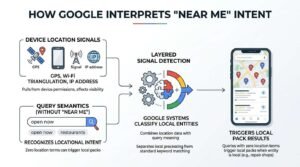
I’ve tested this across dozens of accounts. A query with zero location terms still triggers a local pack the moment Google’s systems classify the underlying entity as something people search for locally, like restaurants or repair shops.
The Role of Device Location Signals
Device location signals, pulled from GPS, Wi-Fi triangulation, or IP address, feed directly into how Google decides which local results to surface for a given query. These signals often carry more weight than the query text itself for mobile searches.
I always tell clients that a phone’s location permission setting can affect visibility more than a keyword choice. That’s counterintuitive to people used to thinking purely in terms of on-page optimization.
Query Semantics Without the Words “Near Me”
Query semantics allow Google to recognize locational intent in phrases like “open now” or a simple category term typed on a mobile device, without any explicit distance-related language present. This is why category and service pages need to be built for implied local intent, not just literal “near me” phrasing.
Why “Near Me” Searches Matter for Local SEO
“Near me” searches matter for local SEO because they represent some of the highest-converting, most immediate-intent traffic a local business can capture. A user searching this way is frequently ready to visit, call, or purchase within the hour.
I’ve watched conversion rates on this traffic type consistently outperform broader informational searches by a wide margin, because the searcher has already decided they need a solution nearby.
The Business Impact of Hyperlocal Visibility
Hyperlocal visibility directly affects foot traffic, phone calls, and in-store revenue for any business with a physical location or defined service area. BrightLocal’s Local Consumer Review Survey found that a large majority of consumers use search to find local businesses on a weekly basis or more, underscoring how central this behavior has become to buying decisions.
The Three Pack, Maps, and “Near Me” Results
The Local Three Pack is the block of three business listings, complete with map pins, that Google displays prominently above traditional organic results for most local and “near me” style queries. Winning a spot here often matters more than ranking first in standard organic listings.
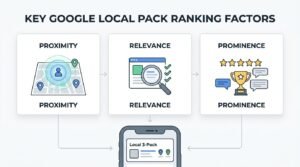
I prioritize Three Pack visibility over traditional rankings for any client with a physical storefront, because that’s where the clicks and calls concentrate for this query type.
How Local Pack Rankings Are Determined
Local Pack rankings are determined primarily through a combination of proximity to the searcher, relevance of the business profile to the query, and overall prominence across the web. Google balances these three factors differently depending on the query and searcher location.
Google Business Profile’s Role in “Near Me” Visibility
A Google Business Profile is the free business listing that powers most of the information Google displays in local pack results, map listings, and “near me” style searches. It functions as the primary data source Google uses to match a business to local intent.
I treat this profile as the single highest-leverage asset in local SEO work, often producing visibility improvements faster than any other tactic I use.
Key Profile Signals Google Evaluates
Google evaluates several profile-level signals, including category accuracy, completeness of business information, photo volume, posting activity, and review metrics, when deciding local pack placement. Profiles missing basic fields like hours or categories consistently underperform against fully completed competitors.
Ranking Factors Behind “Near Me” Searches
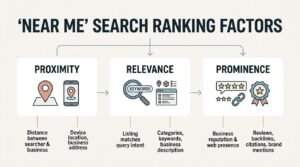
Three primary ranking factors control “near me” search results: proximity, relevance, and prominence, and Google weighs each differently depending on query type and competitive density. Understanding how these interact helps prioritize which levers to pull first.
| Ranking Factor | What It Measures | Primary Influence |
| Proximity | Physical distance between searcher and business | Device location, business address |
| Relevance | How well a listing matches the query intent | Categories, keywords, business description |
| Prominence | Overall business reputation and web presence | Reviews, backlinks, citations, brand mentions |
Proximity
Proximity measures the physical distance between the searcher’s current location and the business address listed in its Google Business Profile. This factor alone can overrule stronger relevance or prominence signals for genuinely nearby competitors.
Relevance
Relevance measures how closely a business profile and its associated content match the specific intent behind a searcher’s query. Category selection inside the Business Profile carries significant weight in this calculation.
Prominence
Prominence measures a business’s overall reputation and authority, drawn from signals like review volume, review ratings, and how often the business is mentioned or linked to across the web. A well-known local brand with strong citations often outranks a closer but less established competitor.
On-Page and Technical Signals That Support “Near Me” Rankings
On-page and technical signals like structured data, consistent NAP information, and dedicated location pages give Google clear, machine-readable confirmation of where a business operates. These signals work alongside the Business Profile rather than replacing it.
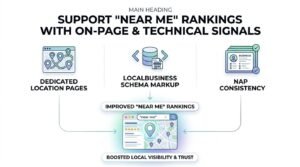
I always audit for schema markup gaps first, since missing LocalBusiness schema is one of the most common technical oversights I find on client sites.
Location Pages, Schema, and NAP Consistency
Dedicated location pages built for each service area, paired with accurate LocalBusiness schema markup, give search engines structured confirmation of a business’s service radius and physical presence. NAP consistency, meaning identical name, address, and phone number across every online listing, prevents Google from splitting trust signals across conflicting data points.
The Role of Reviews in “Near Me” Search Performance
Reviews directly influence “near me” search performance because Google treats review volume, rating, and recency as core prominence signals within its local ranking systems. A business with consistent, recent reviews signals ongoing legitimacy that older or stagnant profiles lack.
I watch review velocity as closely as I watch backlink acquisition for any client competing in a dense local market.
Review Velocity, Recency, and Response Rate
Review velocity refers to how consistently new reviews arrive over time, and Google appears to favor businesses showing steady, ongoing review activity over those with a stagnant history. Responding to reviews, both positive and negative, adds an additional trust signal that Google’s systems can detect and factor into prominence scoring.
Mobile and Voice Search’s Influence on “Near Me” Queries
Mobile and voice search have accelerated “near me” query volume because both formats naturally favor short, locationally-aware phrasing over typed, detailed searches. A voice query like “find a mechanic nearby” mirrors typed “near me” intent almost exactly.
I’ve noticed voice-driven queries skew even more conversational, which changes how content and FAQ sections should be structured to capture that phrasing.
Voice Assistants and Conversational Local Queries
Voice assistants process conversational local queries by parsing natural speech patterns and matching them against the same proximity, relevance, and prominence signals used for typed searches. This means optimizing for voice search overlaps heavily with standard local SEO work rather than requiring a separate strategy.
Industries Most Impacted by “Near Me” Searches
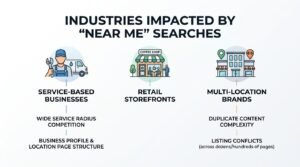
Service-based businesses, retail storefronts, and multi-location brands experience the heaviest impact from “near me” search behavior, though each faces distinct optimization challenges. A plumber, a coffee shop, and a regional gym chain all compete for this intent very differently.
Service-Based vs. Retail vs. Multi-Location Businesses
Service-based businesses often compete across a wide service radius rather than a single fixed address, which changes how their Business Profile and location pages should be structured. Multi-location brands face the added complexity of avoiding duplicate content and listing conflicts across dozens or hundreds of individual location pages.
Common Mistakes That Hurt “Near Me” Visibility
The most damaging mistakes I see include inconsistent NAP data across listings, duplicate or unauthorized Business Profile listings, and neglected review management. Any one of these can quietly suppress a business’s local pack visibility for months before anyone notices.
Inconsistent Listings and Duplicate Profiles
Inconsistent listings occur when a business’s name, address, or phone number differs even slightly across directories, confusing Google’s trust and verification systems. Duplicate profiles, often created accidentally during a move or rebrand, actively compete against the legitimate listing and split ranking signals.
How to Measure “Near Me” Search Performance
Measuring “near me” search performance requires tracking local pack impressions, click-through data, and direction requests through Google Business Profile Insights alongside Google Search Console’s location-filtered query data. Combining both data sources gives a complete picture that neither tool provides alone.
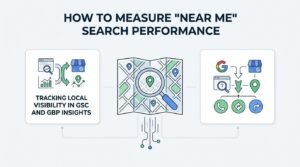
I check these numbers monthly for every local client, because visibility swings in local pack results happen faster than in traditional organic rankings.
Tracking Local Visibility in GSC and GBP Insights
Google Search Console shows which queries and locations generate impressions and clicks, while Google Business Profile Insights reveals direct actions like calls, direction requests, and website visits generated from the profile itself. Together, these tools show both the discovery stage and the conversion stage of local search behavior.
Building a Long-Term Local SEO Strategy Around “Near Me” Intent
A long-term local SEO strategy built around “near me” intent combines consistent technical foundations, ongoing content development, and ongoing reputation management rather than any single quick fix. I’ve never seen a business sustain local pack visibility through one-time optimization alone.
We treat this as an ongoing discipline for every client we work with, revisiting profile accuracy, review velocity, and location-specific content on a recurring schedule rather than a one-time setup.
Aligning Content, Technical SEO, and Authority Signals
Aligning content, technical SEO, and authority-building signals means every location page, schema update, and review response works toward the same visibility goal instead of operating as disconnected tasks. This coordinated approach is what separates businesses that dominate local pack results from those stuck competing for scraps.
Conclusion
“Near me” searches now blend proximity, relevance, and prominence into one ranking system, built on Business Profile accuracy, technical signals, and reviews. Mastering these fundamentals separates visible local businesses from invisible ones.
This intent category keeps growing as mobile and voice search expand, making a coordinated, ongoing local strategy more valuable than ever.
We build these strategies daily. Partner with White Label SEO Service to turn “near me” visibility into consistent, measurable local growth.
Frequently Asked Questions
What does a “near me” search mean in SEO?
A “near me” search means a query carrying explicit or implicit local intent, where the searcher wants results close to their current location. Google detects this through both query text and device signals.
Do I need to use the exact phrase “near me” in my content?
No, Google no longer requires the literal phrase to trigger local results. Location-aware algorithms now infer proximity intent from context, device data, and query patterns automatically.
How does Google know my location for “near me” searches?
Google uses GPS data, Wi-Fi triangulation, and IP address information from a searcher’s device to determine location. This data combines with query semantics to surface relevant local results.
What’s the difference between local pack rankings and organic rankings?
Local pack rankings depend on proximity, relevance, and prominence signals tied to a Business Profile, while organic rankings rely more heavily on content quality and backlinks. Both systems can rank the same business differently.
Why did my business disappear from “near me” search results?
Disappearance usually stems from inconsistent NAP data, a suspended or duplicate Business Profile, or a sudden drop in review activity. Technical errors on location pages can also cause this.
How often should I update my Google Business Profile?
Update it whenever business details change, and add fresh photos or posts regularly to signal ongoing activity. Consistent, recent activity supports stronger prominence signals over time.
Can small businesses compete with larger brands in “near me” results?
Yes, proximity often outweighs brand size in local pack rankings, letting well-optimized small businesses outrank larger, more distant competitors. Strong reviews and profile accuracy level the playing field significantly.