Local search behavior is the set of patterns customers follow when they look for nearby businesses, products, or services using search engines, maps, voice assistants, or social platforms. I’ve watched this behavior shift dramatically over the past few years, and it now shapes almost every decision a local business makes about visibility. Understanding it isn’t optional anymore.
Local customers move faster than they used to, and they trust fewer signals before acting. A business that doesn’t understand this behavior loses visibility exactly when a customer is ready to buy.
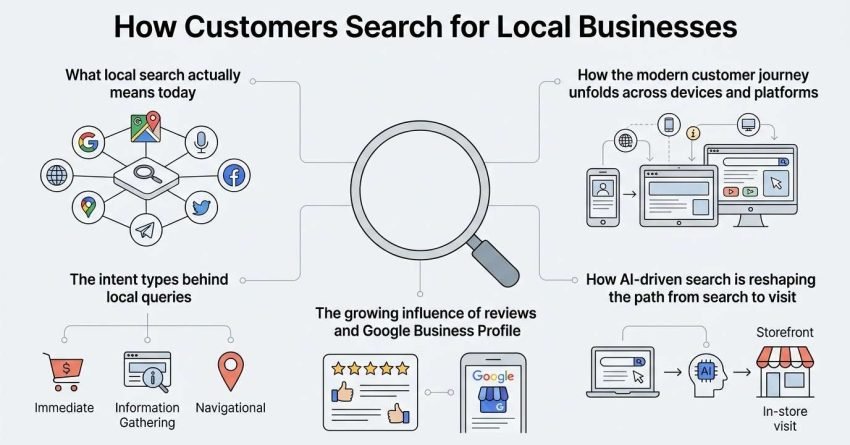
This guide covers what local search actually means today, how the modern customer journey unfolds across devices and platforms, the intent types behind local queries, the growing influence of reviews and Google Business Profile, and how AI-driven search is reshaping the path from search to visit.
What “Local Search” Actually Means Today
Local search is the process by which a search engine matches a user’s query to nearby businesses based on proximity, relevance, and prominence. I think of it as a completely different discipline from general organic search, even though they share the same search box.
General search tries to answer a question. Local search tries to answer a question and point a person toward a physical or geographically bound solution. That distinction changes almost everything about how results get ranked and displayed.
How Local Search Differs From General Search
A general query like “how does SEO work” pulls from the entire web, ranked mostly on topical authority and content quality. A local query like “SEO agency near me” pulls from a much smaller, geographically filtered pool.
Local results also surface differently. They often trigger a map pack, business listings, and review snippets instead of a standard blue-link result. The intent behind the query assumes the searcher will act in person or by phone within hours.
The Role of Google’s Local Algorithm (Proximity, Relevance, Prominence)
Google’s local ranking system weighs three core factors: proximity to the searcher, relevance of the business profile to the query, and prominence based on reviews, citations, and overall authority. Google has publicly confirmed these three factors as the foundation of local ranking.
Proximity has grown heavier in weight as mobile search has grown. A searcher standing three blocks from a business now often outranks a more “prominent” competitor located across town, purely on distance.
The Modern Local Customer Journey From Need to Visit
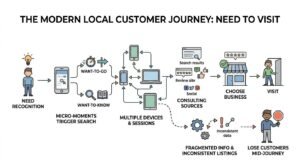
The modern local customer journey is the sequence of micro-decisions a person makes between recognizing a need and choosing a specific business to fulfill it. I’ve mapped this journey across dozens of client accounts, and it rarely looks like the neat funnel diagrams from a decade ago.
It’s messier now. A person might search on their phone during a commute, check reviews at lunch, and finally call from their laptop that evening. Multiple devices, multiple sessions, one decision.
The Micro-Moments That Trigger a Local Search
Google first introduced the concept of micro-moments to describe the split-second, intent-rich moments when someone turns to a device to act on a need. A “want-to-go” moment (“coffee shop open now”) behaves completely differently from a “want-to-know” moment (“best coffee shop for meetings”).
These moments are short, specific, and impatient. A customer in a want-to-go moment expects an answer in seconds, not a research session.
How Many Touchpoints Happen Before a Decision
Local decisions rarely happen on a single search. A study from Uberall found that local searchers consult an average of five sources before choosing a business, including search results, review sites, and social platforms.
This behavior directly explains why businesses with fragmented online information, inconsistent hours, missing reviews, and outdated listings lose customers mid-journey, even when the original search ranked well.
Where Customers Search Platforms & Channels
Customers today search for local businesses across four primary channels: traditional search engines, map applications, voice assistants, and social media platforms used as discovery tools. I no longer treat any of these as secondary; each one now drives real transactions.
The channel mix shifts depending on age, urgency, and device, but all four now play a role in nearly every local buying decision.
| Platform | Primary Use Case | Behavior Signal |
| Google Search & Maps | Direct local queries, navigation | High purchase intent |
| Voice Assistants | Hands-free, conversational queries | Convenience-driven |
| TikTok / Instagram | Discovery, recommendations, “hidden gem” searches | Trend- and social-proof driven |
| Apple Maps / Siri | iOS-native local discovery | Growing but smaller share |
Google Search and Google Maps
Google Search and Maps remain the dominant discovery channel for local businesses, handling the overwhelming majority of “near me” and location-qualified queries. Most local journeys still start here, even when they end somewhere else, like a review site or social profile.
Voice Search and AI Assistants
Voice search behavior tends to favor longer, conversational queries spoken in natural language rather than typed keyword fragments. Someone typing might search “plumber Chicago,” while the same person speaking to an assistant asks “who’s a good plumber near me that’s open right now.”
Social Platforms Used as Search Engines (TikTok, Instagram)
A growing share of younger consumers now start local discovery on TikTok or Instagram instead of Google, searching hashtags and location tags to find recommendations. Google’s own leadership has acknowledged this shift among users under 25, describing a meaningful portion of local discovery moving to social-first platforms.
Search Intent Types Behind Local Queries
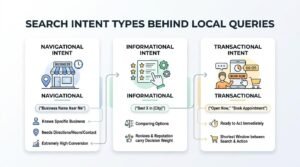
Local search intent falls into three primary categories: navigational, informational, and transactional, each requiring a different type of business response. I treat these as separate strategic problems, not variations of the same query.
Misreading intent is one of the most common mistakes I see: a business optimizing for information when the customer actually wants to transact loses the conversion entirely.
Navigational Intent (“Business Name Near Me”)
Navigational local queries occur when a searcher already knows the specific business they want and simply needs directions, hours, or contact information. These searches convert at extremely high rates because brand preference has already been decided before the query happens.
Informational Intent (“Best X in [City]”)
Informational local queries happen when a searcher is comparing options and hasn’t committed to a specific business yet. “Best” and “top” queries dominate this category, and they’re where reviews and reputation carry the most decision-making weight.
Transactional Intent (“Open Now,” “Book Appointment”)
Transactional local queries signal a searcher ready to act immediately, often including modifiers like “open now,” “book online,” or “same-day.” These queries carry the shortest window between search and action, sometimes measured in minutes rather than hours.
The Power of “Near Me” and Proximity-Based Queries
“Near me” search behavior refers to location-implicit or location-explicit queries where proximity is the dominant ranking and decision factor. This single query pattern has reshaped local SEO more than almost any other behavioral shift in the last decade.
Google’s own trend data shows “near me” search interest has grown steadily since smartphones normalized location-aware search, and it no longer requires the literal phrase. Google now infers proximity intent automatically from context.
How Mobile GPS Changed Local Query Behavior
GPS-enabled mobile search allows engines to automatically assume location intent even when a query doesn’t mention a place at all. Typing simply “tacos” on a phone now returns local results by default, something that never happened on desktop search a decade ago.
How Google Business Profile Shapes Customer Decisions
A Google Business Profile is a free business listing that controls how a company appears in Google Search and Maps local results, including its photos, hours, reviews, and contact details. It’s often the single most influential piece of real estate a local business controls.
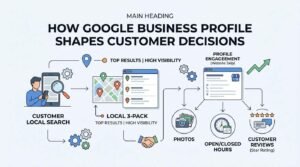
Customers frequently make a decision based entirely on the Business Profile without ever visiting the company website, which makes profile completeness a direct revenue factor rather than a cosmetic detail.
The Local 3-Pack and Why It Matters
The local 3-pack is the block of three business listings Google displays at the top of local search results, typically alongside a map. Businesses appearing here capture a disproportionate share of clicks compared to organic listings below them.
What Customers Look At First (Photos, Hours, Reviews)
Eye-tracking and behavioral research consistently shows customers scan photos, star ratings, and open/closed status before reading any other listing detail. A BrightLocal survey found that 98% of consumers read online reviews for local businesses in 2024, most often before checking anything else on a listing.
The Role of Online Reviews in Local Search Behavior
Online reviews function as both a ranking signal for local search algorithms and a trust signal for human decision-making, making them one of the few elements that influence customers and machines simultaneously. I consider review management inseparable from local SEO strategy at this point.
A business with excellent rankings but poor or thin reviews consistently underperforms one with modest rankings and a strong review profile.
Star Ratings vs. Review Content
Star ratings drive the initial filtering decision, but the written content of reviews drives the final choice between two similarly-rated businesses. Customers scan review text specifically for mentions of the service, product, or concern most relevant to their own situation.
How Recency and Response Rate Influence Trust
Review recency signals that a business is currently active and consistent, while owner responses signal accountability and customer care. A pattern of unanswered negative reviews damages trust more than the negative review itself in most cases.
Mobile Behavior and On-the-Go Local Search
Mobile local search behavior is defined by short sessions, high urgency, and immediate action expectations, distinguishing it sharply from desktop research behavior. The majority of local searches now happen on a mobile device, often within a few miles of the business itself.
This behavior rewards businesses with fast-loading mobile pages, clickable phone numbers, and accurate map pins, since friction at this stage causes immediate drop-off to a competitor.
Click-to-Call and Click-to-Directions Behavior
Click-to-call and click-to-directions are two of the highest-intent actions available on a mobile local listing, often replacing the need to visit a website entirely. A customer tapping “call now” from a map listing has typically already made their decision.
Voice Search and Conversational Query Behavior
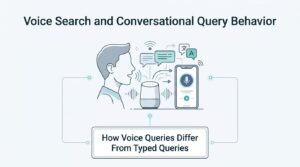
Voice search behavior involves spoken, conversational queries processed by assistants like Google Assistant, Siri, or Alexa, and it favors natural sentence structure over keyword fragments. This shift has pushed content strategy toward answering full questions rather than targeting isolated keywords.
How Voice Queries Differ From Typed Queries
Typed queries tend to be short and fragmented, while voice queries are longer, use question words, and mirror how people actually speak. This distinction matters most for FAQ content, which tends to align naturally with the phrasing voice assistants favor.
AI Overviews and the Shift in How Customers Find Local Businesses
AI Overviews are AI-generated summary answers that appear at the top of Google search results, often synthesizing information from multiple sources before a user ever sees a traditional listing. This has introduced a genuinely new stage into the local search journey.
Local businesses now compete not just for a ranking position, but for inclusion in the language an AI system generates in response to a customer’s question.
What Happens When AI Answers the Search Before a Click
When an AI Overview fully answers a query, click-through rates to individual websites drop, a pattern documented in Ahrefs’ 2024 study showing organic clicks fell by 34.5% on average for queries triggering an AI Overview. This makes structured, extractable content more valuable than ever for maintaining visibility.
Local Pack vs. Organic Results: What Customers Click
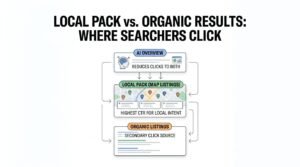
The local pack and organic search results occupy different visual positions on the page and attract measurably different click behavior from local searchers. The local pack, positioned above traditional organic listings, captures the majority of clicks for queries with strong local intent.
| Result Type | Position | Typical Click Behavior |
| Local Pack (Map Listings) | Top of page | Highest CTR for local intent |
| Organic Listings | Below local pack | Secondary click source |
| AI Overview | Above both | Reduces clicks to both |
Businesses without a strong local pack presence increasingly rely on organic content depth to recover visibility lost to map-pack competitors.
Trust Signals That Influence Local Buying Decisions
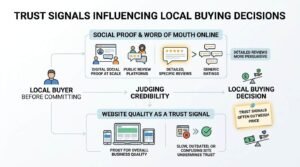
Trust signals are the visible cues reviews, citations, website quality, social proof that customers use to judge a local business’s credibility before committing. I’ve found that trust signals often outweigh price in the final decision stage.
Social Proof and Word of Mouth Online
Word of mouth has moved from private conversation to public review platforms and social media comments, functioning as digital social proof at scale. A single detailed, specific review often carries more persuasive weight than a dozen generic five-star ratings.
Website Quality as a Trust Signal
A slow, outdated, or confusing website undermines trust even when a business has strong reviews everywhere else. Customers treat website quality as a proxy for overall business quality, fair or not.
How Local Search Behavior Differs by Industry
Local search behavior varies significantly by industry, with urgency-driven sectors like emergency plumbing showing very different query patterns than consideration-driven sectors like home renovation. A restaurant customer might decide within minutes, while a customer researching a roofing contractor might take weeks.
Recognizing this difference changes what content and response speed a business needs to prioritize.
Seasonal and Time-Based Local Search Patterns
Seasonal local search patterns reflect predictable spikes in demand tied to weather, holidays, and annual events, and they shift both query volume and query type. Searches for “AC repair near me” spike in summer heat waves, while “gift shops near me” spikes in December.
Time-of-day patterns matter too, with breakfast-related queries peaking in the morning and dinner-related queries peaking in the early evening, almost like clockwork.
What This Means for Local Business Visibility Strategy
Understanding these behavior patterns changes how a local business should prioritize its visibility efforts, shifting focus from rankings alone toward the full decision journey. I look at proximity optimization, review generation, mobile experience, and AI-readiness as one connected system rather than separate tasks.
The businesses winning local visibility now treat every platform search, maps, voice, and social as one continuous customer conversation rather than isolated channels.
Conclusion
Local search behavior now spans search engines, maps, voice assistants, and social platforms, all shaped by proximity, trust, and intent. Understanding these micro-moments reveals how modern customers actually decide.
This landscape keeps shifting as AI Overviews and voice search grow, and deeper cluster resources cover each piece in more depth.
We help businesses turn this behavior into visibility and revenue. Partner with White Label SEO Service to capture every local search moment.
Frequently Asked Questions
What is local search behavior?
Local search behavior refers to how people search for nearby businesses using proximity, intent, and trust signals. It includes patterns across search engines, maps, voice assistants, and social platforms.
Why do customers use “near me” searches?
Customers use “near me” searches because mobile GPS lets search engines automatically prioritize proximity. This phrase signals immediate, location-based intent even when unspoken.
How many sources do customers check before choosing a local business?
Local searchers typically consult around five sources before deciding, including search results, reviews, and social media. This multi-touchpoint behavior means consistency across platforms matters greatly.
Do reviews really affect local search rankings?
Yes, reviews influence both rankings and customer trust simultaneously. Google factors review quantity, recency, and rating into its local prominence signal.
How is AI search changing local customer behavior?
AI Overviews now answer many local queries directly within the search results page. This reduces click-through rates and shifts visibility competition toward being cited within AI-generated answers.
Is voice search different from typed local search?
Voice search queries tend to be longer and more conversational than typed queries. Voice searchers often phrase requests as full questions rather than short keyword fragments.
Does local search behavior vary by industry?
Yes, urgency-driven industries like emergency repair see fast, transactional search behavior. Consideration-heavy industries like renovation see longer, research-driven search journeys.