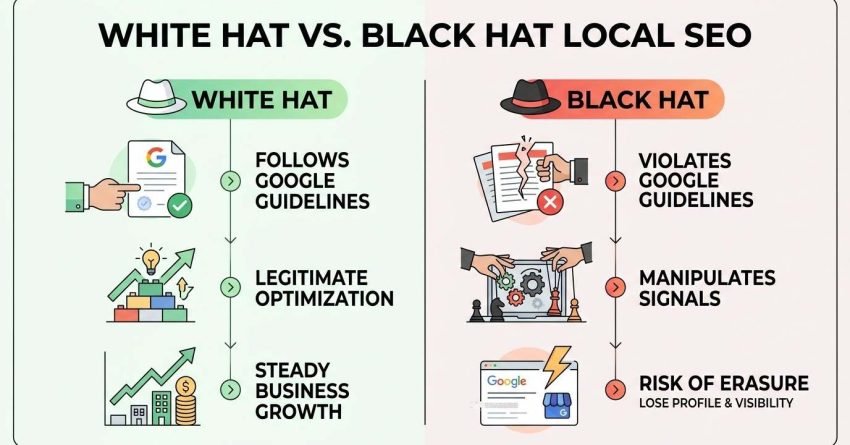
White hat local SEO follows Google’s guidelines to build rankings through legitimate optimization, while black hat local SEO manipulates ranking signals through tactics that violate those guidelines and risk penalties. I’ve watched businesses lose their entire Google Business Profile overnight because a shortcut felt faster than doing the work properly. The gap between these two approaches determines whether a local business grows steadily or gets erased from search results without warning.
Getting this wrong costs more than rankings. Penalties can wipe out months of revenue, trust, and visibility in a single algorithm update.
This guide covers what separates white hat from black hat local SEO, the specific tactics that trigger Google penalties, how detection actually works, and what recovery looks like when a business gets hit. We’ll also walk through real audit steps and a side-by-side risk comparison to help you evaluate your own local SEO approach.
What White Hat and Black Hat Local SEO Actually Mean
White hat local SEO is an optimization approach that improves search visibility by following Google’s Webmaster Guidelines and prioritizing genuine user value. Black hat local SEO is the opposite approach — it manipulates ranking signals through tactics designed to exploit algorithm weaknesses rather than earn rankings honestly.
The split matters because Google’s Search Essentials explicitly state that sites using deceptive practices can be removed from search results entirely. I treat this distinction as the first filter for every local SEO decision I make with a client.
The Core Philosophy Behind Each Approach
White hat SEO assumes that ranking well and serving users well are the same goal. Black hat SEO assumes they’re separate problems, and that the ranking problem can be solved without solving the user problem. That assumption is what eventually gets flagged.
Why Google Distinguishes Between the Two
Google’s business model depends on search results users trust enough to keep coming back to. A search engine full of manipulated local listings and fake reviews stops being useful, so Google invests heavily in detecting and penalizing manipulation at scale.
Grey Hat Local SEO: The Ambiguous Middle Ground
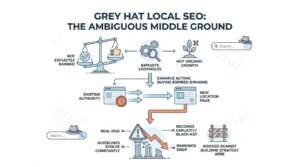
Grey hat local SEO refers to tactics that don’t explicitly violate Google’s written guidelines but exploit loopholes or ambiguous rules in ways Google didn’t intend. Buying an expired domain with existing authority for a new location page is a common example: it’s not explicitly banned, but it’s not organic growth either.
Grey hat tactics carry real risk because Google’s guidelines evolve constantly, and what’s grey today often becomes explicitly black hat tomorrow. I generally advise against building any strategy on tactics that live in this zone, since the rules can shift without notice and take rankings down with them.
White Hat Local SEO Tactics That Build Sustainable Rankings
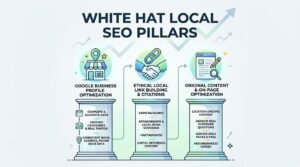
White hat local SEO tactics focus on three pillars: accurate business information, genuine content value, and earned authority signals. These three pillars compound over time instead of expiring the moment Google updates its algorithm.
Google Business Profile Optimization Done Right
Complete, accurate Google Business Profile data remains one of the strongest local ranking factors available. This means verified business categories, accurate hours, real photos, and consistent name-address-phone (NAP) data across every directory listing.
Ethical Local Link Building and Citations
Local link building earns backlinks through sponsorships, local news coverage, partnerships, and genuinely useful content that other sites want to reference. Moz’s Local Search Ranking Factors study consistently ranks link signals among the top three local ranking factors, which is why manipulated links carry such high penalty risk.
Original Content and On-Page Optimization
Location-specific content that answers real customer questions service area pages, local FAQs, neighborhood guides builds topical relevance without crossing into manipulation. This content works because it’s useful independent of its SEO value.
Black Hat Local SEO Tactics Still Used Today
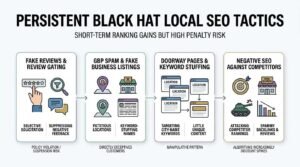
Black hat local SEO tactics persist because they can produce short-term ranking gains before detection catches up, which makes them tempting for businesses under pressure to show fast results. Every tactic in this category carries penalty risk that scales with how aggressively it’s used.
Fake Reviews and Review Gating
Fake reviews and review gating filtering customers to only ask happy ones for reviews while suppressing negative feedback directly violate Google’s review policies. Google has been actively removing fake reviews and can suspend profiles caught using review manipulation software.
GBP Spam and Fake Business Listings
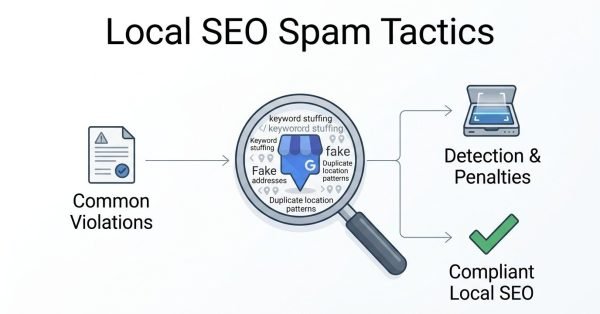
GBP spam includes creating fake business locations, keyword-stuffing business names, or claiming listings for businesses that don’t physically operate at the listed address. This is one of the most heavily policed areas of local search because it directly deceives customers about who they’re contacting.
Keyword Stuffing and Doorway Pages
Doorway pages are location pages built purely to rank for city-name keywords with little unique content, often duplicated across dozens of cities with only the city name swapped. Google’s spam policies for doorway pages specifically call out this pattern as manipulative.
Negative SEO Against Competitors
Negative SEO involves attacking a competitor’s rankings through spammy backlinks, fake negative reviews, or reported false information, rather than improving your own site. It’s harder to prove and harder to police, but Google’s algorithms increasingly discount suspicious link spikes automatically.
How Google Detects Black Hat Local SEO
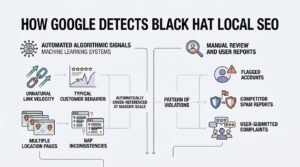
Google detects black hat local SEO through a combination of automated algorithmic signals and manual human review, with most large-scale spam caught by machine learning systems before a human ever sees it. Detection has become faster and more precise with every major update since 2021.
Algorithmic Detection Signals
Google’s systems flag unnatural link velocity, review patterns that don’t match typical customer behavior, duplicate content across multiple location pages, and NAP inconsistencies that suggest fake listings. These signals get cross-referenced automatically at massive scale.
Manual Review and User Reports
Human reviewers at Google investigate flagged accounts, competitor spam reports, and user-submitted complaints about fake listings or reviews. Manual actions typically follow a documented pattern of guideline violations rather than a single mistake.
Google Penalties: Algorithmic vs Manual Actions
Google issues two distinct types of penalties: algorithmic penalties, which are automatic ranking suppressions triggered by an update, and manual actions, which are penalties applied by a human reviewer after investigation. The two require completely different recovery approaches.
Algorithmic penalties often resolve themselves once the offending tactic is removed and Google recrawls the site, sometimes within weeks. Manual actions require submitting a reconsideration request through Google Search Console and explicitly documenting what was fixed, and recovery can take months.
Local-Specific Penalties: GBP Suspensions and Map Pack Removal
Local-specific penalties hit differently than standard web penalties because they can remove a business entirely from the Map Pack or suspend the Google Business Profile outright, cutting off the single highest-converting local search real estate overnight. This is the most severe consequence available in local search.
GBP suspensions typically follow guideline violations like fake reviews, address manipulation, or category abuse, and reinstatement requires a formal appeal with supporting documentation proving the business is legitimate.
Real Business Consequences of Black Hat Penalties
Black hat penalties translate directly into lost revenue, damaged trust, and wasted marketing spend, often at a scale far larger than whatever short-term gain the tactic produced. The math rarely works out in the business’s favor once the full cost is counted.
Traffic and Revenue Loss
A Map Pack suspension or significant ranking drop can eliminate the majority of a local business’s organic lead flow within days. For service businesses relying on local search for new customer acquisition, that gap often has no fast substitute.
Recovery Timelines and Costs
Manual action recovery typically takes two to six months from reconsideration request to restored rankings, according to patterns documented by Search Engine Journal, and that timeline assumes the violation is fully corrected on the first submission.
How to Recover From a Local SEO Penalty
Recovering from a local SEO penalty starts with identifying the exact cause through Google Search Console’s manual action report or a careful audit of recent ranking drops correlated to known algorithm updates. Guessing at the cause before confirming it wastes the most valuable recovery time.
Once the cause is confirmed, every violating element needs to be removed or fixed completely, not partially, before requesting reconsideration. Partial fixes are one of the most common reasons reconsideration requests get rejected on the first attempt.
Case Studies: Businesses Penalized for Black Hat Local SEO
Local businesses across multiple industries have lost Map Pack visibility after mass-purchasing fake reviews, with several documented cases showing full profile suspension within weeks of the spike being detected. The pattern is consistent: rapid, unnatural growth in reviews or links draws algorithmic attention fast.
Multi-location service businesses that built doorway pages for dozens of cities using duplicated content have seen entire location page sets deindexed simultaneously, erasing years of accumulated rankings in a single update cycle.
How to Audit Your Local SEO for Risky Practices
A local SEO risk audit starts by reviewing every review acquisition method, backlink source, and piece of location-based content against Google’s current guidelines, since practices that were acceptable years ago may now carry penalty risk. This audit works best as a recurring quarterly process, not a one-time check.
Cross-checking NAP consistency across directories, reviewing GBP category accuracy, and scanning backlink profiles for suspicious spikes covers the highest-risk areas first. Anything ambiguous should be treated as a liability until proven otherwise.
White Hat vs Black Hat: Side-by-Side Risk Comparison
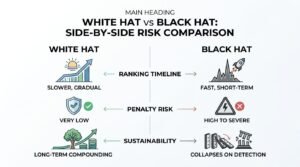
The table below compares white hat and black hat local SEO across the dimensions that matter most for long-term business risk.
| Factor | White Hat | Black Hat |
| Ranking timeline | Slower, gradual | Fast, short-term |
| Penalty risk | Very low | High to severe |
| Recovery cost if penalized | N/A | High (months of lost revenue) |
| Sustainability | Long-term compounding | Collapses on detection |
| Google guideline compliance | Full compliance | Direct violation |
Choosing a Sustainable Local SEO Strategy
Choosing a sustainable local SEO strategy means evaluating every tactic against one question: would this still work if Google published exactly how it operates tomorrow? Tactics that only work because they’re hidden from scrutiny are the ones carrying the highest long-term risk.
Businesses that build on accurate listings, genuine reviews, and real local content don’t have to watch every algorithm update anxiously. That stability is the actual return on doing local SEO the right way from the start.
Conclusion
White hat and black hat local SEO produce fundamentally different outcomes: one compounds steadily, the other risks total collapse under a single penalty. Understanding detection methods, penalty types, and recovery costs helps you evaluate any tactic before adopting it. We build local SEO strategies at White Label SEO Service designed to grow rankings safely and protect the visibility you’ve already earned.
Frequently Asked Questions
What is the difference between white hat and black hat local SEO?
White hat local SEO follows Google’s guidelines using legitimate optimization tactics, while black hat local SEO manipulates ranking signals through practices that violate those guidelines. The difference determines whether rankings are sustainable or penalty-prone.
Can black hat SEO get my Google Business Profile suspended?
Yes, black hat tactics like fake reviews, address manipulation, or category abuse can trigger a full GBP suspension. Reinstatement requires a formal appeal with documentation proving the business is legitimate.
How long does a Google penalty last?
Algorithmic penalties can resolve within weeks once the violation is removed and the site is recrawled. Manual actions typically take two to six months to resolve after a successful reconsideration request.
Is grey hat SEO safe to use?
Grey hat SEO isn’t explicitly banned, but it exploits ambiguous rules that Google frequently updates and closes. Tactics considered grey hat today often become explicitly penalized as guidelines evolve.
How do I know if my SEO agency uses black hat tactics?
Warning signs include unusually fast ranking promises, mass-produced duplicate location pages, sudden spikes in reviews or backlinks, and vague explanations of specific tactics used. Legitimate agencies can explain exactly what they’re doing and why it’s compliant.
Can I recover rankings after a manual penalty?
Yes, recovery is possible by fully correcting the violation, documenting the fix, and submitting a reconsideration request through Google Search Console. Partial fixes are the most common reason first attempts get rejected.
Does buying local backlinks count as black hat SEO?
Yes, purchasing backlinks specifically to manipulate rankings violates Google’s link scheme policies regardless of the link’s local relevance. Earned links from genuine local relationships remain the compliant alternative.